
Mold Exposure During Pregnancy and What It Means for Your Baby

Mold during pregnancy carries a different risk in every trimester — the first is most dangerous. Here’s the trimester breakdown with exact steps.

Table of Contents
You spotted a dark patch near the grout line — and you’re pregnant.
That combination is enough to make anyone’s stomach drop, and the concern is completely valid.
Mold exposure during pregnancy is a real health consideration, but the actual risk depends on factors most sources never address: the type of mold present, the size of the colony, which trimester you’re in, and whether you’re a renter with a landlord to call or a homeowner with a contractor to hire.
This guide covers all of it — clinical risks broken down by mold type, a trimester-specific vulnerability breakdown that no other home resource currently offers, and a clear step-by-step protocol for the moment you find mold in your home.
ℹ️ Disclaimer: This article is for informational purposes only and does not constitute medical advice. Always consult your OB-GYN for guidance specific to your pregnancy and personal health history.
For a full framework on mold across every room in your home, start with Gladewick’s complete mold remediation diagnostic plan.

How mold affects your health during pregnancy
Pregnant women are not more likely to encounter mold — but their bodies are significantly more vulnerable to it than at any other point in adult life.
The immune suppression that protects a developing baby also reduces the respiratory and immune responses that would otherwise neutralize everyday mold spores.
Why pregnant women are more vulnerable to mold
Mycotoxins — the chemical compounds released by certain mold species — trigger inflammation, respiratory irritation, and in sustained exposures, systemic effects even in healthy adults.
During pregnancy, the body’s reduced detoxification capacity means those compounds linger longer and create a more persistent physiological response.
According to CDC guidance on indoor environmental quality and mold health effects, individuals with compromised immune function — including pregnant women — experience more severe and prolonged effects from mold exposure than the general population.
The mold types that matter most
Not all household molds carry the same pregnancy risk level.
The table below identifies the four species most commonly found in US homes, ranked by concern during pregnancy:
| Mold Type | Appearance | Common Location | Pregnancy Risk Level |
|---|---|---|---|
| Stachybotrys chartarum | Dark black, slimy texture | Wet drywall, ceiling tiles | High |
| Aspergillus | Yellow-green or brown | HVAC systems, insulation | Moderate–High |
| Cladosporium | Olive-green to black | Windows, carpet, wood | Moderate |
| Penicillium | Blue-green, powdery | Wallpaper, mattresses | Moderate |
Source: CDC National Institute for Occupational Safety and Health — Indoor Environmental Quality
If your symptoms feel allergy-related but refuse to resolve, the complete guide to black mold symptoms covers the warning signs most people dismiss for weeks.
When the HVAC system is involved, risk escalates to a whole-home level — mold in air ducts spreads spores to every room every time the system runs.
Symptoms of mold exposure to watch for when pregnant
Mold symptoms in pregnant women overlap so closely with normal pregnancy discomforts that many women don’t make the connection until weeks of exposure have passed.
The most reliable diagnostic clue is not the symptom itself — it’s the pattern.
Respiratory and allergy-type symptoms
Mold-related symptoms consistently worsen in specific rooms and improve when you leave the home or spend time outdoors. If you are experiencing any of the following with that room-specific pattern, mold is a serious candidate:
- Persistent cough unrelated to a cold or flu
- Nasal congestion without a seasonal allergy history
- Wheezing or shortness of breath that worsens indoors
- Recurring headaches that improve when you step outside
- Watery, itchy, or burning eyes
- Skin rash or hives without a dietary explanation
⚠️ Warning: Severe respiratory symptoms — or any symptom accompanied by fever — require an immediate call to your OB-GYN. Do not wait to see if it resolves on its own.
Symptoms that overlap with pregnancy — how to tell the difference
Indoor air quality problems produce a pattern anchored to location: symptoms tied to a specific room or time of day, not to physical exertion, food, or a typical illness trajectory.
Fatigue that worsens in the bedroom, headaches that appear only at home, and congestion that clears on weekends away from the house are all room-specific flags worth investigating.
If your symptoms follow that pattern, one of the most commonly missed sources is basement mold — basement colonies contaminate whole-home air for months before becoming visible.

| Mold Exposure Symptom | Pregnancy Symptom It Resembles | Key Differentiator |
|---|---|---|
| Persistent cough, worse indoors | Pregnancy-related congestion | Room-specific — not general |
| Chronic fatigue, worsens at home | First-trimester exhaustion | Improves when leaving home |
| Skin rash or hives | Hormonal skin changes | No dietary or product trigger |
| Recurring headaches | Pregnancy headaches | Relieved by fresh air or outdoors |
Trimester-by-trimester: when is mold exposure riskiest?
The first trimester carries the highest theoretical risk from mold exposure during pregnancy — but each developmental stage creates its own distinct vulnerability profile, not a simple progression from dangerous to safe.
Understanding your trimester changes both the urgency of your response and what specifically to raise with your OB-GYN.
First trimester — highest vulnerability window
During weeks 6 through 12, organogenesis is occurring — every major organ system forms simultaneously, and the embryo has no independent detoxification capacity of its own.
Mycotoxin exposure during this window is the scenario most flagged in environmental health literature, because chemical stress during active organ formation has no parallel at any later developmental stage.
⚠️ Warning: If you discover significant mold during your first trimester, contact your OB-GYN before remediation begins — not after. Whether to temporarily relocate is a medical decision, not a contractor’s call.
Second trimester — development milestones and mold risk
Lung maturation and neurological development are actively occurring through weeks 13–26.
Aspergillus — which colonizes HVAC systems and insulation far more quietly than black mold — poses a persistent moderate spore inhalation risk during this period that is easy to underestimate precisely because it rarely looks dramatic.
Third trimester — respiratory load and birth outcomes
By the third trimester, the growing uterus reduces lung capacity by up to 20 percent.
Adding elevated airborne spore levels to that already-reduced respiratory baseline compounds a physiological load that observational research has associated with low birth weight and preterm labor outcomes.
| Trimester | Primary Development Stage | Main Mold Concern | Response Priority |
|---|---|---|---|
| First (wks 1–12) | Organogenesis | Mycotoxin chemical stress | Highest — contact OB-GYN first |
| Second (wks 13–26) | Lung maturation, neurological | Sustained spore inhalation | High — remediate promptly |
| Third (wks 27–40) | Respiratory capacity, weight | Compounded lung load | High — minimize exposure |
Reviewed by Jennifer Hayes, Licensed Mold Remediation Specialist. For environmental context, see the NIEHS guidance on mold as an indoor air priority for pregnant women.
What to do if you find mold while pregnant
If you discover mold in your home during pregnancy, follow these steps in order — do not skip ahead to cleaning before completing the first three.
⚠️ Warning: Pregnant women should not clean mold personally. Disturbing a colony releases a concentrated spore burst into the air, and effective cleaning chemicals — bleach, hydrogen peroxide — are respiratory irritants with no safe pregnancy threshold.


- cloth
- Made in the USA and Imported
- NIOSH APPROVED for at least 95 percent filtration efficiency against certain non-oil based particles
Step 1–3: Immediate actions
- Do not touch, wipe, or disturb the mold in any way. Even a single pass with a damp cloth releases a concentrated burst of spores into breathing air.
- Open windows and ventilate the affected room immediately. Air circulation reduces ambient spore concentration within minutes and costs nothing.
- Photograph the patch with something for scale before anything is moved or cleaned. A coin or ruler works — you need this image for your landlord, insurance claim, or remediation contractor.
When to DIY vs. when to call a pro
The EPA’s mold cleanup guidelines for homeowners specify that any patch larger than 10 square feet — or any mold on porous materials — requires professional mold remediation, not surface treatment.
For smaller, non-porous patches that someone other than you can clean, the right approach depends on the surface:
- Bathroom grout, caulk, and wall mold
- Drywall mold removal without recurrence
- Mold on wood and structural studs
- Mold in carpet — clean or replace
- Mold on concrete floors
- Black mold removal by specific surface type
When the job is beyond DIY scope, find a mold remediation company you can actually trust before the problem expands further.
If you’re unsure which side of the line you’re on, here’s exactly when DIY mold removal is the right call — and when it isn’t.
Renters have one additional step: notify your landlord in writing with a timestamp — a text or email creates documentation — and reference your state’s housing code, which in most US states requires remediation within 30 days of written notice.
When to call your OB-GYN
Call your OB-GYN without waiting for your next scheduled appointment if any of the following apply:
- You are in the first trimester and found mold in a room you use daily
- You have been experiencing symptoms for more than one week
- The mold colony appears to involve the HVAC system or structural materials
- You have a pre-existing respiratory condition such as asthma
Temporary relocation during professional remediation is a medical decision — your doctor should weigh in before the remediation crew arrives, not after.
Products that help protect your home air during pregnancy
The right HEPA air purifier does not replace remediation — but it meaningfully reduces the spore load your respiratory system processes while remediation is being arranged.
Two product categories make the most practical difference during pregnancy.

on Unsplash
HEPA air purifiers: what to look for
A true HEPA filter captures particles down to 0.3 microns at 99.97 percent efficiency — mold spores range from 3 to 100 microns, placing them well within that capture range.

- AHAM Verifide Air Purifiers- Certified by AHAM, an ANSI accredited body, these purifiers are independently tested for pe…
- Compact Wozoyo Pure Air PA1 Air Purifier – Perfect for pets, small rooms & desks, modern design with efficient air circu…
- Optimized Filteration– Wozoyo Pure Air PA1 Air Purifier provides 40 CFM, covering upto 300 Ft² (1ACH), delivering fast, …
When comparing models, look for these features specifically:
- AHAM Verifide certification (independent performance verification)
- CADR rating matched to your room’s square footage
- No ozone output — confirmed in writing by the manufacturer
- Sealed housing to prevent air bypassing the filter
✅ Pro Tip: Avoid any purifier marketed as ionic, plasma, or UV-C unless the manufacturer explicitly certifies zero ozone output. Ozone is a respiratory irritant with no established safe threshold during pregnancy — it makes the air situation worse, not better.
Humidity monitors and mold test kits
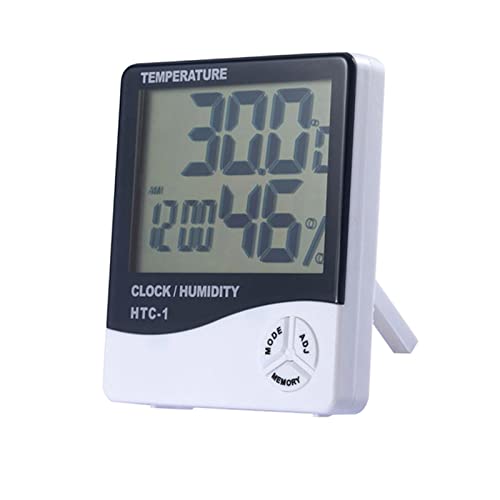
- 【Multi Function】Accurate hygrometer digital thermometer displays high and low temperature & humidity;At the same time, r…
- 【Easy to Use and Install】This indoor room thermometer features a kickstand and hanging hole, can be placed in vertical o…
- 【12/24 Hour, °F/°C Selector】12/24 hour display switching function; ℃ /℉ switching function. Measuring Temperature Range:…

- 【*REQUIRES Tapo Hub】To utilize Tapo motion sensor T315, a Tapo hub H100 (sold separately) and a secured 2.4 GHz Wi-Fi ne…
- 【2.7″ E-ink Display】Displays temperature & humidity, comfort level, battery status, and signal strength. Features low-po…
- 【Real-Time & Accurate Monitoring】Featuring the Swiss-made sensor chip, Tapo T315 provides high accuracy and real-time da…
Mold growth requires sustained humidity above 60 percent — keeping indoor humidity below 50 percent is the single most effective long-term prevention step available.
A digital hygrometer costs under $20 and belongs in every bathroom, basement, and bedroom in your home.
Attics and crawl spaces are the two most commonly overlooked mold sources in US homes — colonies there can contaminate whole-home air for months before a visible patch appears: attic mold removal costs and causes and crawl space mold removal both cover what to do when mold is found in those spaces.
What experts say pregnant women often get wrong about mold
Two misconceptions consistently push pregnant women toward the wrong response — one toward ignoring what warrants action, one toward panicking over what doesn’t.
“Black mold is the only dangerous kind” — myth vs. reality
Stachybotrys chartarum is genuinely high-concern during pregnancy, but Aspergillus is far more prevalent in US homes, colonizes HVAC systems and insulation without visible drama, and produces aflatoxins that are equally potent mycotoxins.
It doesn’t announce itself. It spreads quietly through the air supply while appearing unremarkable on the surface.
“A small spot isn’t worth worrying about” — why size isn’t the only factor
A small active colony in a closed, daily-use bathroom represents sustained spore exposure — which, with immune suppression already in place, is a meaningfully different risk profile than the same patch would present to a non-pregnant adult.
According to Jennifer Hayes, Licensed Mold Remediation Specialist and reviewer of this article: “Location and ventilation matter as much as size. A small bathroom patch used daily is a more significant pregnancy exposure than a larger patch in a rarely visited attic.”
For a complete mold framework across every room and system in your home, Gladewick’s mold remediation diagnostic plan is the reference resource.
Frequently asked questions about mold exposure during pregnancy
1. Can mold cause a miscarriage?
Current research does not establish a direct causal link between household mold exposure and miscarriage. High-level mycotoxin exposure is associated with adverse pregnancy outcomes in some studies, but risk in typical home scenarios is considered low to moderate. Consult your OB-GYN for personalized guidance on your specific situation.
2. What are the symptoms of mold exposure during pregnancy?
Mold exposure symptoms include persistent cough, nasal congestion, watery eyes, skin rash, and recurring headaches. The differentiator from standard pregnancy symptoms is location pattern: mold-related symptoms worsen in specific rooms and improve when you leave the home. Severe or worsening symptoms warrant an immediate call to your OB-GYN.
3. Is it safe to stay in a house with mold while pregnant?
Safety depends on mold type, colony size, and location. A small surface patch in a rarely used room differs significantly from HVAC contamination distributing spores throughout the home. CDC guidance on indoor environmental health recommends that pregnant women and other sensitive groups minimize all mold exposure as a precaution.
4. How do I know if mold is affecting my pregnancy?
Room-specific symptom patterns are the most reliable early indicator. If fatigue, congestion, or headaches worsen indoors and improve when you leave, airborne spores are a serious candidate. A home air quality test kit or professional inspection can confirm elevated spore counts before symptoms become your only evidence of a problem.
5. What should I do immediately if I find mold while pregnant?
Do not disturb the mold. Ventilate the room by opening windows, photograph the patch for documentation, and notify your landlord in writing if you rent. Contact your OB-GYN to assess trimester-specific risk, then call a licensed contractor for any patch larger than 10 square feet.
6. Is black mold especially dangerous during pregnancy?
Black mold (Stachybotrys chartarum) is high-concern, but Aspergillus — far more common in US homes — produces equally potent aflatoxin mycotoxins and colonizes HVAC systems without visible warning. All mold types require attention during pregnancy. The type matters less than the exposure level, duration, and ventilation of the space involved.
7. Can I clean mold myself while pregnant?
Pregnant women should not clean mold personally. Disturbing a colony releases a concentrated spore burst, and effective cleaning agents — bleach, hydrogen peroxide — are respiratory irritants during pregnancy. Delegate all cleaning, and review whether the job calls for DIY or professional help before anyone starts.
8. Does mold affect the baby or just the mother?
Mold primarily affects the mother’s respiratory and immune system, but mycotoxins at sustained high exposures are small enough to cross placental barriers. The mother’s inflammatory response to mold also creates physiological conditions that can indirectly affect fetal development, particularly during organogenesis in the first trimester.
9. What trimester is mold exposure most risky?
The first trimester presents the highest concern because organ formation occurs during weeks 6 through 12 and the embryo cannot process mycotoxins independently. The second and third trimesters carry ongoing respiratory risk, as lung maturation continues through week 36 and the uterus progressively reduces maternal lung capacity.
10. How quickly can mold affect a pregnant woman?
Acute reactions — eye irritation, cough, headache — can appear within hours of significant mold spore inhalation. Chronic effects from sustained low-level exposure develop over days to weeks. Pregnant women may experience faster symptom onset because immune suppression reduces the body’s initial buffering capacity against airborne particulates.
11. Should I tell my OB-GYN about mold exposure?
Inform your OB-GYN as soon as possible. Share your trimester, potential exposure duration, any symptoms, and the colony location in your home. Your doctor may recommend air quality testing, temporary relocation during remediation, or monitoring appointments to track any respiratory or inflammatory changes over time.
12. What air purifiers are safe to use during pregnancy?
HEPA-certified air purifiers are safe and effective at reducing airborne mold spore concentrations during pregnancy. Avoid ozone-generating models — ionizers and many UV-C devices — as ozone is a respiratory irritant. Look for AHAM Verifide certification and a CADR rating appropriate for the specific room’s square footage.
13. Can I make my landlord remove mold during pregnancy?
In most US states, landlords must address mold that makes a rental uninhabitable. Notify in writing with a timestamp and reference your state’s implied warranty of habitability. Property owners should also check whether homeowners insurance covers mold remediation — coverage varies significantly by policy and cause of moisture.
14. How do I test for mold in my home?
Home mold test kits involve a surface swab or air sample mailed to a certified lab, with results in 48 to 72 hours. For suspected HVAC involvement or large infestations, a certified industrial hygienist provides more reliable results than any consumer-grade testing kit available at hardware stores.
15. Does opening windows help with mold exposure during pregnancy?
Opening windows reduces airborne spore concentration in the affected room immediately, but ventilation is a temporary measure, not a solution. Most useful right after discovery and while remediation is being arranged. Pairing ventilation with a HEPA air purifier provides meaningfully better spore reduction than fresh air circulation alone.
16. Is mold exposure during the first trimester more dangerous?
First trimester exposure carries the highest concern because organogenesis occurs during weeks 6 through 12 with no embryonic detoxification capacity. This developmental window is most flagged in environmental health research for chemical stress sensitivity. Discuss any first-trimester mold discovery with your OB-GYN immediately, regardless of colony size.
17. What does mold remediation typically cost?
Surface-level remediation runs approximately $500 to $1,500. Structural work involving drywall, studs, or HVAC systems can reach $3,000 to $10,000 or more depending on scope. For a current room-by-room pricing breakdown, see mold remediation cost by room.
The bottom line on mold and pregnancy safety
Mold exposure during pregnancy is manageable — but it requires action, not patience.
The moment you find mold, your awareness is already the first layer of protection. Identify it, assess the size and location, delegate the cleanup, and loop in your OB-GYN if you are in the first trimester or have active symptoms.
For next steps on air quality, mold remediation cost by room helps you plan financially, and finding a trusted remediation company ensures the job is handled correctly the first time.
Related Articles
 Mold Remediation
Here’s When Homeowners Insurance Covers Mold Remediation
May 12, 2026 Mold Remediation
Here’s What Your Tenant Rights for Mold Actually Are
May 30, 2026 Mold Remediation
Black Mold Symptoms You Should Never Dismiss as Allergies
May 26, 2026 Mold Remediation
Here’s How to Remove Mold from Drywall Without It Coming Back
May 22, 2026 Mold Remediation
Why Your Mold Keeps Returning and How to Prevent It
June 15, 2026 Mold Remediation
Here’s How Post Mold Remediation Testing Confirms It Worked
June 3, 2026 Mold Remediation
Bathroom Mold Removal: Grout, Caulk, and Walls Fixed
May 13, 2026 Mold Remediation
What a Mold Inspection Really Costs for Your Home
June 2, 2026 Mold Remediation