Attic mold removal cost starts with the moisture source

Attic mold above a bath fan, across a cold slope or at the eaves points to different causes, and each adds its own line to the removal quote.
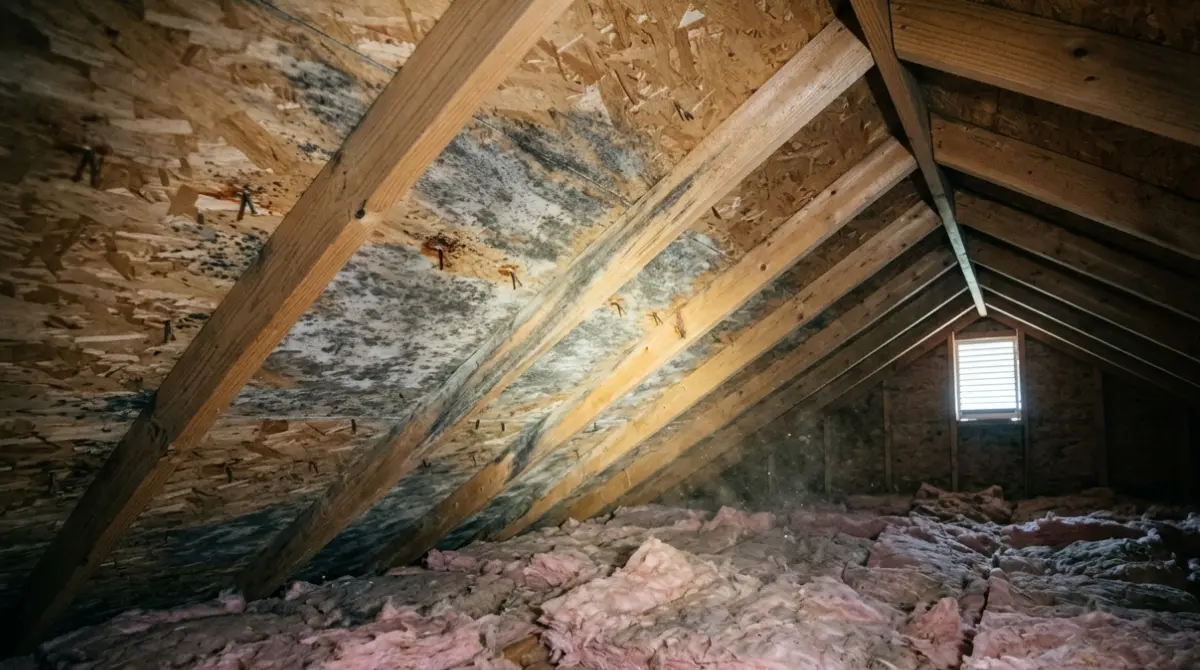
Table of Contents
What you pay to remove attic mold depends on three things: how much of the sheathing and framing has growth on it, whether insulation has to come out, and which trade fixes the moisture behind it. Start with that moisture, because mold that is cleaned up without fixing the water problem will most likely come back (EPA mold and moisture guide).
Published price ranges for attic jobs disagree with each other and seldom say where their numbers came from. So this page sticks to what moves the price and what a written quote should show. How attic work compares with basements and bathrooms is covered in mold remediation costs room by room, and the step-by-step plan for diagnosing mold before paying for remediation starts one step earlier.
Where the mold sits tells you what you’re paying to fix
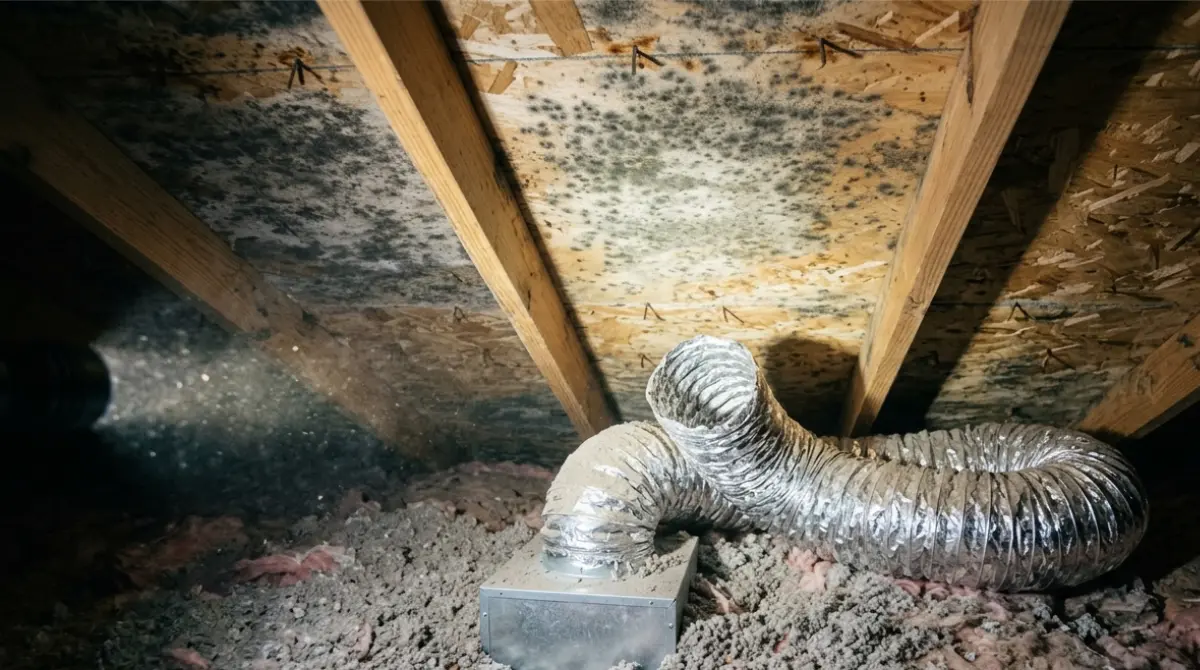
Look up before you price anything. On the underside of a roof, the location of the growth usually points to its cause, and each cause adds its own line to a quote.
| What you see | Likely cause | What it adds to the quote | Who handles it |
|---|---|---|---|
| Growth on the sheathing above a bath fan, or a fan duct lying loose on the insulation | Fan exhaust blowing into the attic | Rerouting the duct to an outdoor cap | HVAC or electrical contractor, plus a roofer if the duct exits through the roof |
| Darkening spread across the sheathing, worst after cold spells | Warm, damp house air leaking up and condensing | Air sealing at the attic floor | Insulation or home-performance contractor |
| Staining on the north slope only, in an attic with good venting | Possibly outdoor air condensing on sheathing chilled by the night sky | A moisture and venting review before cleanup | Mold assessor or building-performance consultant |
| Growth along the eaves where insulation touches the roof deck | Insulation blocking the soffit intake vents | Baffles that hold insulation back from the vents | Insulation contractor |
Sources: DOE Building America, exhaust fans; PNNL, attic condensation; north-slope research paper; ICC, IRC R806 ventilation text.
A bathroom fan has to vent outdoors. The International Residential Code’s exhaust rule, section M1501.1, requires exhaust air to discharge outdoors and lists the attic, soffit, ridge vent and crawl space as places it may not end (ICC code text). DOE’s Building America guidance pictures mold growing on roof sheathing directly above a duct that empties bathroom air under the roof (Building America Solution Center). That is why rerouting the duct belongs on the quote next to the cleanup.
A duct that ends beside a soffit vent panel doesn’t solve it. A Florida building officials’ code interpretation found that exhaust aimed at perforated soffit panels is likely to rise back into the attic instead of reaching outdoor air (BOAF interpretation 8676).
The spread-out pattern has a different cause. When warm, moist air from the house or from leaky attic ducts escapes into a cold attic, its water vapor condenses on cold surfaces such as trusses and the underside of the sheathing (PNNL). Sealing the air leaks between the attic and the rooms below helps prevent those moisture problems (DOE air sealing guidance).
At the eaves, the code says insulation must not block eave or cornice vents and must leave at least a 1-inch air space (ICC). Cleaning the wood itself is covered in how to remove mold from wood studs and sheathing.
When does the contractor need a state mold license?
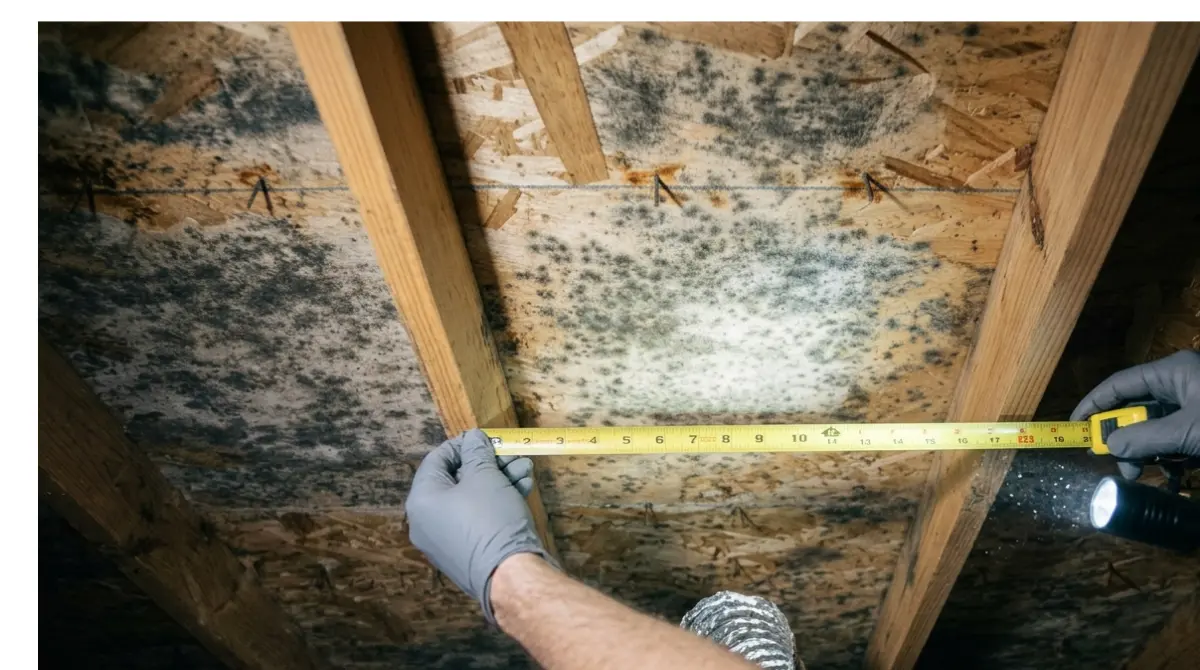
Ten square feet, roughly a 3-by-3-foot patch, is where EPA’s homeowner guide draws its line. Below about that size, the guide treats cleanup as a job most people can handle themselves. Above it, or after a lot of water damage, it points readers to EPA’s professional remediation guidance (EPA guide). That guidance sorts jobs into small (under 10 square feet), medium (10 to 100) and large (over 100), and calls for a remediation manager on medium and large jobs (EPA remediation guide). A single 10-by-12-foot section of roof deck is already 120 square feet, so measure all of the growth before deciding.
Licensing applies to paid work, and the starting point differs by state.
| State | Where the license rule starts | Check a license |
|---|---|---|
| Texas | Visible mold under 25 contiguous sq ft can usually be cleaned by unlicensed people, and homeowners can clean mold in their own home without a license | TDLR license search |
| New York | Cleanup isn’t required, but anyone hired to assess and remediate more than 10 sq ft must hold a state mold license | NY Department of Labor mold program |
| Florida | Remediation licensing covers mold or mold-contaminated matter over 10 sq ft | Florida DBPR mold-related services |
Sources: TDLR consumer sheet; TDHCA mold information; NY DOL fact sheet; Florida Statutes ch. 468, part XVI.
In other states, ask the state’s contractor licensing agency whether mold work carries its own license. The agency decides what applies, not the contractor.
If you hire, look the company up in your state’s database. Ask them what moisture source they found and who will fix it. Contracts, references and red flags are covered in how to vet a mold remediation company.
Stop and call a professional if: the growth is larger than a 3-by-3-foot patch or followed heavy water damage, the insulation is loose, pebble-like vermiculite, or ductwork running through the attic may be moldy. EPA advises against running an HVAC system you know or suspect is contaminated, because it could spread mold (EPA guide).
Gray-brown pebbles in the insulation stop the job
Vermiculite is a pebble-like, pour-in insulation, usually gray-brown or silver-gold (EPA fact sheet). EPA says to assume vermiculite contains asbestos and not to disturb it. If you stay out of the attic and leave the insulation alone, exposure is unlikely (EPA vermiculite guidance).
That changes the mold job, because any work that moves the insulation disturbs it. EPA and ATSDR strongly recommend a trained and certified professional for removal, since removing the insulation yourself could spread fibers through the house (Michigan health department brochure). Hire an asbestos professional certified in your state. Ask whether they will handle the vermiculite as asbestos-containing before any mold work begins.
Safety: Any disturbance of vermiculite can release asbestos fibers into the air. If you must go up, stay on the floored part of the attic and leave right after (EPA fact sheet). Fewer, shorter trips limit exposure (Michigan brochure).
What a fair attic mold quote should list
A quote with only a total can’t be compared with another one. Ask each company to put these in writing:
- The moisture source they found and who fixes it, priced as its own line
- The measured area of growth, in square feet
- The containment and protective equipment they plan, matched to EPA’s job sizes
- How they will clean the wood, and whether any sheathing gets replaced
- Whether insulation comes out, and what goes back in
- Disposal of removed material
- Their state license number, where your state licenses mold work
- How the job will be judged finished, including what post-remediation testing can confirm
If a quote includes testing before the work, ask what the result would change about the plan. Sampling is usually unnecessary when mold growth is visible, and no federal limits exist to compare a result against (Cornell Cooperative Extension, from EPA guidance).
Will spraying or painting over it hold?
Killing mold and removing it are separate steps. Routine use of biocides such as chlorine bleach isn’t recommended for mold cleanup. Dead mold can still cause allergic reactions, so it has to be removed (Cornell Cooperative Extension).
Paint runs into the same limit. Moldy surfaces shouldn’t be painted or caulked, because paint applied over mold is likely to peel (Louisiana Housing Corporation, from EPA’s guide). A quote built around fogging or a coating, with no cleaning and no moisture repair, skips both steps.
Warranty terms that depend on the moisture fix
If the fan duct still ends inside the attic after cleanup, the conditions that grew the mold haven’t changed. EPA’s guide expects mold to return when the water problem stays (EPA).
Before signing, find out whether the warranty requires the cause to be repaired, and who signs off on that repair. Ask too whether it transfers to a buyer if you sell the house.
Photograph the pattern before anyone quotes
Before the first contractor climbs up, take your own photos so every company prices the same evidence. Work from the hatch or a floored area:
- The worst patch of growth, with a tape measure in the frame
- The end of every bathroom and kitchen fan duct
- The eaves, where insulation meets the roof
- A close shot of the insulation itself
If the insulation looks like vermiculite, take the photos from the hatch and go no farther. For handling anything moldy, EPA’s guidance for small areas lists an N-95 respirator, gloves and goggles (EPA Table 2).
Infants and children, older adults, people with asthma, allergies or other breathing conditions, and people with weakened immune systems are at greater risk from mold, and CDC advises they stay out of areas likely to be contaminated (CDC). Symptoms are a question for a doctor.
Whether a homeowners policy pays for any of the work depends on the policy and the cause, and the insurer decides. When homeowners insurance covers mold remediation explains how insurers usually look at it.