Bathroom mold removal on grout, caulk and walls

Bathroom mold on a caulk line is replaced rather than caulked over, per EPA. Grout scrubs clean with detergent and water; drywall follows a stricter rule.
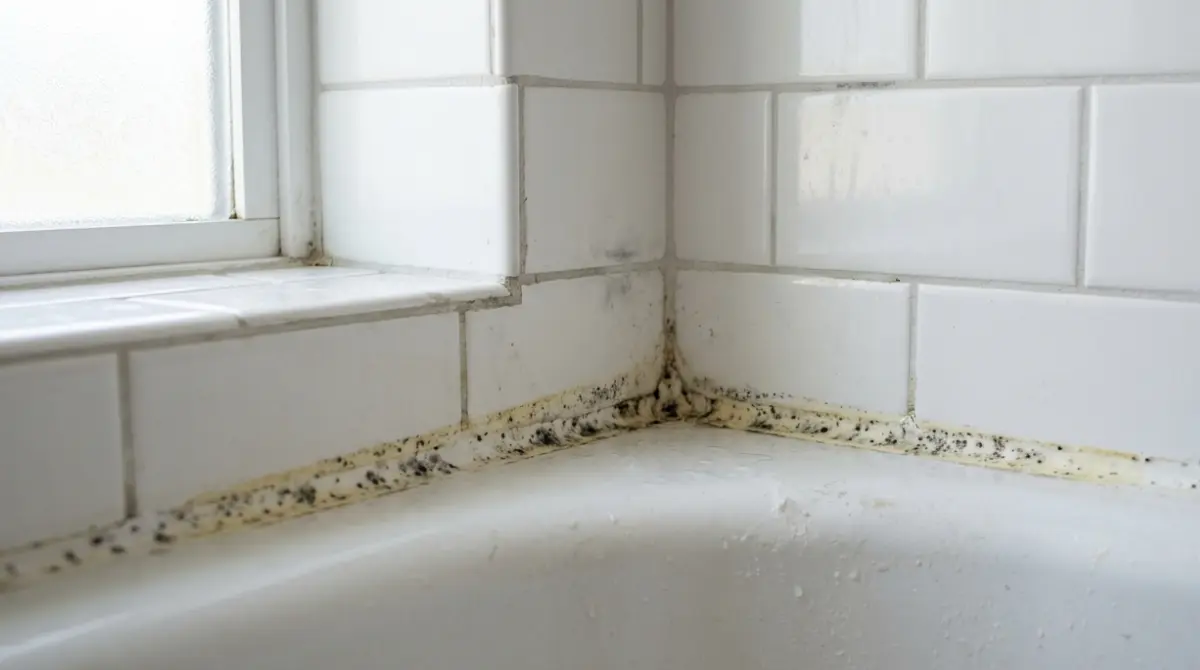
Table of Contents
Mold on bathroom tile and grout is usually a cleanup you can do yourself: EPA’s homeowner guide treats a moldy area under about 10 square feet, roughly 3 feet by 3 feet, as a job most people can handle. Moldy caulk and moldy drywall get replaced rather than cleaned, and a musty smell with no visible source points to water behind the wall.
Start by naming the surface
| Where you see it | What the guidance supports | Watch for | Next step |
|---|---|---|---|
| Tile, grout, tub and glass | Scrubbing with water and detergent, then drying completely | Staining may remain after cleaning | Scrub and dry |
| Caulk bead | No new caulk applied on top of mold | A joint that stays wet | Remove the bead, clean, dry, recaulk |
| Painted drywall or ceiling | For a small drywall patch, HEPA vacuuming once dry; no painting over mold | Porous material may have to be discarded | Replace the section if mold is in the board |
| Musty smell, no visible mold | Treat it as possible hidden mold | Mold on the back of drywall or around pipes | Get a professional before opening the wall |
Sources: EPA, A Brief Guide to Mold, Moisture, and Your Home; EPA, Mold Remediation Guidelines, Table 2.
In EPA’s remediation table, hard surfaces such as ceramic tile can be damp-wiped and scrubbed, while the only method listed for a small patch of moldy drywall is HEPA vacuuming once the board is thoroughly dry (method definitions, DC Department of Energy & Environment). Mold on wood or concrete elsewhere in the house is covered in black mold removal by surface type.
Grout and tile: detergent, a brush and drying time
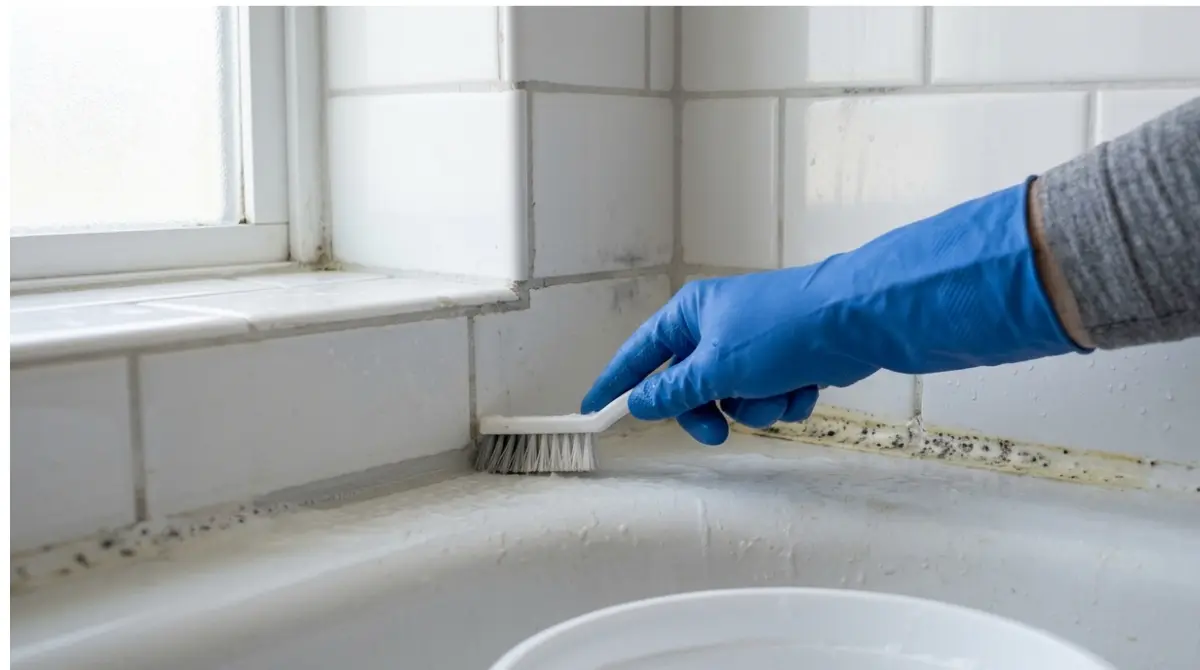
Scrubbing with detergent and water, then drying completely, is the method in EPA’s cleanup guidelines, which put fixing plumbing leaks first. On grout that means a stiff brush worked along each line.
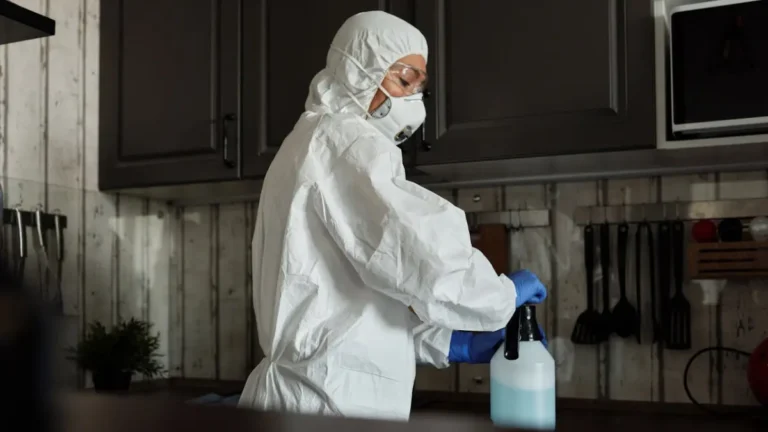
Protection comes from the same guide: a properly fitted N-95 respirator, goggles without ventilation holes, and gloves reaching the middle of the forearm. Household rubber gloves are fine with mild detergent, while bleach calls for natural rubber, neoprene, nitrile, polyurethane or PVC (EPA). Fit and sizing are in the mold cleanup safety gear checklist.
Mold can cause allergic reactions such as sneezing, a runny nose and skin rash, and asthma attacks in people with asthma who are allergic to it (EPA). Symptoms are a question for a doctor.
Bleach is optional. Chlorine bleach and other biocides are not recommended as a routine part of mold cleanup, and dead mold can still cause allergic reactions, so the growth has to come off the grout either way (EPA, cleanup and biocides). If you choose bleach, use no more than 1 cup of household bleach per gallon of water and open a window (CDC). A store-bought mold and mildew cleaner goes only on the surfaces its label lists.
Safety: Never mix bleach with ammonia or any other cleaning product. The combination can release toxic fumes, which build up fast in a small, closed bathroom, and bleach is never used straight from the bottle (CDC; EPA).
Cut out moldy caulk instead of caulking over it
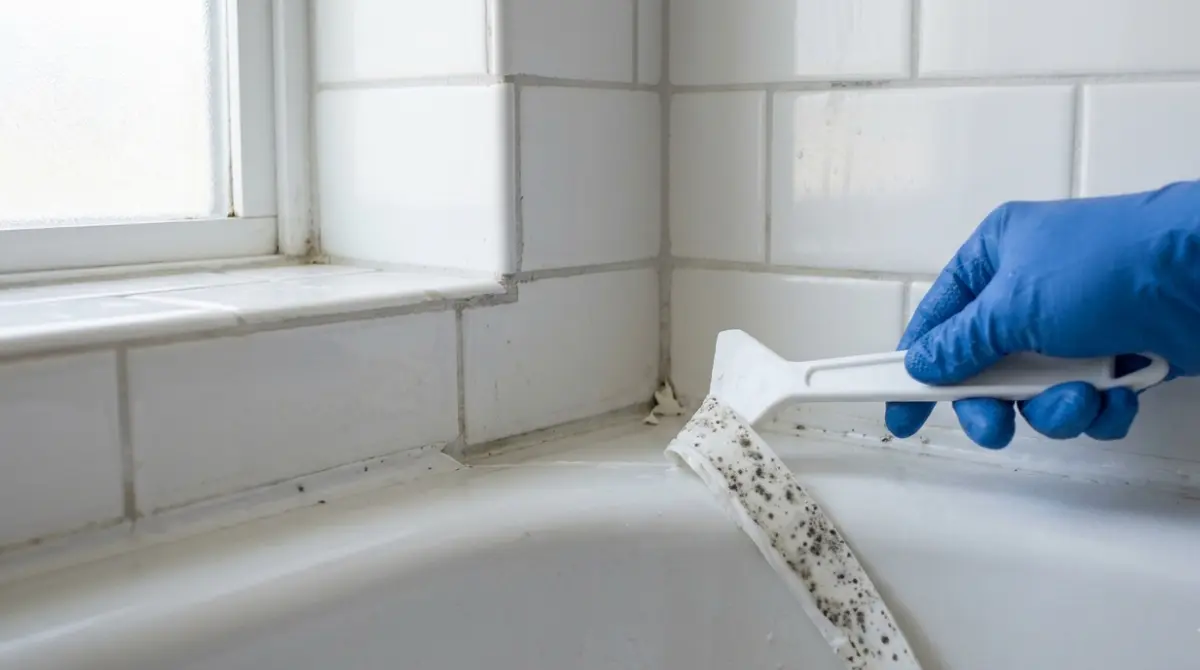
Running a fresh bead over the old one is the shortcut the guidance rules out.
Mold in a bathroom caulk line is handled by replacing the bead. EPA’s homeowner guide says not to caulk moldy surfaces, and DAP’s data sheet for its Kwik Seal caulk requires a joint that is clean, dry and free of all old caulk before new caulk goes on (EPA; DAP Kwik Seal data sheet). A new bead on a scrubbed, fully dried joint meets both.
- Remove all of the old caulk, including residue left in the corner.
- Scrub the joint using detergent and water; the same data sheet recommends rubbing alcohol for soap film.
- Let the joint dry completely, with the shower off, before new caulk goes on.
- Run a new bead and keep water off it for the cure time printed on its tube.
If the joint stays wet, the leak comes first, since mold cleaned up without fixing the water problem will most likely come back (EPA).
Painted walls and the ceiling above the shower
Under the paint on a bathroom ceiling is gypsum board with a paper face. Porous materials may have to be thrown away because mold can fill their crevices, and paint applied over moldy surfaces is likely to peel (EPA). When the mold is in the board, that section is likely to need replacing, and removing mold from drywall walks through the job.
Older bathrooms add two hazards to that cutting. Any renovation, repair or painting work in a pre-1978 home with lead-based paint can create dangerous lead dust, and EPA recommends that homeowners hire a lead-safe certified contractor for it (EPA RRP program; EPA advice for consumers). Ask the contractor to show the firm’s EPA or state lead-safe certification before work starts.
Joint compound and textured paint on walls and ceilings may contain asbestos, which was banned from those products in 1977, and sanding or scraping them can release fibers (Arkansas Department of Health). Asbestos can’t be identified by looking, so the material is treated as asbestos-containing or sampled by a qualified professional first (Georgia Department of Public Health).
Signs the water is behind the tile
A musty smell with no visible mold is the sign to take seriously.
That smell, or known water damage alongside health complaints, is a reason to suspect hidden mold on the back of drywall or inside walls around leaking pipes, and opening the wall has its own risk: pulling wallpaper off a moldy wall can release a burst of spores (EPA, hidden mold).
Stop and call a professional if:
- the moldy area is larger than about 10 square feet, or there has been a lot of water damage
- the water was sewage or otherwise contaminated
- mold may be in the heating and cooling system, which stays off until it is checked
- you have health concerns, in which case a health professional comes before the cleanup
These triggers come from EPA’s mold cleanup guidance.
The leak is plumbing work; the cleanup goes to a mold contractor. Ask that contractor for references and whether the crew follows EPA’s Mold Remediation in Schools and Commercial Buildings or ACGIH guidelines, the checks EPA’s guide suggests. EPA does not regulate indoor mold, so licensing is set by states and cities; Washington, DC, for example, requires a license to remediate 10 or more affected square feet (DC Department of Energy & Environment). Your state health department’s mold page shows whether yours does, and the mold remediation company hiring guide lists more questions.
Why does the same corner keep going black?
Mold that comes back in a shower is common. EPA’s bathroom tip says places that are often or always damp are hard to keep completely mold-free, and that running a fan or opening a window, plus cleaning more often, will usually prevent recurrence or keep it to a minimum (EPA). Indoor humidity below 60 percent, ideally 30 to 50 percent, is the target in the same guide.
A bathroom exhaust fan that meets the residential ventilation standard moves at least 50 cubic feet per minute (cfm) when switched on as needed, or at least 20 cfm if it runs continuously, and vents outdoors. Those are the ASHRAE 62.2 and International Residential Code M1507 rates, and ENERGY STAR suggests a fan rated at 70 cfm or more to deliver the 50 (Building America Solution Center).
The fan’s label carries a cfm rating and a sone rating; the standard caps intermittent bathroom fans at 3 sones and continuous ones at 1 (Building America Solution Center). Replacing an undersized fan is electrical work over a wet room, so a licensed electrician does it, with a permit where your building department requires one. Ask whether the new duct will end outdoors.
Renters report leaks to the owner or manager right away; when water problems persist unfixed, a health or housing authority is the next contact (EPA). What to do when a landlord won’t fix mold covers the steps after that.
Measure the patch, then read the fan label
Take a tape measure and a flashlight to the tub joint and the ceiling over the shower, since size and surface decide whether this is a weekend job or a call. Then check the fan’s cfm rating against the 50-cfm mark. If the bathroom turns out to be one of several damp spots, mold remediation guidance for the whole house shows where to look next.
Other questions about bathroom mold
Do I need to test bathroom mold before cleaning it?
Usually not. When mold growth is visible, sampling is in most cases unnecessary, and no EPA or other federal limits exist to compare results against (EPA).
Is the grout still moldy if it stays dark?
Not necessarily, because mold can leave staining that cleaning won’t remove. The cleanup counts as finished once the moisture problem is fixed and a check shortly afterward shows no mold growth or moldy odor (EPA).