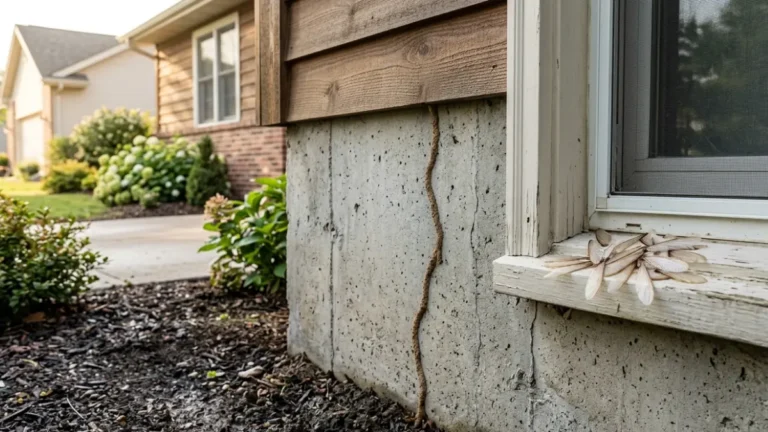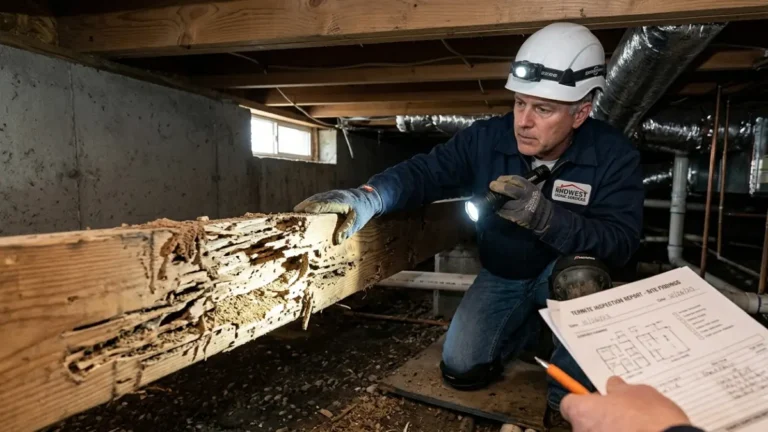
The real answer to when termites swarm is species by species

Termites swarm on warm days after rain — yet two extension programs report winter flights inside heated structures. The species flying decides the month.
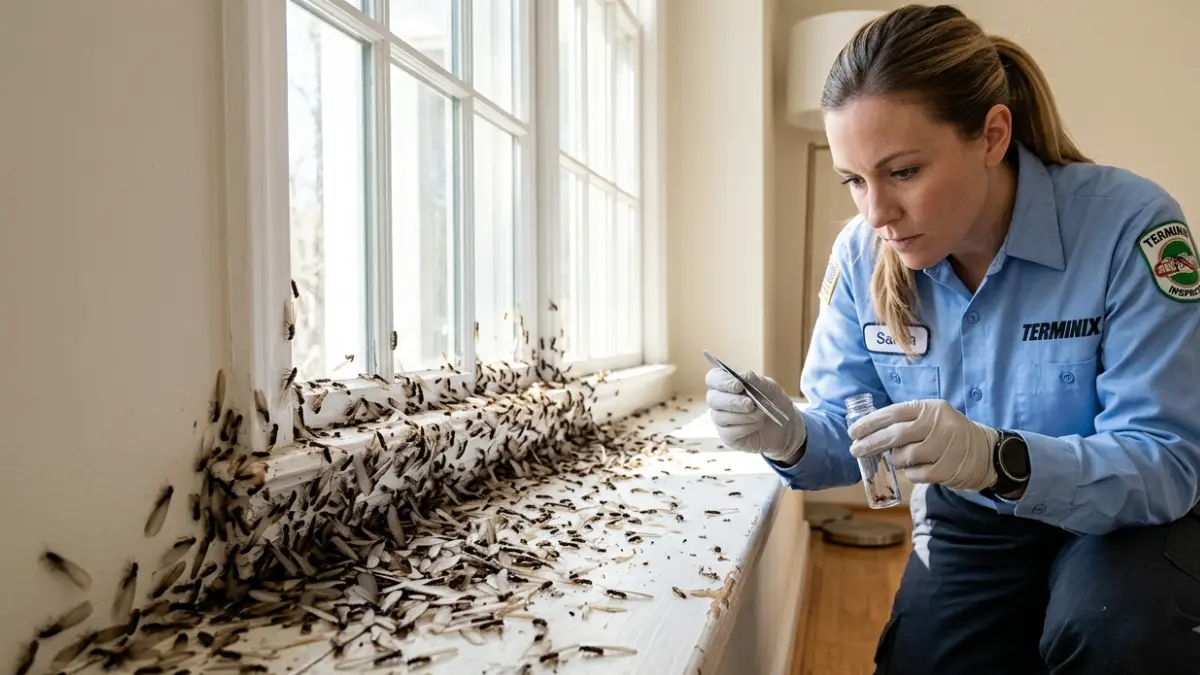
Table of Contents
Most termite swarms happen in spring, on a warm day after rain, in daylight. That is the general answer, and it is incomplete in a way that matters — UC IPM states plainly that the time of day and the time of year when flights occur varies with species and with geographic location.
In the eastern United States alone, UGA Extension publishes four separate windows for four different termites, spanning February through September. So the useful question is not when termites swarm. It is which termite is swarming.
Start where you are. If winged termites are inside right now, sections five and seven cover what that means and what to do next. If they are outside — a stump, a woodpile, a porch light — start with the calendar in section three. If you found only shed wings, section six explains what they still tell you.
Past that stage and looking at treatment instead? What the five treatment types actually do covers the methods and their real scope.
ℹ️ Safety Note: Deciding what to do about a termite swarm touches structural damage, pesticide use, and money — including service agreements and repair liability. Everything here is general understanding, not a treatment plan, a legal opinion, or an inspection. For anything involving your structure, use a licensed pest management professional and your state structural pest control agency.
- Ideal Box for Insect Collection – The insect display case with A-grade Acrylic panel top cover. Bottom lined with EVA fo…
- Material – Wood insect display box with shatterproof acrylic panel top cover that gives a clear view of your specimens a…
- Different Display Options – Two hooks on the bug display case allow you to0 hang it on the wall horizontally or vertical…
First, make sure you are looking at a termite
Winged ants and termite swarmers are confused constantly, and there is a good reason for it that has nothing to do with your eyesight.
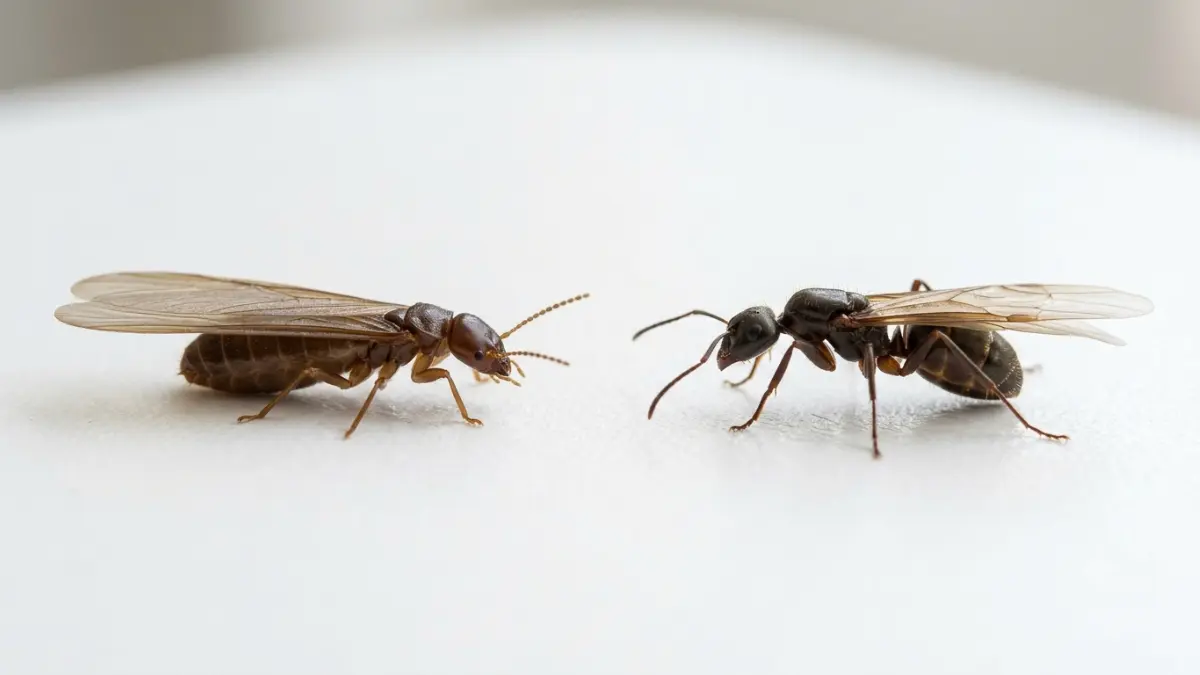
Three differences you can see without a magnifier
Three characters separate them, and UGA Extension, the University of Kentucky and NC State Extension all publish the same three:
- Antennae. A termite’s antennae are straight to slightly curved and look beaded. An ant’s have a distinct elbow in them.
- Waist. A termite’s body is one even tube from front to back. An ant has a pinched constriction between body regions.
- Wings. All four termite wings are the same size and shape. On an ant, the front pair is noticeably longer than the back pair.
The wing character is easiest at arm’s length, and it outlasts the insect — termite wings detach readily, so four matched wings on a sill still tell you what flew.The wing character is easiest at arm’s length, and it outlasts the insect — termite wings detach readily, so four matched wings on a sill still tell you what flew
- Resolution: 0005″/0. 01mm
- Automatic power off, move the digital unit to turn on power
- Battery CR2032. Data output. Made of stainless steel
Why ants and termites swarm at the same time of year
The University of Kentucky notes that ants tend to swarm at the same time of year as termites. Both are responding to the same cues — warmth and moisture — so a spring afternoon that pushes one into the air pushes the other with it.
That is why “a swarm in April” narrows almost nothing by itself. NC State Extension also notes you will often find only dead alates or wings, so the three characters matter more than watching anything fly.
For the full side-by-side, see telling swarmers from flying ants; for insects appearing indoors, swarmers appearing inside the house covers what follows.
The swarm calendar is keyed to species, not to states
Here is the finding that shaped this article: no cooperative extension service, state structural pest control regulator, or federal agency we could locate publishes a state-by-state termite swarm calendar. What they publish is keyed to species.
What extension services actually publish
That is not an oversight. A state is a container for a species pool, not a unit of insect timing, and the pools differ enough that a single month range for a whole state would be wrong for most of the termites in it.
| Termite | Published months | Time of day | Published by | Key detail |
|---|---|---|---|---|
| Eastern subterranean | February–April | Daytime | UGA Extension, eastern US, 2024 | The most widely distributed termite in the eastern US |
| Dark southeastern subterranean | April–June | Daytime | UGA Extension, eastern US, 2024 | Alates brownish black to black |
| Light southeastern subterranean | July–September | Daytime | UGA Extension, eastern US, 2024 | Yellowish-brown alates; UF/IFAS records it in structures less often than the other two |
| Formosan subterranean | April–July | Dusk to about midnight | UGA Extension, eastern US, 2024 | Alates larger than natives, wings finely haired |
| Formosan subterranean (Louisiana) | April–June, peak early to mid May | Dusk | LSU AgCenter, Louisiana, 2026 | Prefers warm, humid, windless evenings |
| Reticulitermes species | Spring or fall | Afternoon | UC IPM, California, 2014 | Clear days after a soaking rain |
| Desert subterranean | July–September | Late afternoon to early evening | UC IPM, California (Sonoran Desert), 2014 | Light-brown alates, drawn to lights |
| Western drywood | Summer and fall | Daytime | UC IPM Pest Note 7440, California, 2014 | Nests above ground; no soil contact needed |
| Dampwood | Summer and fall | Daytime, drawn to lights after dark | UC IPM Pest Note 7440, California, 2014 | Larger than drywood alates |
Sourced, not tested. Every row comes from the extension publication named in it, with that publication’s own jurisdiction and date attached. Two carry 2014 update stamps and are used here only for stable biology and published flight periods.
Time of day is the fastest clue you have
Before the month narrows anything, the hour does. UGA Extension and the LSU AgCenter state independently that native subterranean termites fly during the day while the Formosan subterranean termite flies at dusk — so a cloud around a porch light after dark in May tells you something the calendar alone cannot.
A daytime flight the same week points at a native species. It costs nothing and it works while the swarm is still happening.
📊 Sourced Spec: Two independent programs, two states, two decades apart, agree that winter swarms are real but narrow. UC IPM reports that in buildings with heated basements, termites occasionally fly inside during winter; UGA Extension reports that in warm sections of infested structures termites may swarm in winter, though it is not common.
The winter exception
That is the strongest argument against the phrase “termite season.” Outdoors, cold or frozen topsoil limits foraging and swarming needs warmth. Inside a heated structure, neither limit applies the same way.
The group split matters here too: drywood and dampwood species nest above ground rather than in soil, and how the two main groups differ explains why that changes the calendar and the treatment.
The eastern windows are detailed in UGA Extension’s bulletin on subterranean termite biology; the western and desert species in UC IPM’s pest note on subterranean and other termites.
Which termites are established where you live
The table above becomes a local answer only once you know which rows are possible where you are. That second layer exists — it is just published separately.
The map that does exist is about risk, not timing
There is a national termite map, and it measures something else. The Termite Infestation Probability Map, adapted from the 2021 International Residential Code as Figure R301.2(7) and hosted by the Department of Energy’s Building America Solution Center, divides the country into four bands from “none to slight” to “very heavy.” UGA Extension reproduces the same four-band map.
It tells a builder how much termite protection a structure needs. It does not tell you what month anything flies. Subterranean termites are found in every state except Alaska, and they are most abundant in the south and southeast.
Twenty species in one state
Florida is the case that makes the point. UF/IFAS records 20 established termite species there, the highest diversity in the mainland United States, six of them invasive — and most of those species are almost never found inside buildings.
Even the state-level facts turn out to be city-level ones. UGA Extension describes Formosan distribution as patchy and reports it from cities in eleven states; the LSU AgCenter puts it in 42 of Louisiana’s 64 parishes as of 2025. Within Florida, the Asian subterranean termite is restricted to the south, while the Formosan sits mainly in coastal cities and has been spreading since the early 1980s.
One species shows how far geography goes. UF/IFAS notes that western drywood alates do not appear able to survive dispersal flights in Florida’s climate, so infestations there stay extremely localized. Geography does not just shift a calendar — it can cancel the flight.
How to find out what is near you
Florida publishes an interactive species distribution map built from more than 6,500 samples, and its authors disclose its limits: sampling effort tracks population density, so coastal urban counties are both better sampled and likelier to receive introductions.
Other states have no equivalent public map. There the route is your local cooperative extension office, which will identify a specimen and tell you what has been recorded nearby. The species list, invasive status and submission instructions sit in the University of Florida’s termite species distribution guide.
Two rows on that list have their own coverage here: the Formosan situation in Florida and, for drywood species that arrive inside objects rather than through soil, drywood termites in furniture and outbuildings.
Indoors, outdoors, and what each one actually means
This is the question almost everyone arrives with, and three university extension programs answer it three different ways.
Swarmers in the yard
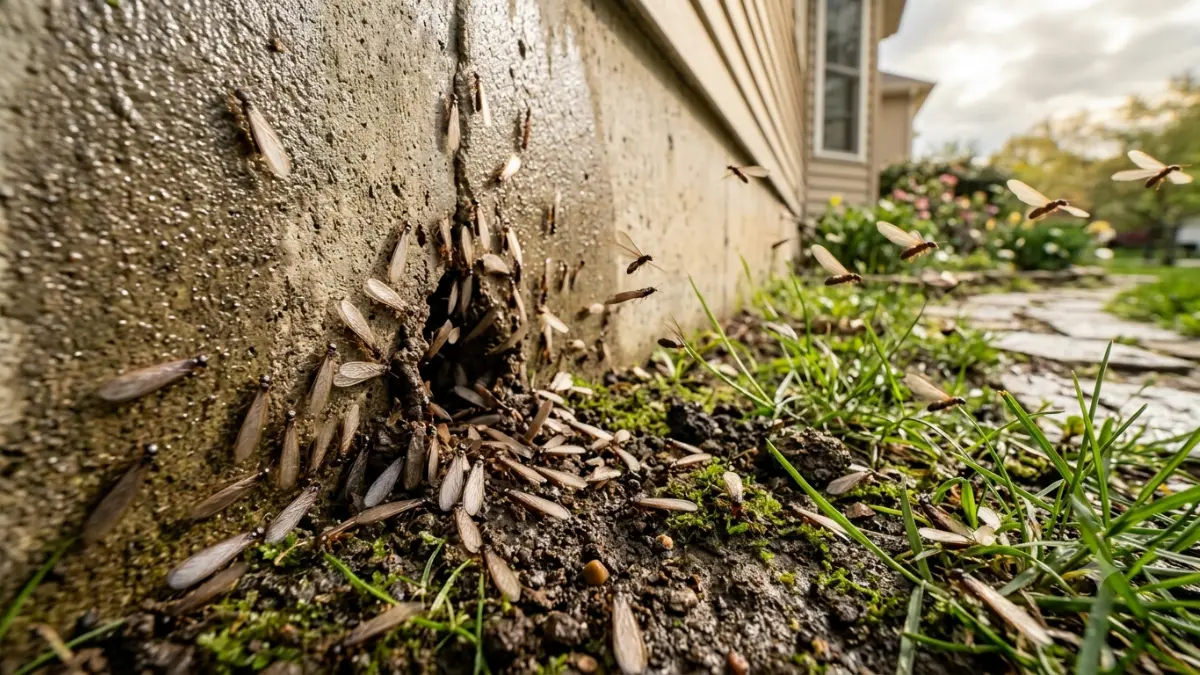
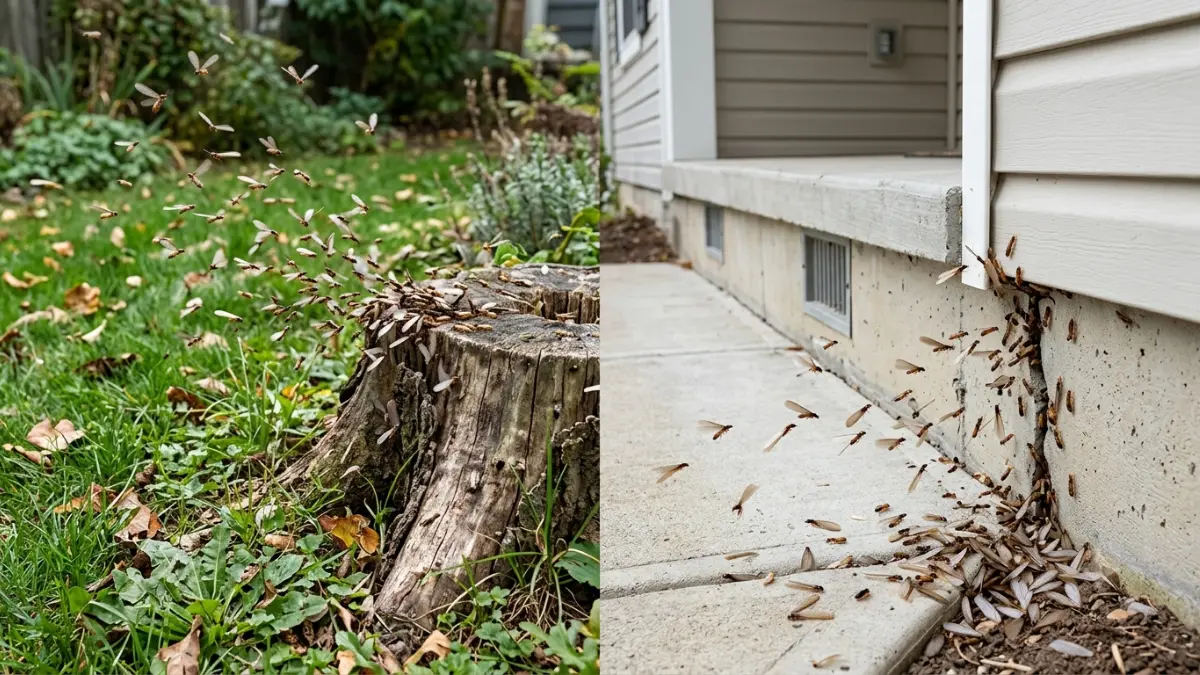
The emergence point is the diagnostic, not the sighting. The University of Kentucky draws the line: swarms out of tree stumps or woodpiles in the yard are not necessarily cause for concern and do not automatically mean the house is infested — but swarmers emerging next to the foundation, or from an abutting porch or patio, mean there is a good chance the house is infested too.
UC IPM reaches the same conclusion from a different direction, noting that most soil around a home holds buried cellulose — roots, stumps, old fence posts — so a yard swarm has plenty of possible origins. NC State Extension adds that an outdoor nest could be in your yard, a neighbor’s, or a wooded area down the street.
Swarmers inside the house
Here the programs diverge, and the divergence is worth seeing rather than smoothing:
- Kentucky (University of Kentucky, revised 3/26): discovering winged termites indoors almost always indicates an infestation warranting treatment.
- Louisiana (LSU AgCenter, April 2026): flying termites commonly enter homes through a vent, and a few crawling in a bathroom or kitchen may be that. But termites flying indoors, or a large number of wings inside, means an active infestation is likely.
- Florida (UF/IFAS, February 2025): several native species are widespread but rarely or never found inside structures, and during their flight seasons their winged reproductives may still make their way into buildings — giving the illusion that they are infesting them.
Why three universities give three answers
Read side by side, the split tracks the species pools each document is written for. Kentucky’s structural picture is dominated by one termite. Louisiana’s is natives plus a dusk-flying invasive; Florida’s is twenty species, most of which never touch a building.
That is an observation about the documents, not a correction of any of them. Each is accurate for its own state, which is exactly why a national month grid cannot carry the same information.
⚠️ Watch Out: A swarm you can explain is still a swarm you have not identified. None of the three positions above resolves to “do nothing” — all three end at the same place, which is getting the specimen identified and the structure inspected. The signs that are not seasonal matter more than the flight: the signs of termites and, for drywood species, the pellets they leave behind.
The full homeowner guidance behind the Kentucky position is in the University of Kentucky’s homeowner termite guide.
How close is the colony, and what the wings tell you
A swarm is evidence, and evidence has a radius — but the published flight distance depends on who measured it and on which termite.
Two published flight distances, and why they differ
Two figures exist in the extension literature, and they are about eight times apart:
- UC IPM (California, 2014): new kings and queens generally fly less than 100 meters from their colony.
- LSU AgCenter (Louisiana, 2026): swarmers are not good fliers and usually fly no more than half a mile.
These are not in conflict and should not be averaged into one number. The first describes where alates typically end up; the second sets an outer bound on what a poor flier can manage. They also cover different species in different climates.
Both support the same practical point: the colony is close. Not necessarily on your property, but close enough that the search area is your lot and the ones adjoining it.
What the wings on the sill are actually telling you
After landing, alates shed their wings and pair off, with the female leading and the male following in tandem — the LSU AgCenter and NC State Extension both describe it. Indoors, they typically die of desiccation, which is why the wings often outlast the insects.
The reassuring part is also sourced. UGA Extension reports that most alates die soon after swarming and that colony establishment by this route has an extremely low success rate. UC IPM also describes a distinct fourth tube type — a swarm tube — built specifically for reproductives to emerge from, which is why an emergence point can sometimes be seen at all.
🔍 Why It Works: A swarm runs on two clocks, and both started before you saw anything. UGA Extension reports that large numbers of nymphs are produced seasonally, usually beginning in late summer, and molt over several months to develop wings, eyes and working reproductive organs — and that colonies swarm only once mature. So the flight in front of you reflects a wing cycle that began last year and a colony older than that.
Damage found while investigating needs its own check, since termite damage and moisture damage look alike to most eyes — telling termite damage from water damage covers the difference.
What swarm season is actually good for
The calendar has a use beyond anxiety: swarm season is the only time a homeowner can get hold of the part of the colony that can be identified.
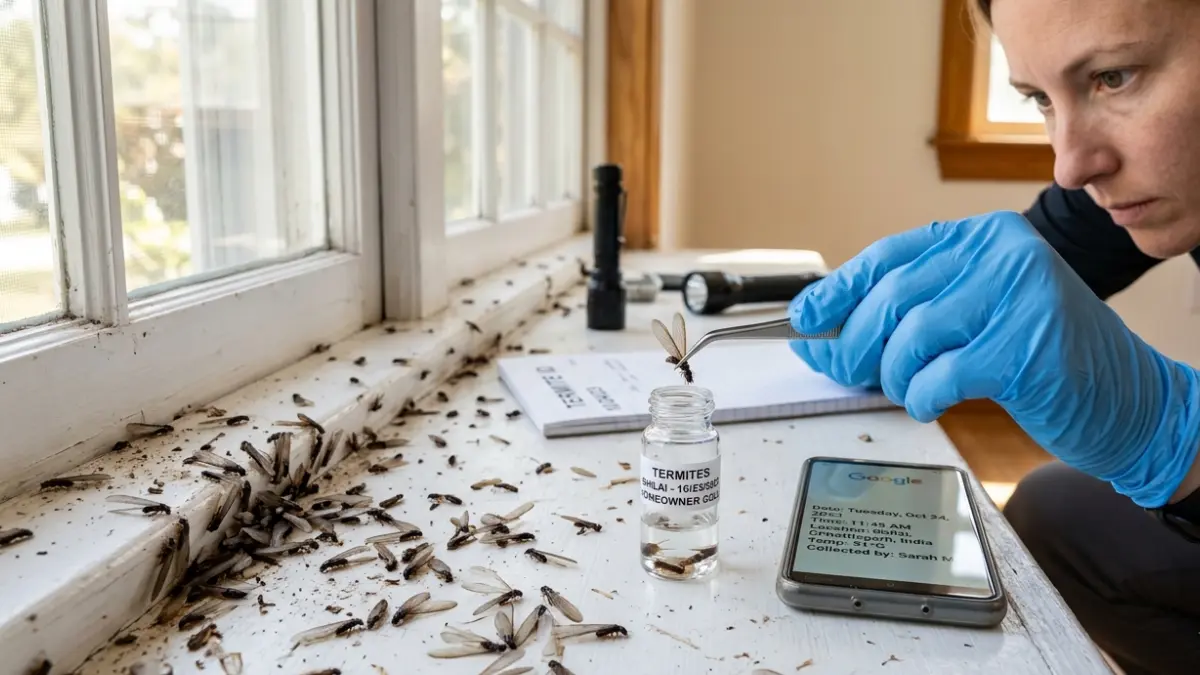
Collect a few, before they dry out

UF/IFAS is explicit that winged swarmers and soldiers are the castes used for termite identification, and that workers — the most numerous caste — are the hardest to identify from. Workers stay hidden inside wood and soil. Alates come to your window.
Collect several into a small sealed container with a preservative solution rather than loose in an envelope, where samples are usually destroyed in transit, and record where and when they were collected and by whom. Check the receiving lab’s own current instructions before posting anything, since shipping rules apply to preservatives.

- 4-in-1 VERSATILE CORDLESS VACUUM CLEANER: Combines vacuuming, blowing, inflating, and deflating in one device for this p…
- 19,500PA CYCLONIC STRONG SUCTION: This cordless hand vacuum features an 85,800RPM high-speed brushless motor and advance…
- MULTI-PURPOSE CLEANING ACCESSORIES: Equipped with various accessories for diverse cleaning scenarios. The extension flex…
UF/IFAS accepts termite samples for identification at no cost, from Florida and beyond. The University of Kentucky directs homeowners to their local cooperative extension office; the LSU AgCenter takes specimens through parish offices; NC State Extension points to county centers.
Do not spray them
This is the instinct to resist. The LSU AgCenter states that killing swarmers in or around the house gives little protection from further termite activity and damage, and NC State Extension says the same — it removes the nuisance and none of the risk.
The University of Kentucky gives the alternative directly: indoor swarmers can be removed with a broom or a vacuum. They cannot damage wood and they live only about a day.
The one week the emergence point is visible
UC IPM notes that spring, especially a warm sunny day after rain, is the optimum for subterranean swarming — and that for brief moments it is a chance to see live termites and possibly the exact spot they are emerging from inside the home. That location is worth photographing.
One seasonal action is published for a specific case: the LSU AgCenter advises Louisiana homeowners to turn outdoor lights off at night in May and June to avoid attracting Formosan swarmers. That is state- and species-specific, not a national rule.
✅ Do This: Ask a licensed pest management professional two things — what the species is, and whether the emergence point is at or inside the structure. Those answers drive everything else; your state structural pest control agency handles verification and complaints. If you rent, report the swarm to the property owner rather than arranging treatment yourself, and if you already hold a service agreement, contact that company first and read it before starting construction work, since NC State Extension notes such activities can void a renewal.
Between events, the perimeter holds the useful information — see the perimeter walk, choosing a termite company and what a WDO inspection covers. The Louisiana lights guidance is in the LSU AgCenter’s Formosan swarm advisory.
Common questions about termite swarms
1. Are termite swarmers the same as flying ants?
No. Termite swarmers have straight, beaded antennae, a body with no pinched waist, and four wings of equal size and shape. Flying ants have elbowed antennae, a constricted waist, and front wings noticeably longer than the back pair. Both groups tend to swarm at the same time of year, which is why they get confused so often.
2. What time of day do termites swarm?
It depends on the species, and that is useful rather than evasive. UGA Extension and the LSU AgCenter both report that native subterranean termites fly during daylight while Formosan subterranean termites fly at dusk. UC IPM places California Reticulitermes flights in the afternoon and desert subterranean flights in the late afternoon or early evening.
3. How long do termite swarmers live?
Not long. The University of Kentucky reports that termite swarmers emerging inside a home are incapable of damaging wood and live only about a day. UGA Extension adds that most alates die soon after swarming from desiccation and predation, and that establishing a new colony this way succeeds at an extremely low rate.
4. Can termites swarm in winter?
Yes, in one situation. UC IPM reports that in buildings with heated basements termites occasionally fly inside during winter, and UGA Extension reports that termites may swarm in winter in warm sections of infested structures, though it is not common. A winter flight indoors is unusual enough to warrant identification rather than dismissal.
5. Do termite swarmers bite or damage wood?
They do not. The University of Kentucky states that swarmers emerging indoors are incapable of damaging wood. Damage is done by the worker caste, which stays inside wood and soil and is almost never the part you see. The swarmers are a signal about a colony, not the cause of any damage themselves.
6. Should I kill the swarmers I find inside?
Removing them is fine; treating that as the solution is not. The LSU AgCenter and NC State Extension both state that killing swarmers gives little or no protection from continuing termite activity and damage. The University of Kentucky suggests a broom or vacuum. Then have the species identified and the structure inspected by a licensed professional.
7. Does a swarm in my yard mean my house has termites?
Not automatically. The University of Kentucky states that swarms from stumps and woodpiles out in the yard are not necessarily cause for concern, while swarmers emerging beside the foundation or an abutting porch mean there is a good chance the house is infested too. UC IPM notes buried cellulose in most yard soil gives swarms many possible origins.
8. How old is a colony that produces swarmers?
Old enough to be established. UGA Extension states that swarming happens usually only in mature colonies, and that the nymphs which become swarmers begin developing seasonally, generally from late summer, molting over several months. No source in this set gives a fixed number of years, so treat a swarm as evidence of an established colony and arrange an inspection.
The calendar you wanted, and the one that exists
A state-by-state swarm calendar could not be built here because the underlying information is not shaped that way. Timing belongs to species; states hold pools of them; and in the most extreme case, one state holds twenty. Any national grid you find has been assembled by someone filling that gap with inference.
What you can do is match what you saw — the month, the hour, indoors or out, and the exact emergence point — against the species rows above, then get the insect identified while you still have one. That window is short, it is free, and it is the only part of this that closes.