How to choose a termite company and avoid the usual guesswork

Choosing a termite company means trusting a person you’ll never meet: the operator who selects the chemical for your house. Ask for their name.
Table of Contents
Three situations bring people here, and the right first move is different for each.
If someone is in your driveway right now with a proposal in hand, go straight to checks seven and eight — they are the only two you can run in the next ten minutes.
If you have found evidence and are about to start calling, start at the top. Checks one and two happen before any phone call.
If two or three quotes are already on the table, checks six and seven are where the real differences between them show up.
Most advice on how to choose a termite company tells you what to ask. That is fine as far as it goes, but it leaves you depending on the answers of the person selling to you. These eight checks are sorted by something else: what actually settles each one.
This page will not rank companies for you. No national list can tell you whether the individual arriving at your house holds an active wood-destroying organism licence in your state, and nothing here was tested. If you want the treatment side first, the pillar covers what the five main termite treatment types actually involve.
ℹ️ Safety Note: Hiring a termite company is a contract and pesticide decision with money and legal stakes. Everything here is general guidance — licensing rules and consumer-contract rules differ by state. Verify licensing with your state pesticide regulatory agency, and take anything contractual to your state consumer protection office or a licensed professional.
The eight checks at a glance
| # | The check | How you settle it |
|---|---|---|
| 1 | The licence category covers wood-destroying pests | Verify — your state’s licence database |
| 2 | The individual licence is active, not just the company’s | Verify — same database, searched by name |
| 3 | The certified operator in-charge has a name | Ask — one question, to the inspector |
| 4 | The ID card and the vehicle match the role | Ask and observe — in your driveway |
| 5 | What training and vetting stand behind that card | Ask — company policy, not state policy |
| 6 | The finding is written evidence, not suspicion | Read — the written proposal |
| 7 | The proposal names the diagram, product, strength, and amount | Read — the written proposal |
| 8 | The signing page carries what the federal rule requires | Read — the page in front of you |
Five of these — 1, 2, 6, 7, and 8 — settle without depending on anyone’s answer.
A pest control licence may not cover termites at all
The phrase “licensed and insured” hides the check that matters most, because a pest control licence is usually not one thing. States that regulate structural pest control tend to split it into categories, and termite work almost always sits in its own.

How states split the categories
North Carolina codes the split into the licence number itself. NC State Extension explains the three phases a licence can carry: P for household pests, W for wood-destroying pests, and F for fumigation, appearing as letters after the digits.
Florida separates the same work into general household pest control, termites and wood-destroying organisms, lawn and ornamental, and fumigation. UF/IFAS Extension states that a company must have a certified operator in each category it offers.
What a general household licence cannot do
This is the part worth reading twice. NC State Extension states that a company holding a P-only licence cannot perform any treatment for termites or other wood-destroying pests — not even treatments applied indoors rather than to the soil.
So a company can be genuinely, currently, fully licensed, and still be barred from touching your termite treatment. Nothing about the phrase “we’re licensed” tells you which side of that line they sit on.
🔍 Why It Works: The categories exist because the work is different, not because the paperwork is. Termite jobs involve soil volumes, structural access, and inspection reports that a general household pest licence never tested anyone on — which is also why the products that do the job are not sold to homeowners.
Why fumigation is separate again
Fumigation carries its own certification in both states. That matters if you have drywood termites rather than subterranean ones, because the treatment your house needs may require a category the company quoting you does not hold.
The same phase letter often governs who may write the inspection report, too. In North Carolina, W-phase holders are the ones who perform the wood-destroying insect reports used in home sales, which is a useful cross-check when you are also paying for a WDO inspection report.
Whose licence is it, and who picked the chemical?
Knowing which licence matters is only half of it. The next question is whose licence you are actually relying on, and that answer is rarely the person standing in front of you.
Look up the person, not just the company
The EPA sets out the structure plainly in its list of questions to ask a pest control firm: a company must have at least one certified, licensed commercial applicator in the proper service category, and other staff must be certified applicators or licensed technicians working under a certified applicator’s direct supervision.
That means a company-level licence is a real credential attached to at least one person — not to everyone who wears the uniform. Search the individual licensee by name, not only the business name.
Florida publishes a public individual-licensee database, and UF/IFAS advises checking that the status returned reads active. The same lookup logic applies to any structural pest work, including hiring an exterminator for bed bugs.
The one question to ask the inspector
This is the single most useful question on the page, and it takes four seconds.
UF/IFAS Extension’s homeowner’s guide to selecting a pest control service describes the “certified operator in-charge” as the person responsible for day-to-day operations at that business location — and, specifically, for selecting the techniques and products used at your home.
Ask the person inspecting your house to name theirs. UF/IFAS states that if they cannot, it may mean there is little supervision or guidance reaching the technician who will service your home.
✅ Do This: Ask, in these words: “Who is your certified operator in-charge?” You are not testing their memory. You are finding out whether the person choosing the chemical that goes around your foundation is a real, named, supervising individual — or nobody in particular.
Where to find your state’s database
Every state has one agency that works with the EPA to enforce pesticide rules and take complaints. The National Pesticide Information Center maintains a directory of the agency that licenses pest control in your state, covering all fifty states, DC, and five territories.
That agency is also where a complaint about a misapplication goes. The EPA notes that licences can be verified through state departments of agriculture, and no private review site substitutes for it.
Who actually shows up, and what training they have

- Round Awl Screwdriver
- Cellulose Acetate Handle
- Clear Transparent With Black Inlay Stripe
The person who inspects your home and the person who treats it are frequently two different people with two different roles. Both extension services say so directly.
The card and the vehicle in your driveway
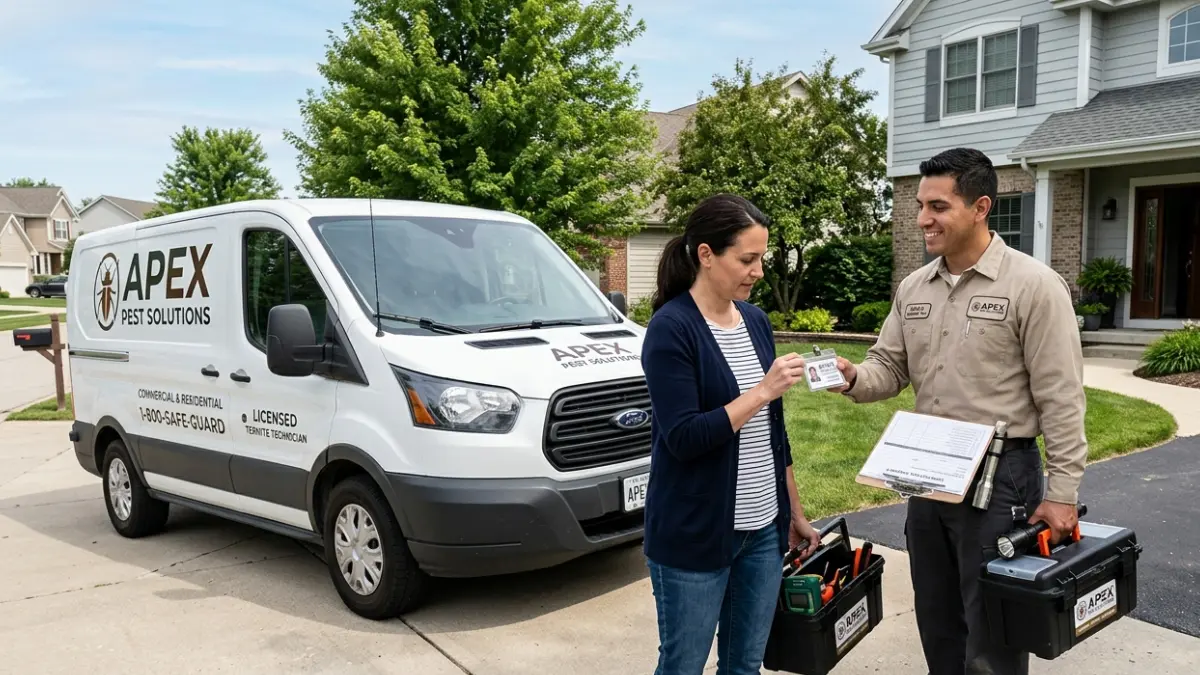
In North Carolina, everyone who sells pest control contracts or performs the work carries a state identification card showing their employer’s structural pest control licence number. NC State Extension advises asking to see it, and contacting the state agency if the person cannot produce one.
The vehicle tells you something too, and the two states do it by opposite mechanisms. North Carolina requires the company name or licence number on both sides of every service vehicle and exempts sales-only vehicles; Florida bars magnetic signage on the vehicle driven by the person performing the work, permitting it only on sales vehicles.
Either way, the service vehicle in your driveway is a five-second read on which conversation you are having.
Salesperson or technician?
Both extension services note that many companies run separate sales and technical staff, and that the person assessing your problem may not be the person returning to do the job.
NC State Extension is careful about this, and so is this page: asking does not imply that a commissioned salesperson is less honest than a salaried one. It establishes who you are talking to, which changes what their answers can reliably cover.
What “licensed and insured” does not cover
Here is the fact the competing pages leave out. Under Florida’s system, as described by UF/IFAS, a new technician’s identification card can be applied for within thirty days of hire, and the forty hours of documented technician training are due within six months — of which only four classroom hours must cover pesticide safety, integrated pest management, and applicable law. Two hours annually follow.
UF/IFAS also states that background checks are the hiring company’s responsibility, not the department’s.
📊 Spec (sourced): Florida ID card within 30 days of hire · 40 documented training hours within 6 months · 4 of those hours in classroom safety, IPM, and law · 2 hours annually thereafter · background checks run by the employer, not the state. Source: UF/IFAS ENY-2043, citing Florida Statute 482.091.
None of that means technicians are unqualified. It means the word “licensed” answers a narrower question than most homeowners assume — which is exactly why checks one, two, and three are worth running.
Ask what they found, not what they suspect

- HUMIDITY SENSOR: Our handy meter tool can quickly determine what level of remediation is needed to keep your family safe…
- WATER LEAK DETECTOR: Finding the moisture content in your wood or drywall is the first step in early prevention. Continu…
- MOISTURE READER: The mold test features large 0.3″ high digits in a backlit LCD for quick and easy detecting. Our mildew…
Everything so far has been about the company. This check is about the claim they are making.
“Suspected” is not a finding
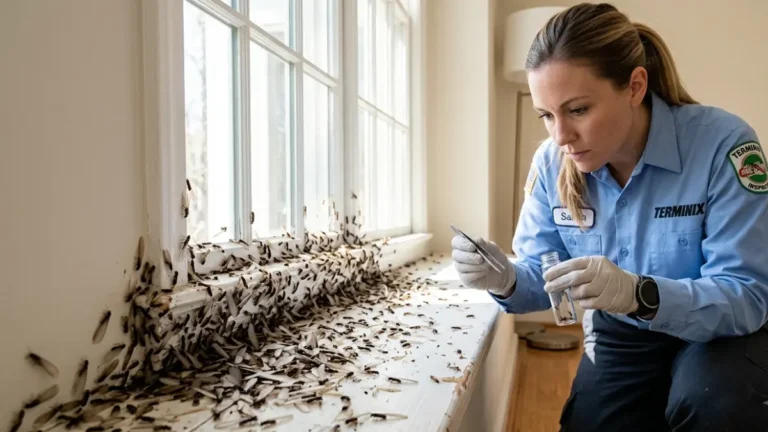
NC State Extension is unambiguous: a claim that an infestation is active must be supported by visible evidence, and you should not accept a conclusion of “suspected” termite activity.
If the evidence is inconclusive, the same source suggests collecting a sample of the insects or damage for your county cooperative extension centre. Some state agencies will send an inspector when a sample cannot be collected — ask yours whether it does.
It also helps to know what you are being shown. There is a real difference between finding termites and finding conditions conducive to termites, and both need attention in different ways — the evidence a real inspection produces and telling an active mud tube from an abandoned one are separate skills from judging what it costs.
The two pressure lines to walk away from
The EPA publishes a list of behaviours to be wary of, and two appear in termite sales specifically.
One is pressure to sign immediately on the basis that the house is structurally unsound and may collapse. The other is an offer of leftover material from a previous job at a reduced price.
⚠️ Watch Out: The collapse line is the one to be most alert to, because the inspection form used across the industry says on its own face that the inspector’s training does not qualify them in damage evaluation. Anyone making a structural-failure claim to close a sale is speaking outside the scope of their own report.
Who is qualified to judge the damage
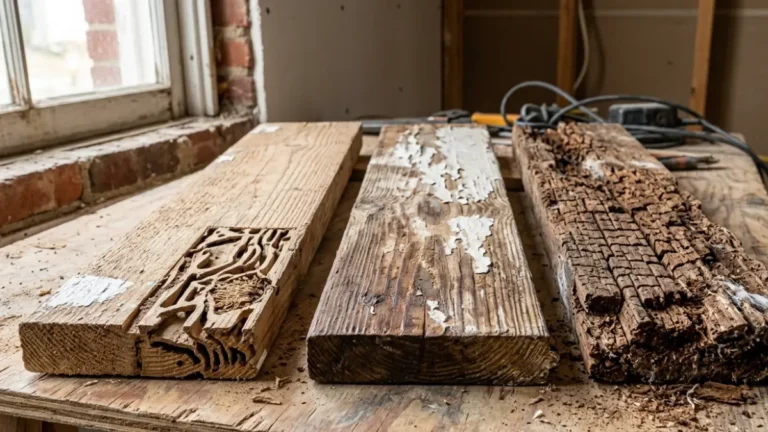
NC State Extension also states that it is nearly impossible to determine the age of termite damage simply by looking at the wood — the third independent source we have found saying so.
That matters because severity and repair scope are a separate professional judgement from pest identification. If damage is part of the conversation, who is actually qualified to assess it is worth settling before any number is discussed.
What a real termite proposal says in writing
- MAXIMUM COMFORT & SUPPORT – Sellstrom’s Ultra Flex KneePro Knee Pads offer professional & durable knee protection for me…
- TOUGH PROTECTION THAT STAYS IN PLACE – Ultra-durable, flexible hard plastic outer shell withstands impact and sharp obje…
- BREATHABLE FOAM PADDING – Upgraded foam with ventilation holes on a triple-layer 3/4″ thick inner padding offers maximum…
Once the finding is established, the written proposal is where a serious company separates itself. Four things should be on it.
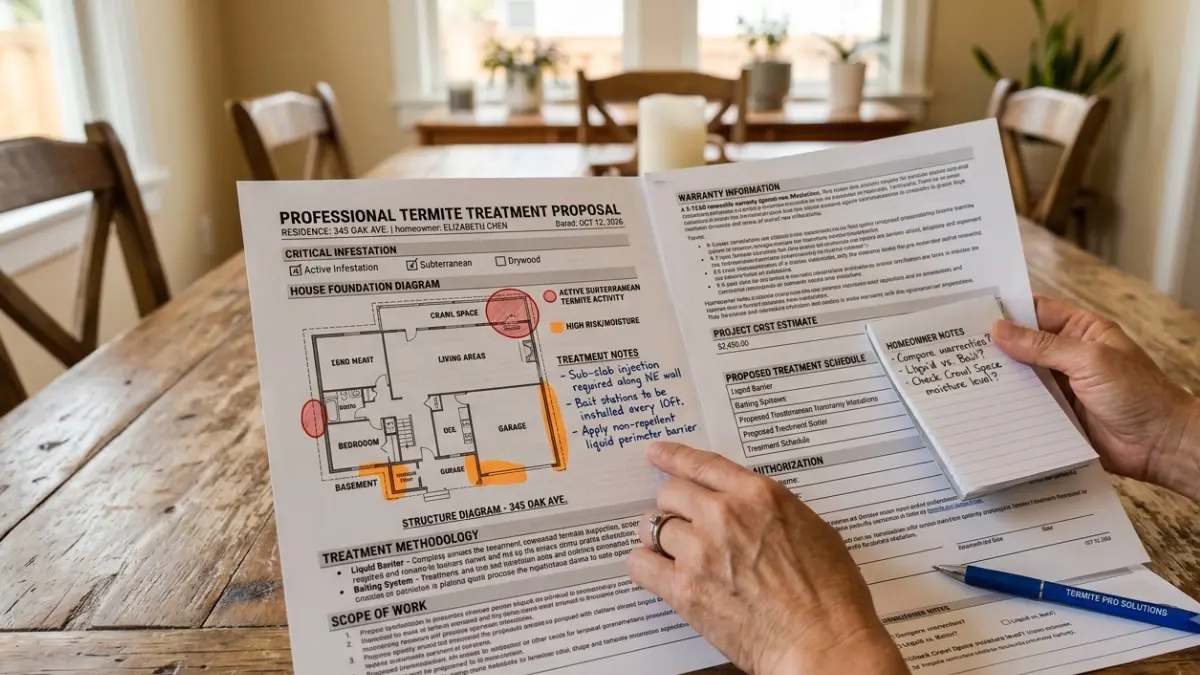
The building diagram
NC State Extension states that any proposal or contract to treat for termites must include a detailed building diagram describing the problem — specifically its location and nature, whether that is damage, tubes, or live insects.
A contract that says only “termite treatment” is not enough. That is the source’s phrasing of it, not ours.
The product, the concentration, the amount
The same source states the proposal should specify the name, concentration, and approximate amount of the insecticide to be used. The EPA’s own list says a reliable applicator will provide copies of the pesticide labels showing the application rates.
If a product is named, what the named product on the proposal tells you becomes a question you can research independently before signing anything.
Two prices that should stop you
The EPA warns specifically against accepting a per-gallon price, noting that termite control can require several hundred gallons of diluted insecticide. UF/IFAS separately advises caution about quotes based on the size of your house alone, since the quote should come from the inspection.
Those two red flags point at the same thing: why treated volume rather than house size drives the number.
How many proposals to compare
Two or three, per both extension services. NC State Extension lists what to compare them on: treatment specifications, cost, warranty type, the cost of annual renewal, and any waivers for work one company is excluding that another is including.
💡 Pro Tip: NC State Extension states plainly that a delay of even several weeks makes no real difference in terms of additional termite damage — and adds that if a floor were going to fail from damage already done, it would likely do so regardless. Whatever urgency you are feeling, the calendar is not the reason for it.
✅ Do This: Line the proposals up and compare them on those five points only. Price alone tells you almost nothing until you know whether two companies are quoting the same scope of work.
The three-day window and the page you’re signing
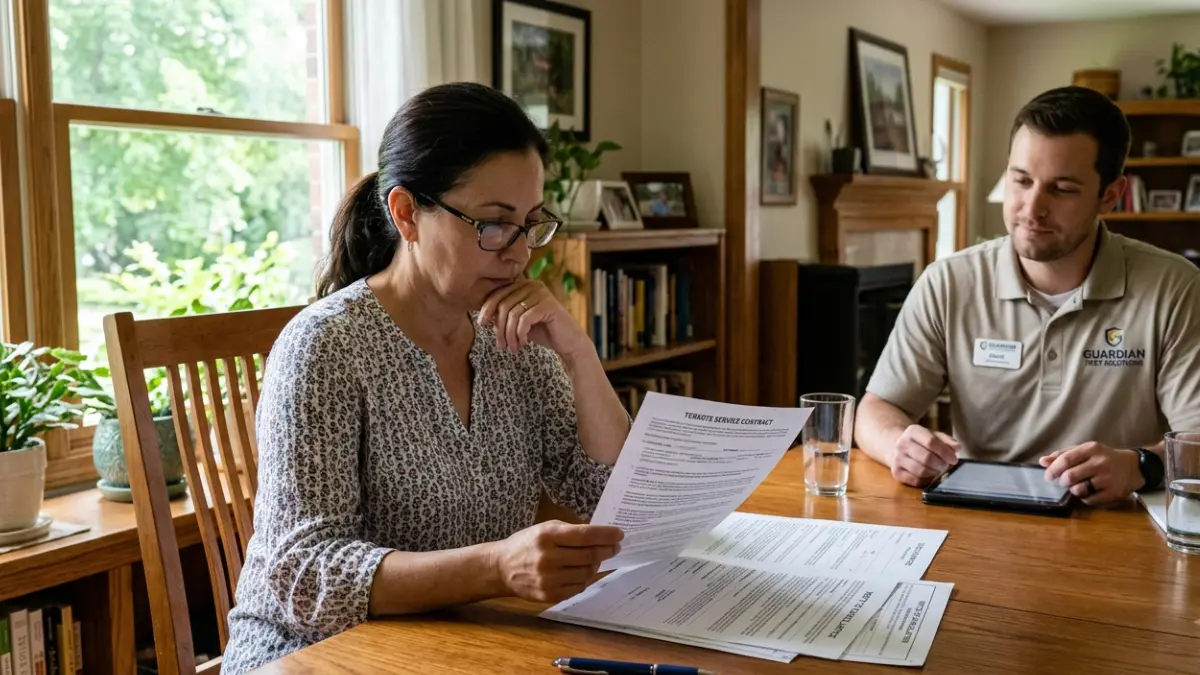
One page is left, and there are federal rules about what has to be on it. This is general information about a regulation, not advice about your contract — that question belongs to your state consumer protection office.
Why an invited visit still counts
The FTC’s rule on sales made at a buyer’s home defines the sales it covers more broadly than most people expect. Its definition reaches solicitations made “in response to or following an invitation by the buyer,” where the agreement is made somewhere other than the seller’s place of business.
In other words, the fact that you called them does not automatically put the signing outside the rule.
Five things the paperwork must show
The rule sets out what the seller must do at signing. It requires a completed contract or receipt at the time it is signed, in the same language as the spoken sales presentation; a cancellation statement in bold type of at least ten points, positioned immediately next to the signature space; two completed cancellation notices; the seller’s name, address, transaction date, and the deadline date filled in before handover; and oral notice of the right as well.
📊 Spec (sourced): The rule also names any waiver of the cancellation right written into the contract as itself an unfair and deceptive practice, and its emergency exclusion requires a separate dated statement in the buyer’s own handwriting. Source: 16 CFR §§ 429.0–429.1.
State rules can go further. NC State Extension states that with termite contracts, North Carolina companies must give three days in which to cancel.
Nobody endorses anybody
⚠️ Watch Out: The EPA states that government agencies do not endorse any service company or pesticide product. NC State Extension says the same about itself. “EPA-approved company” is not a status that exists, and an association badge is a membership, not a credential.
What the contract itself should say is a separate exercise — the ten questions to settle before signing a termite bond covers it, and it is worth knowing that a service agreement generally pays before a homeowners policy does.
How to choose a termite company: common questions
1. How do I verify a pest control licence?
Find your state’s pesticide regulatory agency through the National Pesticide Information Center’s directory, then search that agency’s licensee database. Search by the individual’s name, not only the company, and confirm the status reads active and the category covers wood-destroying organisms. Florida publishes exactly such a database; other states run their own versions.
2. Who is the certified operator in-charge?
Under Florida’s system, the certified operator in-charge runs day-to-day operations at a pest control business location and is responsible for selecting the techniques and products used at your home. UF/IFAS advises asking the inspector to name theirs. An inability to name that person may signal thin supervision of the technician doing the work.
3. Is the person who inspects my home the one who treats it?
Often not. Both NC State and UF/IFAS Extension note that companies frequently run separate sales and technical staff, so the person assessing your problem may not be the person returning to perform the treatment. Ask which role you are speaking to — it changes what their answers can reliably cover.
4. How much training does a pest control technician need?
It varies by state. In Florida, UF/IFAS states an identification card may be applied for within thirty days of hire, with forty documented training hours due within six months, only four of which must be classroom safety, IPM, and law, then two hours annually. Background checks are the employer’s responsibility.
5. How do I know if I really have termites?
Ask to be shown the evidence. NC State Extension states that a claim of active infestation must be supported by visible evidence and that you should not accept a conclusion of “suspected” activity. If it is inconclusive, take a sample to your county extension centre or ask your state agency whether it sends inspectors.
6. Should a termite quote be based on house size?
No. UF/IFAS advises caution about quotes derived from house size alone, since recommendations and pricing should come from the inspection itself. The EPA separately warns against accepting a per-gallon price, noting that termite work can require several hundred gallons of diluted insecticide. Ask for the treated scope, not a shortcut figure.
7. Can I cancel a termite contract after signing?
That is a legal question about your specific contract, and this page cannot answer it. What the federal rule does is require the seller, at a qualifying home signing, to provide a bold ten-point cancellation statement beside the signature line and two completed cancellation notices. Take the question to your state consumer protection office.
8. Is any company “EPA approved”?
No. The EPA states that government agencies do not endorse any service company or pesticide product, and NC State Extension says the same of itself. Individual pesticide products are registered with the EPA, which is a different thing from approval of a company. Treat any such badge as marketing — and check whether the licence category matches your termite type.
Your next three moves
Do these in order, and the pressure drops considerably.
First, look up the individual and the licence category in your state’s own database before you call anyone. Second, ask the inspector to name their certified operator in-charge. Third, read the signature page before you sign it — not after.

- Durable Material: The Clipboard is made of high quality recycled aluminum. Makes stationery products wear-resistant, whi…
- Easy to Carry and Store Clipboard: The aluminum clipboard sizes 12.6inch * 9inch (31.9cm*22.9cm), stylish design, occupy…
- Smooth Writing Surface and Rounded Edges: The metal nurse clipboard features roundedd edges and flat surface, providing …
Then take the time. NC State Extension’s position on this is worth carrying with you: a delay of even several weeks makes no real difference to the damage already in your walls. The urgency in the room is almost never coming from the termites.