Does insurance cover termite damage, and why claims fail

Does insurance cover termite damage? Almost never. The standard form names insect damage once, in a collapse provision that a 2000 revision narrowed.

Table of Contents
The short answer, and the part nobody prints
No — a standard homeowners policy does not cover termite damage. Most pages tell you that much, and most stop there.
What they leave out is where that “no” actually comes from inside the document, and that the same policy names insect damage in one place as something it will pay for.
This page works differently from the rest. Rather than summarising what insurers say about the policy, it reads three editions of the actual special form filed with state regulators: the 1991, 2000 and 2011 versions.
That comparison turns up something no consumer page carries. The single clause that names insect damage narrowed in one specific revision year — and it narrowed in the way that matters most for termites.
ℹ️ Safety Note: This article describes how standard homeowners policy language is written. It is not insurance, legal, or claims advice, and it does not predict what any insurer will do with any claim. Policies vary by company, by form edition, and by state amendment — read your own document, and contact your state insurance department with questions about your own coverage.
Where termites actually appear in your policy

- Newest Upgraded Stud Finder – FNIRSI stud finder have Newly Designed Positioning Hole which can accurately and quickly m…
- 6-in-1 DETECTION: The wall detector provides users with more detection needs. Exact scan mode locates the center and edg…
- 6-in-1 DETECTION: Non-Ferrous Metal scan detects metal (Copper) up to 3.9” deep; Ferrous Metal scan detects metal (Iron…
Most explanations describe a “termite exclusion.” The standard form doesn’t contain one, and knowing that changes what you go looking for.

It isn’t an exclusion — it’s a limitation on the dwelling grant
Your house and detached structures are insured against direct physical loss — an open-peril grant, meaning everything is covered unless something in the document takes it back. Birds, rodents and insects appear on a short list of causes that do exactly that.
But that list sits inside the Perils Insured Against section, not in the Exclusions section. Readers hunting for a termite exclusion look in the wrong half of the policy and conclude the subject isn’t addressed.
Why “sudden and accidental” is the wrong test
You will see it written that homeowners insurance only pays for sudden and accidental losses, so slow termite damage can’t qualify. That phrase does appear in the form — attached to three named personal-property perils, including smoke and artificially generated electrical current.
It is not the standard applied to your dwelling. The dwelling standard is direct physical loss, and getting this backwards sends people into a claim conversation arguing the wrong point.
🔍 Why It Works: An open-peril grant flips the burden. Rather than you proving your loss appears on a list of covered events, the insurer identifies the provision that removes it — which is why finding the right provision matters more than arguing about suddenness.
The carve-back most summaries leave out
The birds-rodents-insects limitation is followed by language restoring coverage for ensuing loss that isn’t precluded elsewhere in the policy. So the limitation removes the termite damage itself, but does not automatically remove everything downstream of it.
That distinction is easier to see in the mold provisions, which are written the same way — an exclusion with a narrow door built into it. Working out which provision applies starts with correctly identifying the cause, because telling termite damage from water damage and rot determines everything that follows.
The regulators themselves put it plainly: their consumer guidance lists infestation damage among the things a homeowners policy typically doesn’t cover. You can read the standard homeowners special form as filed with a state regulator and the regulators’ own consumer summary side by side, and compare the structure against how the mold provisions are written.
The collapse provision, and the year it narrowed
There is exactly one place in the standard form where insect damage appears as something the policy affirmatively covers, and it isn’t in the main grant at all.
What the collapse coverage actually says
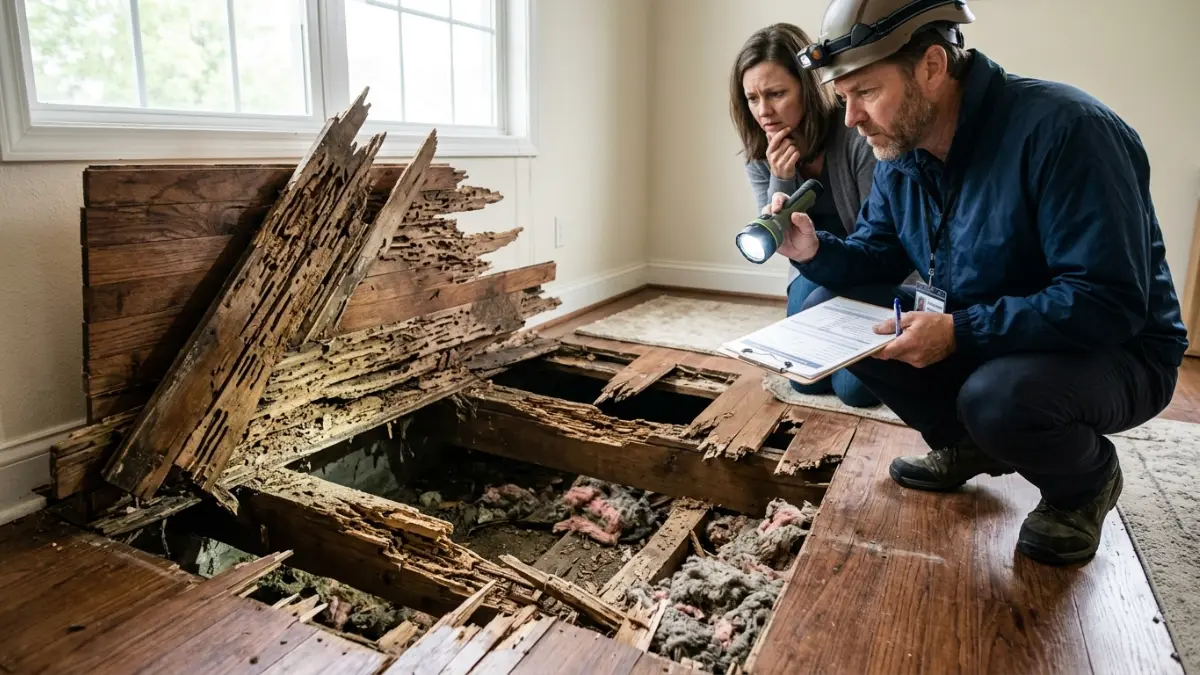
Among the additional coverages sits collapse. It covers direct physical loss involving a building collapsing, where the collapse was caused by one of a short list of things — and hidden insect or vermin damage is on that list.
That is the door. Both of its hinges were fitted in the same revision.
1991 vs 2000: the two conditions that changed everything
| Edition | What it required | Key detail |
|---|---|---|
| HO 00 03 04 91 (1991) | Hidden insect or vermin damage listed as a qualifying cause, with no further condition attached | Collapse itself left undefined, beyond ruling out settling, cracking, shrinking, bulging and expansion |
| HO 00 03 10 00 (2000) | Collapse redefined as an abrupt falling down or caving in that leaves the building unusable for its intended purpose | Added the condition that the insect damage must not have been known to an insured before the collapse |
| HO 00 03 05 11 (2011) | Same substance, restated so the coverage applies only to an abrupt collapse | Carried the 2000 knowledge condition forward unchanged |
📊 Sourced: All three editions read in full from copies hosted by the Maine Bureau of Insurance, July 2026. A 2022 revision of this form also exists — check the edition date printed on your own policy.
The 2000 edition also added three paragraphs stating what is not collapse: a structure in danger of falling, a standing part that has separated from the rest, and a standing part showing cracking, bulging, sagging, bending, leaning, settling, shrinkage or expansion. A sagging termite-eaten floor is described almost exactly by that third paragraph.
Deck, patio, fence — and why that list matters
The provision also carves out a list of structures — awning, fence, patio, deck, pavement, foundation, retaining wall, pier and others — unless their loss directly results from a building collapsing. Deck was added to that list in the 2000 edition; the 1991 list doesn’t contain it.
Decks are among the most termite-exposed structures on a property, which makes that one-word addition worth knowing about when choosing wood for decks and framing. Whether damage plausibly reaches a collapse threshold at all depends on how the two termite types damage a structure.
Compare the 2000 edition of the same form against the 1991 edition and the change is visible in a single paragraph.
Your termite bond pays before your insurance does
If you hold a repair-warranty termite bond, one condition in the policy decides which phone call you make first — and most people make it in the wrong order.

What the policy calls a service agreement
The form contains a condition covering other insurance and service agreements. Where a loss is also covered by a service agreement, the insurance sits in excess over whatever that agreement pays.
The form defines a service agreement broadly: a service plan, property restoration plan, home warranty, or similar service warranty agreement — even one described as insurance. A termite bond carrying a repair obligation reads onto that definition.
Which document to open first

- Expanding file folder in Black with flap and cord closure for organizing and securing 8.5 x 11-inch letter-size document…
- Holds up to 260 sheets; 13 pockets for easy subdividing; each pocket expands to 7/8-inch
- Archival quality, acid free, and PVC free
This clause did not exist in the 1991 edition, whose other-insurance condition dealt only with other insurance. It appears in the 2000 edition, so it is a comparatively recent feature of the standard form.
✅ Do This: Before calling your insurer, read your bond and confirm whether it covers repair or only retreatment. Ask the pest control company in writing what it will pay, and ask your insurer’s licensed representative how the service agreement condition applies to your policy — only those two documents together settle the order.
The trap in switching companies
Changing pest control providers usually restarts the clock, because a new company will exclude damage that existed before its contract began. That gap can leave damage covered by neither the old bond nor the new one.
Working out what you actually hold starts with what a termite bond does and doesn’t guarantee.
The two questions a termite claim can’t answer
- 6-in-1 Pinless Moisture Meter—Choose the correct mode for softwood, hardwood, drywall, plaster, screed, or concrete to q…
- Non-destructive moisture detection up to 19 mm deep—Scan walls, floors, wood, and building materials without drilling or…
- Customizable moisture alerts—set your own thresholds. Real-time measurements show relative moisture values, with LED ind…
Termite claims fail on four grounds, and adjusters reach them in a predictable order:
- The damage isn’t a covered cause of loss under the dwelling coverage
- The loss can’t be shown to have occurred during the policy period
- Where collapse is claimed, the damage was known before the collapse
- Where a service agreement covers the loss, the policy sits in excess
Grounds two and three are the ones almost nobody sees coming.
When did the loss occur?
A sworn proof of loss must state the time and cause of loss, and a separate condition limits the policy to loss occurring during the policy period — typically twelve months.
NC State Extension reports that serious termite damage usually takes roughly three to eight years to develop, and that no accurate method exists for determining the age of recently discovered damage.
📊 Sourced: Three to eight years for serious damage, and no reliable way to date it — NC State Extension on termite damage.
Read those two facts against the policy period condition and the shape of the problem appears. The entomology says the damage spans several policy terms; the form asks you to place it inside one.
Did you already know?
The collapse door requires damage that was hidden from view and not known to an insured beforehand. Whether you knew turns on things like the signs of an active infestation and whether mud tubes indicate active termites.
The paperwork paradox
Here is the part worth sitting with — and this is reasoning drawn from the documents above, not a sourced fact in itself.
The only papers that prove your damage is real are the WDO report, the bond service records, and the seller’s disclosure. Those same papers are the clearest available evidence that an insured knew about the damage — the exact condition the 2000 revision added.
The documents that make your claim credible are the documents that close the one door available to it. Understanding what those reports do and don’t record starts with what a WDO report does and doesn’t capture.
What to do if you’ve already been denied

- Document organiser waterproof bag with zipper lock it to ensure that your contracts, cards, certificates, meeting materi…
- Professional File Folders Bag for Certificates & Document is suitable for offices, business activities and outdoor trave…
- Multilayer Design: Experience efficient document management with the intelligent multilayer design, offering ample space…
A denial letter is a starting point, not a verdict — but the useful moves are narrower than most people expect.

Ask for the denial in writing, with the clause named
Request the specific policy provision the decision rests on, by name and section. A denial citing “the vermin exclusion” is worth questioning, because the standard form addresses insects as a limitation on the dwelling grant rather than under that heading.
Ask which edition of the form your policy uses, and request a full copy including any state amendments.
Where to take it if the explanation doesn’t hold up
Your insurer’s internal appeal process comes first. After that, your state insurance department accepts consumer complaints about claims handling, and its rules — not this article — govern what your insurer owes you by way of explanation.
⚠️ Watch Out: Nobody writing on the internet can tell you whether your denial was correct, including this page. A licensed public adjuster or a coverage attorney in your state can review your actual policy and letter; a general article cannot, and anyone claiming otherwise is guessing with your money.
When to stop and price the repair instead
At some point the hours and fees exceed the repair bill. If the damage is confined and the claim rests on a collapse argument your own inspection report undercuts, pricing the work is usually the better use of the same energy — and how repair scope is actually decided is the more useful question at that stage.
Three things this page won’t tell you
Being clear about what a page refuses to do is part of being useful.
We won’t predict your claim
No article can read your policy, your denial letter, or your state’s amendments. Every coverage question here ends at your own document and your state insurance department, and that limit is real rather than decorative.
We won’t quote a repair price
The largest home-cost sites publish termite repair figures that contradict each other, because they are built from self-reported user data with no verification. Publishing a number we can’t stand behind would make this page feel more useful while making it less so — so there are no dollar figures anywhere on it.
We won’t tell you your policy says this
At least four editions of this standard form exist, insurers may file their own wording, and state amendments override both. Everything above describes what the filed standard form says — your document may differ, and the edition date printed on it is the first thing to check.
If your attention is better spent on the spend you actually control, what termite treatment actually costs is the place to put it.
Termite damage and insurance: common questions
1. Does homeowners insurance ever cover termite damage?
Rarely, and only through the collapse additional coverage. The standard form covers a building collapse caused by hidden insect damage, provided the collapse was abrupt and the damage wasn’t known to an insured beforehand. Ordinary termite damage without a collapse falls outside the dwelling grant. Read your own policy and ask your state insurance department about your specific coverage.
2. What is the termite exclusion called in a policy?
There isn’t one by that name in the standard form. Birds, rodents and insects appear as a limitation inside the Perils Insured Against section, not in Section I Exclusions. If a denial letter cites a “vermin exclusion,” ask which provision and section it means, and request a copy of your policy’s full form.
3. Can I claim if termites caused my floor to collapse?
A sagging or separated floor generally isn’t collapse under the current form, which requires an abrupt falling down or caving in leaving the building unusable. The form expressly states that standing parts showing sagging, bending or settling are not in a state of collapse. Only a licensed professional reviewing your policy can assess your situation.
4. Does insurance cover a fire started by termite-damaged wiring?
Possibly. The limitation covering insects is followed by language restoring coverage for ensuing loss not precluded elsewhere in the policy, and fire is a covered peril. The termite damage itself would still sit outside coverage. Report it promptly and ask your insurer’s licensed representative how the ensuing loss provision applies.
5. Does my termite bond or my insurance pay first?
The bond, if it covers the loss. The standard form places the insurance in excess over amounts payable under a service agreement, defined to include service plans, home warranties and similar warranty agreements. A repair-warranty termite bond reads onto that definition. Read both documents and ask both companies in writing before filing anything.
6. How long do I have to file after finding termite damage?
Notice is due promptly, and the form limits legal action to two years from the date of loss in the 2000 and 2011 editions — the 1991 edition allowed one year. State law can override either figure. Because termite damage can’t be reliably dated, the date of loss itself is often disputed. Check your edition and your state’s rules.
7. Can I buy termite coverage as an add-on?
We could not verify one. Every source claiming such coverage exists was a comparison or marketing site, and no filed endorsement providing termite damage coverage was located during research for this article. That doesn’t prove none exists anywhere. Ask your own insurer’s licensed representative directly rather than relying on any third-party listing.
8. What do I do if my termite claim was denied?
Request the denial in writing naming the specific provision and section, plus a full copy of your policy form and any state amendments. Use your insurer’s appeal process first, then your state insurance department. A licensed public adjuster or coverage attorney can review your actual documents — no article, including this one, can do that.
Where to put your attention tonight
Find the edition date printed on your own policy — it’s usually on the form itself, in the corner of each page. Then find two things: the collapse additional coverage, and the conditions section covering your duties after a loss.
Reading those two passages tells you more about your position than any summary of them, including this one.
The harder truth is that the money in a termite problem sits almost entirely in prevention and repair, not in claims. That is the unglamorous answer, and it is also where your effort actually pays.