
The Right Way to Read the Signs of Termites You Just Found

Signs of termites are easy to misread. Termite-damaged wood is hollowed along the grain with soil in the galleries — moisture damage isn’t.
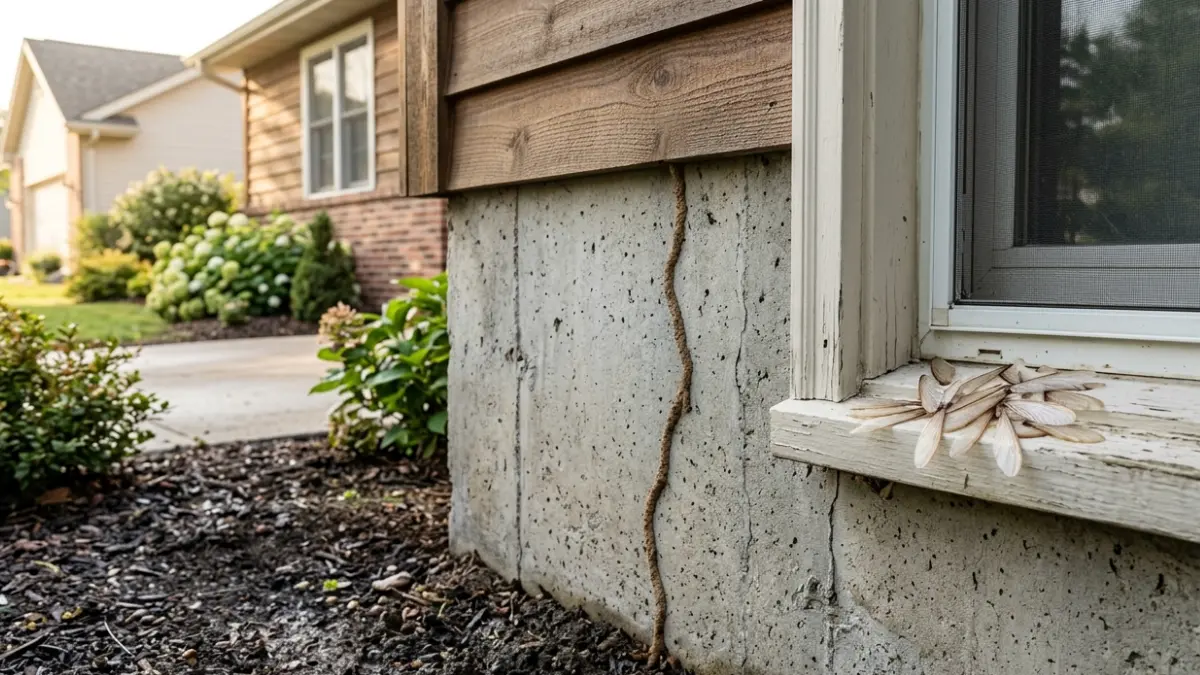
Table of Contents
You found something — a line of dried mud up the foundation, a pile of identical wings on a windowsill, or gritty specks under a door frame that keep coming back after you sweep.
Start with what you’re looking at:
- Winged insects indoors — the three signs you can spot without tools.
- Pellets, grit, or something like sawdust — the four signs hiding in the wood and walls.
- Not sure it’s a termite at all — the five false alarms.
- Fairly sure it is — what to do next, and what not to do.
- You rent — treat nothing, open nothing. Photograph it, note the date, tell your landlord in writing today.
Two halves to this page: seven signs of termites that hold up against what the EPA, the USDA and the university extension services actually say, and five that don’t — including two that nearly every page on this topic states with total confidence.
ℹ️ Safety Note: Termite work sits where pesticides, structural damage and a fear-driven sales process meet. Everything below is for identification only — it is not a treatment instruction and does not replace an inspection. The EPA is explicit that termiticide application in most cases requires a trained professional, so confirmed or suspected termites means calling a pest control company licensed by your state.
Subterranean vs drywood: why the signs are different
Which termite you have decides which evidence exists at all.
Subterranean termites: mud is the signature
Subterranean termites nest in soil and tunnel up to reach wood. To cross what they can’t eat — concrete, block, brick — they build shelter tubes from soil and saliva, so everything they leave behind has mud in it.
Drywood termites: pellets are the signature
Drywood termites live inside the wood they eat and need no soil contact, so they build no mud tubes, ever. What they leave is dry fecal pellets, pushed out through holes barely wider than a pinhead.
Mud means subterranean. Pellets mean drywood. You will almost never see both.
📊 Sourced: Termites are found in every U.S. state except Alaska and are most common in the Southern states. Most damage comes from native subterranean species, though the invasive Formosan subterranean termite does heavy damage in some regions. — USDA Forest Service, Subterranean Termites: Their Prevention and Control in Buildings
3 signs you can spot without any tools

- [ ULTRA LONG RANGE – 3280 FT & ADJUSTABLE FOCUS ] The Esgreen ED2405B rechargeable flashlights high lumens is made of im…
- [ SINGLE 2 MODES HIGH/LOW – BRIGHTNESS ADJUSTABLE ] The Esgreen LED flashlight rechargeable USB C is single modes, only …
- [ MULTIFUNCTIONAL 2-IN-1 USB C CHARGING & DISCHARGING ] The super bright LED flashlight long range is built-in 2 USB int…
The three strongest signs of termites need no tools: winged termites indoors, piles of shed wings, and pencil-width mud tubes climbing a foundation.
Winged termites indoors
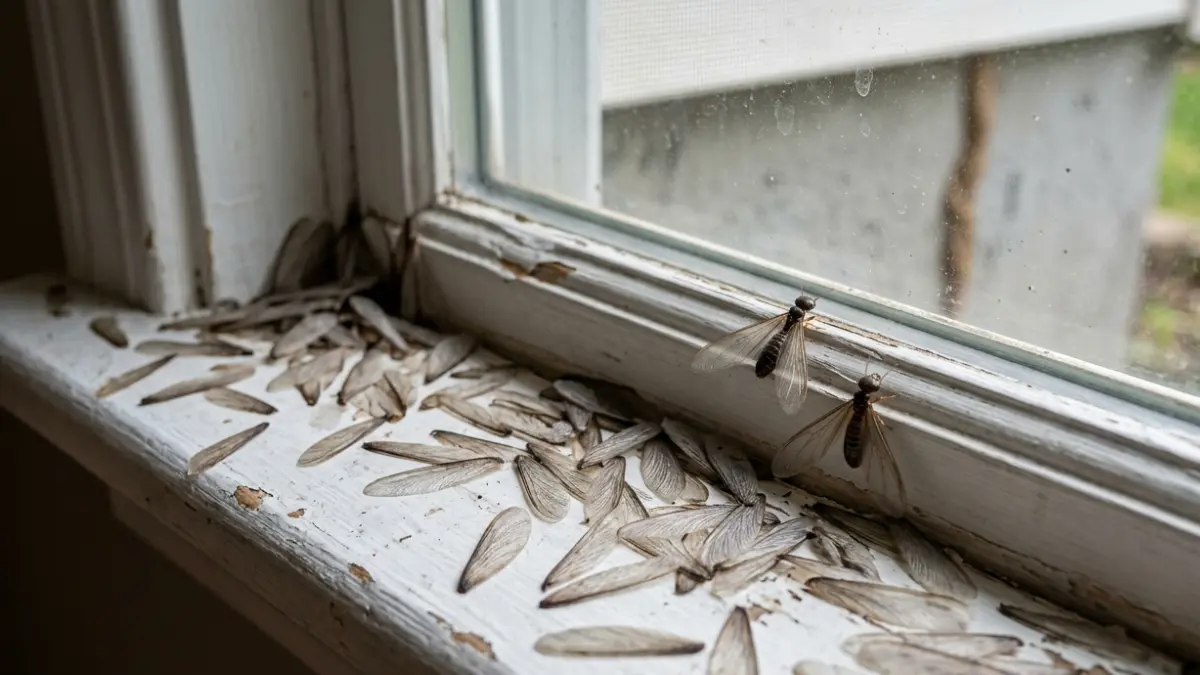
Finding winged termites inside almost always means an infestation warranting treatment, per the University of Kentucky’s termite guide for homeowners. Swarmers are drawn to light, so they turn up at windows, doors and lamps.
They can’t eat wood and live about a day. A broom handles them; an aerosol only destroys evidence.
Piles of shed wings
Termites drop all four wings at once after a swarm. Look for piles of identical, equal-length wings on windowsills, in spider webs and under light fixtures — often the only trace of a swarm nobody saw.
Pencil-width mud tubes
Mud tubes run about the diameter of a pencil over foundation walls, piers, sill plates and floor joists, sometimes thicker.
Timing depends on where you live. Native subterranean termites swarm in spring, in daylight, after warmth and rain. Formosan subterranean termites fly at dusk, cluster at lights, and swarm April through June, peaking in early-to-mid May, according to LSU AgCenter.
4 more signs hiding in the wood and walls

- STRENGTH AND DURABILITY: Made of heat-treated alloy steel
- COMFORT OPTIMIZED HANDLE: For high and low torque application
- Satin-nickel finish
The other four take a closer look and one tool you already own — a flathead screwdriver.
Six-sided pellets under a pinhead-sized hole
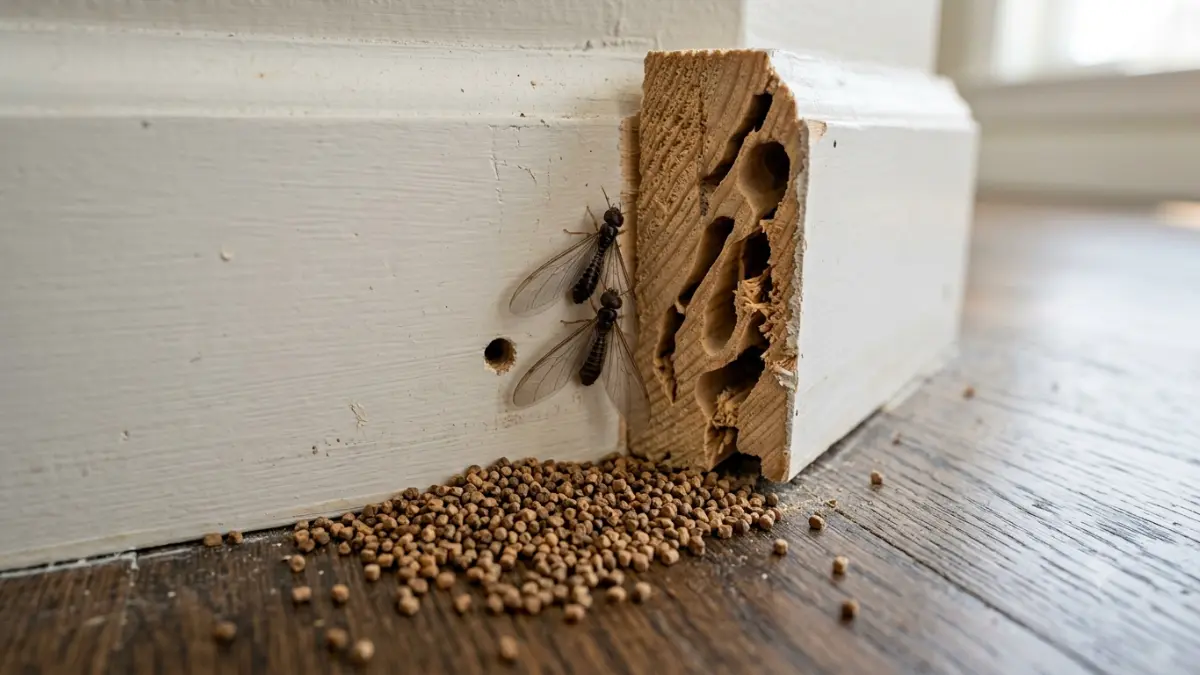
Termite droppings are hard, dry pellets about a millimetre long, gritty, uniform in size, and coloured by the wood being eaten. Under magnification each has six distinct sides, which UC IPM’s drywood termite pest notes call diagnostic for drywood termites, and they collect beneath kick-out holes smaller than 2 mm. Dampwood pellets, by contrast, are football-shaped and rounded at both ends.
Wood hollowed along the grain, with soil in the galleries
This is the most useful sentence in termite identification: termite-damaged wood is hollowed out along the grain, with bits of dried mud or soil lining the feeding galleries. Wood damaged by moisture or by carpenter ants does not look like this. The EPA’s homeowner guidance on termites says to probe exposed wood for hollow spots with a screwdriver.
Rippled or sunken traces under paint and wallpaper
Termites sometimes bore tiny holes through drywall, leaving specks of soil at the margin, and rippled or sunken traces behind a wall covering can mean tunnelling underneath. They also feed inside exposed wood while the outer surface stays intact — which is why wood that sounds hollow matters more than wood that looks fine.
Live workers
Worker termites are soft, creamy-white and have no pinched waist. Finding them in a broken tube or in damaged wood settles it.
⚠️ Watch Out: Probe only exposed wood you can reach standing up. Don’t crawl into a crawl space or attic you aren’t equipped for, don’t chase this off a ladder, and don’t cut or pry into a joist, beam or stud — you can turn a treatable infestation into a structural repair. If the evidence is under the house, that’s an inspector’s job.
5 things people mistake for termites

- HUMIDITY SENSOR: Our handy meter tool can quickly determine what level of remediation is needed to keep your family safe…
- WATER LEAK DETECTOR: Finding the moisture content in your wood or drywall is the first step in early prevention. Continu…
- MOISTURE READER: The mold test features large 0.3″ high digits in a backlit LCD for quick and easy detecting. Our mildew…
Plenty of termite quotes start with something that isn’t a termite.
1. Flying ants
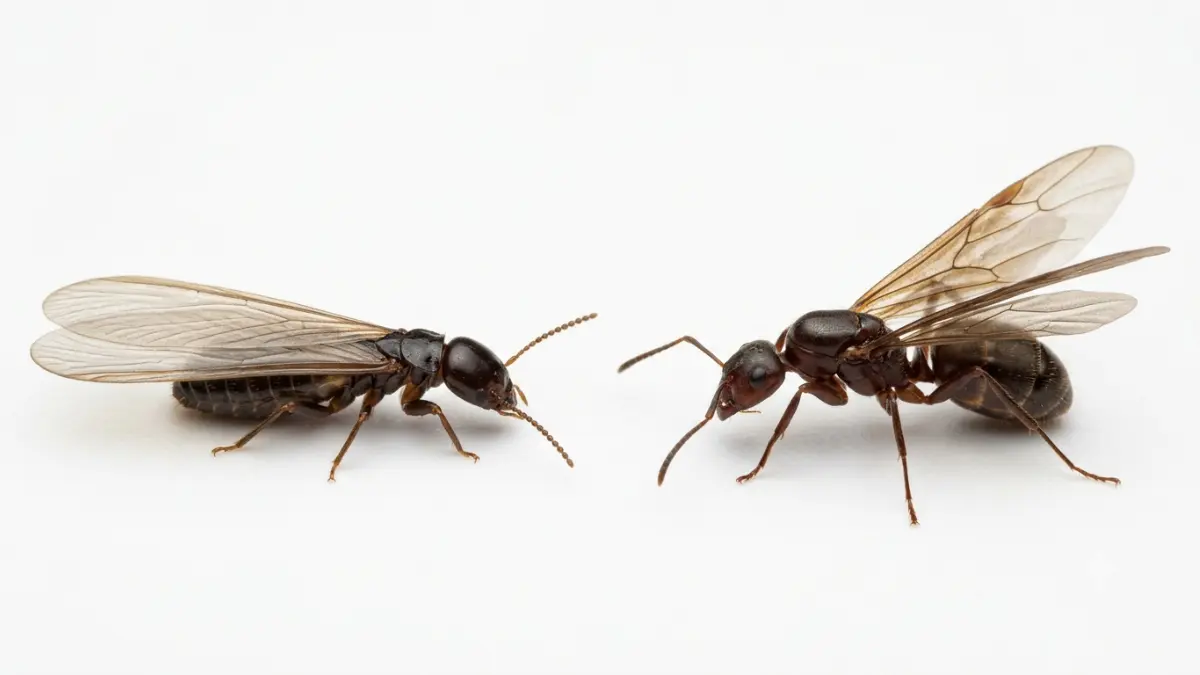
| Check this | Termite swarmer | Flying ant |
|---|---|---|
| Antennae | Straight, bead-like | Elbowed, obvious bend |
| Waist | Broad, uniform | Pinched, like a wasp |
| Wings | Four, equal length | Front pair longer |
Sourced from University of Maryland Extension and University of Kentucky Entomology.
Check the waist first — fastest of the three, hardest to get wrong.
2. Sawdust piles
Termites don’t make sawdust; they eat the wood. Coarse shavings mixed with insect parts mean carpenter ants; a fine, flour-like powder falling from tiny round holes means powderpost beetles.
3. Water damage and wood decay
Buckled flooring, blistered paint, soft dark wood and a musty smell are as consistent with a leak as with an infestation — and moisture-damaged wood won’t show that along-the-grain hollowing with soil in the galleries.
If the wood is soft, dark and smells earthy, you may have mold and rot in wood framing rather than insects, or a crawl space moisture problem under the house.
4. Swarmers out in the yard
Termites swarming from a stump, woodpile or mulch bed don’t automatically mean your house is infested — only that they’re in the neighbourhood. Swarmers emerging next to the foundation, or from an abutting porch or patio, are a different matter: there’s a good chance the house is infested too.
5. Clicking in the walls and sticking doors
Soldier termites do bang their heads against tunnel walls to signal alarm. What no extension service or federal agency does is tell homeowners to use that sound as proof — UC IPM notes acoustic detection devices are infrequently used even by professionals, and that visual inspection remains the mainstay.
Sticking doors and windows have ordinary causes, like humidity or a settling frame, and prove nothing alone. If a salesperson leads with either as evidence you need treatment, ask what else they found.
Active infestation or old damage? 3 ways to tell
Evidence of termites is not the same as an active infestation, and the difference decides whether you spend money. Three checks, all from university extension services:
- The mud tube test. Break out a roughly one-inch section. Over the next few days, watch for repairs and check the break for small creamy-white workers. Either result means active.
- The pellet test. Sweep up every pellet, tape a dated note nearby, and return in a few days. Fresh pellets mean active feeding.
- The pinhole test. Termites plug any accidental opening with mud, because they avoid open air. Scrape a mud spot away, mark it, and watch whether it gets re-plugged.
Now the caveats, which is the part nobody publishes. An empty mud tube does not prove the infestation is over — termites routinely abandon sections while feeding elsewhere. Pellets alone can’t establish activity either, since they shake loose from old or treated galleries when a building vibrates.
Dried mud in the galleries with no live termites may simply be old damage from an infestation controlled years ago, as Mississippi State Extension’s photo guide to termite signs shows.
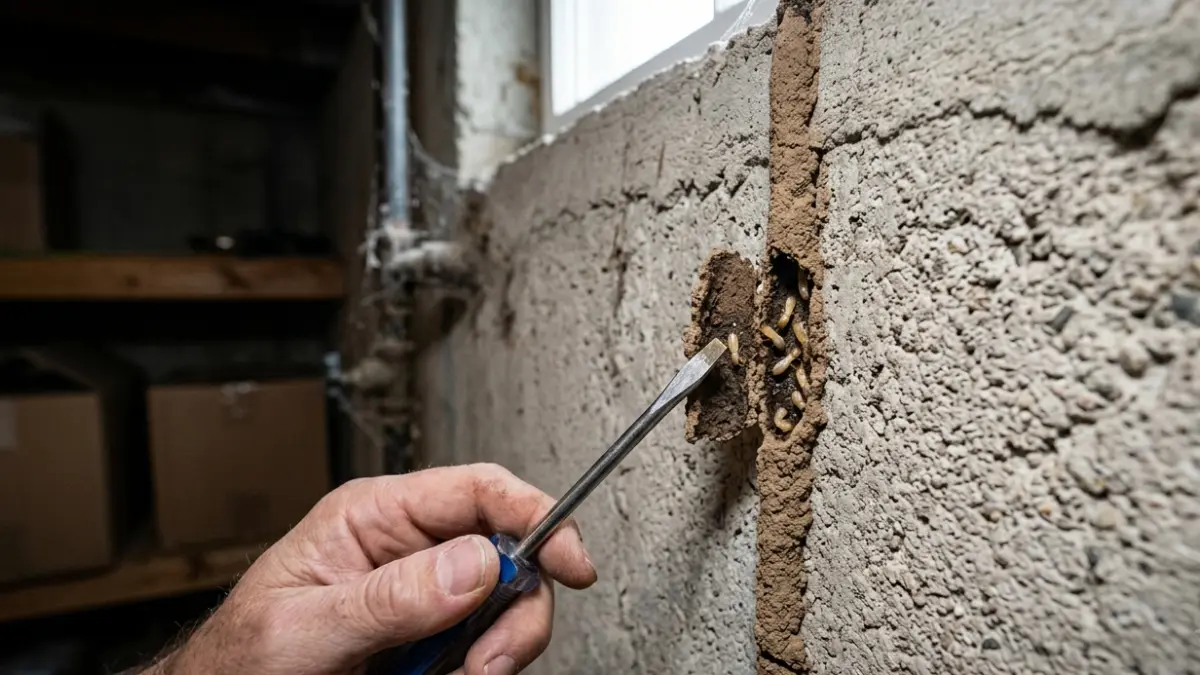
What each sign actually proves
| What you found | What it proves | What it doesn’t | What settles it |
|---|---|---|---|
| Mud tube on foundation | Termites reached the structure | That they’re still there | Break a section; recheck in days |
| Winged termites or shed wings indoors | An infestation warranting treatment | Where the colony is | Professional inspection |
| Six-sided pellets | Drywood termites fed there | That they’re feeding now | Sweep clean, date it, recheck |
| Hollow wood, soil in galleries | Damage occurred | That it’s current | Look for live workers, fresh mud |
| Clicking in the walls | Nothing you can act on | Anything at all | Not a homeowner test |
Compiled by Gladewick from the EPA, USDA Forest Service, UC IPM, University of Kentucky Entomology and Mississippi State Extension. No hands-on inspection was performed for this article.
Breaking tubes controls nothing — the colony is still in the soil. These checks make you a better-informed customer; they don’t make you your own inspector.
What to do next — and what not to do

- Two termite products IN one: pop-up indicators detect termite activity, and the stakes kill foraging termites
- Installs IN minutes: place stakes in the ground 2 to 3 feet away from your home and no more than 10 feet apart
- Pop-up indicator: check the stakes for termite activity when the pop-up indicator is seen
If a test came back positive, the next week matters more than the next hour.
Don’t spray it, seal it, or tear it open
Killing swarmers protects nothing, and an aerosol scatters the evidence an inspector needs. Knocking down mud tubes doesn’t control the colony either, and sealing a kick-out hole destroys the best locator anyone has.
Skip the retail products. The EPA states termiticide application in most cases requires a trained professional, and the University of Kentucky is blunt that DIY termite products seldom eradicate an existing infestation.
With some pests that call is close — our DIY versus professional breakdown for bed bugs shows where the line falls. With subterranean termites, it isn’t.
Do this instead
Photograph the evidence where it sits, bag a specimen — your county extension office will identify it free — and hire a company licensed by your state’s Department of Agriculture. The same vetting that applies to any pest control company applies here, and estimates from more than one firm help confirm an infestation exists at all.
✅ Do This: Before signing, ask each company: (1) your licence number and issuing agency; (2) does this estimate follow an actual inspection or a phone call; (3) liquid barrier or bait, and why for my house; (4) what does the warranty cover, what voids it, what does retreatment cost; (5) is the quote per linear foot, and how many feet did you measure?
The $5 billion number, and why you have time
📊 Sourced: The “$5 billion a year” figure repeated across this topic is attributed to the pest control industry’s trade association, not to any government source. The EPA says only that termites cause billions in structural damage annually and that property owners spend over $2 billion treating them. The USDA Forest Service is blunter: the exact figure is difficult to establish, common estimates run near $1 billion, and some reach $7 billion.
Termites are a real and expensive problem, but they eat slowly. The University of Kentucky says it plainly: the damage caused by taking an extra day, week or month to decide is generally inconsequential, and firms that pressure you into signing immediately with specials or scare tactics should be avoided.
One last thing. Standard homeowners policies exclude insect and vermin damage as gradual and preventable rather than a sudden peril, and a termite bond is a service contract, not insurance — the same line insurers draw around mold remediation coverage. Read your own policy’s exclusions.
Once activity is confirmed, what termite treatment actually costs lays out the options and the real numbers.
Signs of termites: quick answers
1. What is the first sign of termites in a house?
Usually a swarm — the EPA notes most people don’t realise they have termites until they see winged swarmers or uncover damage during construction. Indoors, winged termites almost always indicate an infestation warranting treatment, because they are drawn to light and emerge near windows and doors. Piles of identical shed wings on windowsills are the next most common first clue.
2. What do termite droppings look like?
Drywood termite droppings are hard, dry pellets roughly a millimetre long, gritty between the fingers and uniform in size. Under magnification each pellet has six distinct sides, which is diagnostic for drywood termites, and they pile up beneath kick-out holes under 2 mm across. Subterranean termites leave no loose pellets at all.
3. How do I tell termite swarmers from flying ants?
Three checks settle it. Termites have straight, bead-like antennae, a broad uniform waist, and four wings of equal length. Flying ants have an obvious elbow in the antennae, a pinched wasp-like waist, and a front wing pair clearly longer than the back pair. Check the waist first — it is the fastest of the three and the hardest to get wrong.
4. Do termites leave sawdust?
No — termites eat the wood rather than pushing it out, so sawdust points to a different pest entirely. Coarse shavings mixed with insect parts mean carpenter ants, while a fine, flour-like powder falling from tiny round holes means powderpost beetles. Termite frass is uniform six-sided pellets, and only drywood and dampwood species leave visible piles of it.
5. How do I know if a mud tube is active?
Break out a roughly one-inch section, then check over the following days for repairs, or look at the break itself for small creamy-white workers. Either result means an active infestation. An empty tube proves nothing on its own, because termites often abandon sections of tube while feeding elsewhere in the same structure.
6. Is old termite damage still a problem?
It can be. Dried mud in the feeding galleries with no live termites may be old damage from an infestation controlled years ago, but only an inspection can confirm that, and weakened wood does not repair itself. Have a licensed inspector confirm the activity status and a contractor assess the structure.
7. What time of year do termites swarm?
Spring, mostly, though it varies by species and region. Native subterranean termites swarm in daylight, triggered by warm weather and rain. Formosan subterranean termites swarm from around April through June, peaking in early-to-mid May, and fly at dusk on warm, humid, windless evenings, clustering around outdoor lights where thousands can appear at once.
8. Can you actually hear termites in your walls?
Soldier termites do bang their heads against tunnel walls to signal alarm, so the behaviour itself is real and documented. But no extension service or federal agency tells homeowners to use the sound as proof, and UC IPM notes that acoustic devices are rarely used even by professionals. Look for physical evidence instead.
9. Can I get rid of termites myself?
No. The EPA states that termiticide application in most cases can only be properly performed by a trained professional, and the University of Kentucky notes that retail DIY termite products seldom eradicate an existing infestation. Hire a pest control company licensed by your state, and get more than one estimate.
10. Does homeowners insurance cover termite damage?
Almost never. Standard homeowners policies exclude insect and vermin damage, treating it as gradual and preventable rather than a sudden peril, which is not what property insurance is designed to cover. A termite bond is a pest control service contract, not insurance. Read the exclusions in your own policy and ask your insurer directly before assuming anything.
The honest bottom line
Mud tubes, winged termites indoors, piles of shed wings, six-sided pellets, and wood hollowed along the grain with soil in the galleries — that is your evidence. Clicking walls and sticking doors are not.
Confirm the activity before you spend a dollar. Then get three quotes, not one, from firms licensed in your state, and walk away from anyone who tells you to sign today. The treatment options and real costs are laid out separately, without the pitch.
Related Articles
 Termite Treatment
Sentricon vs Termidor and How to Choose Without the Sales Spin
July 21, 2026 Termite Treatment
How to Identify Termite Frass and Drywood Droppings
July 15, 2026 Termite Treatment
Termite treatment cost gaps come down to one hidden number
July 26, 2026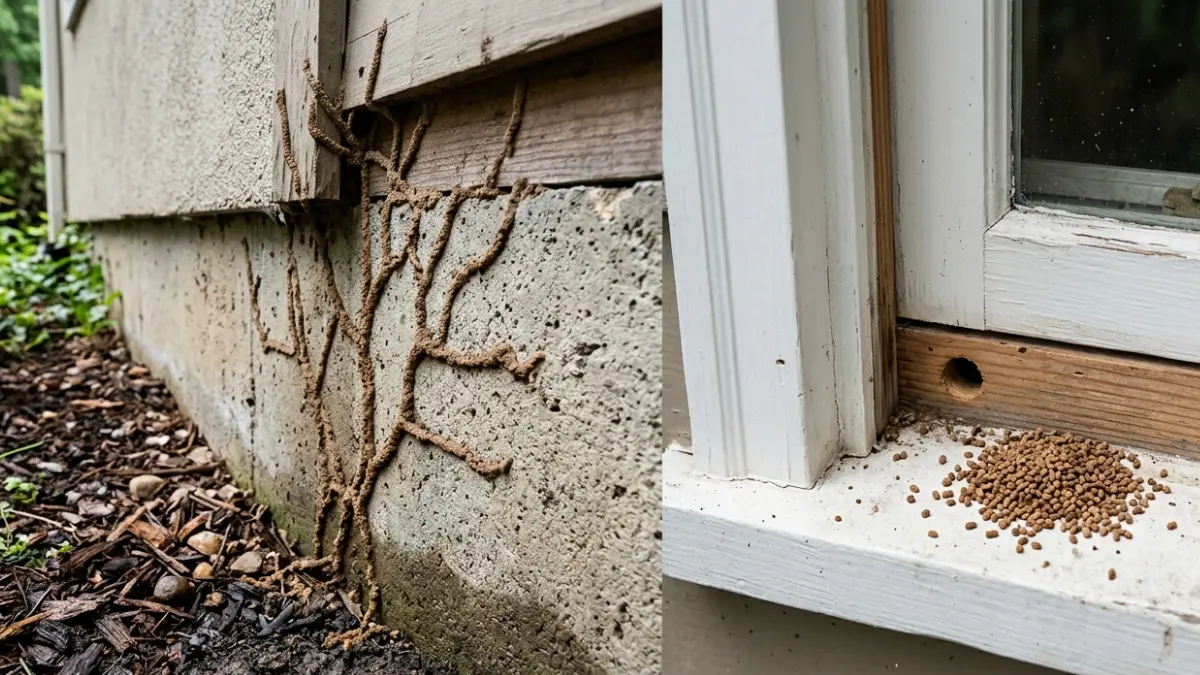 Termite Treatment
Subterranean vs Drywood Termites and the Real Cost to Fix Each
July 18, 2026 Termite Treatment
Buying a house with termite damage hinges on one overlooked line
July 30, 2026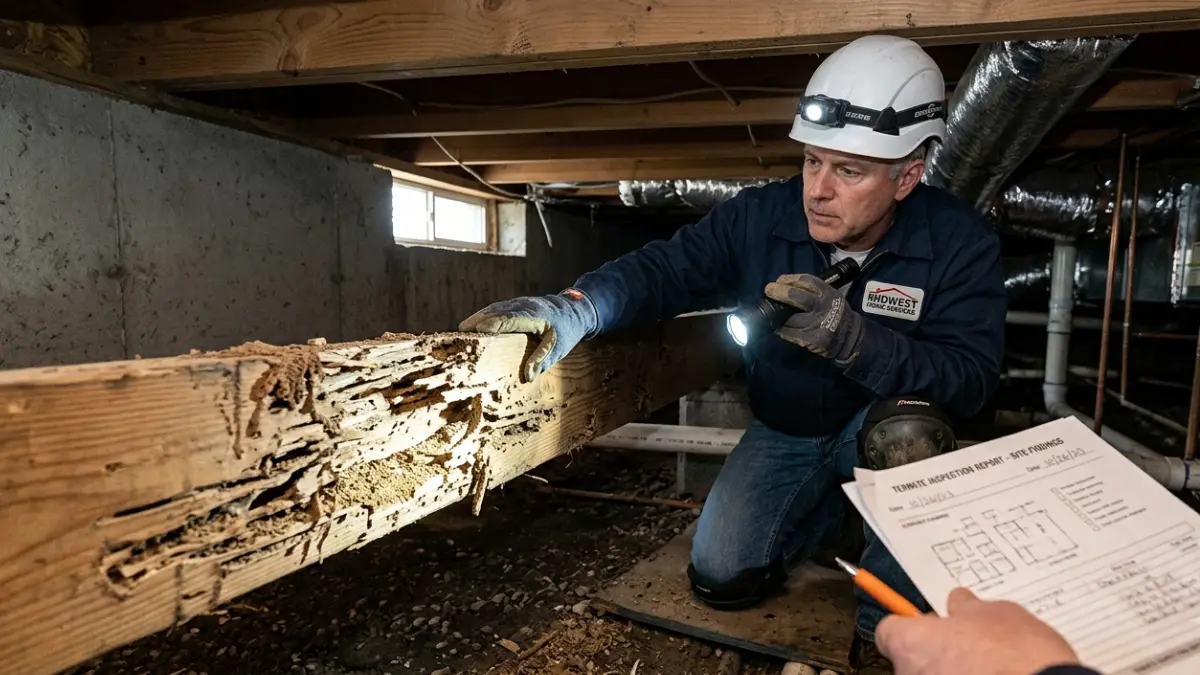 Termite Treatment
Termite damage repair cost rests on one costly missing step
July 27, 2026 Termite Treatment
The real test with termites in rental property is who caused it
August 5, 2026 Termite Treatment
How Termite Bait vs Liquid Treatment Compares
July 20, 2026 Termite Treatment