The common termite prevention list is really three lists

Termite prevention has a ceiling, and the inspection form used in federally backed home sales states it: any structure can be attacked.
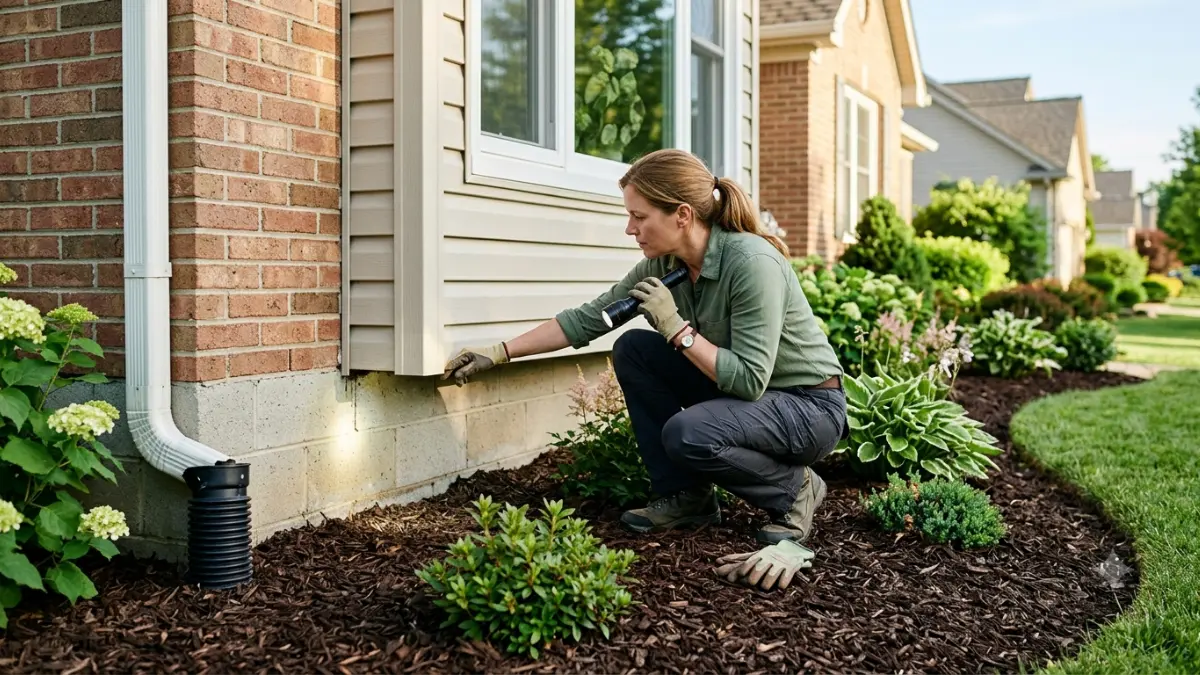
Table of Contents
Termite prevention is a moisture check and a sight-line check, walked in one pass around the outside of your house. It is not a treatment, and it will not make a house termite-proof.
Twenty minutes is what this route takes to walk, counted from the number of stops on it rather than from a stopwatch. Nobody here has timed a lap of your house.
ℹ️ Safety Note: Sections 4 through 7 touch soil at the foundation, drainage work, crawl spaces, and chemically treated ground. Moving soil near a treated perimeter can affect an existing termite treatment, and crawl spaces carry their own access and air-quality hazards. The information here is for general understanding. Hire a licensed pest management professional, a licensed contractor, or your local building department for the work itself, and follow local code.
What a walk-around can and can’t do
No, you cannot completely prevent termites — and the clearest statement of that comes from inside the pest control industry rather than from outside it.
“Any structure can be attacked” — what the documents actually claim
The consumer advisory on the second page of the inspection report used in federally backed home sales opens its prevention guidance by stating that any structure can be attacked by wood-destroying insects. It then frames corrective measures as something that reduces the chances of infestation and the need for treatment.
It tells homeowners to eliminate conducive conditions while conceding in the same breath that doing so lowers a probability rather than closing a door. What the walk buys is fewer conditions, fewer blind spots, and an earlier warning.
Your yard already has termites in it, and that’s not the question
The University of California’s termite pest note points out that a home with a 2,400-square-foot footprint could sit above several colonies with hundreds of thousands of foragers between them. UF/IFAS Extension makes the same point from the other direction: it is possible to build a house on top of a colony.
The same page adds something reassuring: finding swarming termites in your yard does not necessarily mean your house has them, because most soil around a home already holds buried cellulose — roots, old stumps, forgotten fence posts.
This is also why the prevention product aisle disappoints. The EPA states that products which only claim to kill termites have not demonstrated the ability to protect a structure, and are intended only to kill the termites that directly contact the pesticide; UC IPM adds that in California, no reliable over-the-counter termite control products are available to the public. Treatment options and their real prices sit in our breakdown of the five termite treatments; the consumer aisle is covered in what termite products can and can’t do.
Three prevention lists, and where they disagree
Every termite prevention list you have read is a synthesis of three underlying documents, and those three do not say the same thing.
The six items all three name
They are the EPA’s consumer guidance on termites, UF/IFAS Extension’s termite prevention guide, and the consumer advisory on the NPMA-33 report. Six conducive conditions appear on all three:
| Condition | EPA consumer page | UF/IFAS Extension | NPMA-33 advisory |
|---|---|---|---|
| Earth-to-wood contact | Yes (construction section) | Yes | Yes |
| Faulty grade and drainage | Yes | Yes | Yes |
| Moisture and leaks | Yes | Yes | Yes |
| Firewood and wood debris | Yes | Yes | Yes |
| Tree branches touching the structure | Yes | Yes | Yes |
| Blocked or insufficient ventilation | Yes | Yes | Yes |
| Sealing foundation cracks and utility gaps | Yes | — | — |
| A measured inspection space | — | Yes (6 inches) | — |
| Set-back distances for plants and containers | — | Yes (2 feet) | — |
| Landscape timbers | — | Yes | Yes |
| Foam insulation at the foundation | — | Yes | Yes |
| Mulch or ground cover against the wall | — | Yes | Yes |
| Wood decay | — | Yes | Yes |
Sourced from the three documents named above, each read in full on August 1, 2026. Not tested.
The items only one document names
The single-source rows are where the useful detail lives. Only the EPA tells you to seal cracks in the foundation and around the points where utilities pass through the wall. Only UF/IFAS gives you a number to aim at.
- 💪 1350N HIGH THRUST FOR HEAVY-DUTY APPLICATIONS Delivers up to 1350N thrust force for smooth and consistent dispensing o…
- 🔄 DUAL MODE: DRIPLESS & STANDARD CONTROL Easily switch between dripless mode for clean, controlled application and stand…
- 🔁 360° ROTATING BARREL FOR PRECISION WORK Front holder rotates 360 degrees, allowing effortless application at different…
And the NPMA-33 advisory is the only one of the three attached to a document that gets filed about a specific house — which is why its list of conditions carries consequences the other two do not.
One row deserves its own page. Mulch type turns out to be a far weaker lever than mulch placement, and the evidence on gravel as a substitute is not what the internet says: see what the studies found about mulch, gravel, and termites.
The outside route: water first, then wood

- HUMIDITY SENSOR: Our handy meter tool can quickly determine what level of remediation is needed to keep your family safe…
- WATER LEAK DETECTOR: Finding the moisture content in your wood or drywall is the first step in early prevention. Continu…
- MOISTURE READER: The mold test features large 0.3″ high digits in a backlit LCD for quick and easy detecting. Our mildew…

- HPPE, Polyester, Spandex, Metal wire
- Imported
- ULTRA-THIN & PROTECTION – When you slide your hand into these cut resistant gloves, you will be struck by their lightwei…
Walk it in two laps, water before wood, because almost every wood item on the list only matters once it is wet. The water lap tells you which wood to worry about.
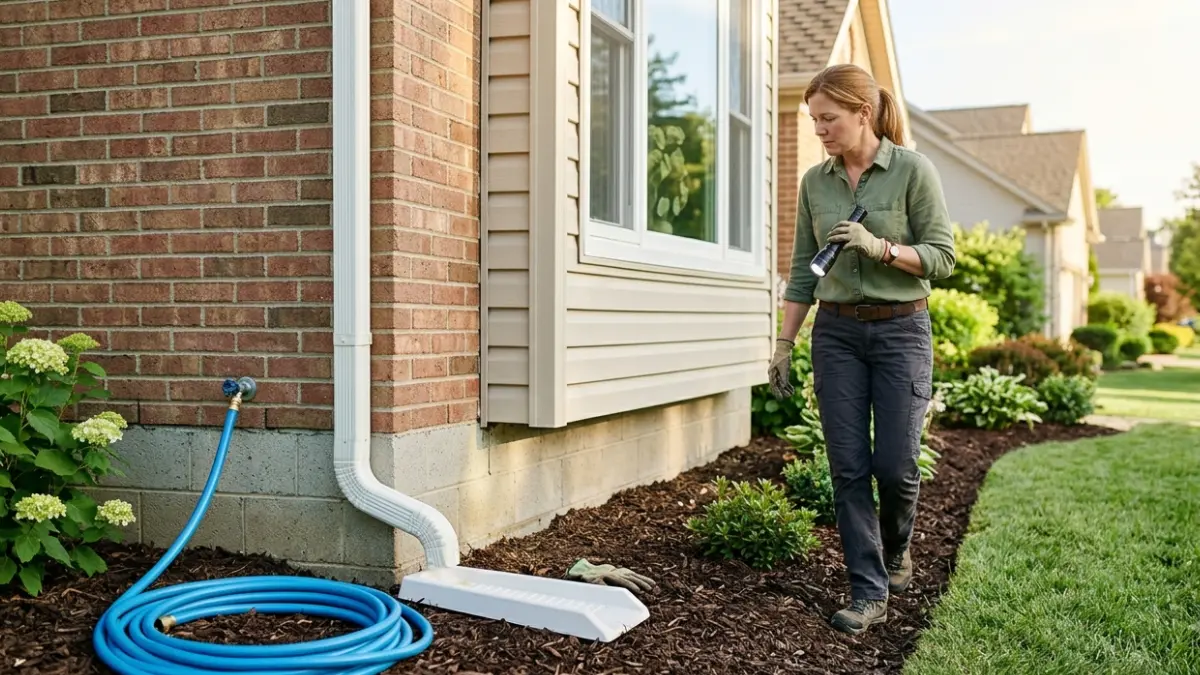
Lap one: follow the water
- Start at a downspout. Check where it discharges and which way the splash block points — UK Extension notes that a splash block facing the wrong way is a common find.
- Follow the wall to the next corner, watching the final grade. The ground should fall away from the building, not toward it.
- Check the air conditioning condensate line and any irrigation heads. UF/IFAS advises directing both away from the walls, since irrigation that waters a wall creates a conducive condition.
- Note anything at ground level that holds water. UF/IFAS puts rain barrels, compost bins, and similar containers at least 2 feet from the foundation.
- Look for leaks at hose bibs, pipes, and outdoor AC units.
Lap two: follow the wood
Walk the same circuit looking only at cellulose. Firewood, lumber, cardboard, and newspapers stacked against a foundation are the classic find, and UK Extension gives the reason that matters: against the wall they offer hidden entry and may let termites bypass surrounding soil that has been treated.
Every ranking page tells you to keep firewood a set distance away — five feet, twenty feet, thirty feet. None of the extension or regulator sources gives a distance at all. The EPA says not next to the house, UK Extension says not against foundations, UF/IFAS says away from any structure you want to protect. The footages in circulation are not theirs.
Then the items people walk past: stumps and dead roots, wooden landscape timbers used as edging, and any concrete form boards left in place after the house was built. Two more from the University of Kentucky’s protection guidance run against the common assumption — pressure-treated wood is still vulnerable, because termites enter through cracks and cut ends or tunnel over the surface, and posts or stairs embedded in concrete are vulnerable too, since they usually extend all the way through the concrete to the soil. Which grades and species actually resist attack is covered in termite-resistant wood for decks, framing, and fences.
⚠️ Watch Out: If your home has ever had a liquid termite treatment, the soil around the foundation is part of that treatment. UF/IFAS warns that when treated soil is disturbed — by excavation, by digging from pets or wildlife, or by a washing rain — those areas may need treating again. Before you regrade, dig, or move soil at the wall, find out whether the perimeter was treated and when; what a perimeter treatment involves shows the scale of what a retreatment means.
The sight line you’re really maintaining
The gap between the ground and the bottom of your siding is not a barrier. It is an inspection space, and understanding that changes what you do with it.
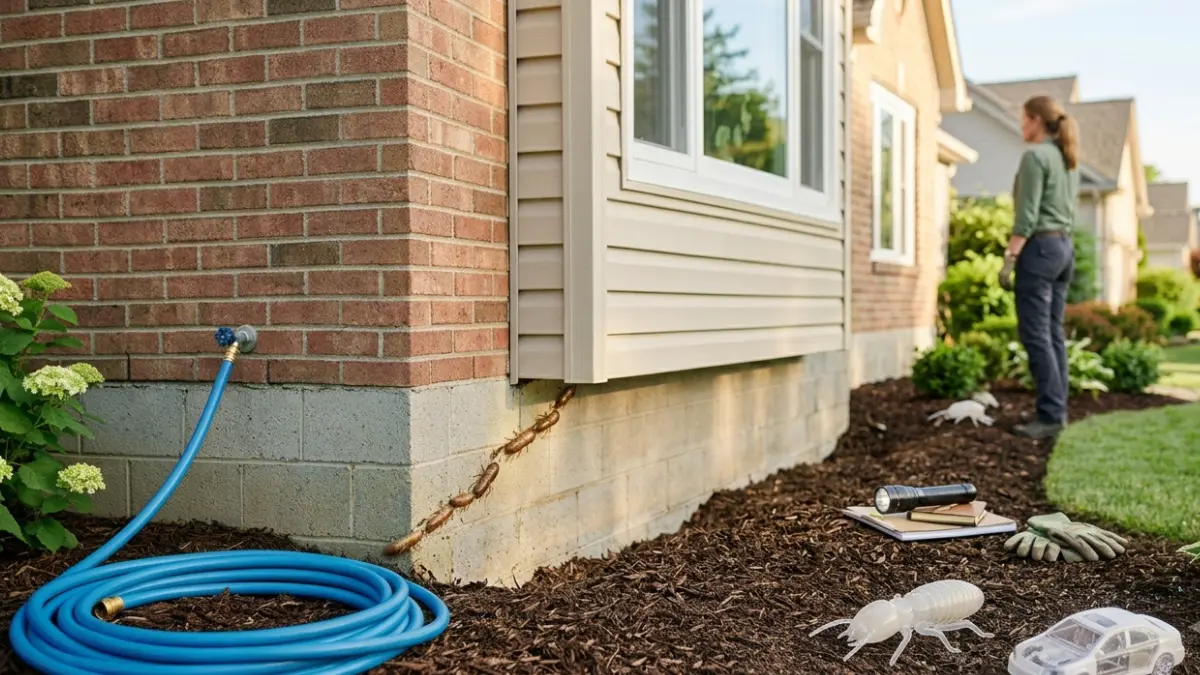
Why six inches stops nothing, and what it does instead
🔍 Why It Works: Six inches of bare foundation stops nothing — a subterranean termite can build a shelter tube straight up it. What the gap does is force that tube into the open where a person can see it. UF/IFAS states the purpose directly: inspection spaces allow termite tubes to be detected. Bury the gap under soil or mulch and the tube still gets built, just out of sight.
UF/IFAS advises keeping at least 6 inches between the soil or mulch line and the bottom of wall sidings, and notes that building codes in many states require an inspection space of at least that at the time of construction. UK Extension gives the same figure for siding and door and window frames in its Kentucky guidance, and is specific about what restoring it can involve: pulling soil or mulch back, cutting the bottom off wood latticework, or setting steps and posts on a concrete base.
Two numbers govern how you keep it clear. UK Extension says mulch should go on sparingly — a couple of inches is usually adequate — and never touch siding or the framing of doors and windows. UF/IFAS puts landscape plants at least 2 feet from exterior walls, allowing for future growth, and notes that improper placement may void a termite warranty.
The number changes with what’s under the wall
Do not carry six inches to every part of the house. UC IPM’s California guidance puts substructural wood beneath a building at least 12 inches above the soil, and the same page tells readers outright to consult local building codes for exact minimum distances from wood to soil.
Our clearance guide explains why crawl spaces need 18 inches, and that figure holds. It answers a different question from the 6 inches at your siding, which is the visible inspection space, and from UC IPM’s 12 inches, which is substructural wood in one state’s guidance.
One detail worth noting while you are down there: UC IPM warns that stucco siding running all the way to the ground can let termites travel between the stucco and the foundation unseen.
Vents, the crawl space door, and the garage

- Package Includes: the purchase comes with 2 pieces of inspection mirrors, you can use for a long time, and can meet your…
- Metal and Glass Materials: this mechanics mirror is carefully built from metal and glass materials, designed for durabil…
- Adjustable Handle Size for Comfort: the handle of the telescoping mirror can be stretched from about 9.8 inches/ 25 cm t…
The last stops need no equipment and, in one case, need you to stay outside.
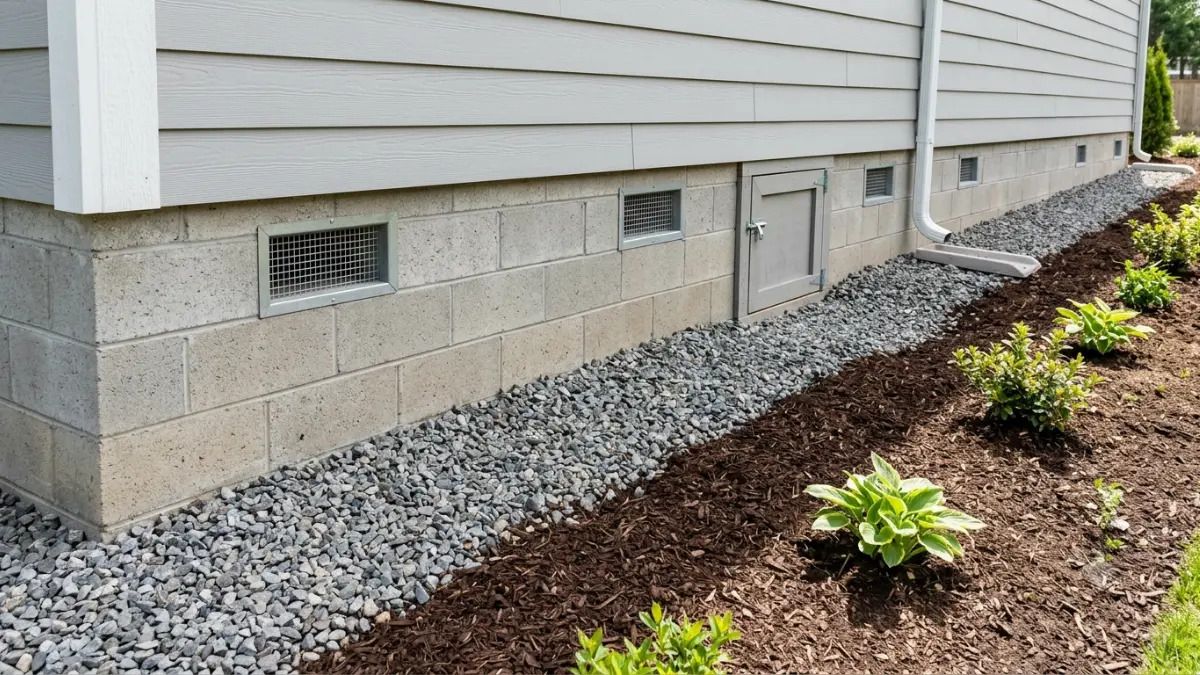
What you can check without going in
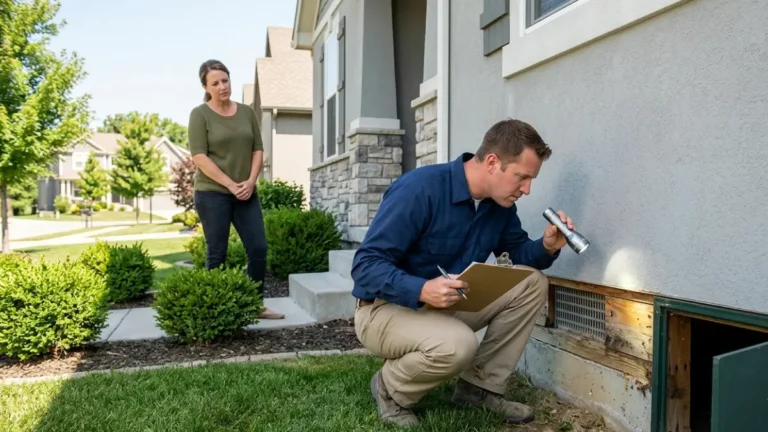
Crawl space vents are a moisture control, not a termite barrier, and the check is whether they are doing their job. Both the EPA and UK Extension say to keep vents clear of blockage including plants; UK Extension adds leaves, dirt, and debris.
📊 Sourced: UK Extension states that most building codes call for one square foot of vent opening per 150 square feet of crawlspace area, that this can often drop to one square foot per 300 to 500 square feet where a vapor barrier is installed, and that one vent should sit within three feet of each exterior corner. The corner rule is the one you can check from the driveway in under a minute. These are UK Extension’s figures and its characterization of building codes, not a code citation — confirm the requirement for your area with your building department. Sourced, not tested.
Check the vents and the access door from outside, then stop. What is inside — standing water, a failed vapor barrier, wood debris, condensation on joists — is a professional’s assessment, and the order to fix it in is set out in what to fix in a wet crawl space, and in what sequence.
While you are looking up rather than down, UF/IFAS advises keeping soffits in good repair and screening vents, which helps keep swarmers out of attics.
The indoor lap nobody puts on a prevention list
The one stop where you might genuinely find something live is indoors. UF/IFAS’s best-practice list says to move items out of the garage and other storage areas periodically and look for mud tubes — and no consumer prevention list we found includes it.
Timing helps. UF/IFAS states that swarmers appear in spring and possibly fall; UC IPM adds that in California, Reticulitermes swarm in the afternoon in spring or fall on clear days after a soaking rain, while Heterotermes aureus flies in July, August, and September. A spring walk before swarm season is better placed than a midwinter one — and if winged insects have already turned up indoors, start with what swarmers inside the house mean.
What to do with what you found
Most of what you will find is a condition rather than an insect. The two are handled differently.
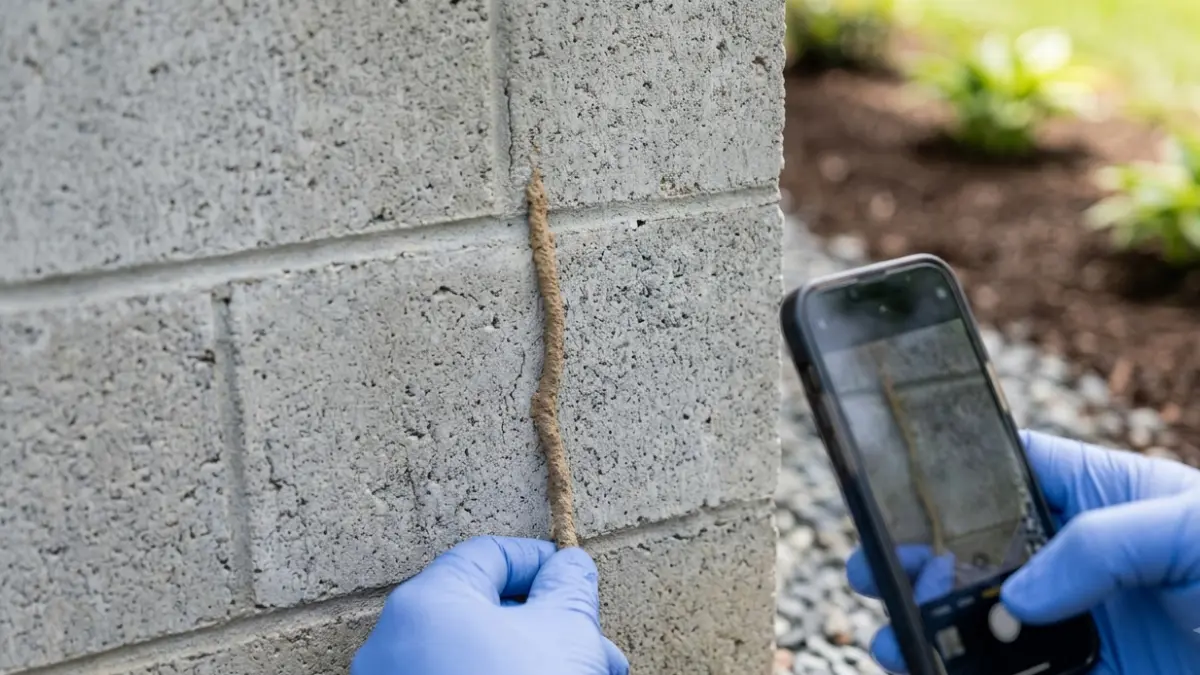
Photograph it, don’t poke it
If you find a shelter tube, photograph it and leave it alone. The inspection report records visible evidence — shelter tubes among it — and a tube you have broken apart is evidence an inspector can no longer assess.
UC IPM does advise destroying shelter tubes to interrupt access, and that is not wrong; it sits in the page’s control section, as a step inside a treatment program run by a licensed professional. The two documents answer different questions, and before an inspection the homeowner-facing answer is to photograph and step back. Reading a mud tube before you touch it covers what one can and cannot tell you.
Three institutions, three different answers
There is no national answer to how often a house should be checked, and the three sources behind this article genuinely disagree:
- UK Extension (Kentucky, revised March 2026): the measures above help make a structure less attractive, but the best way to prevent infestation is to protect it with a termiticide, and preventive treatment is a prudent investment where there is no prior treatment history.
- UC IPM (California, page updated 2014): regular inspections every 3 to 5 years help detect infestations before they become damaging, with more frequent checks where there is a history of problems.
- UF/IFAS Extension (Florida, updated November 2024): consider an annual renewal inspection by someone trained to recognize termite evidence.
Termite pressure and state practice both vary enormously between Kentucky, California, and Florida, which is most of why the advice diverges. Where you live and what your house’s history is decide which answer is closest to your situation.
✅ Do This: Before acting on anything from the route, find out whether your perimeter has ever been treated, when, and what your service agreement says about conducive conditions. Those answers change both what you may safely disturb and what your coverage depends on. The clauses that decide whether a repair claim pays and what a free inspection is and isn’t cover the paperwork side.
Termite prevention questions people actually ask
1. Can you completely prevent termites?
No. The consumer advisory on the NPMA-33 inspection report states that any structure can be attacked by wood-destroying insects, and frames corrective measures as reducing the chances of infestation and the need for treatment. Termite prevention lowers risk and shortens the list of places a problem could develop unseen. It does not make a house immune.
2. How far should firewood be from the house?
Far enough that it is not against the structure — but no extension service or regulator we checked publishes a distance. The EPA says do not pile firewood next to the house, UK Extension says never against foundations or inside crawlspaces, and UF/IFAS says stack it away from any structure you want to protect. The footages circulating online are not theirs.
3. Does pressure-treated wood stop termites?
No, and it is one of the most common misunderstandings in termite prevention. UK Extension states that pressure-treated wood remains vulnerable, because termites enter through cracks and cut ends or build tunnels over the surface. Treated wood in ground contact still needs the same clearance and inspection attention as any other wood on the building.
4. How much space should there be between soil and siding?
UF/IFAS advises at least 6 inches between the soil or mulch line and the bottom of wall sidings, and notes that codes in many states require an inspection space of at least that at construction. UC IPM’s California guidance puts substructural wood at 12 inches and tells readers to check local codes for exact minimums, so confirm the figure with your building department.
5. Can landscaping void a termite warranty?
It can. UF/IFAS states that improper plant placement creates conditions attractive to termites and may void a termite warranty, and that moisture is a conducive condition that can void some warranties. Those hedges are the source’s own. Read your service agreement and ask the company what it treats as a conducive condition before you plant.
6. Should I break open a mud tube to check if it’s active?
Not before an inspection. The inspection report records shelter tubes as visible evidence, and a tube you have opened is evidence an inspector can no longer assess properly. UC IPM does recommend destroying tubes, but as a control step within a professional treatment program. Photograph it, leave it, and call a licensed pest management professional.
7. Do crawl space vents stop termites?
No — vents manage moisture, and moisture is what makes a crawl space hospitable. UK Extension describes ventilation ratios and says one vent should sit within three feet of each exterior corner, and both it and the EPA say to keep vents clear of leaves, debris, and vegetation. Check yours from outside and route anything inside to a qualified professional.
8. When is the best time of year to walk the route?
Before swarm season. UF/IFAS states that swarmers appear in spring and possibly fall, and UC IPM reports that Reticulitermes swarm in spring or fall on clear days after a soaking rain in California, with other species flying in mid to late summer. A spring walk puts your sight lines in order ahead of the period when evidence is most likely to appear.
Twenty minutes, honestly accounted for
The walk did not make your house termite-proof, and nothing you can do in an afternoon will. What it did was remove conditions all three governing documents agree on, and shorten the list of places where a problem could develop unseen.
Put a date in the calendar for the next one, ideally ahead of spring. If anything on the route could not be resolved from where you were standing — soil at a treated perimeter, anything past the crawl space door, a tube on a foundation wall — hand it to a licensed pest management professional or your state’s structural pest control agency rather than to a shovel.