Does mulch attract termites, and what most advice overlooks

Does mulch attract termites, or is the gravel swap worse? The clearance that matters is measured from the top of the mulch, not the wall.
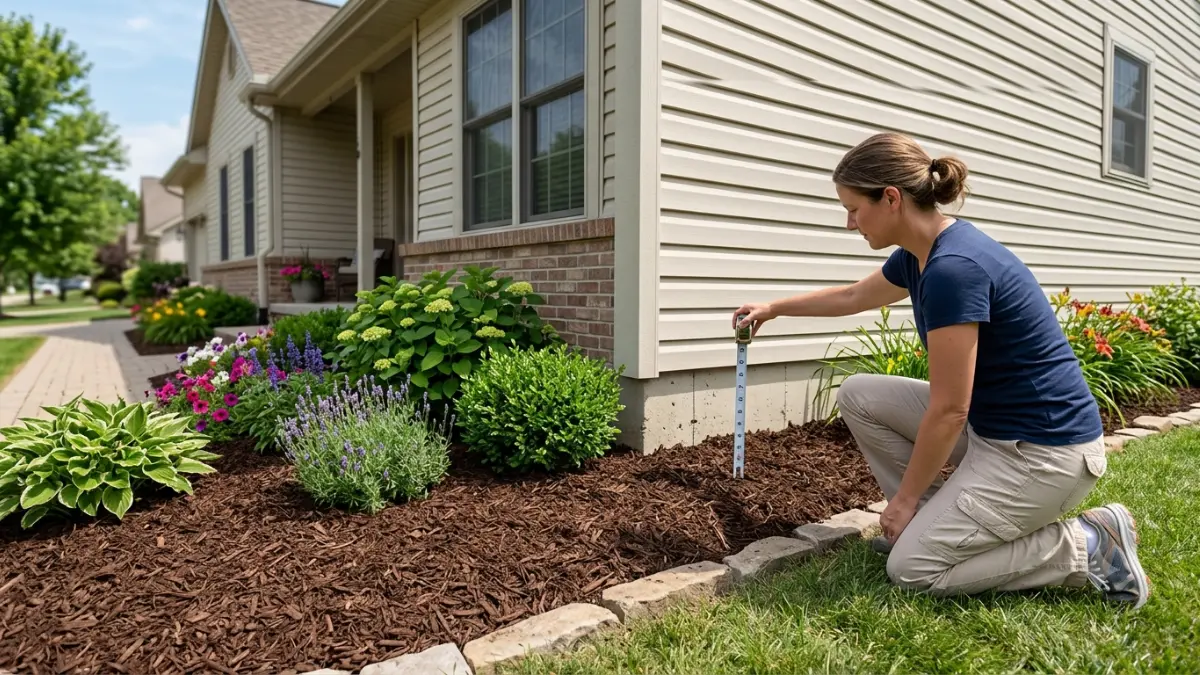
Table of Contents
Mulch does not summon termites to your house. Two university extension services say so outright, and the field research behind that answer says something more useful than the reassurance itself.
Where you are right now decides which part matters.
- About to spread mulch? Depth and setback are the whole decision — skip to the six-inch section.
- Mulch already against the siding? You have a measurement to take, not a bed to tear out.
- Buying or selling? Landscaping shows up twice on a wood-destroying insect report.
Below: what the studies measured, where the advice on page one came from, and the two consequences nobody connects to a bag of bark — the inspection gap your house was built with, and the treated soil somebody already paid for.
ℹ️ Safety Note: This article describes building code provisions, warranty conditions, and inspection documents as written. It does not interpret your contract, your house, or the code in force where you live, and contains no treatment instructions. If you find termite activity, or plan to disturb soil at the foundation of a treated house, contact a licensed pest control operator and your local building department first.
What the research says about mulch and termites
Mulch does not attract termites to a house. It changes conditions at the soil surface, and subterranean termites already foraging nearby are more likely to stay where conditions suit them. Iowa State University Extension answers both versions of the question — does mulch attract termites, and does mulch cause them — with a flat no.
Those termites are already in the soil, excavating random pencil-sized tunnels and foraging as far as 300 feet from the nest, with moisture favoring exploration and feeding. The University of Maryland field study most often cited here reached the same place from the data side, reporting no indication that landscape mulches increase the rate of initial scouting.
Why termites turn up in mulch anyway
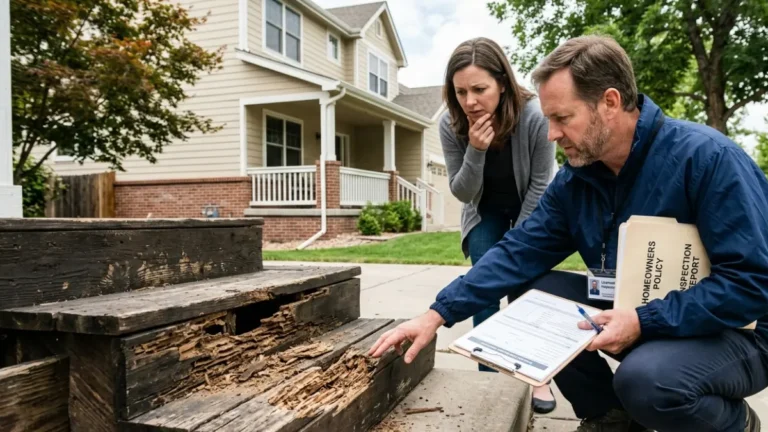
Termites are found in wood chip mulch routinely, along with lumber scraps, firewood, and pallets sitting on soil. Finding them there is not evidence the mulch drew them in.
🔍 Why It Works: Termites need moisture and cover, and any groundcover moderates the surface beneath it. That makes a mulched bed a comfortable place to keep working — not a signal that travels across your yard.
Can termites arrive in a bag of mulch?
Not realistically. UF/IFAS Extension states the greater risk comes from termites already established on the property rather than stragglers in a bag: survival through chipping is poor, and drops further once an insect is separated from its colony.
The real transport risk is bigger material — UF/IFAS points to infested railroad ties and salvaged timbers from razed structures as the route associated with spreading the Formosan subterranean termite.
Mulch is also poor food, though the picture depends on how long you watch. In a three-week Florida trial, termites fed on mulches averaged 62% survival against 8% for termites given nothing. Over nine weeks in Maryland, mulch-fed termites survived no better than termites denied food entirely, which led those researchers to call the mulches nutritionally inadequate rather than toxic.
The gravel problem nobody mentions
The standard advice is to swap wood mulch for pea gravel near the foundation. The one field study that tested that assumption found the opposite of what the advice assumes.
The Maryland researchers ran five sites in Prince George’s County across the 1998 and 1999 seasons, comparing shredded hardwood bark, miniature pine bark nuggets, shredded eucalyptus bark, pea gravel, and bare earth. Cardboard monitors went into the mulch layer and into the soil beneath it.
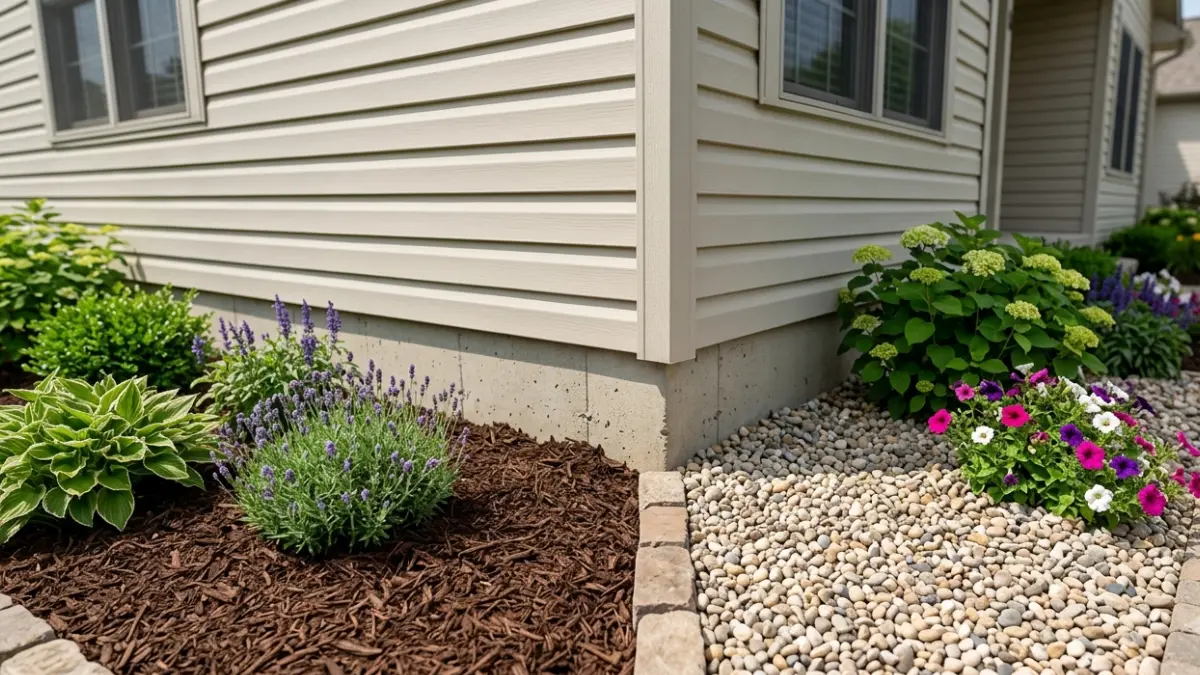
📊 Sourced Result: Groundcover type had no significant effect on how often termites discovered the monitors — bare soil included. What differed was sustained feeding underground, highest beneath the pea gravel (P = 0.0052). All groundcovers cooled the soil surface, but temperature and moisture 12 cm down were no different from bare soil.
What the field study actually measured
Read those two results together, because most coverage reports only one. Termites found every groundcover about equally often, then fed longest under the gravel.
That is a duration result, not an attraction result. Gravel does not pull termites toward a house, and nothing in the study suggests it does. The authors’ own recommendation was to avoid beds of pea gravel directly against a foundation, and to spread a single layer rather than a deep one where material has to sit close for appearance.
Where the “use gravel” advice comes from
Largely from horticulture and drainage thinking, and from sources whose job is not termite management.
| Source | What goes against the foundation | Evidence behind it |
|---|---|---|
| Maryland field study, 2001 | No deep gravel bed; a single layer at most | Measured termite feeding under five groundcovers |
| UF/IFAS, termites and mulch, rev. 2023 | Thin layer under 2 inches; inspection space kept clear | Entomology guidance citing that field study |
| UF/IFAS Florida-Friendly landscapes, 2022 | Gravel around the perimeter, not wood mulch | Plant health and sustainability guidance |
| Iowa State Extension, 2001 | Mulch several inches back, never touching siding | Declines to endorse any mulch type over another |
| Typical pest control blog | Gravel, or wood mulch 6–12 inches out | Usually unsourced |
Sourced from the publications named; no product testing was performed for this table.
The last two UF/IFAS rows come from one university, and the Florida-Friendly guide cites the termite publication while recommending the groundcover that publication flags. Both are doing their own job — one is written about termites, the other about plant health and water. It is a clean illustration of why the source of a rule matters as much as the rule.
Does the type of mulch actually matter?
Less than the marketing suggests. The best-known test is a 1999 University of Florida study in the Journal of Arboriculture by Duryea, Huffman, English, and Osbrink, which ran two no-choice feeding experiments across six landscape mulch types and five wood samples. No-choice means the termites had nothing else — it measures what they eat when cornered, not what they seek.
What termites ate, and what they refused
Termites consumed pine and cypress sapwood readily, and left cypress heartwood and melaleuca almost untouched, eating under 3% of those samples. Survival tracked that split in the second experiment: 64% and 77% survived on pine and cypress sapwood against fewer than 15% on melaleuca and cypress heartwood. The deterrent chemistry in cypress heartwood kills by starvation rather than by poisoning.
Across the six mulches, differences were smaller and mattered less. Melaleuca was least preferred in both experiments and utility pruning mulch most eaten in the first — but survival was statistically the same on every mulch tested. Consumption tracked nitrogen and phosphorus content (r = 0.91 and 0.96), so what termites respond to is nutrition, not species mystique.
Cypress, cedar, and rubber: what the labels don’t tell you
The cypress claim is the one to retire. That resistance belongs to heartwood, and the same study states today’s cypress mulch is harvested from young trees with little or no heartwood — in their second experiment termites ate as much cypress mulch as cypress sapwood.
It is the grade problem that also governs decking and framing lumber: durability sits in the heartwood, and the label rarely says what you are getting.
UF/IFAS does advise against cypress and rubber mulch in its Florida-Friendly guidance, but not for termite reasons — cypress on wetland harvesting grounds, rubber because of leachate and washing into waterways. Iowa State says plainly that the research does not endorse one mulch type as preferable to another.
The six inches that decide everything
Please enter product(-s) ASIN(-s)!Florida’s residential building code requires a clearance of not less than 6 inches between exterior wall coverings and final earth grade, and states why: to allow inspection for termite infestation. Its masonry veneer exception spells out what that clear inspection space is measured against — the top of any soil, sod, mulch or other organic landscaping component, deck, apron, porch, or walk.
That detail changes how to think about a bag of mulch. The clearance is measured from the top of whatever you put down.
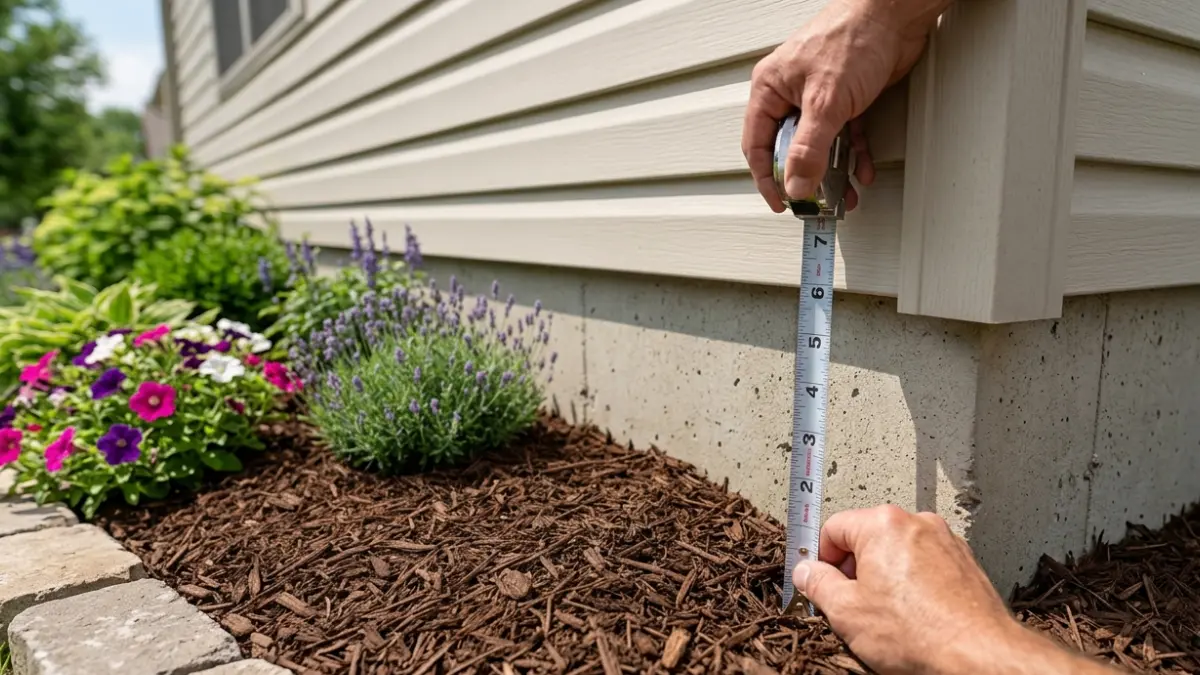
What to measure, and what to measure from
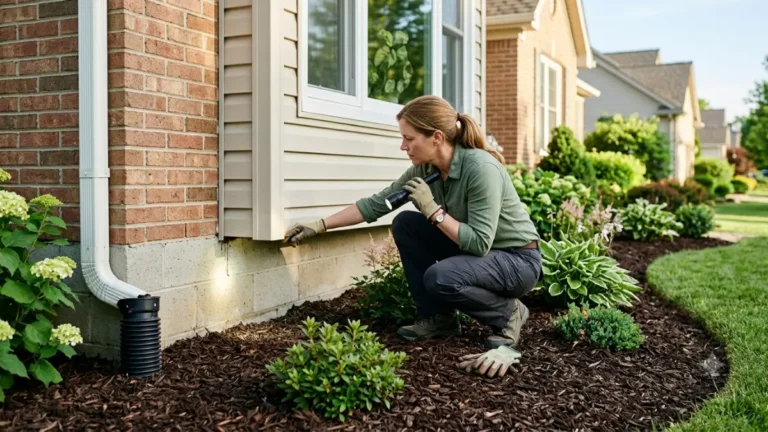
Hold a tape measure vertically from the surface of the mulch to the bottom edge of the siding. That reading, not the horizontal distance to the wall, is what the provision is about.

- Never Forget a Measurement: REEKON’s digital tape measures take the guesswork out of measuring and can save more than 10…
- Upgrade Over Conventional Tape Measures: Operate with one hand and view measurements on a LCD display, clearly visible f…
- Eliminate Mental Math: Switch between quick menu options for any measurement in just two clicks. The built-in marking sq…
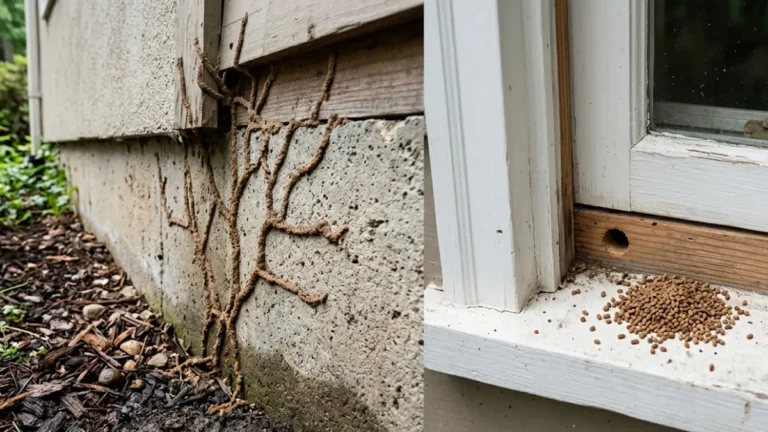
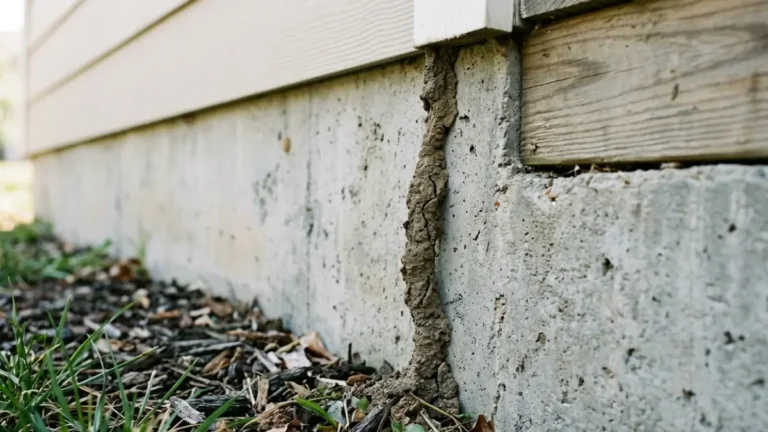
⚠️ Watch Out: A house built with a 6-inch clearance and then given 3 inches of mulch has 3 inches left. Topping up each spring without raking the old layer back is the common way that gap disappears — and it is the same gap in which mud tubes on the foundation would be visible.
How deep is too deep
UF/IFAS recommends a thin layer, under 2 inches, within 12 inches of the foundation so the soil beneath dries naturally — desiccation, as they put it, is the termite’s worst enemy — and keeping roughly a 6-inch inspection space clear. Mulch thicker than 4 to 6 inches, they note, can obscure that space and help termites already present survive by holding moisture and moderating temperature.
Out in the beds, 2 to 3 inches is the general UF/IFAS depth for established landscapes. Iowa State adds the two placement rules worth memorizing: keep mulch several inches back from the foundation, and never let it cover windowsills or touch siding.
✅ Do This: Take the vertical reading before buying more mulch. Florida’s figure is Florida’s — ask your local building department which code edition applies where you live and what clearance it requires. If you find mud tubes in the cleared strip, call a licensed pest control operator before doing anything else.
Mulch, treated soil, and your termite warranty
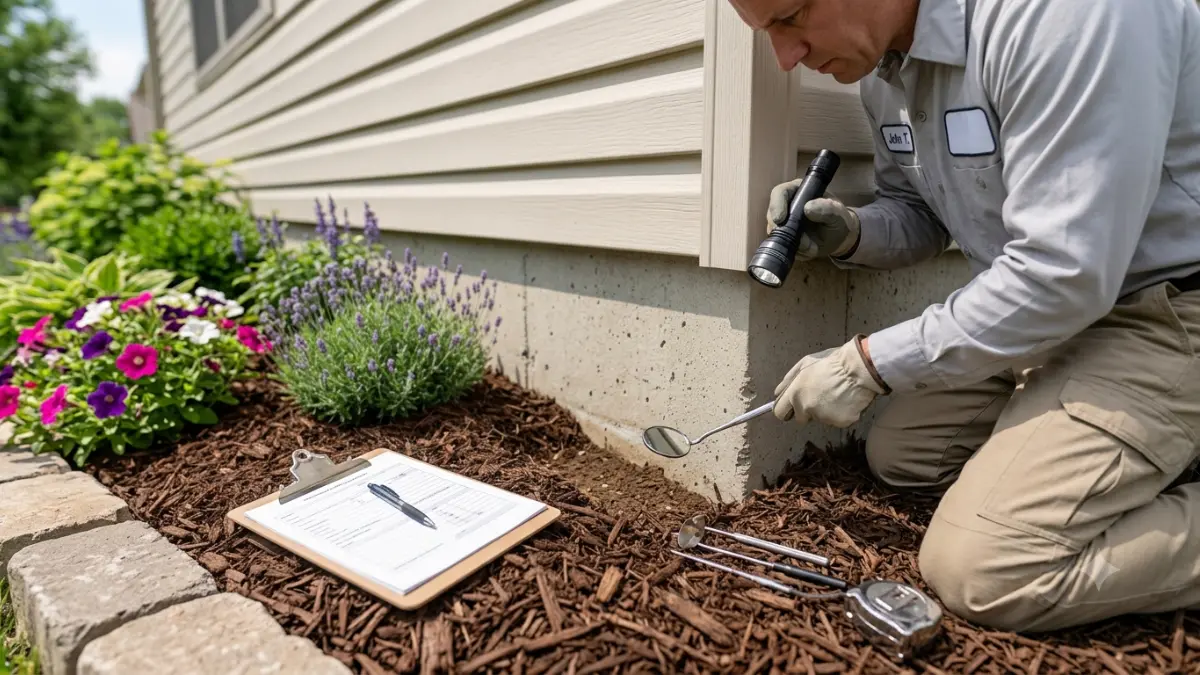
If your house was treated with a liquid soil termiticide, there is something in the ground around the foundation that landscaping can interfere with. Florida’s code is explicit about the sequence and the consequence.

- 【BRIGHT FLASHLIGHT】Flashlights high lumens equipped with an LCD real-time battery level display, which provides a clear …
- 【USB RECHARGEABLE FLASHLIGHT】Tactical flashlight built-in fast charging chip, twice as fast as the charging speed of ord…
- 【5 MODES & ZOOMABLE FUNCTION】Rechargeable flashlight has 5 modes: High/medium/low/strobe/SOS. We can stretch the head to…
What’s already in the soil around a treated house
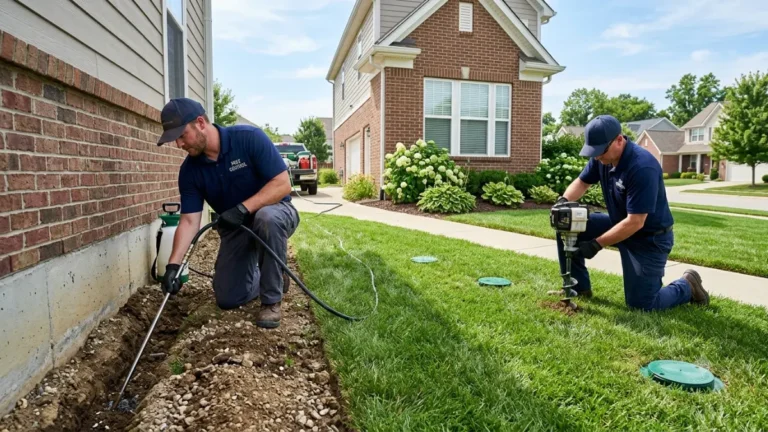
Where soil treatment is used, that code has the vertical chemical barrier applied after construction is complete, including initial landscaping and irrigation installation — and any soil disturbed afterward is to be promptly retreated.
The mulch layer can matter too. The Maryland researchers found termites traveling within both organic and inorganic media, which they noted confirms an earlier caution that mulches may bridge across soil termiticide barrier treatments.
None of that makes mulching reckless. It makes re-edging a bed or regrading against the foundation worth a phone call first, and it is one reason what a soil treatment covers is priced by the linear foot of perimeter.
Conditions that can affect a warranty
Service agreements commonly attach conditions to the property, not only to the treatment. UF/IFAS gives a concrete Florida example, noting irrigation striking a wall is a conducive condition that can void termite control warranties — and the same code requires irrigation risers and downspouts to discharge at least a foot from the sidewall. That code also asks for the area within a foot of the foundation to be kept clear of vegetation, stumps, dead roots, and debris.
✅ Do This: Read the conducive-conditions clause in your own agreement before changing anything at the foundation — the questions worth asking before signing one apply just as well afterward. Your treating company, or a licensed company you choose carefully, is who confirms whether a planned change affects coverage. The full picture of treatment options and costs sits with the pillar guide.
What mulch looks like on an inspection report
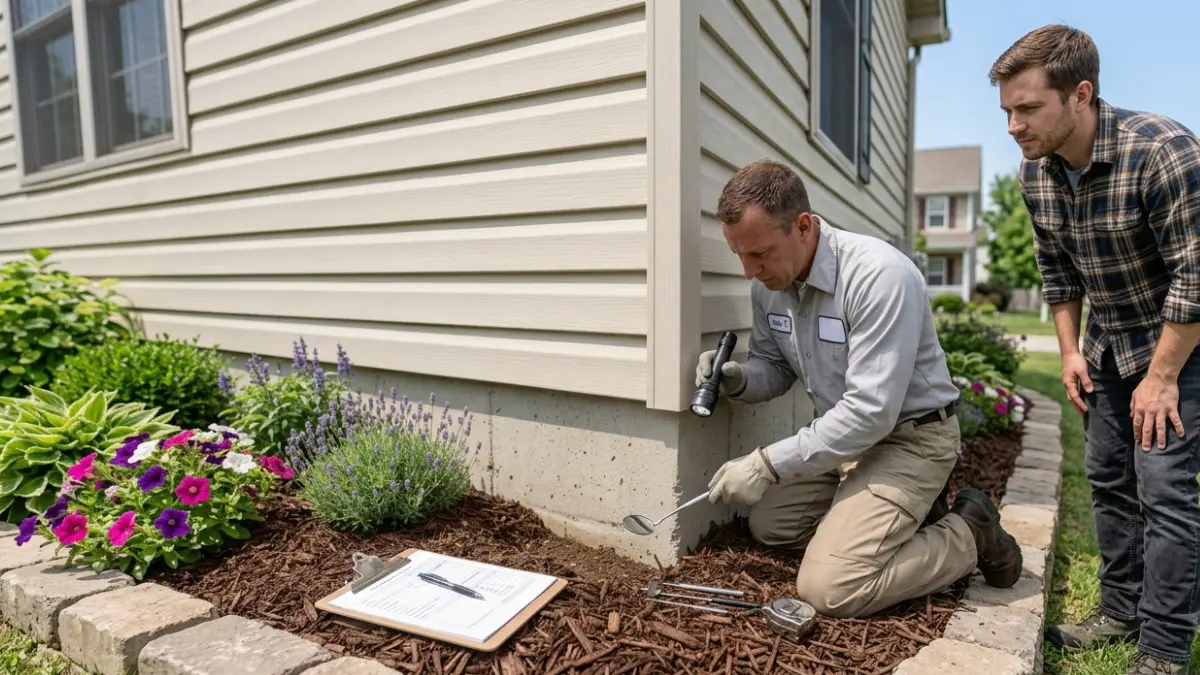
Landscaping stops being a private decision once a house changes hands. On Form NPMA-33, the wood-destroying insect report used for FHA and VA loans, mulch appears twice — and buyers sign page two acknowledging they have read it.
Mulch as a conducive condition
The form’s consumer maintenance advisory lists factors that may lead to infestation, and wood mulch or ground cover in contact with the structure is named among them. It sits alongside earth-to-wood contact, faulty grade, improper drainage, firewood against the structure, moisture, tree branches touching the structure, and landscape timbers. Where such conditions exist, the form instructs that corrective measures should be taken to reduce the chance of infestation and the need for treatment.
When landscaping blocks the inspection
The report also carries a 26-item key for obstructed and inaccessible areas, and two entries on it are dense vegetation and exterior siding. Landscaping can therefore limit what an inspection reached, which is a different problem from what it found.
That distinction is worth understanding before ordering an inspection, whether you are buying a house with termite history or working out whose report it is. A licensed inspector can tell you what a specific report covers; your state pest control agency sets what is required where you live.
Mulch and termites: quick answers
1. Do termites live in bags of mulch from the store?
Very unlikely. UF/IFAS Extension explains termites survive the chipping process poorly and survive even less well once separated from their colony, so a bag is not a realistic source of an infestation. Store bags off the ground rather than resting on soil.
2. Does rubber mulch prevent termites?
No source here supports rubber mulch as termite protection. UF/IFAS advises against it in Florida-Friendly landscapes for unrelated reasons — it does not break down, can leach into local water, and tends to float and wash away. Placement and clearance govern regardless of material.
3. Do I need to move mulch before a termite inspection?
Clearing access helps, because dense vegetation and exterior siding both appear on the inspection form’s obstruction key, and obstructed areas get reported as not inspected. Raking mulch back from the foundation makes the strip visible. Ask the inspector what they need cleared when booking.
4. How often does mulch need replacing?
It settles faster than most people expect. A UF/IFAS settling study by Duryea and Minogue found pine straw dropped to about half its depth within a year and to almost nothing by two years, while four of six mulches held a useful depth for two years. Measure before topping up.
5. Is pine straw safer than wood mulch near the house?
Nothing in the feeding research puts pine straw in a protected category. Its practical difference is that it settles quickly, so a bed topped up on schedule can climb toward the siding fast. The clearance measurement applies to pine straw exactly as to bark.
6. Should I use landscape fabric under mulch near the foundation?
None of the sources used here tested landscape fabric against termites, so there is no honest answer either way. What does not change is the clearance and the value of a visible strip of foundation. Fabric that makes mulch harder to rake back works against both.
7. Are termites in my mulch bed a sign they’re in my house?
Not by itself, though it is worth acting on. Termites forage widely through soil, and a bed is a comfortable place to work. Check the foundation strip for mud tubes, review the signs of termites, then call a licensed operator if anything looks active.
8. Do the same rules apply to drywood termites?
No. Everything above concerns soil-dwelling species that need ground contact for moisture — the difference between subterranean and drywood termites matters here, because drywood species do not depend on soil at all. Mulch practice is a subterranean termite question.
What to do this weekend
The mulch is not the problem; placement is. And the material that feels safest — a neat band of gravel against the foundation — is the one that showed the most sustained termite feeding in the only field study that measured it.

Take the vertical reading before buying another bag, rake the old layer back instead of stripping the bed out, and keep that strip of foundation visible. If there are mud tubes in it, call a licensed operator. It also helps to know termite damage from water damage and wood rot, because the two get confused constantly.