The overlooked question behind who pays for a termite letter

Termite letters carry no warranty, exclude mold and fungi, and expire at 90 days. The duties in them follow whoever ordered the inspection.

Table of Contents
Someone — your agent, your lender, the closing coordinator — has said you need a termite letter, and nobody has explained whose bill it is.
Here is the short answer, up front. No federal or state rule reviewed for this article assigns that fee to the buyer or to the seller. It is a contract term, negotiated like the other contract terms.
What this page will not do: quote you a price, interpret your contract, or tell you what you are entitled to. The first belongs in our breakdown of what a WDO inspection actually costs to run. The other two belong to your own professionals.
ℹ️ Safety Note: This article describes what standard forms and published rules require of licensed inspection companies. It is general information, not legal, tax, or real-estate advice. Requirements differ by state and by lender, and only your state’s structural pest control agency and your own loan officer can confirm what applies to your property and your transaction.
A termite letter is not one document
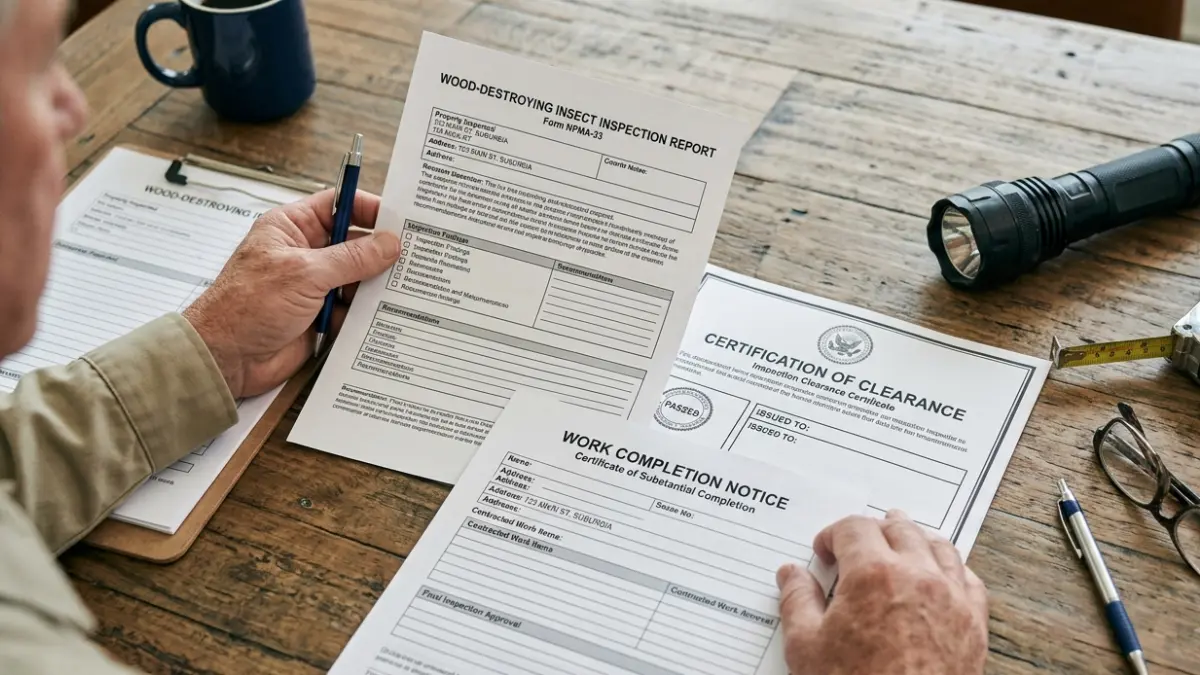
“Termite letter” is a phrase used at closing tables, not a phrase printed on any form. Underneath it sit three separate documents that do three different jobs, and confusing them is where most of the trouble starts.
The report, the clearance, and the letter of work completed

- HUMIDITY SENSOR: Our handy meter tool can quickly determine what level of remediation is needed to keep your family safe…
- WATER LEAK DETECTOR: Finding the moisture content in your wood or drywall is the first step in early prevention. Continu…
- MOISTURE READER: The mold test features large 0.3″ high digits in a backlit LCD for quick and easy detecting. Our mildew…
The inspection report records findings. For federally backed loans that is usually the wood-destroying insect inspection report approved for FHA and VA loans, Form NPMA-33, dated 7/01/19, with earlier editions retired at the end of 2019.
Its findings section offers two choices: no visible evidence of wood-destroying insects was observed, or visible evidence was observed and is then described. There is no box marked “clear.” A clearance letter is a different instrument — in California, a certification under the state’s Structural Pest Control Act, prepared only when the person who ordered the report asks for one, in one of four prescribed wordings, all limited to visible and accessible areas.
The third document is a notice of work completed. Under California’s Act, any document stating an opinion about the presence or absence of wood-destroying pests must refer back to the inspection report and say specifically which recommendations were not completed. That is the one people mean when they say the treatment “cleared.”
Insects only, or organisms too?
The federal form is an insect form. For its purposes, wood-destroying insects means termites, carpenter ants, carpenter bees, and reinfesting wood-boring beetles — and the form states plainly that the inspection does not include mold, mildew, or non-insect wood-destroying organisms.
That is the line where insects and wood-decay fungi part company. Some states close that gap with their own form and some do not. Note too that the form carries no warranty at all unless one is disclosed under state rules or a written warranty or service agreement is physically attached to it.
Who is actually requiring it
Three different things get called a requirement, and they carry very different weight: state law, a lender’s loan condition, and a term in your purchase contract.
VA loans: the map decides, then the Notice of Value
The VA’s rule is more specific than the internet’s summary of it. VA requires a wood-destroying pest inspection report as a Minimum Property Requirement for certain properties in areas the Termite Infestation Probability Map rates “very heavy” or “moderate to heavy,” and where that applies, the Notice of Value is conditioned for it.
The same circular states that repairs identified on the report and needed for Minimum Property Requirement compliance must be completed before the loan is guaranteed. The regional trigger comes first, the loan condition second, repairs third.
FHA, conventional, and cash
For everything else, your lender decides, not a national rule. Appraiser observation is a common trigger, and a lender may impose the condition on its own. We are not stating an FHA handbook requirement here because we did not read the handbook — asking your lender is faster and more reliable than any summary of it.
Buying cash with no lender? Nothing in any document reviewed here requires a report at all. You may still want one, and knowing which termites your region actually has is a better guide than a rule.
✅ Do This: Ask your loan officer one question in writing — “is a wood-destroying pest inspection a condition on my Notice of Value or my loan approval, and which form does my state require?” That single answer determines whether this is a legal step, a lender step, or an optional one, and the three are handled very differently.
Who pays for the termite letter
No rule reviewed for this article puts the inspection fee on the buyer or on the seller. What exists instead is a rule about who is allowed to be charged, which is a different thing and is the source of most of the confusion.

The VA rule that changed, and what it actually permits
Before June 2022, a veteran buyer could be charged for a wood-destroying pest inspection report only as a local variance in a limited number of states and territories. The VA circular that changed who may be charged, issued 15 June 2022 and valid until rescinded, authorised in advance that veterans may be charged those fees wherever the Notice of Value requires the inspection, and may also pay for repairs needed to meet Minimum Property Requirements.
Two details are worth carrying into your closing: veterans are encouraged to negotiate the cost of the inspection and repairs with the seller, and an itemised invoice identifying the veteran and the property is required to verify the charge on the Closing Disclosure.
📊 Sourced: The permission is current, not historical. The wood-destroying insect inspection sits as item 1 on the VA’s current list of allowable fee deviations, dated 17 February 2026 — and it sits there among the non-state-specific variances, meaning it now applies nationally rather than in a handful of states.
Why “the seller usually pays” is a custom, not a rule
Notice what that list is: a schedule of exceptions to fees normally considered unallowable. The VA did not assign the fee to anyone. It removed an obstacle and told the veteran to negotiate.
Advice still circulating on this question says the opposite — that the VA will not let the buyer pay in most states. That was accurate before 15 June 2022 and is not accurate now. Local custom is real and your agent will know it, but custom is not a rule, and it does not survive a contract that says otherwise.
Paying for it is not the same as ordering it
Here is the part nobody publishes. The rules are close to silent on who pays, and surprisingly specific about who ordered the inspection — because that is the name the duties attach to.
What the ordering party gets that the payer doesn’t
| What the rules attach | Who it goes to | Where it’s written |
|---|---|---|
| A copy of the report, within 10 business days of the inspection starting | The person requesting the inspection and the property owner or their agent | California, §8516(b) |
| A copy of the findings on the state form | The party requesting the inspection | Florida, Rule 5E-14.142(2)(c) |
| Being told at ordering time that a separate report is available, splitting evident infestation from conditions likely to lead to it | The person ordering the report | California, §8516(c) |
| A reinspection, at no more than the original inspection price | The person who ordered the original report, and only where an estimate or bid was given | California, §8516(b)(12) |
| A written certification about absence of activity | Prepared when the person who ordered the report requests it | California, §8519 |
Sourced from the Structural Pest Control Board’s published compilation of the Act (updated July 2025) and from Florida’s Administrative Code. These are two states’ rules, named by state. Yours will differ; your state agency is the place to check.
One California timing rule would not fit the table: four months after an original inspection, every inspection is a new original inspection rather than a reinspection. Long escrows quietly cross that line.
The two signatures on the federal form
The federal form records the inspection company and its business licence number, the inspector and their licence number, the property, and the structures inspected. It has no field for who ordered the inspection and no field for who paid.
What it has is two signature lines doing two different jobs. The seller or owner signs a disclosure — that they are disclosing to the buyer all information, to their knowledge, about infestation, damage, repair, and treatment history. The buyer signs an acknowledgement of receiving both pages and understanding the information reported — which includes the entire limitations page most people never read.
🔍 Why It Works: An inspection company’s duties run to a named party, so the report is built around identity rather than payment. That is why “who ordered it” is the more useful question at the closing table — and why verifying both licence numbers printed on the report is worth the two minutes it takes.
What the letter misses, in its own words
- HUMIDITY SENSOR: Our handy meter tool can quickly determine what level of remediation is needed to keep your family safe…
- WATER LEAK DETECTOR: Finding the moisture content in your wood or drywall is the first step in early prevention. Continu…
- MOISTURE READER: The mold test features large 0.3″ high digits in a backlit LCD for quick and easy detecting. Our mildew…

- Triple Pack Convenience: Get three powerful LED Magnetic Worklights for ultimate convenience. Bulk purchase ensures you …
- Dual Light Modes: Each inspection lamp features two lighting modes – COB light and LED light. Adapt to different situati…
- Battery-Powered Mobility: Powered by 3 AAA batteries (not included), these portable worklights offer hassle-free operati…
None of this is an accusation about inspectors. Every limitation below is printed on the federal form itself.
The things the form says it is not
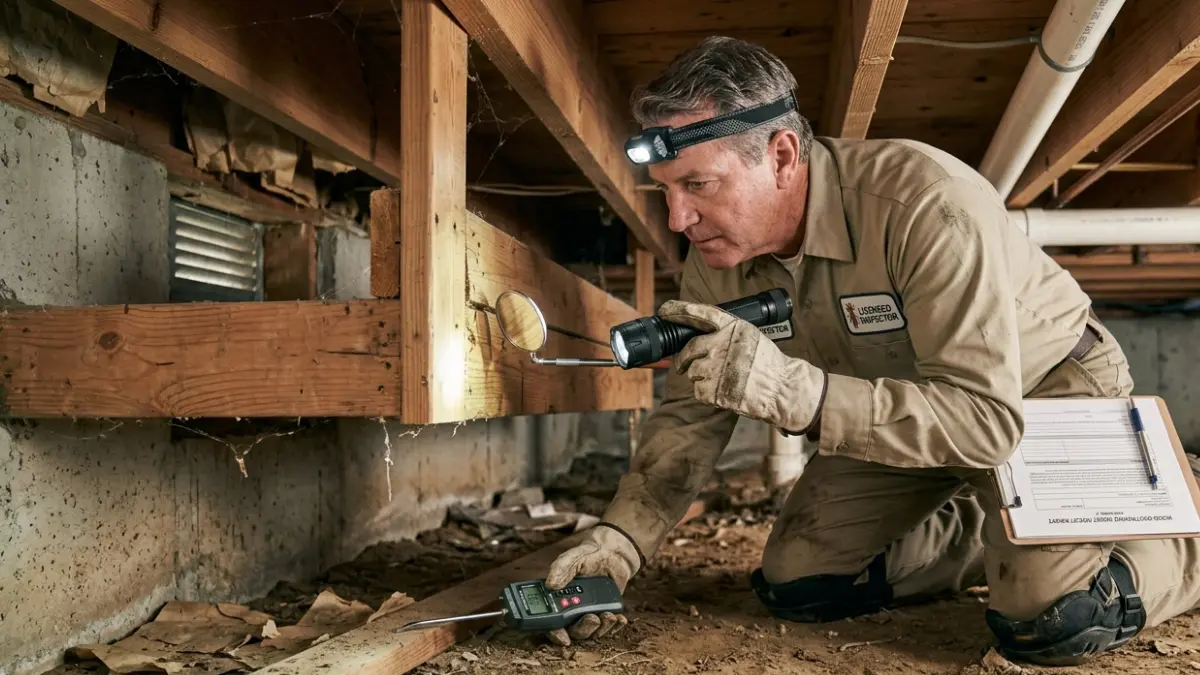
It is not a guarantee or warranty against latent, concealed, or future infestation or wood-destroying insect damage. It says in its own words that it is not a structural damage report, and that where visible evidence is checked, some degree of damage including hidden damage may be present. It states the inspector’s training does not qualify them in damage evaluation or building repair, and recommends contacting a qualified structural professional to determine the extent of damage — a separate assessment the form points you to that no quote includes.
| Federal WDI form | Florida’s state WDO form | |
|---|---|---|
| Scope | Wood-destroying insects only | All wood-destroying organisms defined by Florida statute |
| Mold, mildew, wood-decay fungi | Explicitly outside the inspection | Organisms fall within scope |
| Key detail | A full page of scope limitations | The licensee may not add disclaimers or extra language to the form |
Sourced from Form NPMA-33 and Florida Administrative Code Rule 5E-14.142(2)(c). One state, shown for contrast. Mold is a separate inspection entirely.
Access, obstructions, and the 90-day clock
- Quality Material: USB C Rechargeable flashlight is made of quality aluminum alloy material with stable performance; adds…
- Zoomable Design: Zoom in to focus on objects or zoom out to sweep a large area by pulling the flashlight head; The adjus…
- 3 Modes: LED Flashlight with 3 modes, Strong light mode, low light mode, side cob light, use for long distance observati…
No inspection is made where reaching an area would mean breaking into or dismantling something — mouldings, floor coverings, wall coverings, siding, fixed ceilings, insulation, furniture, appliances, possessions. A crawl space may be reported inaccessible where the opening is too small to enter or where clearance under the floor joists runs below 24 inches; an attic may be reported inaccessible if a ladder was needed to reach it.
⚠️ Watch Out: The form states the report is invalid for securing a mortgage or settling a transfer if it is not used within ninety days of the inspection — and then states directly that this is not a 90-day warranty. A dated report is a record of what was known, and when, which is exactly how a dated report reads to an insurer later.
When the letter comes back with findings
A finding is not a verdict, and the difference between two words on the report governs everything that happens next.
Findings should match; recommendations won’t
California requires the inspection report to carry a boldface notice: reports on the same structure from different registered companies should list the same findings, recommendations to correct them may vary from company to company, and the consumer has the right to seek a second opinion. That is not our advice — it is a notice a regulator requires on the page.
California also forbids something that gets sold hard. Conditions deemed likely to lead to infestation may not be characterised as actual defects, as active infestations, or as needing correction before a certification can be issued. And on the federal form a recommendation does not prove a live colony: its own guidance calls for recommending treatment where evidence is found without a documented previous treatment, even when no live termites are seen — so evidence without live insects is a common, legitimate finding.
- Dual Measurement Modes: Pin and Pinless measurement options for versatile moisture detection on various materials.
- Wide Application: Ideal for wood, drywall, plaster, concrete, cardboard, and other building materials.
- Pinless Mode: Non-destructive measurement for delicate surfaces like furniture and antique wood.
What to get in writing before money moves
✅ Do This: Ask the inspection company three things: who ordered this report, what date did the inspection start, and what is listed in the obstructions section. Then take damage questions to a licensed structural professional, form and licensing questions to your state’s structural pest control agency, and loan-condition questions to your lender — not to the company quoting the repair.
Termite letter questions, answered
1. Who pays for a termite letter, the buyer or the seller?
Neither, as a rule. No federal or state requirement reviewed here assigns the termite letter fee to either party, so it is a contract term you negotiate. Local custom exists and your agent will know it, but custom does not override your purchase contract. Settle it in writing early.
2. Is a termite letter legally required to sell a house?
Not by anything reviewed for this article. The requirement almost always comes from a lender’s loan condition or a term in the purchase contract, not from a law about selling property. With no lender involved, no one may be requiring a termite letter at all. Your state’s structural pest control agency can confirm what applies.
3. Can I use the seller’s termite letter?
Often yes, but understand what you are accepting. In California and Florida, duties like a copy of the findings and a reinspection or certification on request attach to the party who requested the inspection. If that party is the seller, the report is still information you can read — just not a document ordered on your behalf.
4. How long is a termite letter valid?
The federal form states it is invalid for securing a mortgage or settling a property transfer if not used within ninety days of the inspection date. The same form then says directly that this is not a 90-day warranty. Nothing is guaranteed during those ninety days; the document simply stops being accepted afterwards.
5. What is the difference between a WDI and a WDO report?
Scope. A WDI report covers wood-destroying insects — on the federal form, termites, carpenter ants, carpenter bees, and reinfesting wood-boring beetles — and that form excludes mold, mildew, and non-insect organisms. A WDO report covers wood-destroying organisms, which is broader. Florida requires inspection for all organisms its statute defines.
6. Does the VA let the buyer pay for the termite inspection?
Yes. A VA circular issued 15 June 2022, valid until rescinded, authorised veterans to be charged wood-destroying pest inspection fees wherever the Notice of Value requires the inspection. That permission remains current on the VA’s fee deviations list dated 17 February 2026. Veterans are still encouraged to negotiate the cost with the seller.
7. What happens if the termite letter finds evidence?
Findings and recommendations are separate things. California requires reports to state in boldface that different companies should report the same findings while recommendations may vary, and that a second opinion may be sought. Take damage questions to a licensed structural professional and loan-condition questions to your lender, not to the company quoting the work.
8. Is a termite letter the same as a termite bond?
No. The federal inspection report carries no warranty unless one is disclosed under state rules or a written warranty or service agreement is attached to it. A bond is that separate agreement. A report describes one day; a bond is an ongoing contract with its own terms, exclusions, and renewals.

What to do before you sign anything
Put the fee where it belongs: in the contract. It is negotiable in every situation reviewed here, including VA purchases, and conceding it because “that’s just how it works” gives up something no rule required.
Then ask the question that decides what the document is worth to you — who ordered it. If the answer is the seller, consider ordering your own inspection in your own name, and read the second page before signing the line that says you understand it. For what you are looking at in the meantime, start with what the inspector is looking for and what termite treatment actually involves.