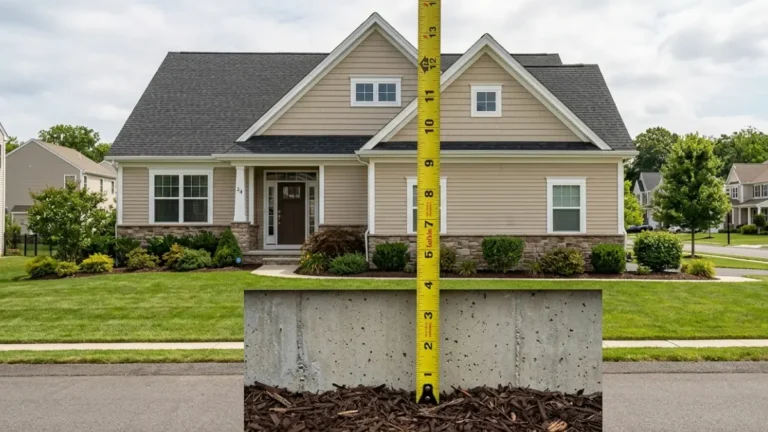
The real work starts where the termite risk map stops

The termite risk map covers subterranean termites only, and USDA puts them in every state but Alaska. A pale band is a regional average, not your address.
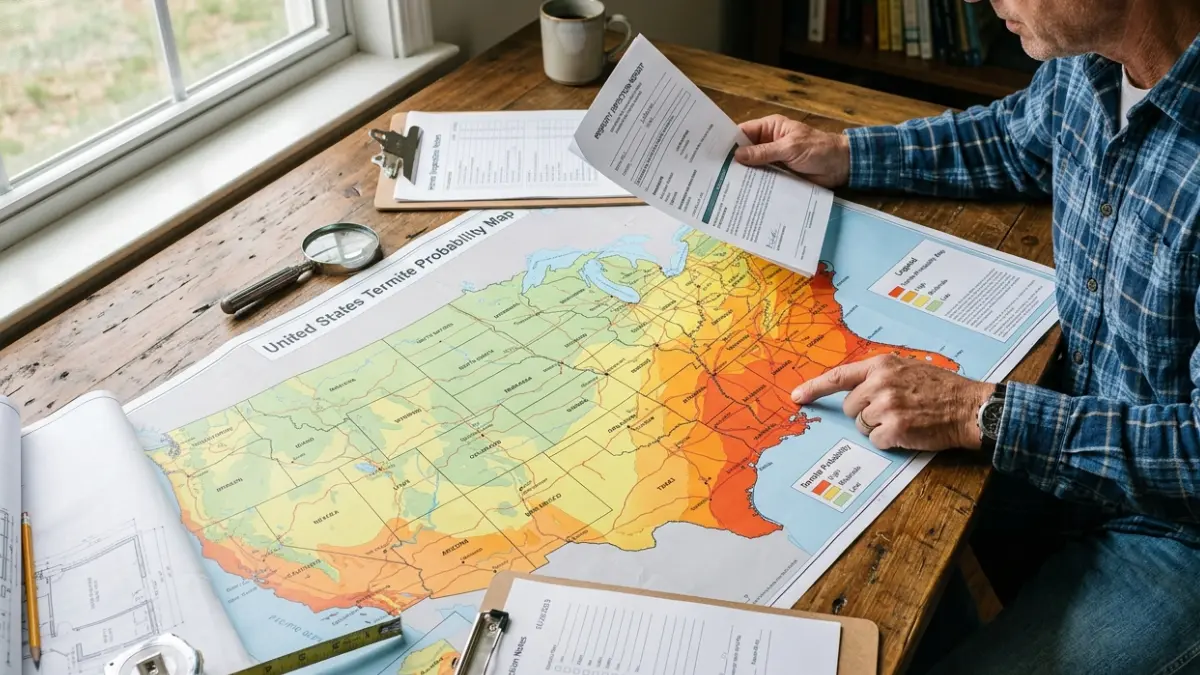
Table of Contents
Termite risk map is the phrase almost everyone searches, and no federal agency, code body, or university publishes anything by that name. What exists is a figure in the building code, and a separate set of mortgage rules built on top of it.
Route yourself before you read further:
- Buying or selling, and someone has said “termite zone” — the band matters, but a published list decides. Go to the lending section.
- Building, renovating, or pulling a permit — your building department’s own table decides, not the colored figure. Go to the code section.
- Wondering whether your own house is at risk — the map was never built to answer that. Go to what it leaves out.
One more thing before the colors. Two different objects get called TIP, and merging them produces most of the wrong answers on this topic. The first is a probability map printed in the residential building code, with four bands. The second is a mortgage underwriting scheme, built decades ago by HUD’s homeownership centers, that used that map as one of its inputs.
They are not the same document, they do not have the same boundaries, and they answer different questions. This article takes them one at a time.
ℹ️ Safety Note: This article explains published documents and where to find them. It is not legal, lending, code-compliance, or pest-control advice. Building requirements are set by your local building department, loan requirements by your lender and the loan program, and treatment by a state-licensed pest management professional — and only those parties can tell you what applies to a specific address.
What the TIP map actually is, and the other thing called TIP
The termite infestation probability map is a figure printed in a model building code. It is not a forecast, not a live data product, and not updated on any published schedule.
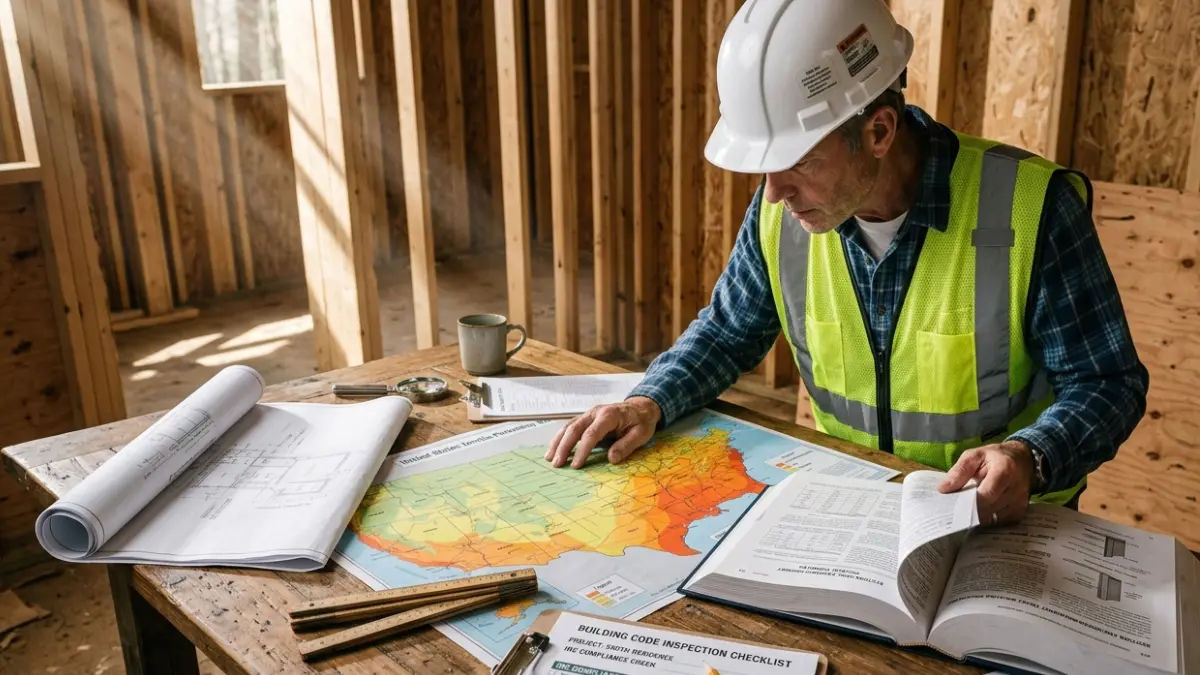
The code figure with four bands
In the 2021 International Residential Code, the map is Figure R301.2(7). The Department of Energy’s Building America Solution Center publishes an adapted version under exactly that citation, in its building-science guidance on pest-resistant construction, last updated September 23, 2021.
The same figure moves around between code books and editions, which is why looking it up is harder than it should be.
| Code book and edition | Figure number | Verified against |
|---|---|---|
| 2021 International Residential Code | R301.2(7) | Department of Energy Building America Solution Center |
| 2024 International Residential Code | R305.4 | product evaluation reports written against the 2024 edition |
| International Building Code | 2603.8 | Massachusetts building regulations, 780 CMR 2603.8 |
| Massachusetts state code, 7th edition (2007) | 5301.2(6) | Massachusetts state building code |
Sourced, not tested. Figure designations taken from published code and federal documents and checked August 5, 2026. Quote the edition along with the number when you talk to a building official — the numbering moved.
HUD’s TIP zones are a different thing
The nickname came from housing finance, not from entomology. HUD’s four homeownership centers built termite infestation probability zones from maps published in the International Residential Code, the older CABO one- and two-family dwelling code, and USDA’s Bulletin 64.
Those zones were drawn as whole states. The Santa Ana center, for instance, listed three: California and Hawaii; Arizona and Nevada; then Alaska, Idaho, Oregon, and Washington. That guidance page has carried an archived stamp since November 2, 2012, and it is not the four-band code figure.
Where the map came from
Its documented ancestor is a figure in the USDA Forest Service’s bulletin on subterranean termites, Home and Garden Bulletin 64, revised October 2006 — titled, in that document, a map of relative hazard.
Page-one results widely state the boundaries were last redrawn in the 1980s. No source we checked says that, so we are not repeating it.
What the four bands mean, and what they do not
The figure sorts the country into four probability bands, and here they are in descending order, because you came for them.
- Very heavy
- Moderate to heavy
- Slight to moderate
- None to slight
What the figure says about its own lines
Printed on the figure is a note most reproductions crop out: the lines defining the areas are approximate only, and local conditions may be more or less severe than the regional classification indicates.
It also covers one kind of termite. The code section the figure serves is titled protection against subterranean termites, and USDA’s Bulletin 64 states plainly that it deals exclusively with subterranean species.
So the object is a regional classification, for one group of insects, with edges its own publisher describes as approximate. That is a useful thing. It is not a reading of your address.
“None to slight” is not “none”
The USDA Forest Service states that subterranean termites are found in every state except Alaska, and are most common in the southern states. The pale band means lower regional probability. It does not mean absence, and it never did.
⚠️ Watch Out: The costly misreading of this map is not panic in a dark band — it is relief in a pale one. Colorado State University Extension notes that the belief there are no termites in Colorado has itself contributed to damage there, because houses got built without the basic termite-proofing that is standard where termites are taken seriously. A low band can quietly raise your exposure by changing how your house was constructed.
If your band is pale, do one thing this week: look at where your siding meets the soil on the shaded, damp side of the house, and note anywhere wood touches ground.
What your building department does with it
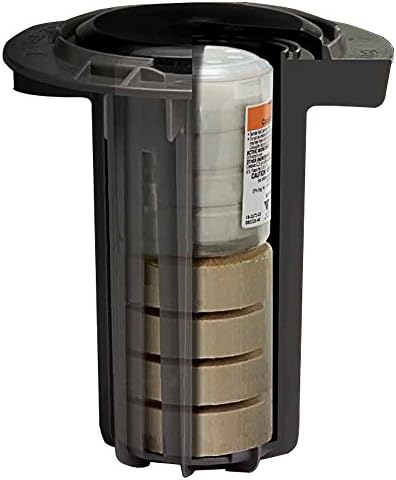
- Includes one CASE of TBS systems: 10 x Advance Termite Inspection Cartdrdge (TIC), 10 x TBS station, 10 x wood block for…
- This bait system functions as a DETECTION tool, and does NOT contain termiticides. Install first to detect if termites a…
- After termites are detected, replace with Trelona cartridges that work with these stations. Trelona is a termiticde by t…
The code never tells anyone to read the map and act on the color. That distinction decides arguments at permit counters.
The trigger is a table entry, not a color
Termite protection applies, in the code’s own words, in areas subject to damage from termites as indicated by Table R301.2 — the climatic and geographic design criteria table that each jurisdiction fills in for itself. The map is the reference figure behind that entry. The entry is the requirement.
That is Section R318.1 in the 2021 edition and Section R305.1 in the 2024 edition, which is the same rule under a different number.
The six accepted methods
Where protection is required, the code accepts one method or a combination:
- Chemical termiticide treatment
- A termite baiting system, installed and maintained according to its label
- Pressure-preservative-treated wood
- Naturally durable, termite-resistant wood
- Physical barriers
- Cold-formed steel framing
Two of those six are wood specifications, and the grade matters more than the species — which is covered in our guide to the treated and naturally durable wood the code accepts.
There is also a separate rule for the top band. In areas where the probability is very heavy, the code restricts foam plastics on or under foundation walls below grade and requires a 6-inch clearance between above-grade foam and exposed earth.
Why your jurisdiction’s version may not match the model code
States adopt model codes on their own timetables and amend them freely, which is why the same figure carries four different numbers in the table above.
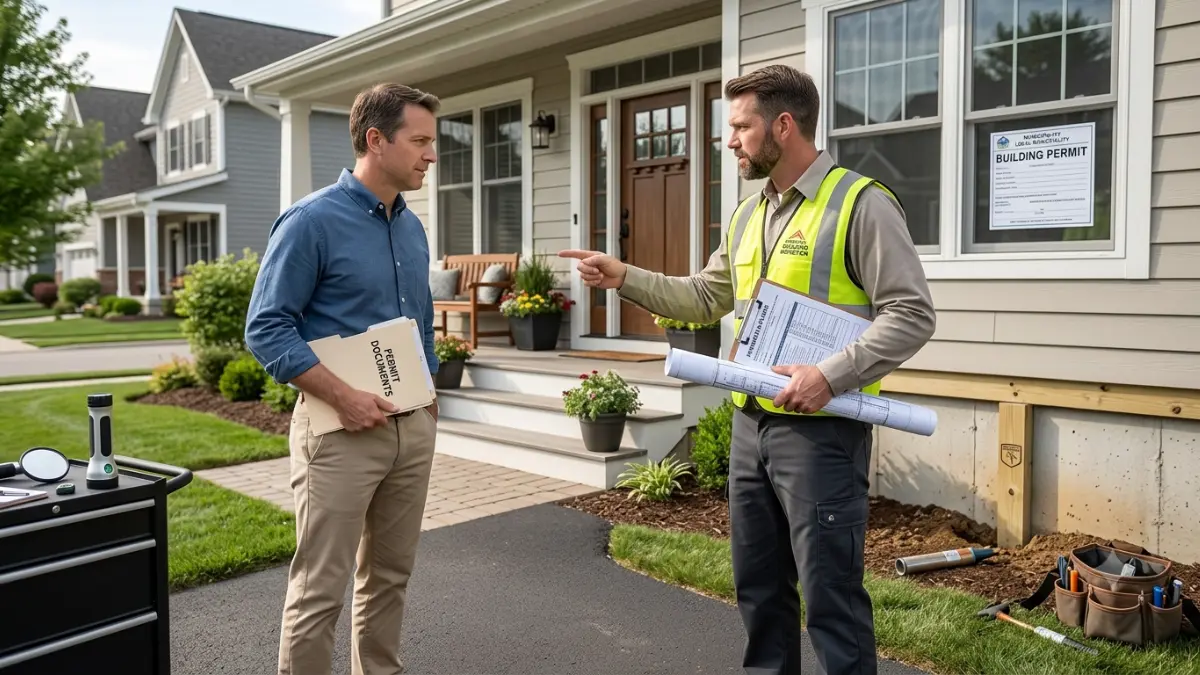
✅ Do This: Call your building department and ask two questions. Which edition of the residential code is adopted here, and what does the termite line in the adopted Table R301.2 say for this jurisdiction? If a permit depends on the answer, ask for it in writing.
What lenders do with it: two programs, two readings
Here the map has teeth, and the two largest government loan programs read it differently.

VA keys the requirement to two named bands
VA Circular 26-22-11, dated June 15, 2022, states that VA requires, as a Minimum Property Requirement, a wood destroying pest inspection report for certain properties in areas where the probability of termite infestation is “very heavy” or “moderate to heavy.” Where it applies, the Notice of Value is conditioned on it, and the repairs it identifies must be completed before guaranty.
The same circular authorized veterans to be charged that inspection fee where the Notice of Value requires the report, and encouraged negotiating it with the seller. What the report itself covers is a separate question, answered in our breakdown of what a WDO inspection actually covers and of who pays for the termite letter in a sale.
One detail worth noting flatly: that circular’s original footnote for the map pointed at the Department of Energy web page. Change 1, issued six weeks later on July 28, 2022, replaced that citation with VA’s own Lenders Handbook.
Which is why VA publishes a list instead
Bands do not have county borders you can read, so VA publishes a list of states and counties instead, last updated July 11, 2025. Wood-destroying insect information is required across 29 states plus the District of Columbia and five territories. Eight more states are handled county by county.
📊 Sourced Spec: counties named on VA’s local requirements list, in the eight partial states.
State Counties named on VA’s list Colorado 43 Iowa 79 Nebraska 57 Nevada 13 New York 18 Pennsylvania 64 Utah 6 Wisconsin 20 Counted by us from VA’s published page on August 5, 2026. This is a count of a published list, not a test or an inspection, and VA edits the page without issuing notice — check it against the live page before you rely on it.
FHA does not work that way
FHA does not automatically require an inspection on an existing home. A report is required where there is evidence of active infestation, where the state or local jurisdiction mandates it, where it is customary to the area, or at the lender’s discretion — with the TIP zone named as one tool in that judgment rather than the trigger itself.
Two programs, one map, two readings. Both end in the same instruction: ask your lender which document their file is built on, and get the answer before your closing date depends on it.
Three things the map cannot show you
Everything above is about what institutions do with the figure. This section is about your house.
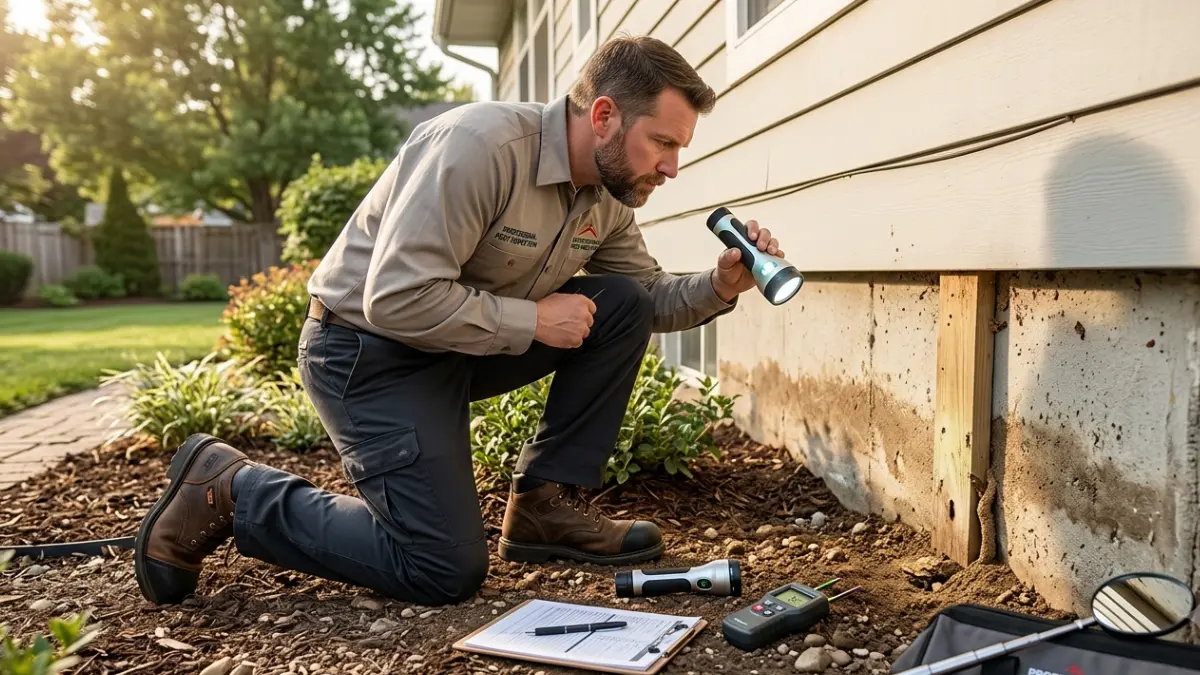
It covers one of three kinds of termite
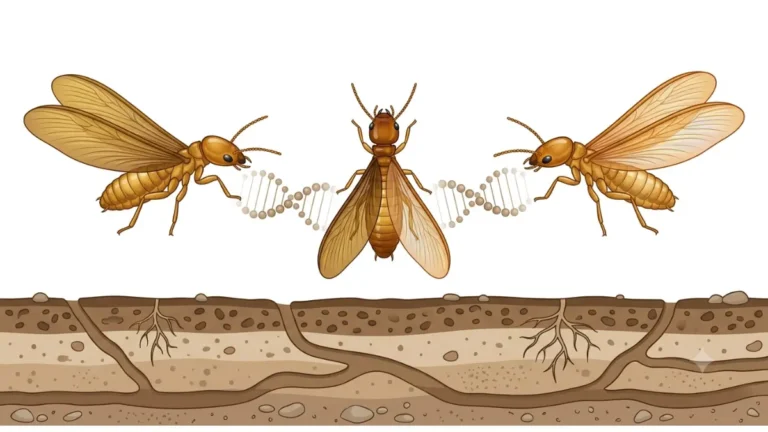
Drywood termites are not on it. USDA places them along the Atlantic coastal states south of Virginia, throughout Florida, along the Gulf Coast, along the Mexican border, and up the Pacific Coast to just north of San Francisco. Dampwood species sit on the Pacific Coast, in the desert Southwest, and in southern Florida, and Hawaii has all three groups.
The practical consequence is that a coastal reader can be in a moderate band and still have the species the map does not track. The differences that matter are set out in subterranean and drywood termites are different problems, and the invasive species moving through the Gulf states is covered in the Formosan termite in Florida. USDA records that one as reaching continental port cities in the 1960s, Florida in 1980, and spreading since largely through human transport of wood products.
It cannot see your water table, your elevation, or your irrigation

- Measurement for 4 wood categories
- Measurement: range: 2 ~ 40%, accuracy: ± 2%, resolution: 0.1%
- Max / min value acquisition
Colorado is the clearest test case, because most people assume it has no termites and VA lists 43 of its counties.
Colorado State University Extension describes at least three native subterranean species there, with the aridland subterranean termite found through most of the state below about 7,500 feet, and a small drywood population near Grand Junction. Damage has not been common compared with wetter and warmer regions — but where it has occurred, it has concentrated where local water tables are high.
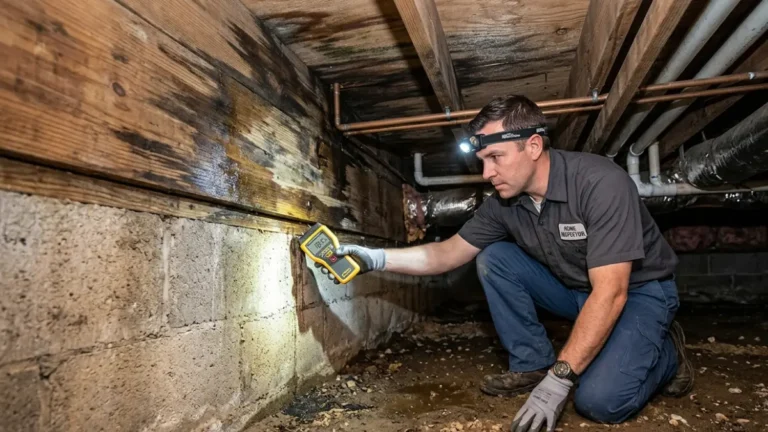
🔍 Why It Works: Subterranean termites need constant moisture or they dry out and die, so their real distribution follows water rather than latitude. That is why a national band cannot see your risk: the variable that decides it is a few feet of soil against your foundation, and soil moisture changes across a single street.
It was drawn before your neighborhood was
Both sources describe the same drift. USDA notes that northern infestations became more common as central heating spread, because heated basements keep soil warm year-round, and that termites became a problem in places where they were formerly of little economic importance.
CSU Extension reports the same effect from landscaping: irrigation aimed at foundations, downspouts draining beside walls, and buried wood such as stumps, posts, and firewood piles. Those conditions are the subject of moisture under the floor, and winged termites appearing indoors — often the first real signal a homeowner gets — are covered in swarmers inside the house.
Three local answers that beat a national band

- HUMIDITY SENSOR: Our handy meter tool can quickly determine what level of remediation is needed to keep your family safe…
- WATER LEAK DETECTOR: Finding the moisture content in your wood or drywall is the first step in early prevention. Continu…
- MOISTURE READER: The mold test features large 0.3″ high digits in a backlit LCD for quick and easy detecting. Our mildew…
A colored band is a regional average. These three lookups are about your address, and all of them are free.
Ask your building department one question. Which edition of the residential code is adopted here, and what does the termite line in the adopted table say? That single answer settles what a permit will require, and it beats any interpretation of the map.
Check the list your lender actually uses. If you are financing, ask whether the property is on VA’s current local requirements list, or which of FHA’s four triggers your lender is applying. Both are documents, not judgment calls, and both are answerable before you are under contract.
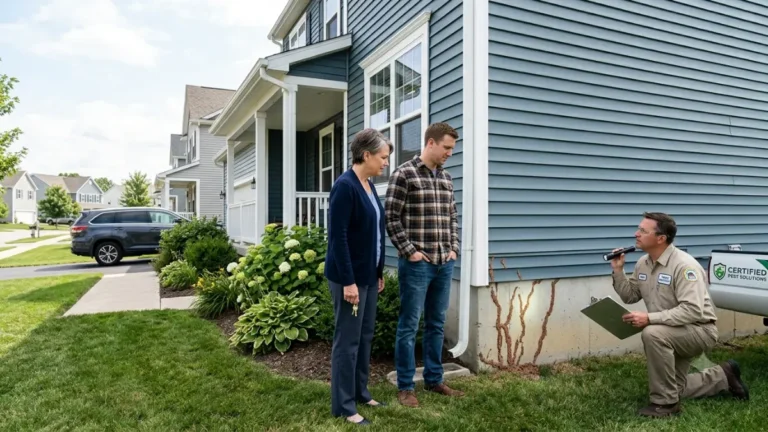
Look at the two feet of ground the map cannot see. Wood touching soil, damp foundation walls, and mud tubes are what actually predict trouble — the specifics are in the signs worth checking yourself, where wood meets soil, and a walk around the outside of the house. Beyond what you can see standing up, that is a job for a licensed firm, and treatment costs are broken down in our guide to what the five treatment methods actually cost.
If you rent, none of the above is yours to arrange. Report anything you find to your landlord or managing agent in writing, keep a copy, and let them commission the inspection.
Termite risk map questions, answered
1. What is a TIP zone?
TIP stands for termite infestation probability, and the phrase covers two different things. One is the four-band map figure printed in the building code. The other is a set of mortgage underwriting zones that HUD’s homeownership centers assembled from that figure and older documents, on a page archived since November 2, 2012. Ask which one someone means.
2. Who made the termite risk map?
The termite risk map most people find is a code figure, published in the International Residential Code and reproduced by the Department of Energy’s Building America Solution Center. Its documented ancestor is a USDA Forest Service figure in Home and Garden Bulletin 64, revised October 2006. No source we checked states when the current boundaries were last redrawn.
3. Does my state require a termite inspection to sell a house?
That depends on the financing, not on the map. Requirements attach to loan programs and to state or local rules, and a cash sale may carry none at all. VA publishes a state and county list; FHA leaves it to four triggers and lender judgment. Ask your lender and your state’s structural pest control agency which rule governs your address.
4. Do I need a termite inspection for a VA loan?
VA requires a wood destroying pest inspection report as a Minimum Property Requirement for certain properties in areas the map shows as very heavy or moderate to heavy. In practice VA publishes a list: 29 states plus the District of Columbia and five territories in full, and named counties in eight more states. Confirm the current entry with your lender.
5. Does FHA require a termite inspection?
Not automatically on an existing home. FHA requires a report where there is evidence of active infestation, where the state or local jurisdiction mandates it, where it is customary to the area, or at the lender’s discretion. The termite risk map is named as one tool in that judgment rather than the trigger. Your lender confirms which applies.
6. Are there termites in cold or dry states?
Yes. The USDA Forest Service states that subterranean termites occur in every state except Alaska, and are most common in the South. Colorado State University Extension describes at least three native subterranean species in Colorado, with damage historically concentrated where local water tables are high. A pale band means lower regional probability, not absence.
7. Why does my area’s requirement not match the map?
Because neither the code nor a lender reads the color directly. The building code applies where your jurisdiction’s own Table R301.2 entry says termites are a hazard, and VA applies a published list of states and counties. The map is the reference behind those documents, not the document itself. Ask your building department or lender which entry covers your address.
8. Does the termite risk map cover drywood termites?
No. The code section the figure serves is titled protection against subterranean termites, and USDA’s Bulletin 64 deals exclusively with subterranean species. Drywood termites have their own range along the southern Atlantic coast, throughout Florida, the Gulf Coast, the Mexican border, and the Pacific Coast. A licensed inspector identifies which species you have.
What to do with the color you found
The band describes a region. The documents describe your address, and there are only two of them worth reading: the entry your jurisdiction wrote into its own code table, and the list your loan program publishes.
So take the next step that matches your situation. If you are financing, ask your lender which list or trigger applies to the property and get it settled early. If you are building, call the building department and ask which code edition is adopted and what its termite line says. If you are simply a homeowner who wanted to know, walk the perimeter and look at the ground against your foundation, because the thing that decides your risk sits there rather than on a national figure.
A pale band is not a clean bill of health, and a dark one is not a verdict. Both are averages, and you live at an address.

- TWO TERMITE PRODUCTS IN ONE: Pop-up indicators detect termite activity, and the stakes kill foraging termites.
- REPLACEMENT STAKES: Includes 5 stakes with locator shields – designed to replace termite stakes already in use with the …
- INSTALLS IN MINUTES: Place stakes in the ground 2 to 3 feet away from your home and no more than 10 feet apart.