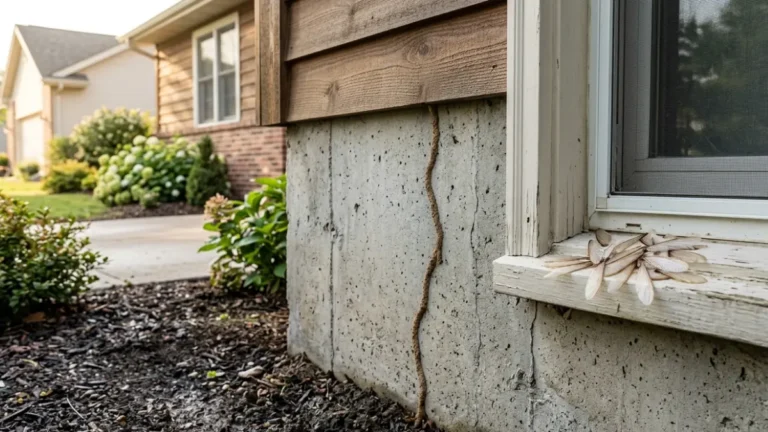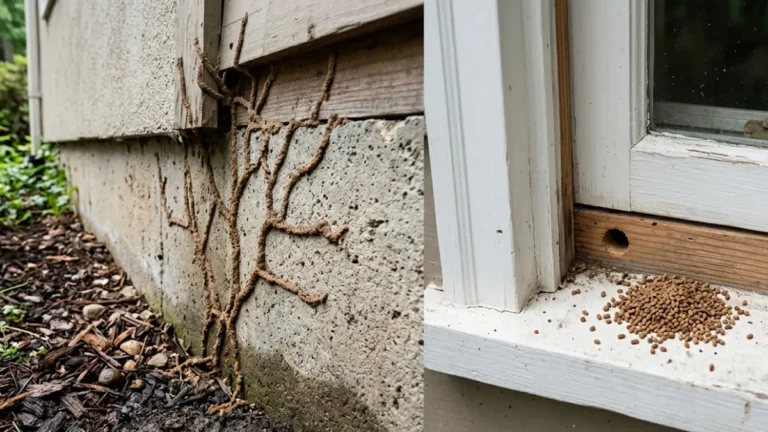
Knowing where termites in furniture live decides the right fix

Termites in furniture: three extension documents publish three cold protocols, and none matches the freezer number circulating online.
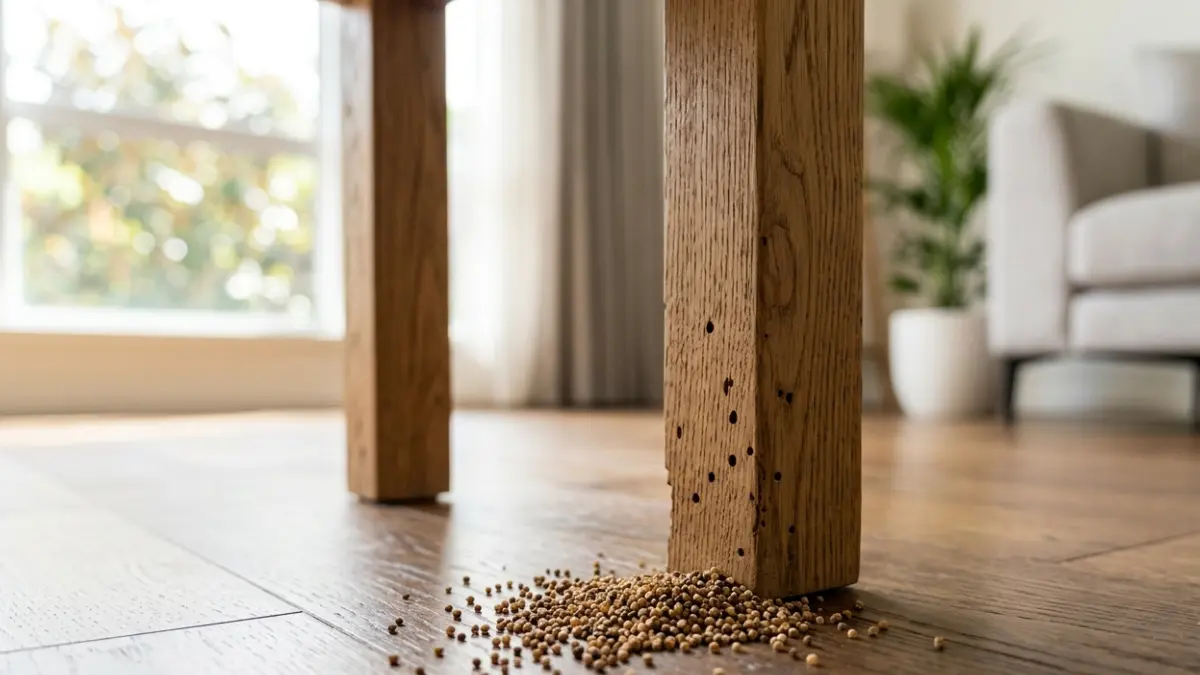
Table of Contents
Termites in furniture are two different problems
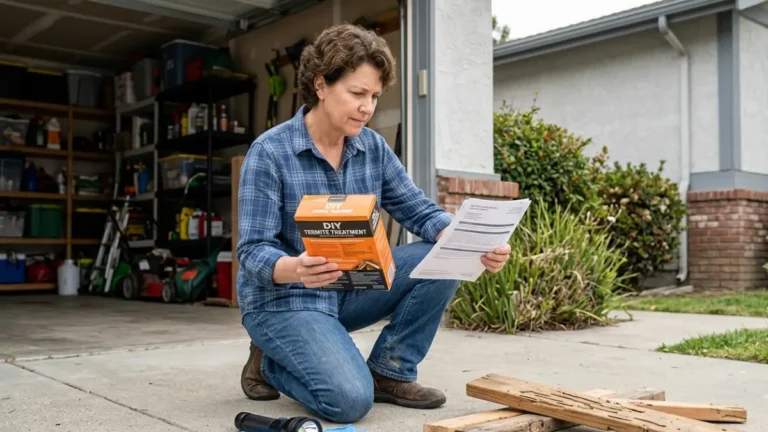
You have found something under a wooden piece — gritty pellets, a pinhole, a patch of blistered surface — and half the internet has already told you to spray it, freeze it, or stand it in the sun.
Stop there. Termites in furniture are two completely different problems, and which one you have decides whether the object can be treated at all.
Which of these is on your desk right now
- Pellets and pinholes, no soil contact. The colony is probably inside the object — sections two to five.
- Mud tubes, damp wood, or anything on the ground. The colony is in the soil and the object is only where it feeds — section six.
- A shed, deck box, or outbuilding on dirt. Sections six and seven.
- A second-hand piece you are thinking of buying. Section seven.
What this article will not tell you to do
It will not hand you a recipe for treating a piece yourself. In most cases there isn’t one, and the reason is specific rather than cautious.
Worth knowing first: the national Cooperative Extension guide to drywood termite control states plainly that these colonies develop slowly, that you usually do not have to rush, and that you should not feel pressured into a fast decision. If the problem is the house rather than the object, start with the five treatment types and what they really cost.
ℹ️ Safety Note: Treating wood for termites means pesticides, restricted-use fumigants, or high heat — all carrying poisoning, fire, and property-damage risk. Nothing here is an instruction to apply any product. Firms offering termite services must be licensed by your state, and the EPA directs consumers to follow label directions exactly and to raise concerns with their state pesticide regulatory agency.
How to tell which termite is in the wood

- HUMIDITY SENSOR: Our handy meter tool can quickly determine what level of remediation is needed to keep your family safe…
- WATER LEAK DETECTOR: Finding the moisture content in your wood or drywall is the first step in early prevention. Continu…
- MOISTURE READER: The mold test features large 0.3″ high digits in a backlit LCD for quick and easy detecting. Our mildew…
Two minutes of looking settles this, and it costs nothing.
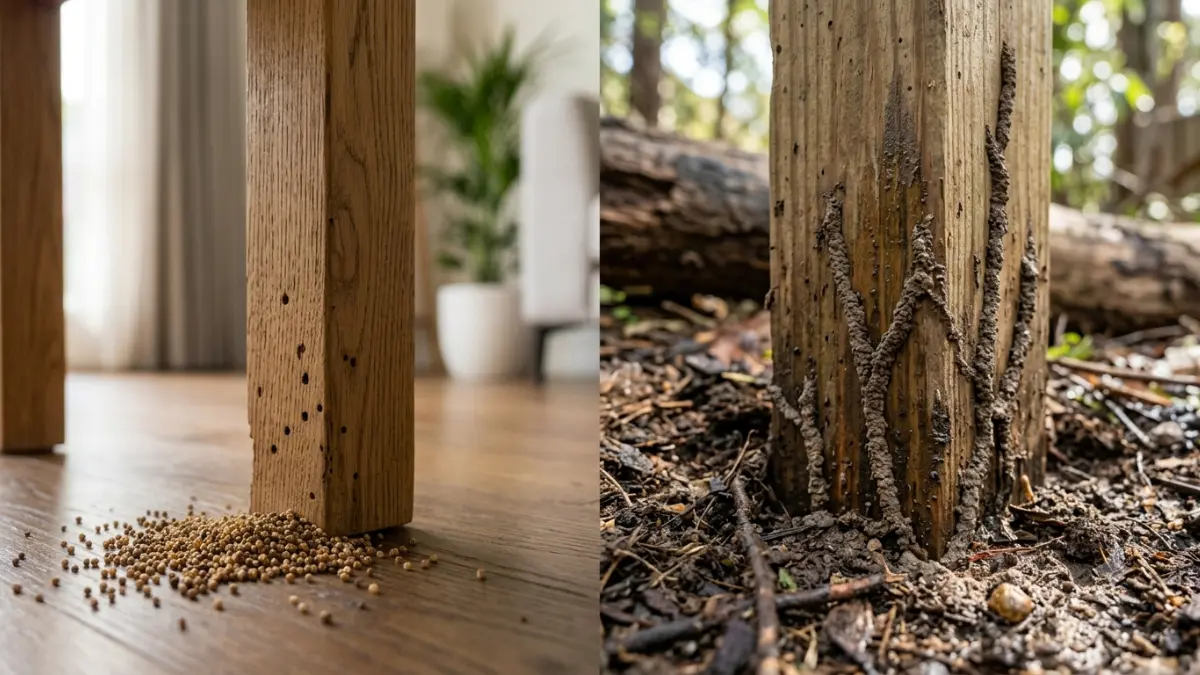
Drywood termites live entirely inside wood: no soil contact, moisture taken from the wood itself, no mud tubes — stated by both UC IPM’s drywood termite Pest Note, last updated in 2014, and the national Cooperative Extension guide. Subterranean termites nest in soil and reach wood from it, and the shelter tubes they build are the tell. If you are unsure which you have, our side-by-side on how the two types differ has the rest.
What the pellets tell you — and what they don’t
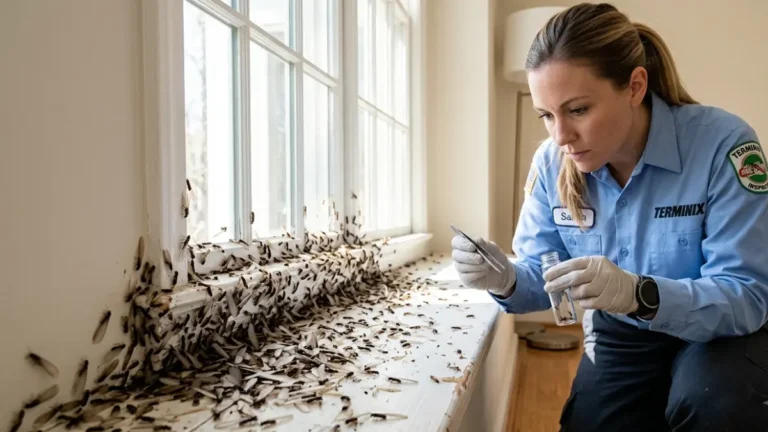
The fecal pellets are the usual first sign. University of Florida entomologists describe kick-out holes of roughly 1 to 2 millimeters, with pellets that are hexagonal in cross-section and range from cream through red to black.
Two details correct what you have probably read elsewhere, and our closer look at what termite droppings look like has more. Pellet color is not set by the wood being eaten, and the six sides show only under magnification — Clemson’s drywood termite factsheet, published in 2000, is explicit that you need a lens.

- Optical Glass Lens — This 10X Retro Reading Magnifier with high transmittance, brings clear image and distortion free …
- Premium Design — This magnifying lens comes with a sandalwood handle and copper frame, which feels like a coherent ent…
- Exquisite Gift — This magnifying glass with the upscale box will be a chic gift choice. The 10X MSLAN Handheld Magnifi…

- Premium Aluminium Alloy & Glass Lens: Folding magnifying glass with light made of high-quality aluminum alloy material, …
- 10X Magnification & Size: The visual diameter of the lens is 28 mm (1.1inch) with 10X magnification times, folding and s…
- Foldable Magnifier with 2 Led Lights: If you’re eyes are easily strained, but you still want to do some fabric project b…
Here is the part almost nobody publishes: pellets alone do not prove anything is alive in there. UC IPM, the University of Florida and the national Cooperative Extension guide all state that old pellets can be shaken loose from a long-dead or already-treated infestation by ordinary vibration.
Pellets tell you a colony was there. They do not tell you one is there now.
Mud tubes point at the ground, not the object
The test that separates the two is free. Clear away every pellet, slide a sheet of white paper under the piece, note the date, and look again in a few days. New pellets or live termites indicate an active infestation; nothing after several days means you found residue.

- PREMIUM QUALITY: 28lb bond/70lb text (105 gsm) bright white paper delivers exceptional print quality and professional re…
- VERSATILE USE: Perfect for everyday printing, copying, and writing tasks with excellent ink absorption and minimal show-…
- STANDARD A4 SIZE: Measures 8.27 x 11.69 inches (210 x 297 mm), compatible with most printers and copiers worldwide
🔍 Why It Works: Drywood termites keep their galleries clean by pushing waste out through a temporary hole that is then resealed. A fresh pile below a piece is therefore a by-product of recent feeding — which is why clearing the old pellets first turns a heap of debris into a dated result.
For a species confirmation, collect specimens rather than photographing them. Immature termites cannot be told apart reliably by eye, and a local extension office or licensed firm can identify a sample.

- Package: 50 count of 14X16 inch frosted shirt packaging bags
- Reusable Zipper: Designed with a convenient resealable zipper, frosted bags allow for easy opening and closing
- Premium Material: Plastic packaging bags are crafted with high-quality materials and feature a matte surface design, ens…
What can actually be done to a piece of furniture
The honest option set for a movable object is shorter than the search results suggest.
Removal first — the answer the extension services lead with
When an infestation is confined to a door, a piece of trim, or one piece of furniture, Clemson’s 2000 factsheet names removing and destroying the infested wood as the best course of action. The national Cooperative Extension guide to drywood termite control agrees for isolated infestations, using an old broken dresser as its example.
That is the option page one skips, and the one that costs you least.
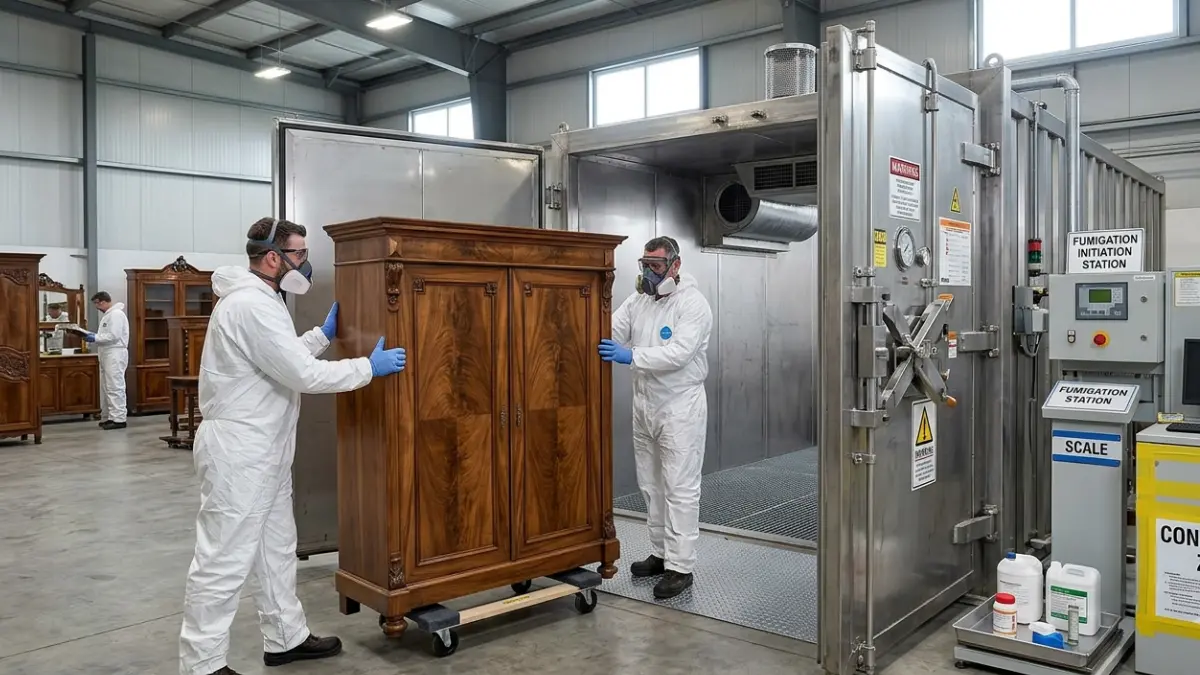
Vault fumigation: sending the piece out instead of tenting the house
If the piece is worth keeping, there is a route almost nobody names. In a vault fumigation the object goes to a sealed chamber at a pest control business — shared with other customers’ infested belongings — and the vault is fumigated rather than your house.
The national Cooperative Extension guide describes it as appropriate only in some circumstances, notes you may need to arrange movers, and reports it as considerably less expensive than tenting a whole structure. Clemson independently notes that some pest management professionals keep a chamber for furniture and other small wooden items.
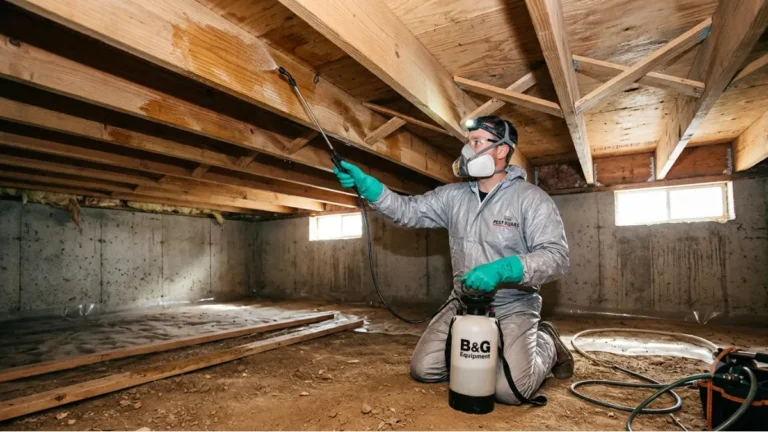
Fumigation of any kind is licensed work using a restricted-use product, never a do-it-yourself job; what fumigation preparation involves covers the whole-house version, and the pillar breaks down what each route costs.
Two things about the result matter. Once a fumigated space has been properly aerated no residue remains, so the piece is not carrying anything — and equally, nothing remains to stop it being infested again. UC IPM’s comparison table records the same “no residue” outcome for fumigants and heat.
Spot treatment — injecting product into galleries through drilled holes — is the fourth option and the most oversold. It cannot ensure eradication, does nothing to a colony the applicator has not found, and survivors can re-establish; UC IPM adds that with current detection methods nobody can be certain every infestation has been reached.
✅ Do This: Before booking anything, ask a licensed firm two questions — is this piece a candidate for a chamber or vault rather than a structural treatment, and what evidence supports treating the building rather than the object? Ask to see the company’s state license at the same time, and see our checklist on choosing a termite company.
What the freezer and oven advice actually says
This is the question most readers arrive with, and the answer is stranger than yes or no.
Three cold protocols, three different jobs
Three extension documents publish a cold treatment for wooden items, including the University of Kentucky’s chilling and heating procedures for household items. They are describing three different jobs.
| Document | Temperature | Duration | Key detail — what it is actually for |
|---|---|---|---|
| University of Kentucky, ENTFACT-640 (revised 2026) | −4°F (−20°C) | 7 days, wrapped and sealed in polyethylene | Powderpost and other wood-boring beetles, plus fabric and stored-product pests. Termites are not named in it. |
| Clemson Extension, HGIC 2420 (published 2000) | none stated | about two weeks in a large freezer | Drywood termites, specifically in small furniture |
| National Cooperative Extension (updated 2026) | around 20°F | very short exposure | Liquid nitrogen injected into galleries by a professional, with asphyxiation, burn and burst-pipe precautions |
Sourced from the three publications named, not from testing performed by Gladewick.
Read the table twice and the gap appears. One gives a temperature but is not about this pest; one is about this pest but gives no temperature; one gives both but describes an injection method no homeowner can carry out.
No document we located gives a homeowner-executable freezer temperature and duration for drywood termites. The confident numbers circulating online average sources answering different questions, and we will not add a fourth by splitting the difference.
Kentucky’s chilling procedure still contains a step every online version drops. The item is wrapped, sealed with the air pushed out, then returned to room temperature inside the bag — up to a full day for larger items — so condensation forms on the plastic rather than the wood.
Why the oven route closes on most furniture
Kentucky also publishes a heating procedure using a household oven on its lowest setting, roughly 150 to 170°F, for small wooden objects such as carvings and baskets.
It is explicitly not recommended for fabrics, oil paintings, or glued items. Furniture is glued — so the document publishing the oven method excludes the category you are asking about. The same page advises against microwaving altogether, because there is no way to know how long lethal temperatures take to reach.
📊 Sourced Spec: For structural heat treatment, UC IPM’s Pest Note (updated 2014) gives a minimum of 120°F held for at least 33 minutes in the core of the infested wood. The national Cooperative Extension guide gives the same 120°F interior threshold and notes higher temperatures work faster. This is a professional whole-structure or single-room figure, not an oven setting — and heat sinks such as wood against concrete can stop it being reached. Our guide to how heat treatment is actually carried out has the rest.
The two lines to read before you spray anything
If you are standing in an aisle holding a bottle, this section gives you a test rather than a recommendation.
What the label has to say before the product counts
The EPA’s guidance on termite pesticides puts it directly: if a product’s label does not include directions to control termites and protect the structure, the product is not intended to protect the structure against termites and should not be applied for that purpose.
That is the first line to check. The second comes from the national Cooperative Extension guide — the product must be labeled for the application site, which indoors means labeled for indoor use on drywood termites, and it must be non-repellent, because termites avoid repellent formulations and the treatment fails.
Two lines, ten seconds, and most of what is marketed for this fails one or both — what over-the-counter termite products are for goes through the categories, and where do-it-yourself treatment stops marks the boundary.
UC IPM is blunter. Its 2014 Pest Note states that home-use products are not effective against drywood termites, that the products needed to control them are not available for homeowner use, and that apart from removing the wood, homeowners should seek professional help.
If a piece or room has been treated professionally, “when is it safe again” has no general answer. The EPA notes re-entry timing varies by product and is stated on the label, so it is a question for the applicator.
The remedies that keep getting recommended
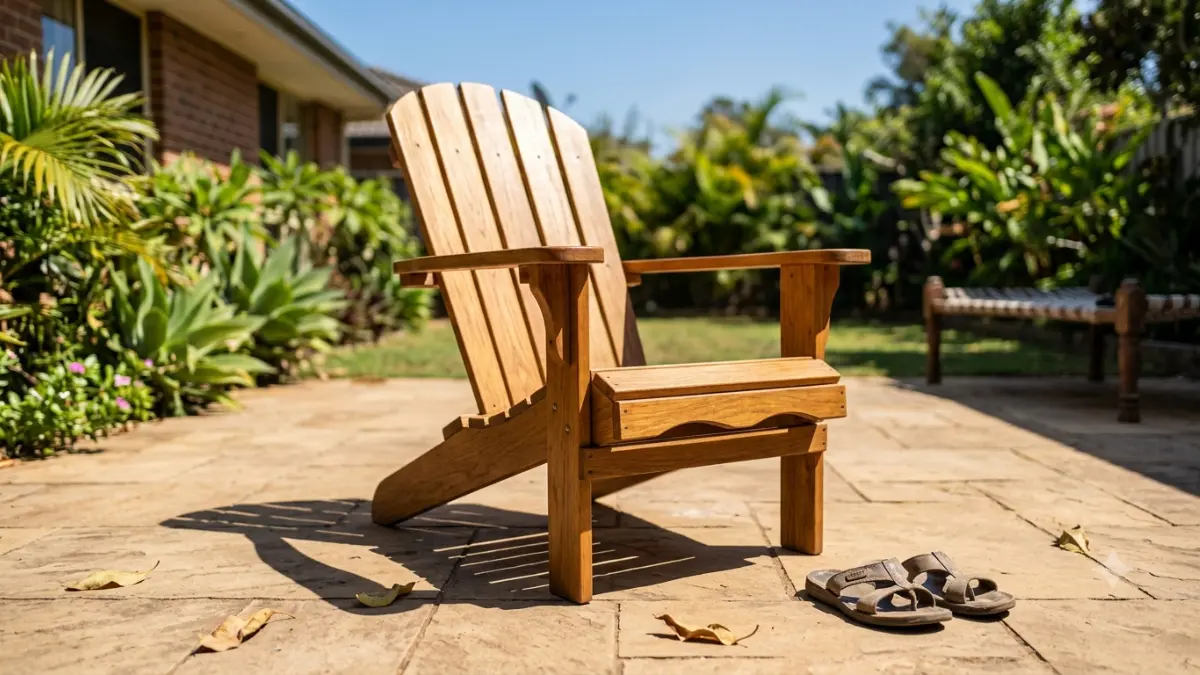
Sunlight deserves a fact rather than an opinion. Drywood termites are known to infest attics where wooden members can exceed 110°F, while the published lethal threshold is at least 120°F sustained in the core — so an afternoon on a warm patio sits inside what these insects live in normally.
Botanical products get similar treatment. UC IPM reports that laboratory and field tests from two universities have questioned the efficacy of d-limonene, the active constituent of orange oil, which has its own record.
As for olive oil, vinegar sprays and cardboard traps: no cooperative extension or regulator source we located recommends any of them for termites in furniture. That is an absence of support rather than proof of failure — but it is worth noticing before acting on a listicle.
⚠️ Watch Out: Applying a pesticide in a way its label does not cover is not a gray area, and many termiticides are highly toxic. If the bottle in your hand does not name termites, structural protection, and your application site, put it back and call a licensed pest control firm or your state pesticide regulatory agency instead.
Sheds are a building, not a big piece of furniture
A shed changes the question, because a shed is a structure on the ground.
Why a shed on the ground is exactly the wood the code singles out
Minnesota’s Department of Labor and Industry publishes a code fact sheet specifically about storage sheds, revised in May 2022. It makes a point most shed owners have never heard: a one-story shed of 200 square feet or less is exempt from a building permit, but not from the code.
That Minnesota fact sheet for storage sheds sets out where decay protection is required, citing residential code sections R317.1 and R317.1.2. Wood joists or the bottom of a wood structural floor closer than 18 inches to the ground, wood girders closer than 12 inches, and siding, sheathing or wall framing with less than 6 inches of clearance all have to be naturally durable or preservative-treated wood. For framed walls built directly on a slab, that state’s fact sheet requires at least six inches of clearance from untreated wood products to grade.
These are decay provisions, not termite provisions, and the distinction matters — our piece on what each clearance number actually governs works through why. The code is not telling you the shed is protected from termites — it singles out the exact assembly, wood at or near soil, that also gives a soil-dwelling colony a way in.
What termites in a shed tell you about the rest of the plot
Treat a shed finding as information about the ground, not a problem with an object. Subterranean termites reach wood from the soil, so a shed on skids in the dirt is not unlucky — it is the nearest available wood, and reading a mud tube tells you whether that route is still in use.
Pressure treatment is not immunity either. Extension guidance from Mississippi State and the University of Kentucky both note treatment may not reach the center of a timber, and that termites can enter through cracks and cut ends or tunnel across a treated surface.
One question is worth asking rather than assuming. If you hold a termite service agreement, ask which structures are actually named on it — detached buildings are not automatically included, and the agreement is the only place that answer exists.
Second-hand wood and when the object stops being the problem
If you are wondering whether you brought this in yourself: you might have, and it is not the freak event it feels like.

How these termites actually get from house to house
The University of Florida’s profile of the West Indian drywood termite, the species most associated with furniture, describes it as colonizing moisture-protected wood in service: houses, boats, furniture. Its appetite for wooden articles plus very low moisture requirements is exactly what has let people carry it around the world.
The same profile holds a startling detail. Outside a narrow strip of the Peruvian and Chilean coast, this termite has never been found in a natural habitat at all — it lives in things humans built and moved.
Timing explains why the problem stays invisible. Soldiers appear two to three years after a colony is founded, winged reproductives not until roughly year five, and colonies can last beyond ten years; Clemson’s factsheet puts fewer than 50 workers in a colony at two years.
A piece can carry a colony for years before doing anything you would notice. When it finally does, timing varies by species: the national Cooperative Extension guide has the western drywood termite swarming in daylight from late August into November, the southern drywood termite at night from May to November, and the West Indian species from April to early June with flights possible at other times.
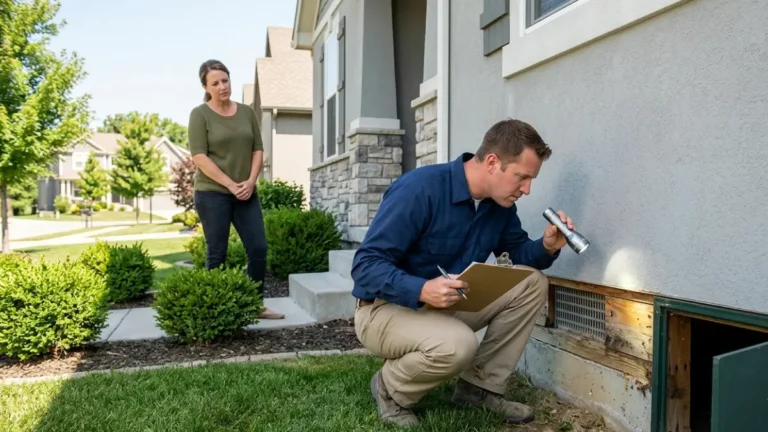
When to stop looking at the object and inspect the building
The escalation rule is clean. Evidence in more than one place, or evidence somewhere away from the object, means the building gets inspected rather than the object treated — and if a sale is involved, what termite damage does to a transaction is next.
The same pellet routine doubles as the post-treatment check. The University of Florida recommends removing all pellets and wings after treatment, after which new or growing piles, or fresh wings, typically indicate it did not work.
Prevention has an honest ceiling too. Caulking and fine screening — openings smaller than about a millimeter — reduce the winged reproductives that get in, but complete exclusion is described as almost impossible even in tightly built structures.
Termites in furniture: quick answers
1. What do termite droppings in furniture look like?
They look like coarse gritty grains in a small pile, roughly a millimeter long, in colors from cream through red to black. Color does not match the wood being eaten. The six flat sides that identify termites in furniture are only visible under magnification, and the pellets are pushed out through kick-out holes one to two millimeters across.
2. Does freezing furniture kill termites?
Possibly, but no source we found supports the numbers circulating online. Kentucky’s protocol of −4°F for seven days is written for wood-boring beetles, not termites. Clemson names drywood termites in furniture at about two weeks but gives no temperature. A licensed firm can tell you whether a cold treatment suits your piece.
3. Can I put a piece of furniture in the oven to kill termites?
No. The University of Kentucky publishes an oven method for small wooden objects, but it excludes glued items explicitly, and nearly all furniture is glued. The same document advises against microwaving, because there is no way to know how long lethal temperatures take to reach. Ask a licensed firm about chamber options instead.
4. Will leaving furniture in the sun kill termites?
There is no support for it. Drywood termites routinely infest attics where wood temperatures can exceed 110°F, while the published lethal threshold is at least 120°F sustained in the core of the wood. An afternoon outdoors does not approach that inside a piece. Treat sunlight as drying, not as treatment.
5. Can one piece of furniture be fumigated on its own?
Yes. It is called vault fumigation: the piece travels to a sealed chamber at a pest control business, alongside other customers’ infested items, instead of your house being tented. National Cooperative Extension guidance describes it as suitable in some circumstances and considerably cheaper than whole-structure work. You may need to arrange transport.
6. Should I just throw out termite-infested furniture?
It is the option extension services name first. Clemson’s factsheet gives removing and destroying the wood as the best course when an infestation is confined to one piece, and national Cooperative Extension guidance agrees for isolated infestations. For a valuable piece, ask a licensed firm about a chamber before deciding anything.
7. Is furniture safe to use after it has been treated?
After a fumigated space has been properly aerated, no residue remains behind on the treated furniture — which also means no protection against reinfestation remains either. For any other product, re-entry timing varies and is stated on the product label, so ask the applicator who treated the piece rather than relying on any general rule.
8. Do termites in my shed mean my house is at risk?
Not automatically, but it is a finding about your soil rather than about the shed. Subterranean termites reach wood from the ground, so a shed sitting on dirt is simply the nearest wood available. Have the property inspected by a licensed firm, and ask which structures your service agreement actually names.
Where to go from here
One question decides everything else: is the colony inside the object, or in the ground under it? Pellets and pinholes point at the object. Mud tubes and soil contact point at the ground, and no amount of treating the object will touch that.
The free next step takes five days. Clear every pellet away, slide a dated sheet of white paper underneath, and look again — new pellets mean live activity, nothing new means residue.
Then ask a licensed firm two questions: is this piece a candidate for a chamber, and what evidence supports treating the building rather than the object.
And take the extension services at their word on pace. Their published position is that you usually have time to decide — the opposite of the feeling the rest of the results page is built to create.