Crawl space termites and moisture share one common cause

Crawl space moisture readings need context: South Carolina reports 20% as excessive, but serious decay needs wood above about 30%.
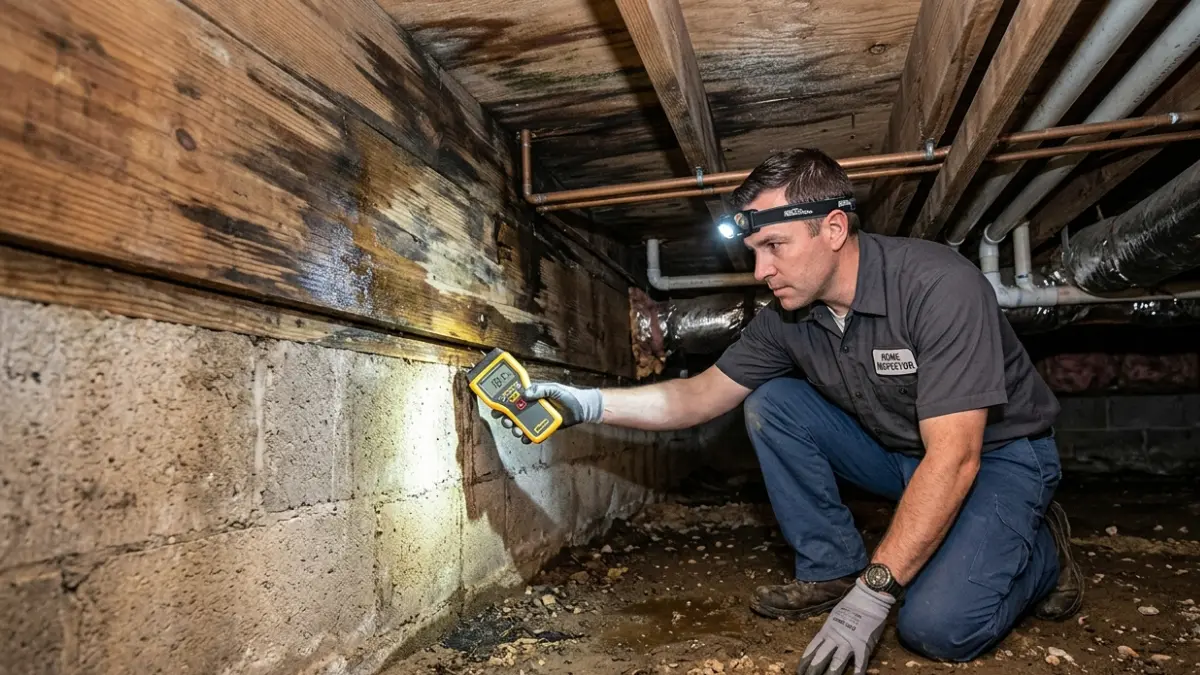
Table of Contents
A wet crawl space is a wood-decay problem first and a termite problem second. Fungi and subterranean termites want close to the same conditions, so the work that fixes one usually fixes the other. The order you do it in is what matters.
Where you are decides where to start. Got a moisture reading on an inspection report and no idea whether it is bad? Start with the thresholds. Standing water, a musty smell, or a soft spot in a floor? Go to the section on finding the water. Holding an encapsulation quote? Skip to the inspection gap, which carries a code requirement most quotes never mention.
Nothing here is for sale. This comes from a federal wood-science handbook, a university entomology text, one state’s pesticide regulation, and one state’s building code. Where a number belongs to a single state, it says so.
ℹ️ Safety Note: Crawl spaces carry confined-space, electrical, structural, and pest hazards, and the work described here touches pesticide-treated soil, building code, and load-bearing framing. Nothing below is an instruction to enter a crawl space or to carry out repairs. Use it for general understanding, then hire a licensed pest control operator, a licensed contractor, or your local building department, and follow local code and permit requirements.
What crawl space moisture actually does to the wood
Moisture does not summon termites. It rots wood on its own schedule, and rotted wood changes what termites do when they find it.
Rot arrives before the termites do
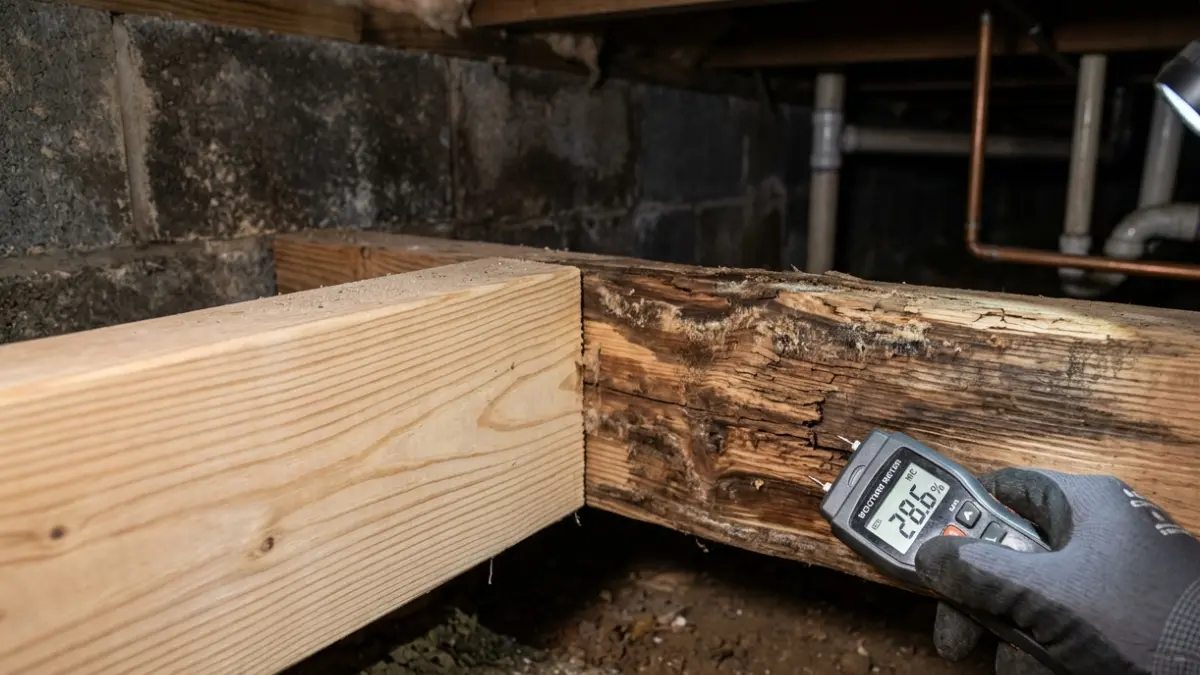
Wood-decay fungi and subterranean termites need much the same conditions, and eliminating those conditions controls both, according to the urban entomology text hosted by UC Riverside’s Department of Entomology. The same text notes fungi probably cause as much structural damage as termites do.
Serious decay only happens above the fiber saturation point, an average of 30% moisture content, per the Forest Products Laboratory’s chapter on wood biodeterioration. Humid air alone will not wet wood that far, though it will support some mold. Liquid water does it — rain, wet ground, or condensation.
That last one is the crawl space problem. The Forest Products Laboratory names soil moisture as the primary source of condensation on floor joists and subflooring, and says that condensation can create conditions favorable to decay and contribute to termite infestation. Our guide to telling rot from termite damage covers the differences, and a damp crawl space raises a separate mold question worth handling at the same time.
Why a damp crawl space changes what termites can do

- Accurate & Easy to Use – This pinless moisture meter offers quick, non-invasive readings without surface damage. Simply …
- Early Moisture Detection – Helps identify hidden dampness in floor, wood, and masonry, reducing the risk of long-term wa…
- Deep Sensing Capability – With up to 0.75 inches of penetration depth, this moisture detector provides reliable readings…
Subterranean termites need a constant moisture source, from the wood they feed on or the soil they nest in. Workers return through their shelter tubes to damp soil to replace moisture lost in the drier wood above.
Break that link and the termites above it die. Where wood stays wet on its own, a colony can survive without ground contact — rare for native species, but the Forest Products Laboratory notes the Formosan termite is adept at starting above-ground infestations where wood stays wet from leaks. Which species you have changes the whole picture.
🔍 Why It Works: Decayed wood is not just softer, it is more attractive. Eastern subterranean termites offered both ate 1.4 to 2 times more decayed than sound wood, and wood rotted by one brown-rot fungus produces a substance that triggers trail-following much as the termites’ own trail pheromone does. The honest caveat comes from the same source: attractiveness does not mean the fungus is good for them, and that study found it associated with generally decreased termite survival.
How wet is too wet, and who decides

- HUMIDITY SENSOR: Our handy meter tool can quickly determine what level of remediation is needed to keep your family safe…
- WATER LEAK DETECTOR: Finding the moisture content in your wood or drywall is the first step in early prevention. Continu…
- MOISTURE READER: The mold test features large 0.3″ high digits in a backlit LCD for quick and easy detecting. Our mildew…
There is no single number, and the numbers in circulation are not measuring the same thing.
What a moisture meter is actually reading

- CLOCK AND ALARM FUNCTION – Combines an indoor thermometer hygrometer with a clock and alarm for convenient everyday use….
- BATTERY INCLUDED, UP TO 12-MONTH BATTERY LIFE – Powered by one AAA battery, which is included for quick setup. A single …
- DUAL COMFORT INDICATOR – Quickly understand indoor conditions with two easy-to-read comfort indicators. The humidity ind…
A moisture meter reports wood moisture content — the weight of water in the wood as a percentage of its dry weight. One reading tells you little. South Carolina’s inspection standard calls for representative readings around the interior perimeter of the crawl space and in the accessible parts of the center, which is a reasonable pattern to ask for.
Wood can also be too wet for decay. Water-soaked wood does not supply the interior air typical decay fungi need, which is why the source matters more than the reading.
Four numbers, and what each one governs
| Reading | What it means | Where it comes from | Key detail |
|---|---|---|---|
| About 15%+ | Enough for anobiid powderpost beetles to infest | USDA Forest Products Laboratory | A risk where ventilation is poor, in humid regions, and where water condenses on cooled surfaces in air-conditioned buildings |
| 20%+, or standing water | “Excessive moisture conditions” that must be reported | South Carolina pesticide regulation | A reporting trigger in one state, not a biological event |
| Up to 20% | What fully air-dried wood usually reads | USDA Forest Products Laboratory | Described as a reasonable margin of safety against fungal damage — national guidance, not a rule |
| 28%+ | The level at which that regulation states decay fungi become active | South Carolina pesticide regulation | Again a reporting standard set by one state |
| Above about 30% | Serious decay occurs (fiber saturation point) | USDA Forest Products Laboratory | Needs liquid water — rain, wet ground, or condensation |
Sourced from the published documents named in each row. Gladewick did not take these readings.
📊 Sourced: The 20% figure does two different jobs. In South Carolina’s standards for termite and wood-destroying organism work it is the point at which an inspector must report excessive moisture. In federal wood-science guidance it is roughly what air-dried wood reads, offered as a margin of safety. Neither one is the point where decay starts.
If your reading came from a real-estate inspection, what the report is and is not covering is worth understanding before you act on it.
Find the water before you buy anything
The cheap steps come first because that is the order the documents put them in, not because we are being frugal.
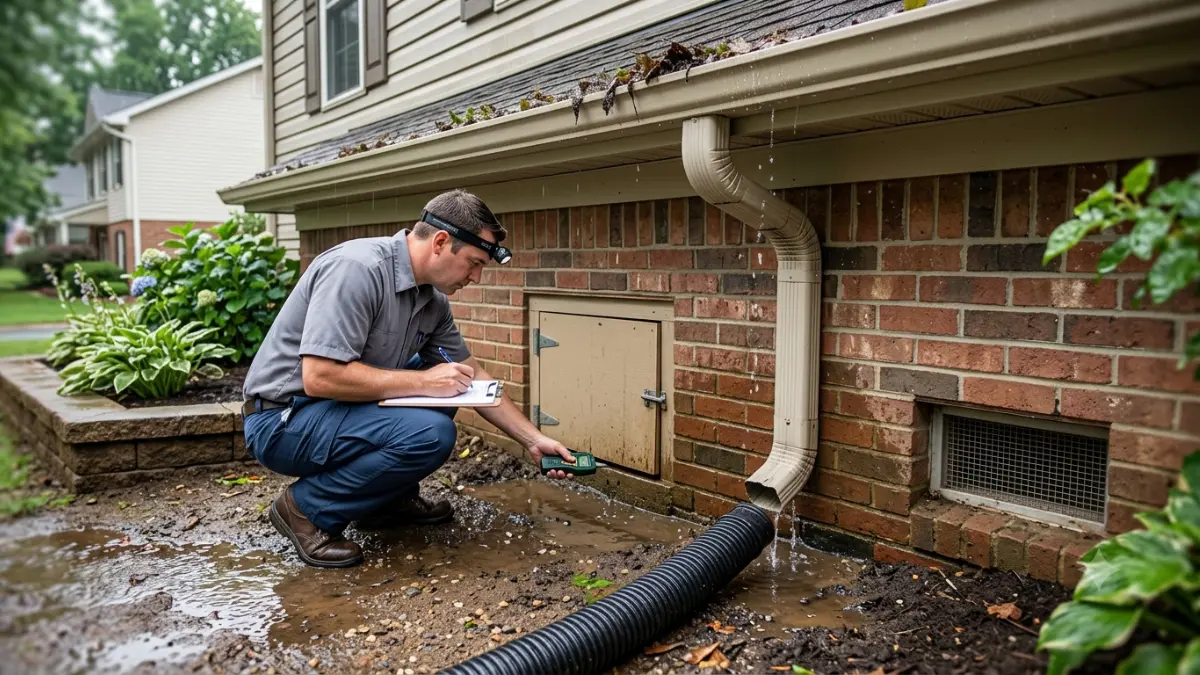
The water that arrives from outside
Start above ground. The Forest Products Laboratory’s guidance for keeping substructures dry is gutters, downspouts, and grading that moves rain and roof runoff away from all sides of the house, with a moisture barrier over the soil below. The ENERGY STAR closed crawl space reference puts the same items at the head of its moisture list, ahead of drains, sealing, and drying equipment.
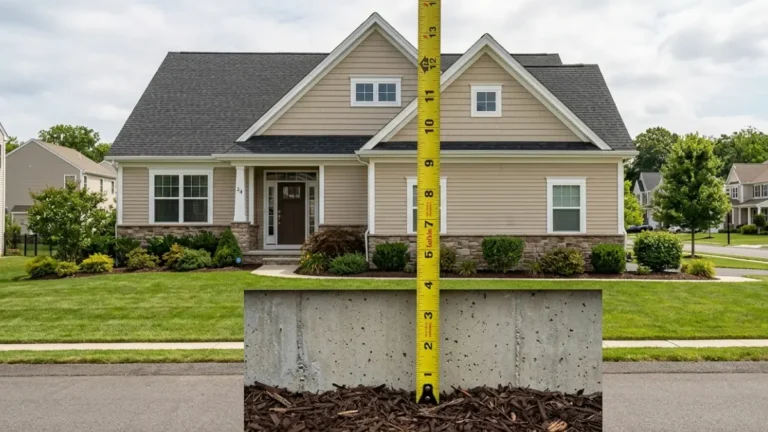
Then check the plumbing. Condensation or leakage invites both termite attack and decay, and the UC Riverside text singles out framing next to first-floor showers, bathrooms, toilets, sinks, and laundry areas as the places to examine first. What sits against the foundation matters too, which is why mulch depth and placement and wood-to-soil clearance outside the wall belong in the same afternoon’s work.
The water that was already under there
Debris comes out next. South Carolina requires cellulose debris — wood, paper, stumps, cloth — removed from crawl spaces on every initial termite treatment, along with form boards touching the soil or sitting less than eight inches above it.
Then the standing water. That regulation notes a sump pump may not be installed without a drain or trench system able to carry water to it, which rules out a pump dropped in a hole as a fix on its own. Condensate lines, appliance drains, and dryer vents belong outside the crawl space.
The clause worth knowing is the last one. Under the same regulation, fungicidal sprays to the substructure may not be applied until the physical correction of the excessive moisture conditions has been done. Chemicals come after the water, by rule.
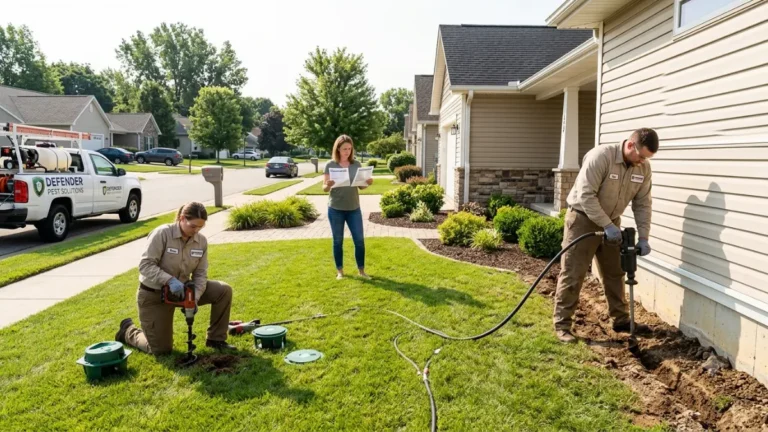
✅ Do This: Before anyone digs, regrades, or trenches near a foundation that has been treated for termites, call the company holding the contract and ask whether the work will disturb treated soil and what they need in order to keep coverage in force. For drainage design or excavation, use a licensed contractor and check permit requirements with your building department first.
Ground cover, clearance, and drying: what the rules require
Three separate things get called “a vapor barrier,” and they do different jobs.
Plastic on the ground is not plastic on the walls
A ground cover goes over the dirt. North Carolina’s closed crawl space code sets a minimum 6-mil polyethylene sheet over all exposed earth, joints lapped at least 12 inches, the floor graded to low spots, and a drain to daylight or a sump at each one — kept separate from gutter and foundation perimeter drains. The floor gets cleared of vegetation and organic material first.

- 【6 Mil Heavy Duty Plastic Sheeting –Thick & Tear-Resistant】 Made from premium 6 mil plastic sheeting, our heavy duty pla…
- 【Versatile Garden Plastic Sheeting – Ideal for Outdoor Use】 This durable black plastic sheeting for garden is perfect fo…
- 【Professional Vapor Barrier for Crawl Space & Moisture Protection】 Engineered as a reliable vapor barrier, this material…
Clearance is separate again. The Forest Products Laboratory puts floor joists at least 18 inches and girders at least 12 inches above the earth, and states the 18 inches is there to make inspection possible. South Carolina’s pesticide regulation sets a different figure for a different question: a minimum eight inches between untreated wood and soil, with enough room to inspect and to apply control measures.
Vents or no vents — what each document is answering
Here the sources genuinely diverge, and it is worth knowing why rather than picking one.
South Carolina’s regulation requires one square foot of ventilator per 150 square feet of crawl space with no unventilated dead ends, as a standard on termite treatments, and names added vents or a polyethylene ground cover as the normal moisture correction. North Carolina’s closed crawl space code prohibits foundation wall vents outright in that construction type and requires mechanical drying instead — a permanent dehumidifier rated at least 15 pints per day, supply air at 1 cfm per 30 square feet, or house air or exhaust at 1 cfm per 50 square feet. The ENERGY STAR closed crawl space reference reports that properly closed crawl spaces can control moisture better than wall-vented ones in temperate, humid climates.
None of those is wrong. One is a pesticide regulation setting minimum treatment standards, one is a building code governing a specific construction type, and one is a design reference built on field research. Which applies to your house is a question for your building department and your state’s structural pest control agency, and the answer can affect what a treated perimeter is expected to include.
Encapsulation, foam, and the gap that has to stay
Crawl space encapsulation does not stop termites. It is a moisture strategy, and it carries one requirement that quotes rarely mention.
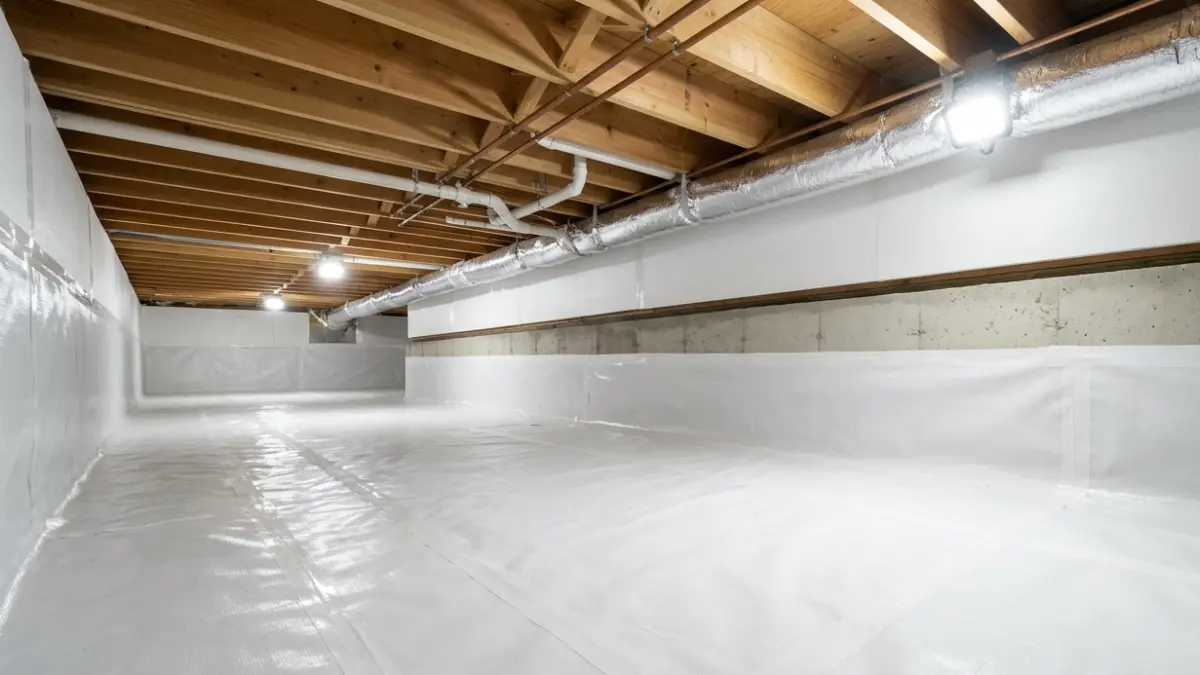
The three inches at the top of the wall
North Carolina’s code requires a clear, unobstructed termite inspection gap of 3 inches minimum and 4 inches maximum between the top of the wall liner and the bottom of the wood sill, with the liner terminating 3 inches below the top of the masonry wall. Foam plastic insulation gets the same gap at the top, plus a continuous 3-inch clearance at the bottom because ground contact is not allowed. Porous insulation gets the same, plus a wicking gap.
The code then says the gap may be ignored for energy-performance purposes and is not intended to create an energy penalty. The calculation is not allowed to squeeze it out.
The reason is sight lines. The ENERGY STAR reference describes the gap as being there to make detection possible, specifies batt insulation at the band joist so it can be removed for inspection or treatment, and suggests a light-colored coating over the gap to make the wall easier to read. That strip is where an active mud tube becomes visible instead of hidden.
What a sealed crawl space does to a termite contract
South Carolina’s regulation treats rigid polystyrene foam board and similar materials, including synthetic stucco systems, the same as untreated wood in ground contact — and says treating the adjacent soil alone does not satisfy the requirement.
Its new-construction warranty section goes further. The requirement to issue coverage does not extend to structures with sealed or encapsulated crawl spaces and open- or closed-cell spray polyurethane foam, nor to structures with rigid foam board of any kind below exterior grade, nor to those whose ground clearance prevents the minimum treatment standards being completed. ENERGY STAR gives the practical version: coordinate with your pest management professional so the system does not interfere with treatment or affect the warranty.
That regulation also requires debris removal, correction of wood-to-ground contact including foam insulation, and shelter tube removal to be completed or formally waived, with the waiver signed by the owner before work begins — and waivers must not be used to sell a treatment using less labor or termiticide. The clauses that decide whether a claim pays are worth reading against your own contract, alongside what a full treatment is meant to cover.
⚠️ Watch Out: If a completed encapsulation runs liner or foam right up to the sill with no gap, nobody can see the top of the foundation wall — which is exactly where a shelter tube crosses. Ask your installer which code applies in your jurisdiction and ask your pest control company, in writing and before the work, whether the system affects your coverage.
When it stops being a moisture job
At some point this stops being about drying and starts being about structure. That line arrives earlier than most people expect.
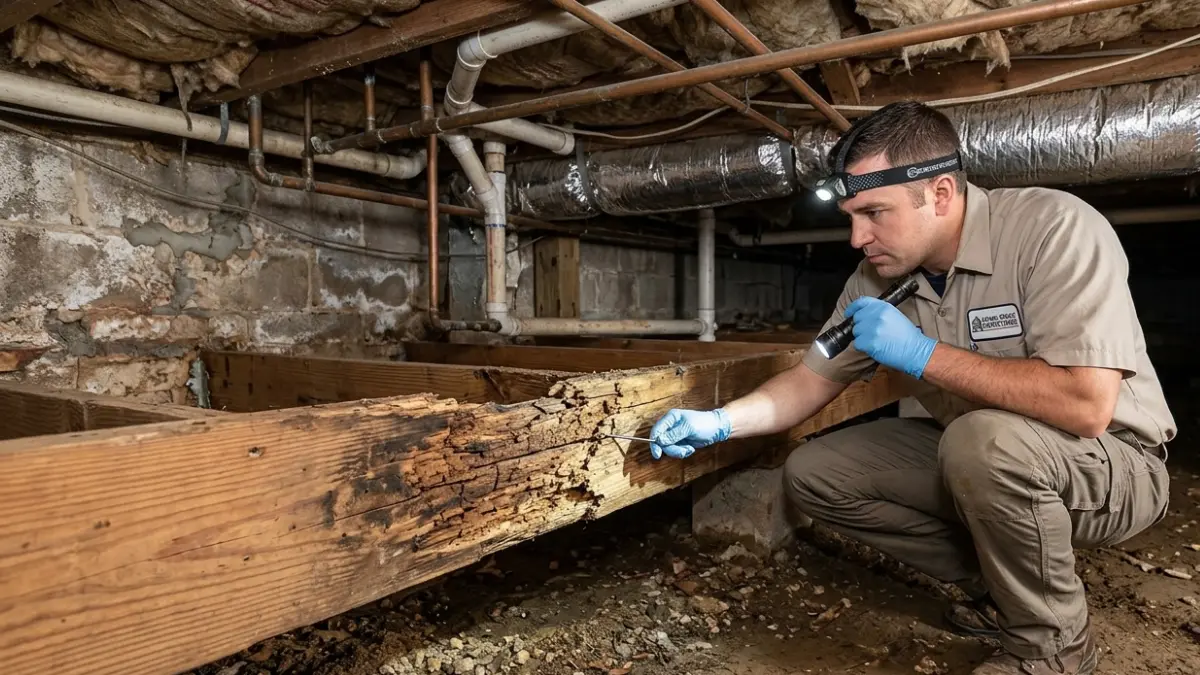
Visible rot has already cost you strength
Decay takes toughness first. Forest Products Laboratory figures put toughness losses between 6% and more than 50% by the time the wood has lost 1% of its weight, and most strength losses above 50% by 10% weight loss — a point at which decay is still only detectable under a microscope.
The conclusion drawn there is blunt: wood with visible decay may be assumed to have greatly reduced strength in all respects. Seeing it does not mean you caught it early.
What replacement wood has to be
Fix the moisture first, then the wood. Where the moisture source is fully eliminated, the guidance is to replace weakened members with dry lumber; where it cannot be, replacement should be preservative-treated or all-heartwood of a naturally durable species — which is the same grade question that decides outdoor framing.
Carpenter ants also prefer wood softened by decay, so a rot problem can bring a second organism with it. Assessment of any load-bearing member belongs to a licensed contractor or structural engineer, and any live infestation to a licensed pest control operator. If you are not sure what you are looking at yet, start with the signs worth checking for.
Crawl space moisture and termites: common questions
1. Does a wet crawl space mean I have termites?
No. Crawl space termites and moisture travel together because fungi and subterranean termites need similar conditions, but dampness alone is a decay problem. Moisture changes what termites do once they arrive: decayed wood is eaten more readily, and wood that stays wet supports a colony with less dependence on soil.
2. What is a normal wood moisture reading under a house?
There is no single normal. Fully air-dried wood usually reads up to 20%, which federal guidance calls a reasonable margin of safety against fungal damage. South Carolina requires 20% or above, or standing water, to be reported as excessive moisture. Serious decay needs wood above roughly 30%.
3. Do I need a vapor barrier or a dehumidifier first?
Neither. Roof runoff, grading, drainage, plumbing leaks and debris removal come first, because both the federal guidance and South Carolina’s regulation sequence physical correction ahead of everything else. A dehumidifier running over standing water treats the symptom. Fix the source, cover the ground, then dry the air.
4. Should I close my foundation vents?
That depends on your jurisdiction and construction type, and the documents differ. South Carolina’s pesticide regulation requires one square foot of ventilator per 150 square feet on treatments; North Carolina’s code prohibits wall vents in closed crawl spaces and requires mechanical drying. Ask your building department first.
5. Does encapsulation void a termite warranty?
Not automatically — it is a contract question, not a general rule. South Carolina’s regulation states its new-construction warranty requirement does not extend to structures with sealed or encapsulated crawl spaces and spray polyurethane foam. ENERGY STAR advises coordinating with your pest management professional. Ask your own company, in writing, before work starts.
6. What is a termite inspection gap?
A deliberate strip of bare foundation wall left uncovered so shelter tubes stay visible. North Carolina’s closed crawl space code sets it at 3 inches minimum and 4 inches maximum between the top of the liner or insulation and the wood sill, and states the energy calculation cannot remove it.
7. Can foam insulation in a crawl space cause termite problems?
It can create an inspection problem and a code problem. South Carolina’s regulation treats rigid polystyrene foam board and similar materials as equivalent to untreated wood in ground contact, and says treating the soil beside it is not enough. Its warranty section separately excludes foam extending below exterior grade.
8. Is it rot or termites?
They look different and often occur together, since both follow the same water. Brown rot removes cellulose, browns the wood, cracks it across the grain and crumbles it, and it commonly colonizes the softwoods used for crawl space framing. Termite galleries are a different pattern entirely.
Where to start tomorrow
The order is the useful part. Move water away from the house, fix the leaks, clear the debris, cover the soil, then dry the air — and treat chemicals as the step that comes after the water is physically dealt with, which is what one state’s regulation requires.
If you already have an encapsulation quote, ask three things: whether the design leaves a termite inspection gap at the top of the wall, which code applies where you live, and whether your pest control company has confirmed in writing that the system does not affect your coverage. For what a full treatment consists of, our parent guide to termite treatments and costs covers the ground this article left alone.