Borate termite treatment offers real protection within limits

Borate termite treatment makes wood inedible to termites — but only bare wood, and the EPA label bars it from soil entirely. Here’s where that leaves you.
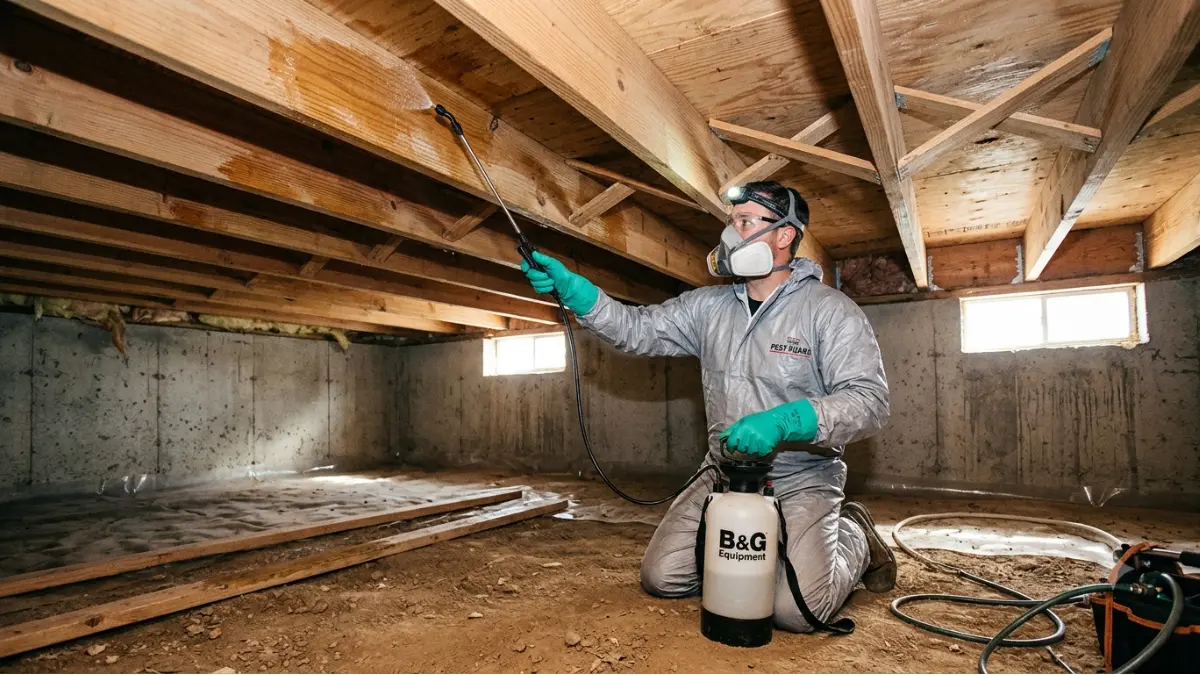
Table of Contents
Borate termite treatment genuinely works — on the wood you can reach and keep dry. What it does not touch is the route termites take to get there, and that one distinction decides whether it belongs in your house as a primary treatment, a supplement, or not at all.
Three people usually land on this page.
- You’ve been quoted for a liquid barrier or bait system and want to know whether borate can replace it. Start with the four gaps.
- You have framing open — a new build, a renovation, a bare crawl space. You’re the reader this product was designed for; the fit and cost sections are yours.
- You have termites in the structure right now. Borate is part of an answer, not the answer, and the last section explains why.
Worth knowing before you read further: nothing here was bench-tested, and no product is rated or ranked. Every number traces to the EPA-stamped label or a cooperative extension source, and if a figure couldn’t be verified, it isn’t printed. If you’re still comparing methods, start with what the five main termite treatments actually cost.
ℹ️ Safety Note: Borate wood treatments are EPA-registered pesticides carrying the signal word CAUTION, and applying one is a chemical job in an occupied building. The information here is for general understanding, not application instructions. If termites are active in your structure, or if you’re unsure whether your state allows homeowner application, hire a licensed pest control operator and check your state’s structural pest control rules first.
What borate actually does to a termite
Bora-Care is a concentrate containing 40% disodium octaborate tetrahydrate, a boron-based mineral salt, registered with the EPA under registration number 64405-1. It isn’t sprayed at insects. It’s driven into wood, and the wood becomes the delivery system.
The active ingredient, and why the carrier matters
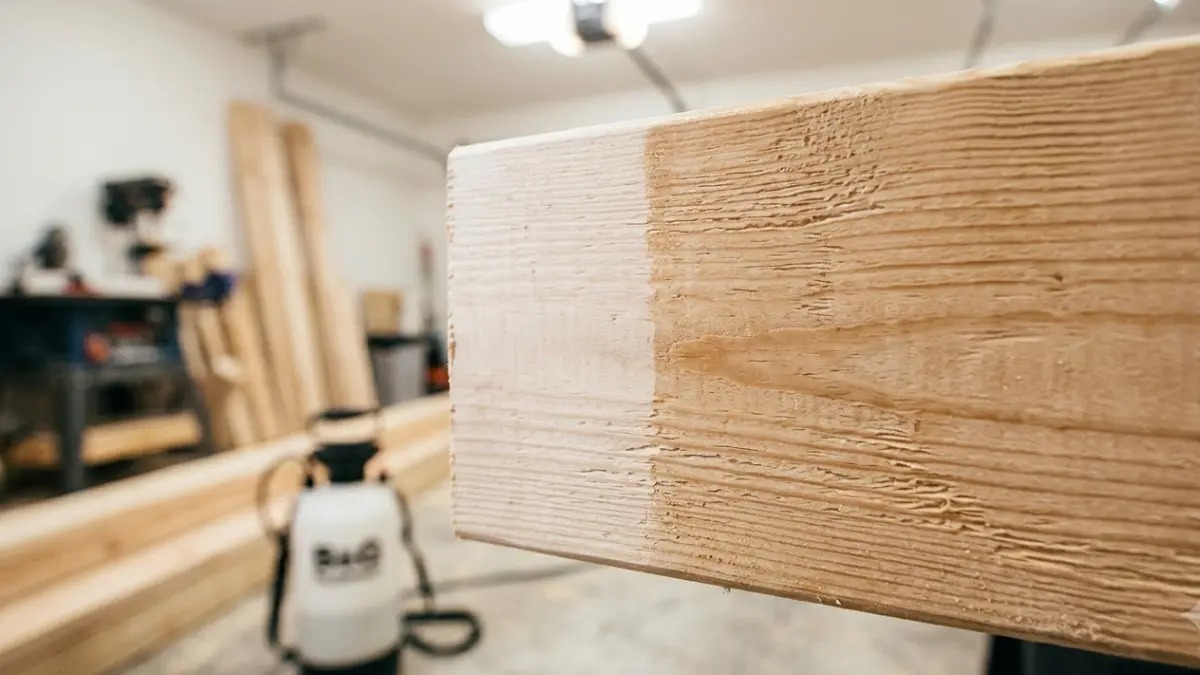
The borate itself is the same compound across every product in this category. What separates a liquid concentrate from a plain borate powder is the carrier — the manufacturer’s stated design is a glycol blend that pulls the salt deeper into the timber rather than leaving it on the surface.
That is a manufacturer claim rather than an independently verified finding, and it’s worth reading it as one. The regulatory facts — the active ingredient, its concentration, the permitted uses — come from the EPA-stamped product label. The penetration mechanism comes from the company that sells it.
Why termites can’t build resistance to it
🔍 Why It Works: Termites eat cellulose. Borate-treated wood is still cellulose, so they consume it, and the borate disrupts their gut and nervous system. Because the mode of action is metabolic rather than neurological, it doesn’t select for the kind of resistance that develops against conventional insecticides.
There’s a limit to that story, and the label states it plainly: once colony members start dying on a food source, the rest usually stop feeding there and pull back. Treated wood protects itself — it doesn’t guarantee the colony dies. That distinction matters more for subterranean than drywood termites, and it shapes how long any termite treatment takes to work.
The National Pesticide Information Center notes that borate wood preservatives are used mainly on wood kept away from the weather, and have been used on structural elements like sill plates and sheathing for more than seventy years.
The four things borate can’t do
This is the section a product page can’t write, and it’s the reason most people are actually here.
It treats wood, not soil
The label is unusually direct about this: Bora-Care is not intended for soil application and is not a soil termiticide. Subterranean termites live in soil and travel through it, so a borate treatment leaves that route completely untouched. If a soil barrier is what your situation calls for, that’s a different product class entirely — see bait systems versus liquid soil barriers.
It has to reach bare wood
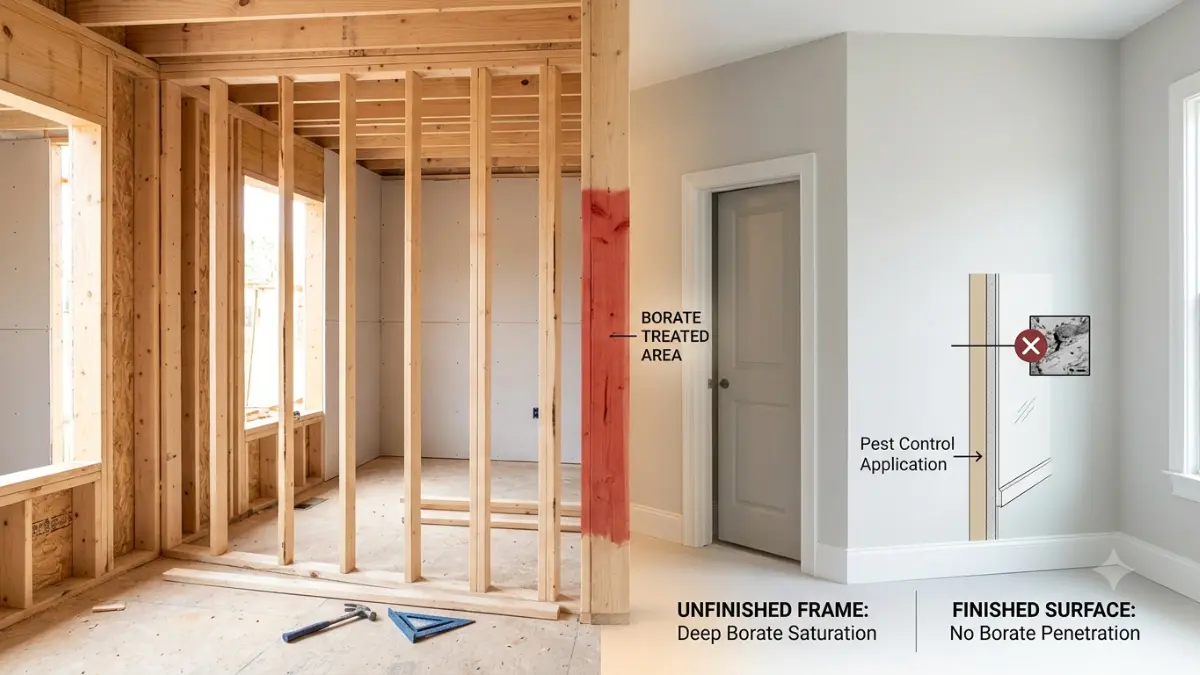
Borate solutions may only be applied to bare wood where no intact water-repellent barrier — paint, stain or sealer — is present. Painted trim, finished floors, sealed siding and anything sealed behind drywall are all out of reach unless the finish is stripped or the wall is drilled and injected.
Water moves it
Borate is water-soluble, which is exactly why it diffuses through timber — and exactly why rain and ground contact wash it back out. The label restricts application during rain or snow, requires treated exterior wood to stay dry for at least 48 hours, and states that wood in ground contact needs periodic reapplication.
A treated house can still show a mud tube
NC State Extension notes that termites can still reach a slab home through an expansion joint and attack untreated wood nearby, such as baseboard trim. Under North Carolina’s rules, a mud tube on a wall must be reported on a wood-destroying insect report whether or not termites are found in it — even where the wood was treated. Inspection-reporting rules are set state by state, so check yours before assuming a treatment clears a sale. Learning to tell an active mud tube from an abandoned one is worth the ten minutes.
⚠️ Watch Out: University of Kentucky extension entomologists point out that pressure-treated wood is still vulnerable — termites enter through cracks and cut ends, or simply tunnel across the surface. The same physics applies to borate-treated framing. Treating wood raises the cost of the journey; it doesn’t close the road.
Where borate is the right call
Four gaps sounds damning until you look at the houses where none of them apply. In those situations this stops being a compromise and becomes the obvious tool.
New construction and renovations, while the framing is open
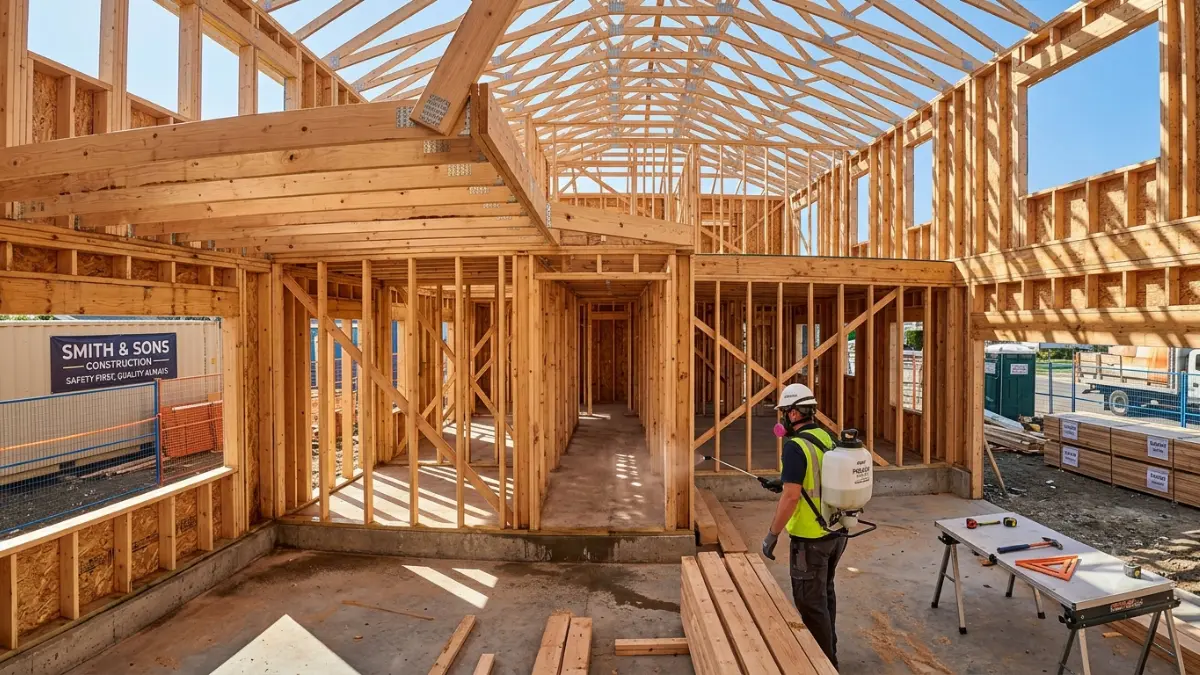
The label defines the sweet spot as the dried-in stage — wood in contact with foundations, sill plates, studs, sheathing, floor joists and subflooring, treated after final framing inspection and before insulation and drywall. NC State Extension lists wood treatment as one of four permitted new-construction termite protection methods in North Carolina; other states set their own rules, so confirm yours.
Crawl spaces, attics and bare framing
An unfinished crawl space or attic is already in the right condition: bare wood, accessible on multiple faces, sheltered from rain. This is also where a supplemental treatment earns its place in a high-pressure region — worth reading alongside what makes Formosan termites a different problem.
Log homes, timbers and exposed beams
Thick timber is where the deep-penetration formulation was originally built to work, and the label carries separate 1:1 instructions for logs, beams and members over four inches. The label also positions borate as a supplement or alternative to whole-structure fumigation for long-term residual protection.
✅ Do This: Before buying anything, walk the space and check five things — is the wood bare, dry, reachable on at least one face, out of ground contact, and protected from rain? If any answer is no, fix that first. Borate applied to wood that fails the checklist is money spent on a treatment that won’t hold.

- Self locking mechanism allows blade to be extended smoothly
- Push button allows blade to be retracted smoothly
- Nylon coated blade for maximum durability
What a gallon really covers, and what it costs
If you’ve shopped this product, you’ve seen coverage quoted as 500, 800, 1,600 and 2,000 square feet per gallon — on different pages, for the same product. All four numbers appear on the label. None of them means what a shopper assumes.
Why every retailer quotes a different number
Two variables get dropped in the retelling. Coverage rate is published per gallon of finished solution, not per gallon of concentrate, and it changes with material thickness. A gallon of concentrate mixed 1:1 makes two gallons of solution, so it covers twice the label figure.
The label’s own coverage figures
📊 Sourced Spec: All figures below are per gallon of finished solution, taken from the Bora-Care label accepted by the EPA on 26 June 2020 (EPA Reg. No. 64405-1). Verify against the current label before you buy.
| Where you’re treating | Label mix | 1 gal of solution covers | Key detail |
|---|---|---|---|
| Crawl space / basement floor area — subfloor, joists, headers, sill plates | 1:1 | 200 sq ft | Two coats where only 1–2 faces are reachable |
| Crawl space or basement walls, 8 ft high | 1:1 | 50 linear ft | Anti-tubing band, 2 ft up from the ground |
| Concrete or block foundation wall band | 1:1 | 400 sq ft | Blocks shelter tubes on masonry |
| Slab home base plates + bottom 2 ft of studs | 1:1 | 200 linear ft of stud wall | The primary slab pretreatment rate |
| 2×4 dimensional lumber | 1:1 | 600 linear ft | 2×6 drops to 400 linear ft |
| ½-inch sheathing or panelling | 1:1 or 2:1 | 800 sq ft | 1-inch material halves it to 400 sq ft |
The 1,600 sq ft figure is quarter-inch panelling. The 500 sq ft figure is wood flooring at a 2:1 mix. Neither describes crawl-space joists, which is what most buyers are actually treating.
What that costs
One critical constraint: subterranean and Formosan termite treatment requires the 1:1 mix, the most concentrate-hungry ratio on the label. The thriftier 5:1 dilution is for drywood termites, beetles and rot — not for the subterranean prevention most homeowners want. Concentrate ran roughly $95–$100 per gallon across pest-supply retailers when checked on 25 July 2026; professional application is quoted per job, not per square foot, so get two quotes rather than trusting an online average. Run your surface area through a square footage calculator before ordering.

- ELIMINATES AND PREVENTS MOLD, FUNGI, AND DECAY: Effectively eliminates existing mold and prevents future growth, protect…
- LONG-LASTING WOOD PROTECTION: Penetrates deep into wood to provide residual protection that lasts for years; prevents da…
- IDEAL FOR NEW CONSTRUCTION AND WATER DAMAGE RESTORATION: Perfect for whole-house protection in new builds or applying to…
Liquid concentrate vs borate powder
Here’s what surprises most people comparing the two: they’re the same active ingredient. Disodium octaborate tetrahydrate is what does the killing in both a glycol-carrier liquid and a water-soluble powder, so the choice is about the job, not about which product is better.
Gladewick has not bench-tested either format. What follows compares them on their labels and on published sources only, and no product here is rated, ranked or recommended.
What the glycol carrier buys you
The liquid concentrate’s stated advantage is depth — the carrier is designed to move borate into thick timber rather than leaving it near the surface. That matters for logs, beams and members over four inches, where the label carries dedicated instructions.
Where a powder is the better choice
A water-soluble powder mixes thin, sprays cleanly through basic equipment, and costs less per treated square foot on light preventive coats of sheathing and framing. It’s the more practical choice when you’re covering large areas of thin material rather than saturating heavy timber.

- Chapin Garden Sprayer: Complete lawn care and basic cleaning tasks faster with the 1‑gallon translucent funnel‑top tank …
- Reliable performance: Achieve consistent spray coverage of weeds, pesticides, fertilizers, Mulch Glue and general sprayi…
- Comfortable handling: move easily around the yard during garden, cleaning and lawn maintenance jobs thanks to the lightw…
💡 Pro Tip: The label says hot water isn’t required for mixing — warm water only speeds dilution. That contradicts several retail pages that insist on it. What the label does require: mix in a separate container first, never directly in the spray tank, because undiluted concentrate blocks hoses and nozzles.
Still weighing the wider category? See how other retail termite products compare on what they actually control.
Doing it yourself, and when not to
Yes, if three things are true — and no if any one of them isn’t.
The three conditions
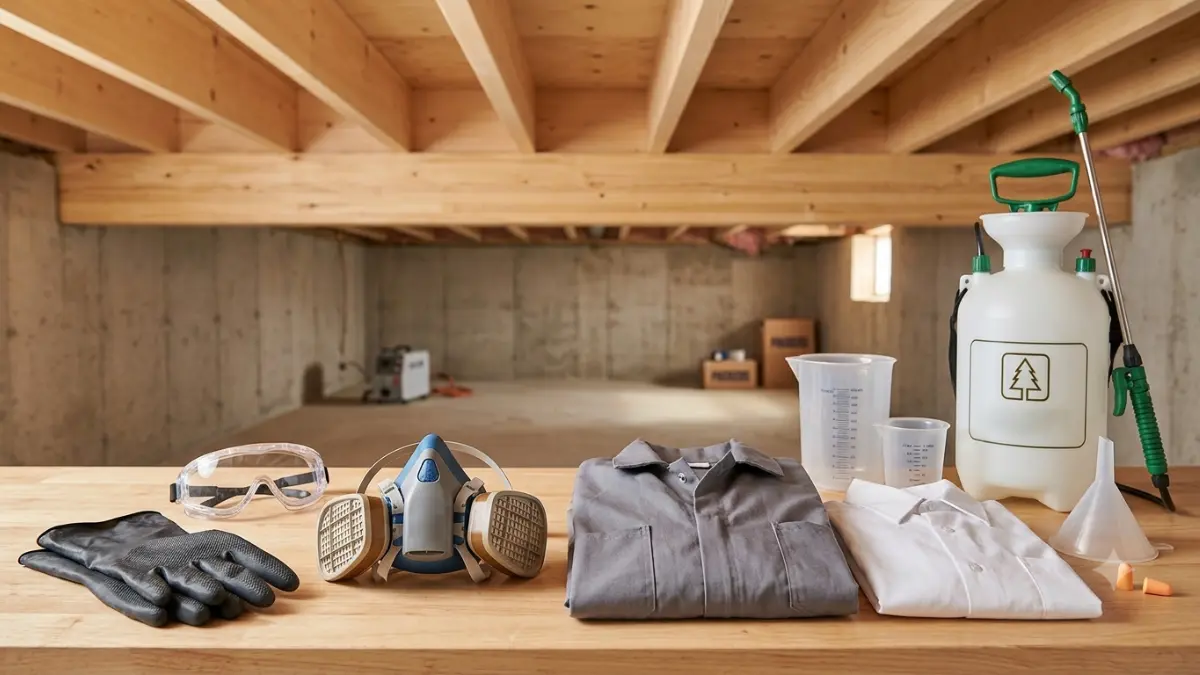
One: no active infestation. Live termites in a structure is a diagnosis-and-treatment job, not a wood-treatment job. Two: you can meet the label’s protective equipment requirement — long sleeves and trousers, socks, shoes, chemical-resistant gloves, protective eyewear, and a NIOSH-approved respirator with organic vapour cartridges. That last item is on the label and on almost no retail page. Three: your state allows it. The label itself directs users to check with their state regulatory agency for requirements beyond the label, and structural pest control licensing varies widely. For the wider picture, see when DIY termite treatment makes sense.


Kids, pets and treated surfaces
The label requires that treated areas stay unoccupied during application, that nobody re-enters until the solution has absorbed into the wood, and that pets be removed and aquarium pumps switched off and covered.
⚠️ Watch Out: Skip the phrase “non-toxic” wherever you see it applied to this product. NPIC’s boric acid fact sheet describes boric acid as low in toxicity if eaten or on skin, but notes borax forms can be corrosive to the eye, and that infants are more sensitive. If a child or pet swallows any product, call Poison Control at 800-222-1222.
✅ Do This: If any of the three conditions fails, hire a licensed pest control operator. Ask two things: whether your state permits homeowner termiticide application on your own structure, and whether the work needs documenting for a wood-destroying insect report or a transferable warranty.
Borate termite treatment: common questions
1. Does Bora-Care really work on termites?
Yes, within its design. Borate termite treatment makes wood toxic to termites that eat it, and the mode of action doesn’t select for resistance. But it protects treated wood rather than eliminating a colony — the label notes surviving colony members typically retreat from a food source once others die on it.
2. Can borate treatment replace a soil termiticide?
Sometimes, and the deciding factor is whether every piece of wood termites can reach is bare and accessible. The label states plainly that this product is not a soil termiticide and must not be applied to soil. Where a soil barrier is required by your state or by your situation, borate supplements it rather than substituting for it.
3. How long does borate wood treatment last?
The label describes protection as long-lasting provided the treated material isn’t exposed to rain, continuous water, or direct ground contact. Those three conditions are the whole answer. Wood in ground contact has a limited service life and needs periodic reapplication regardless of how well the first treatment went.
4. Can I apply Bora-Care myself?
Only if there’s no active infestation, your state permits homeowner application, and you can meet the label’s protective equipment requirement — which includes a NIOSH-approved respirator with organic vapour cartridges, not just gloves and goggles. If any of those fails, hire a licensed pest control operator.
5. Is borate treatment safe around kids and pets?
It requires real precautions. The label states treated areas must not be occupied during application, that nobody re-enters until the solution has absorbed, and that pets be removed and aquarium pumps covered. NPIC describes boric acid as low in toxicity if eaten, but notes infants are more sensitive. Call Poison Control on 800-222-1222 after any ingestion.
6. Will borate kill an active termite colony?
Not reliably on its own. Termites that feed on treated wood are killed, but the label notes that colonies commonly stop feeding on a source once members die there and retreat elsewhere in the structure. An active infestation warrants inspection and treatment by a licensed pest control operator.
7. Can you apply borate over painted or stained wood?
No. The label permits application only to bare wood where no intact water-repellent barrier — paint, stain or sealer — is present. Existing finishes have to be removed first, or the wood accessed another way. This is why borate termite treatment fits open framing so well and finished rooms so poorly.
8. How much does borate termite treatment cost?
Concentrate ran roughly $95–$100 per gallon across pest-supply retailers when checked in July 2026, and how far a gallon goes depends entirely on the mix ratio and material. Professional application is quoted per job rather than per square foot, so collect two quotes rather than relying on a published average.
9. Does borate-treated wood still fail a termite inspection?
It can still generate a finding. NC State Extension notes that under North Carolina rules a mud tube on a wall must be reported on a wood-destroying insect report whether or not termites are in it, even where the wood was treated. Reporting rules vary by state — confirm yours before a sale.
10. Can borate be used on exterior or ground-contact wood?
Exterior wood, yes, with conditions: no application in rain or snow, no rain exposure for at least 48 hours, and a water-resistant topcoat within six weeks. Ground-contact wood is different — the label states that treatment there has a limited lifespan and requires periodic reapplication.
So is borate worth it?
Borate is excellent at what it does and narrow in what it covers, and the deciding question is whether your wood is bare, dry and reachable.
If your framing is open, treat it now — the window closes when the drywall goes up. If you’re holding a quote for a soil or bait treatment, borate is a supplement to that quote rather than a replacement for it, unless every reachable piece of wood in the structure clears the four gaps. If termites are active in your house, book the inspection first and treat the wood second.
Then compare it against the other four treatments before you spend anything.
Related Articles
 Termite Treatment
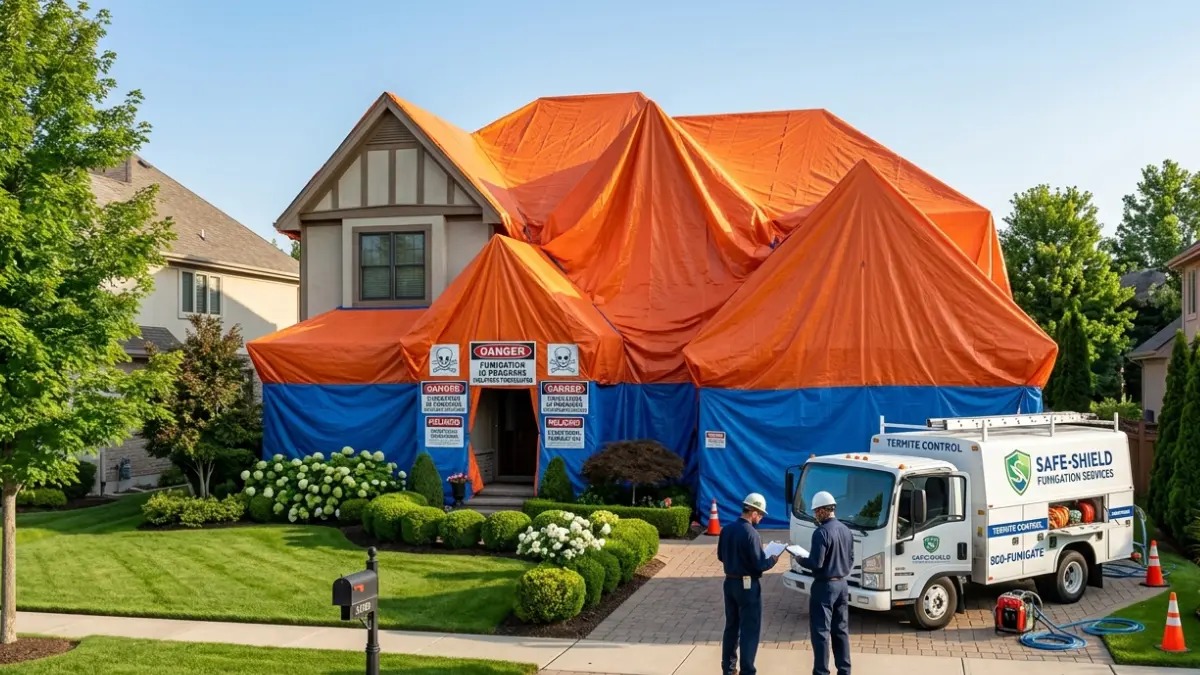
How to Prepare for Termite Fumigation and Avoid Costly Risks
July 21, 2026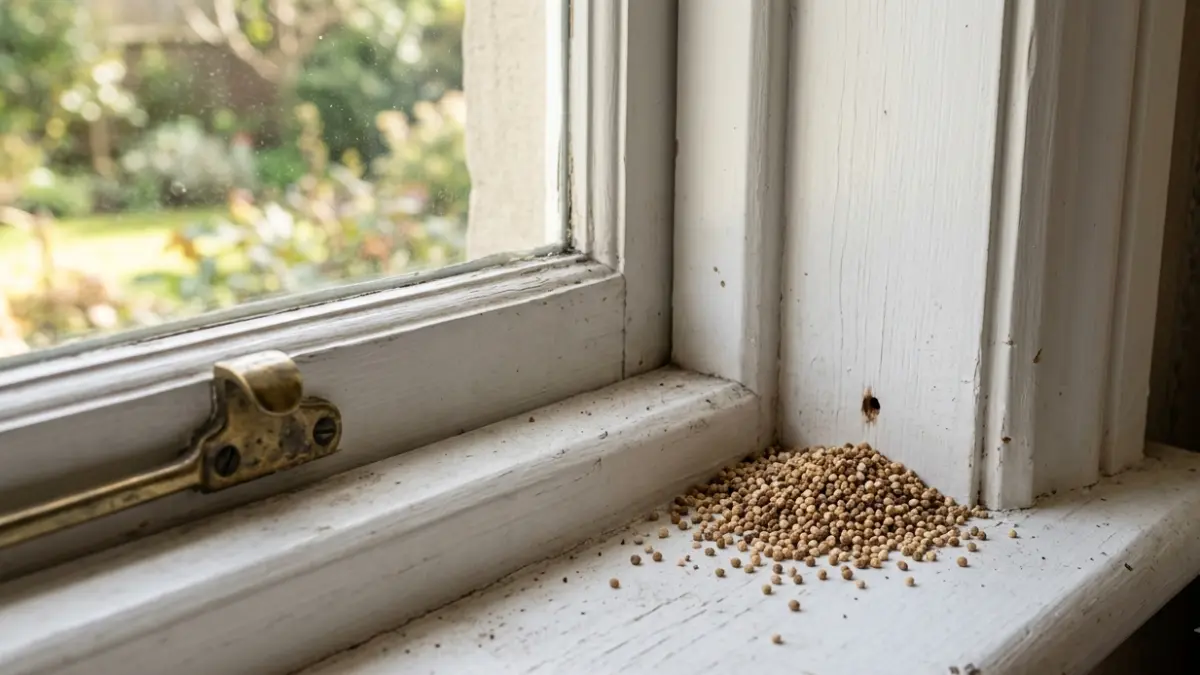 Termite Treatment
How to Identify Termite Frass and Drywood Droppings
July 15, 2026 Termite Treatment
The real answer to when termites swarm is species by species
August 2, 2026 Termite Treatment
How to choose a termite company and avoid the usual guesswork
July 29, 2026 Termite Treatment
Does insurance cover termite damage, and why claims fail
July 29, 2026 Termite Treatment
The overlooked question behind who pays for a termite letter
July 30, 2026 Termite Treatment
Can You DIY Termite Treatment? An Honest Answer
July 23, 2026 Termite Treatment
Does mulch attract termites, and what most advice overlooks
July 31, 2026 Termite Treatment