Roof rats vs Norway rats and the common gaps on most houses

Roof rats vs Norway rats split the house between them: one works above the roofline,
one works the foundation. The ½-inch door gap belongs to both.
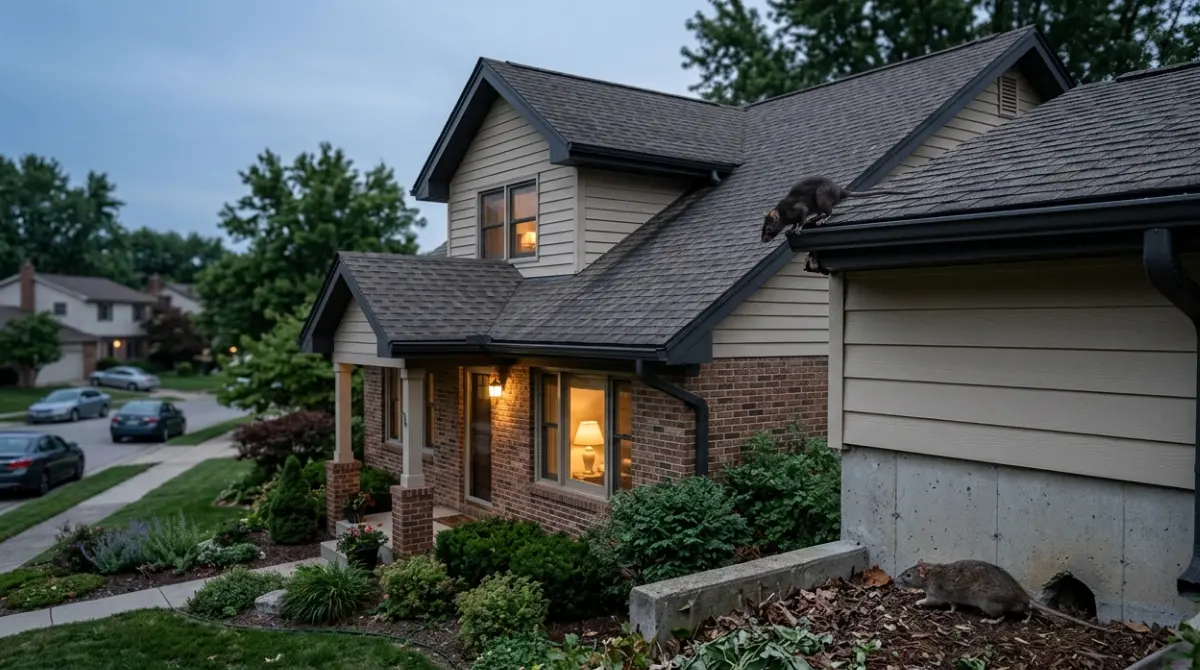
Table of Contents
Which rat you have decides where you point the torch, not just which trap you buy. Roof rats nest above ground and come in at the roofline. Norway rats burrow at ground level and come in near the foundation.
Search the wrong height and you seal half a house.
If all you have so far is a noise overhead, start with the common causes of a scratching noise in walls at night.
If you’ve found droppings and want the species, the next section settles it in about thirty seconds.
If you sealed gaps already and they came back, skip ahead to why one-level sealing fails.
If you rent, the landlord question is legal rather than structural, and the rodent proofing guide linked below covers it.
ℹ️ Safety Note: Rat work carries several real hazards: disease exposure when handling droppings, urine or nesting material; falls when inspecting or sealing at the roofline; confined-space risk in attics and crawl spaces; poisoning risk to children, pets and wildlife from rodenticides; and structural risk where burrows run under a slab. Treat everything here as general understanding. For roofline work, suspected foundation undermining, or any use of rodenticide, hire a licensed pest control operator or contractor and follow your local code.
Telling a roof rat from a Norway rat in 30 seconds
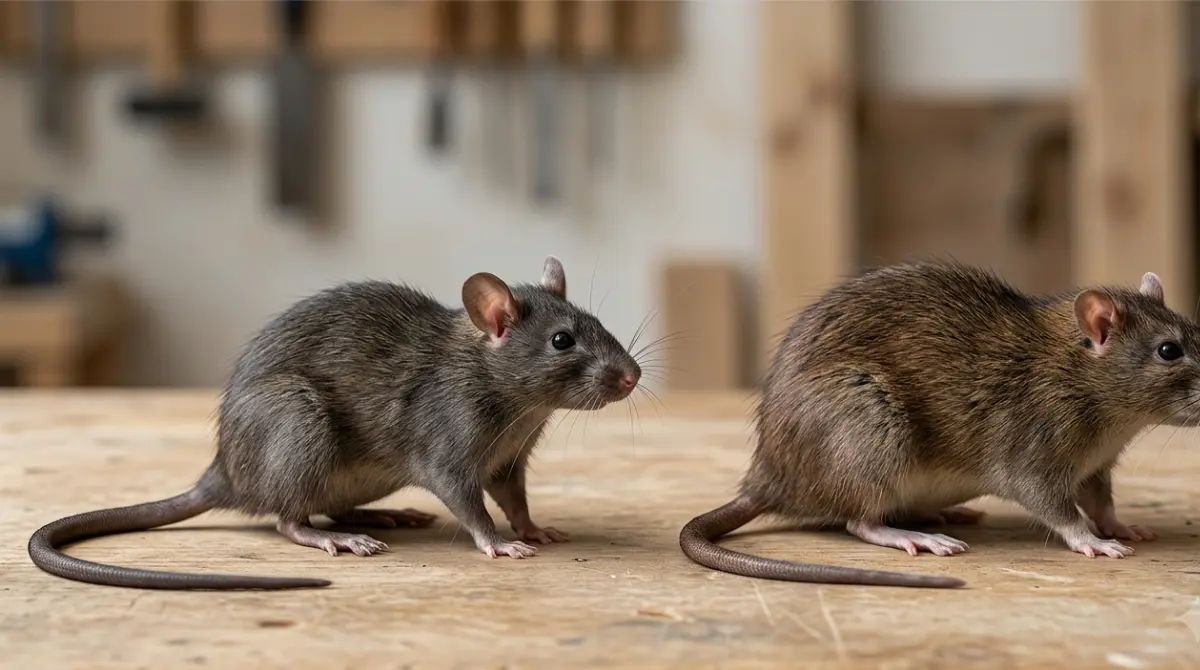
Lay the tail back over the body toward the head. On a roof rat it reaches at least the snout; on a Norway rat it stops around the middle of the skull. That one check, from UC IPM’s Pest Notes on rats, is faster and more dependable than anything else on this page.
The tail test that settles it
| Characteristic | Roof rat | Norway rat | Key detail |
|---|---|---|---|
| Tail, folded over the back | Reaches the snout | Reaches mid-skull | Most reliable single tell |
| Ears, folded forward | Cover the eyes | Don’t reach the eyes | Works from a clear photo |
| Muzzle | Pointed | Blunt | Visible at a distance |
| Body weight | 5–10 oz | 7–18 oz | Needs the animal in hand |
| Belly | Grey to white | Mostly grey | Weakest — the two overlap |
Sourced from UC IPM Pest Notes: Rats (Pub 74106). No hands-on testing was performed for this table.
The tells that don’t work
Coat colour is what most guides lead with and it’s the least dependable signal here. Both species turn up in overlapping browns, greys and near-blacks, so a “black rat” can be brown and a “brown rat” can look almost black.
Haven’t ruled out a mouse yet? Confirm it’s a rat and not a mouse first.
Where each species actually lives in the US
Geography rules one species out for a lot of readers before they pick up a torch. Norway rats live throughout the 48 contiguous states. Roof rats are far more limited, and UC IPM notes they prefer warm climates and coastal conditions.
If you’re on the Gulf, the Pacific, or the lower East Coast
The extension distribution summary for roof rats puts them along the lower half of the East Coast, through the Gulf States up into Arkansas, all along the Pacific Coast, and in Hawaii. Assume both species are possible and inspect both heights.
If you’re in the interior
Most interior states are largely free of roof rats, with isolated infestations traced to cargo shipments. UC IPM does note that the documented range of roof rats is expanding, so a confirmed sighting outside the usual map isn’t impossible — it’s just uncommon.
Where roof rats get in: the roofline route
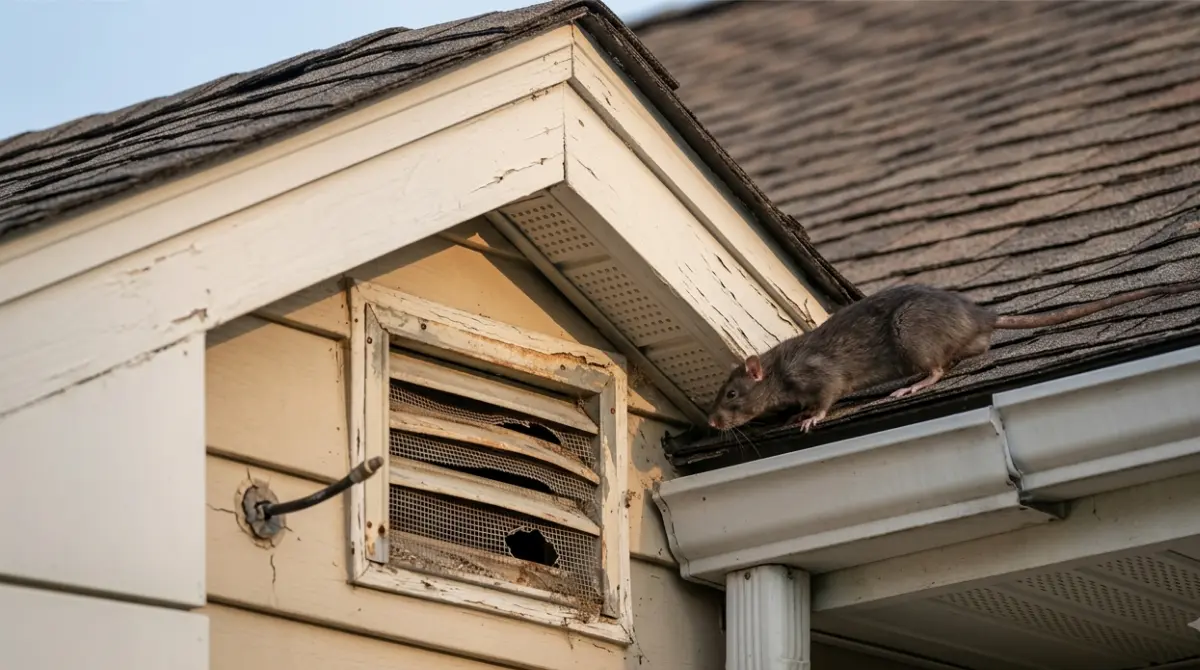
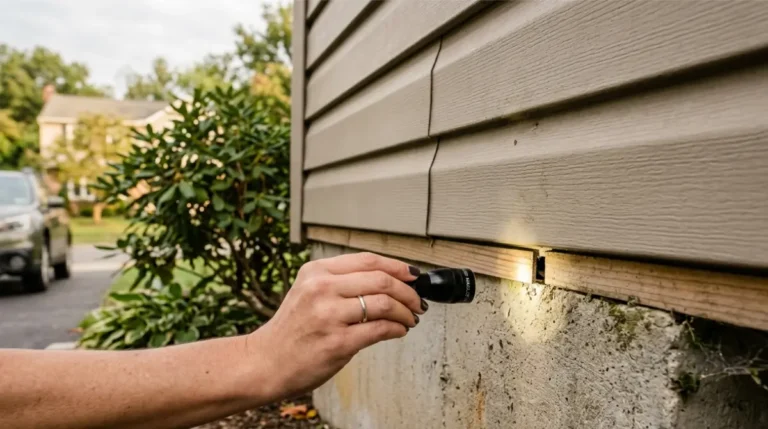
Roof rats enter at or above the roofline. Walk the perimeter a second time looking up, and check these seven points in order:
- Soffit and fascia joints — where the two boards have separated
- Gable and ridge vents — check the screen, not just the louvre
- Eave and attic vent screens — repair or replace damaged ones
- Plumbing vent pipes over 2 inches — screen the tops
- The chimney — fit a spark arrester
- Roof-to-wall junctions — where a roofline meets an adjoining wall
- Cable and utility entries at height — seal around each one
📊 Spec: For ventilator grills, UC IPM specifies 18-gauge ½-inch mesh galvanised expanded metal, or 16-gauge ½-inch mesh galvanised wire cloth — and warns that lightweight chicken wire lets rats straight through. Source: UC IPM Pest Notes: Rats (Pub 74106).
The tree and utility line problem
Remove overhanging limbs within six feet of the roof, and prune dense canopy at least two feet clear of the building. Climbing ivy, star jasmine and honeysuckle on walls and fences are roof rat routes in their own right.
If rats are travelling along overhead utility wires, UC IPM directs you to the utility company or a pest professional rather than the ladder.
When to stop and hire out
✅ Do This: Stop at the roofline if you’re working from a ladder alone or the pitch is steep. EPA’s guidance on hiring a rodent control professional says to ask to see the company’s licence and to call your state pesticide regulatory agency if anything concerns you. Ask three more things: are you licensed for both exclusion and pest control, is the sealing warrantied, and does the quote itemise every entry point.
Where Norway rats get in: the ground-level route
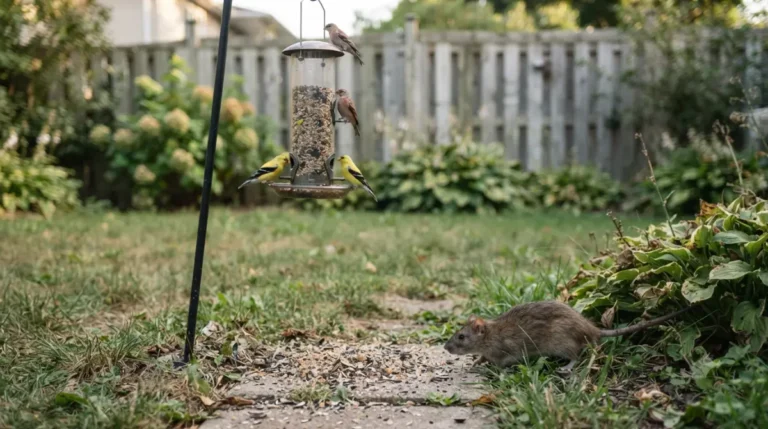
Norway rats work the perimeter. Walk it slowly at ground level, before you look up, and check foundation cracks, pipe and cable penetrations, weep holes at the base of brick veneer, crawl space vents, ground-level windows, and every threshold.
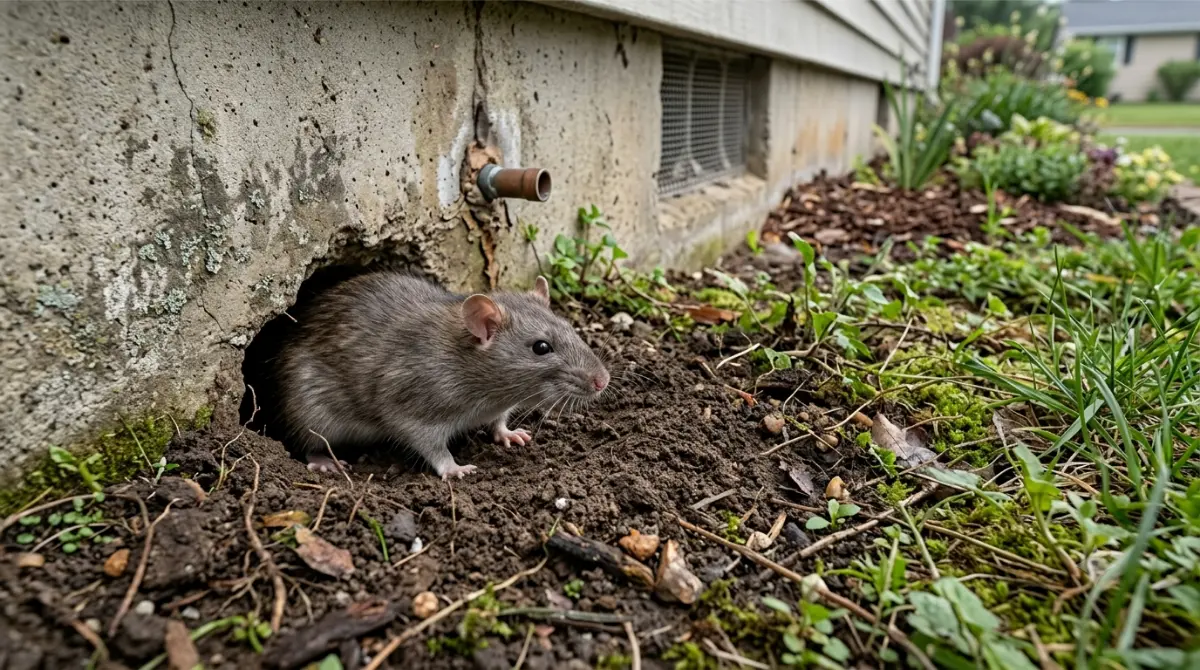
Burrows: what you’re looking for
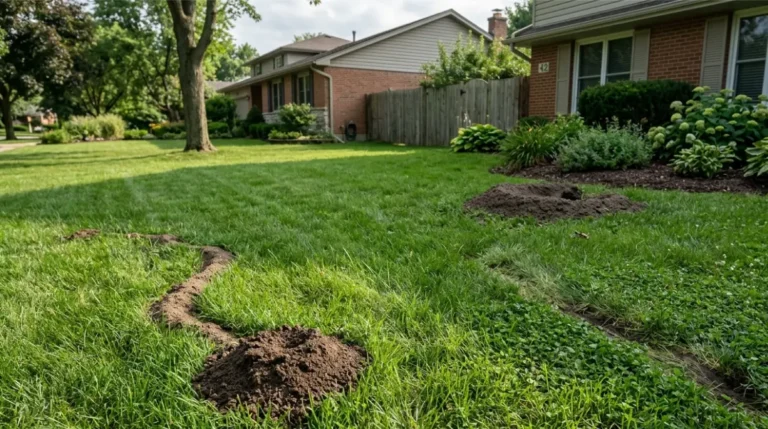
Norway rat burrows run along building foundations and under rubbish piles, woodpiles and garden clutter.
🔍 Why It Works: UC IPM’s burrow diagram shows an entrance, a nest, and a separate escape hole lightly covered with dirt. That’s why plugging the one hole you can see changes nothing — the system has a back door by design.
⚠️ Watch Out: Burrowing can undermine foundations and slabs. If burrows disappear under the structure, that’s an assessment for a licensed contractor before anything gets sealed, not a judgement call from the surface.
The threshold gap almost everyone leaves
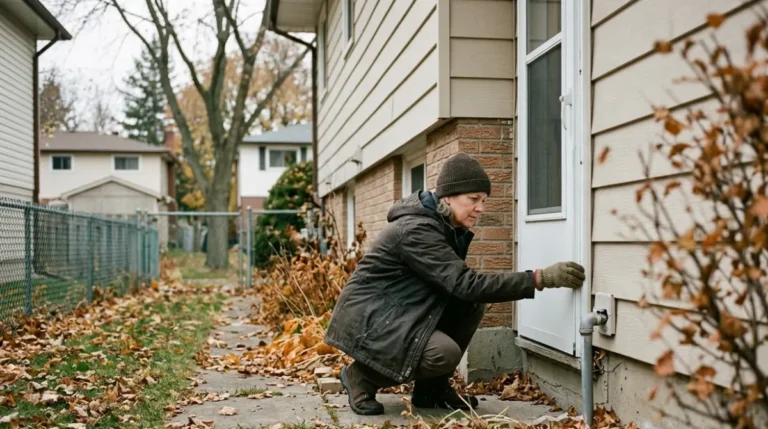
📊 Spec: Rats, especially young ones, squeeze beneath a door with only a ½-inch gap, and may gnaw a wooden door to widen it. UC IPM adds that typical weatherproofing materials may not be enough to exclude rats. Source: UC IPM Pest Notes: Rats (Pub 74106).
Seal exterior doors at the threshold and double doors at the astragal gap between them.
The sewer and drain route
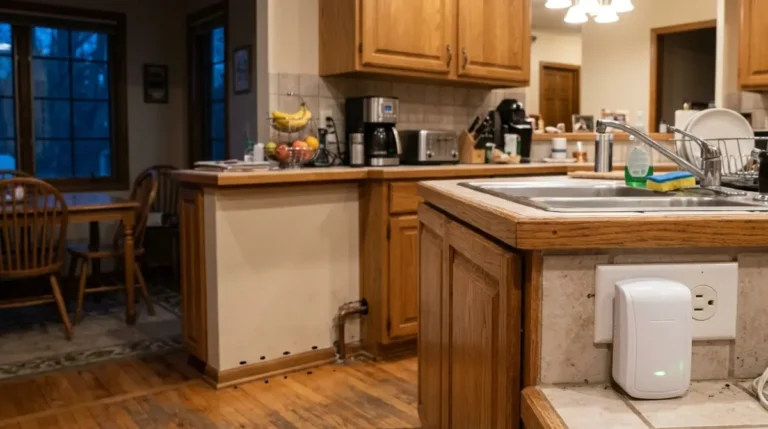
Rats also get in by swimming, entering through toilets or broken drains, and Norway rats are the stronger swimmers of the two. Check basement and laundry floor drains.
Why sealing one level of the house isn’t enough
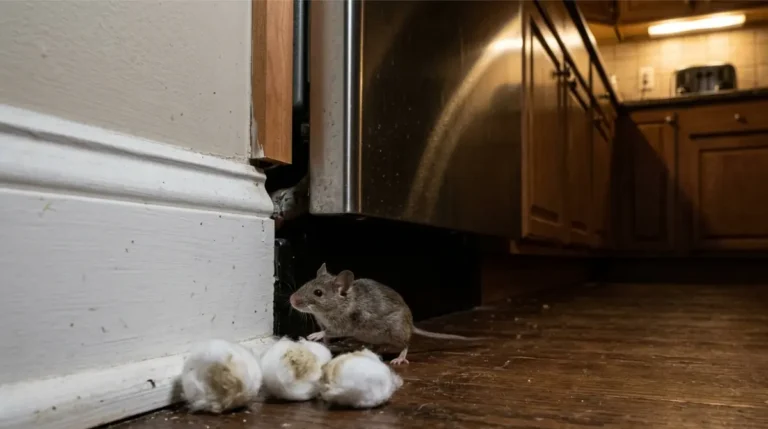
Seal every opening larger than a quarter inch — that’s UC IPM’s threshold for excluding both rats and mice, and it’s the number to plan around. CDC’s seal-up inspection list puts the same figure at a pencil’s width for mice.
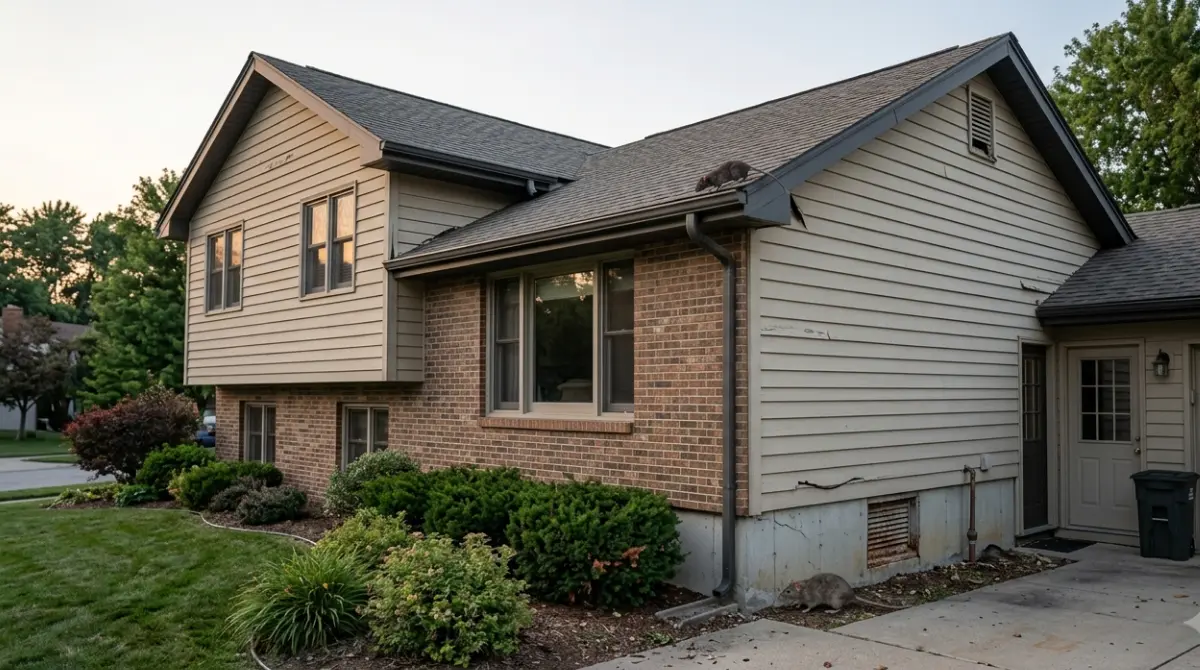
The gap size that actually matters
You’ll see the claim that a rat needs a hole the size of a quarter, or a half-dollar. The CDC’s current page gives a pencil-width figure and no coin measurement for rats at all; the nickel and half-dollar wording sits in an archived version. Use ¼ inch and stop converting to currency.
When both species are in the same house
UC IPM notes that where both occupy one building, Norway rats hold the basement and ground floors while roof rats take the upper ones. A single-height inspection therefore closes half the house. For what to seal each opening with, and what’s legal where you live, see which materials actually hold, and what’s legal where you live.
What droppings can and can’t tell you about the species
Nearly every page on this topic states that roof rat droppings measure about half an inch with pointed ends while Norway rat droppings run three-quarters of an inch with blunt ones. We checked that against the authority sources and could not confirm it as a species test.
CDC’s description of rodent droppings describes them generally as pointed at one end and often containing hair, with no species split. UC IPM doesn’t use dropping shape either — when the species is uncertain, it tells you to look at tail length on a trapped animal.
What the droppings do tell you is location, and location is the usable signal: elevated means roof rat, ground level means Norway rat. For the measurement that does hold up, see the one dropping measurement that does hold up.
Roof rat and Norway rat questions people actually ask
1. How do I tell a roof rat from a Norway rat?
Lay the tail back over the body. A roof rat’s reaches the snout; a Norway rat’s stops at mid-skull.
2. Where do roof rats get into a house?
At or above the roofline — soffit and fascia joints, gable and ridge vents, eave screens, uncapped plumbing vent pipes, and chimneys.
3. Where do Norway rats get in?
At ground level — foundation cracks, pipe and cable penetrations, crawl space vents, floor drains, and the half-inch gap under an exterior door.
4. Do roof rats ever live in the ground?
Occasionally. UC IPM notes roof rats sometimes burrow into soil and use sewers when elevated nesting sites aren’t available to them.
5. Do Norway rats climb?
Yes. Norway rats usually hold the basement and ground floors, but UC IPM notes ceiling void infestations are not uncommon either.
6. What size gap should I seal?
Seal every opening larger than a quarter inch. Rats, especially young ones, squeeze beneath a door with only a half-inch gap.
7. Can droppings tell me which species I have?
Not reliably. Neither the CDC nor UC IPM uses dropping shape as a species test — location and tail length work better. Never sweep or vacuum droppings; wear gloves and wet-clean.
8. Where do roof rats live in the US?
The lower East Coast, the Gulf States into Arkansas, the Pacific Coast and Hawaii. Most interior states see them only rarely.
9. Which rat is in my attic?
Almost always a roof rat. Both species can share one building, with Norway rats low and roof rats on the upper floors.
10. How close can trees be to the roof?
UC IPM recommends removing overhanging limbs within six feet of a roof and pruning dense canopy two feet clear of buildings. Hire a professional for limb work at height.
Your next step
Settle the species first, with the tail test — everything else follows from that one call.
Then run the matching pass. Roof rat means an overhead walk-around: soffits, vents, vent pipes, chimney. Norway rat means a slow perimeter at ground level: foundation, penetrations, thresholds, drains.
Mark every opening wider than a quarter inch as you go. That marked list is the actual job, and it’s what a contractor’s quote should match.