The right way to tell mice vs rats apart tonight

Mice vs rats gets settled by a ruler, not a glance. Mouse droppings run 1/8 inch, Norway rat droppings 3/4 — and size alone will fool you on a young rat.
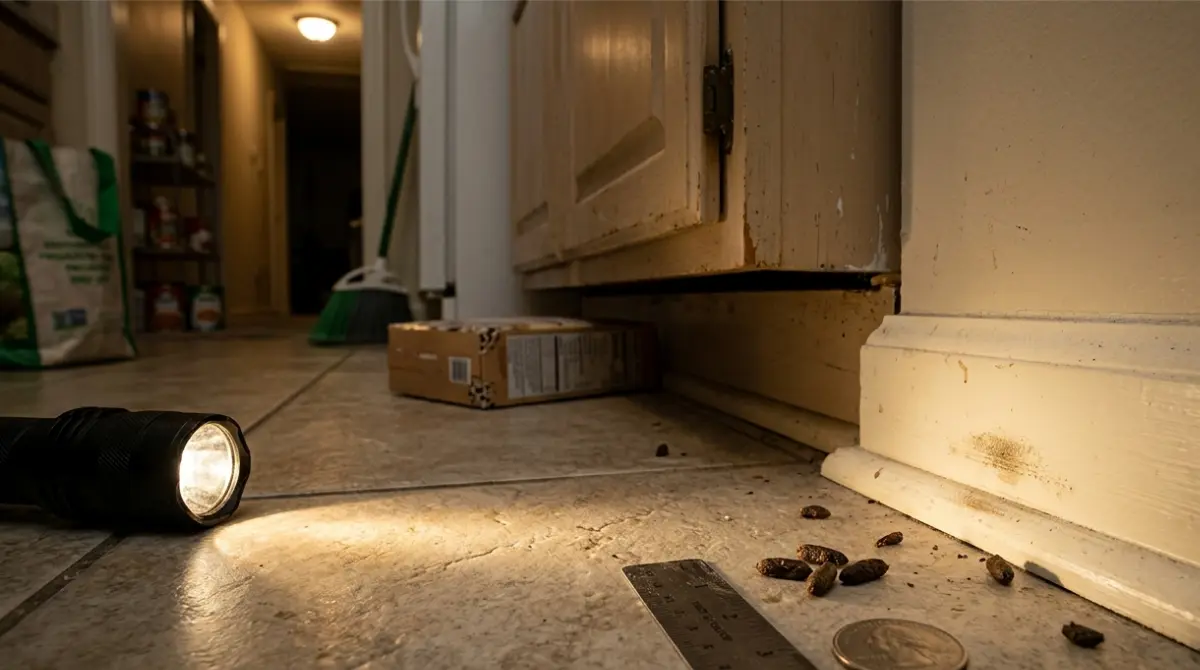
Table of Contents
Start with what you can see
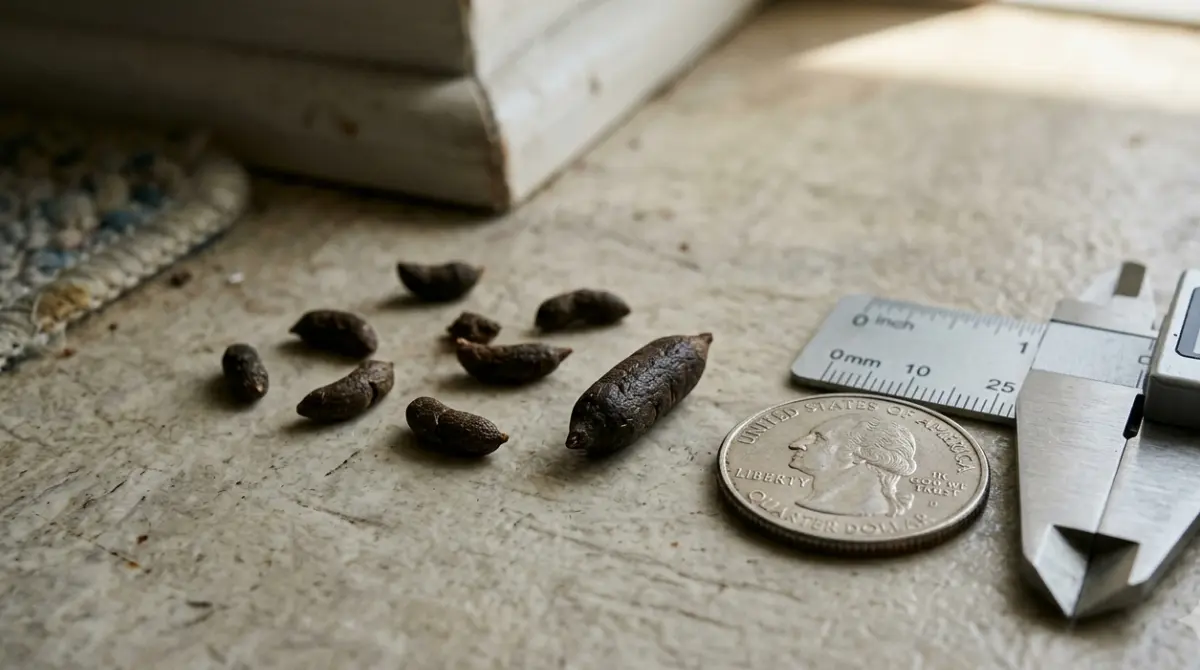
The fastest answer is usually in the droppings, not the animal. Cornell IPM puts house mouse droppings at 1/8 to 1/4 inch and Norway rat droppings at 3/4 to 1 inch. That single measurement settles most cases before you see anything move.
Seven checks follow. All of them can be done tonight with a flashlight, a ruler, and a quarter.
Which check applies to you
- Found droppings but no animal: start at check 3 and measure them.
- Saw something run across the floor: start at check 1 — proportions beat size.
- Only heard noises: go to check 5, where the sound narrows it fast.
- Not sure it’s a rodent at all: check 4 covers gnaw marks and entry gaps.
ℹ️ Safety Note: Rodent droppings, urine, and nesting material can carry disease, and rodenticides are toxic to children and pets. Everything below is for identification and general understanding. For a heavy infestation, an inaccessible space, or any bait use, hire a licensed pest control professional and follow product label directions.
If you saw it, check the tail and the ears
Proportion beats size here, because a half-grown rat and an adult house mouse weigh about the same.

Tail length against the body
Fold the tail forward over the back. On a roof rat it reaches at least the snout; on a Norway rat, only the middle of the skull.
Ears, eyes, and snout
Mice have large ears and eyes and a pointed nose. Roof rat ears reach the eyes when folded down; a Norway rat’s do not, and its muzzle is blunt.
What the numbers actually are
An adult house mouse measures 2.5 to 3.75 inches in the body with a 2.75 to 4 inch tail. A Norway rat reaches roughly 11 inches of body and about 16 inches overall, according to Cornell’s rodent biology and behavior guidance.
Measure the droppings — this is the reliable one
Don’t pick them up. Photograph them beside a quarter — about 0.95 inch across — and compare.
| Rodent | Dropping length | Ends | Key detail |
|---|---|---|---|
| House mouse | 1/8 to 1/4 inch | Pointed | Scattered widely near food and shelter |
| Roof rat | About 1/2 inch | Pointed to curved | Often found above ground — attics, shelves, rafters |
| Norway rat | 3/4 to 1 inch | Blunter, capsule-shaped | Concentrated along walls, runs, and feeding areas |
Lengths sourced from Cornell CALS IPM. Not measured by Gladewick.
Pointed ends or blunt
Rodent droppings are cylindrical with pointed to rounded ends and carry no lengthwise ridges — the ridging is what separates them from American cockroach droppings.
Scattered or along a run
Mouse droppings turn up almost everywhere; rat droppings cluster along travel routes. For close-up comparisons, see what different rodent droppings look like side by side.
Gnaw marks and the size of the gap
How wide are the tooth marks
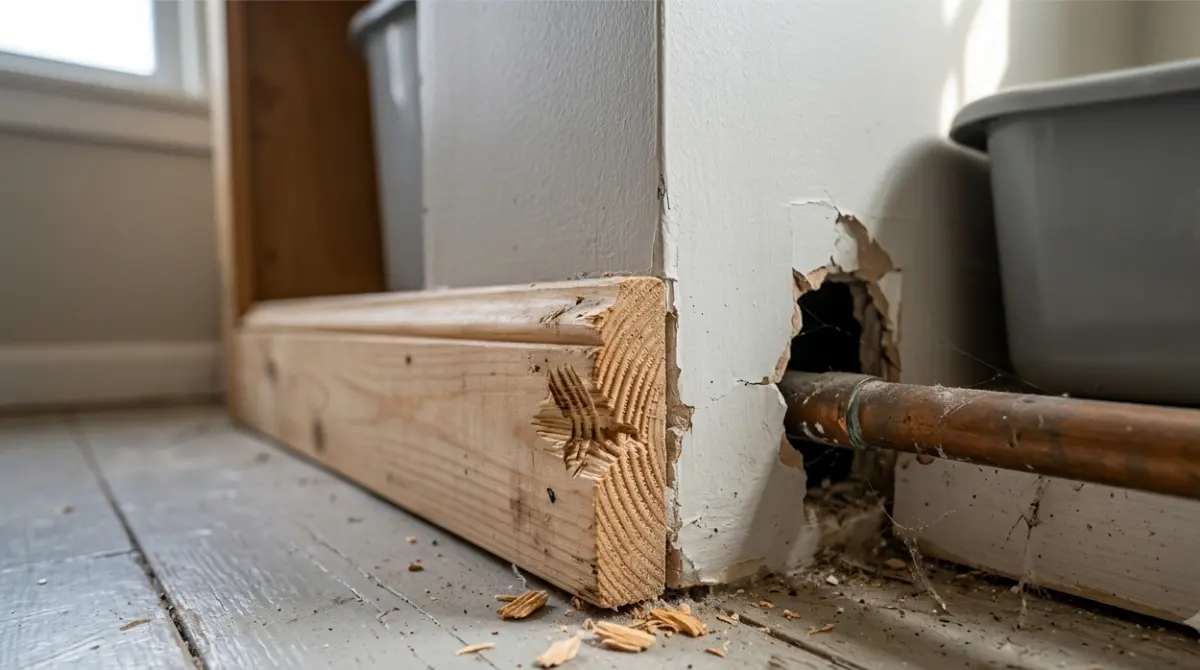
Rodents leave paired grooves. Cornell IPM measures adult mouse gnaw marks at 1 to 2 millimeters wide and adult rat marks at 3.5 to 4 — roughly double.
The quarter-inch rule
CDC puts the mouse figure at a hole the width of a pencil, about 1/4 inch. UC IPM’s rat guidance says to seal anything larger than 1/4 inch, which covers both species.
Where to look for the gap
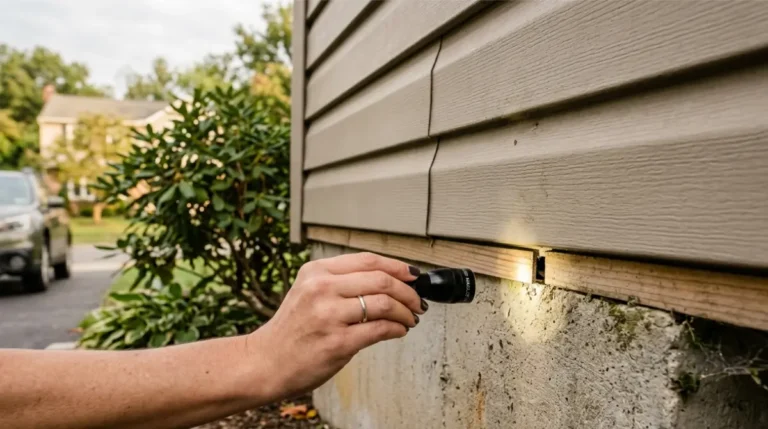
Check under exterior doors, around pipe and cable penetrations, and along the foundation line. Rats squeeze under doors with only a 1/2-inch gap. The full sequence is in what a proper rodent-proofing pass actually covers.
✅ Do This: Seal to the quarter-inch mouse standard and you’ve covered rats automatically — so a wrong identification can’t cost you the repair.
Where the sign is, and the overnight test
Floor level or overhead
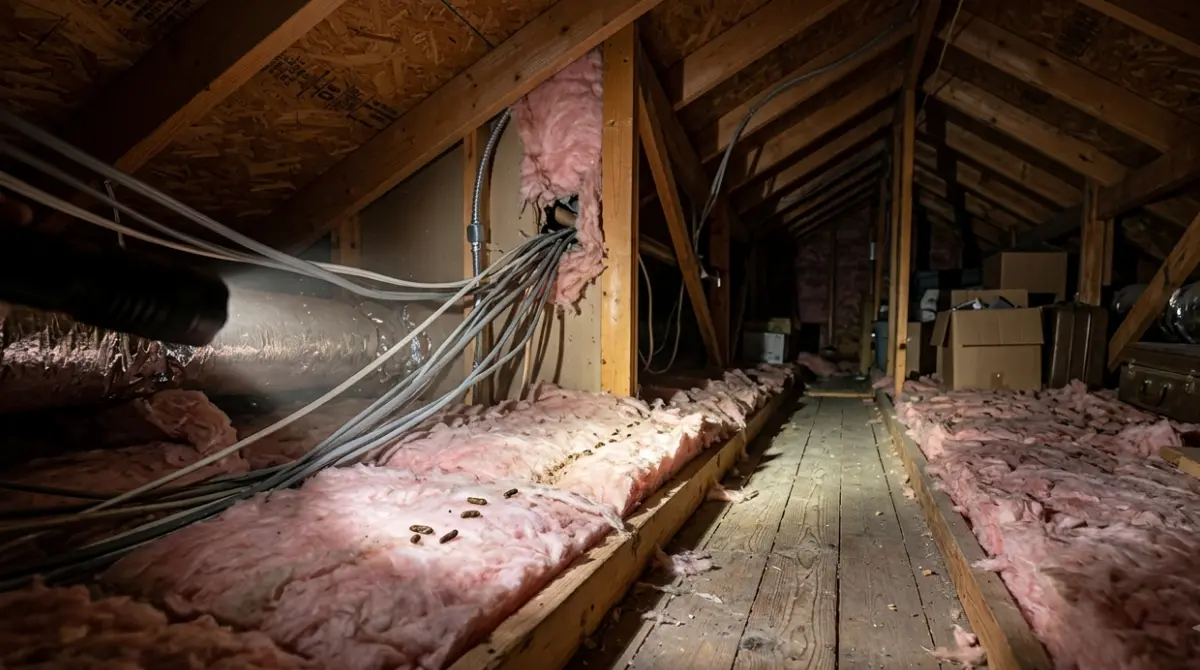
Norway rats burrow along foundations and stay in basements and ground floors. Roof rats nest above ground — attics, wall voids, ceiling voids, cabinets — usually arriving along tree limbs and utility lines. If the noise is overhead, what you’re hearing at night narrows it further.
Set a tracking patch tonight
Dust a light layer of flour or talcum powder along a wall and set a baited cracker in the middle. Mouse prints read as scattered dots, 3/8 to 3/4 inch; rat prints look like an actual foot at 3/4 to 1 1/4 inches, sometimes with a tail drag.
How far the sign should spread
Mice seldom range beyond 30 feet of the nest. Norway rats forage 100 to 500 feet, so evidence scattered across a property points to rats.
The three mix-ups that fool almost everyone
A young rat is not a mouse
Very young rats have large heads and feet in proportion to their bodies, while adult mice are proportionately much smaller in both. Mice also have larger ears and eyes and a pointier nose.
A deer mouse is not a house mouse
Deer and white-footed mice match house mice in size and shape but have white belly fur and a furred, two-tone tail — dark on top, pale beneath.
Roof rat or Norway rat
Both can share one building. UC IPM notes that Norway rats take the basement and ground floor while roof rats occupy the upper floors.
⚠️ Watch Out: Green or red droppings mean the animal has been feeding on rodenticide bait nearby. With pets or young children in the house, locate and secure that bait before anything else.
What the answer actually changes
Trap size and placement
UC IPM is explicit: mice and small juvenile rats often won’t trigger a rat snap trap, so buy by species. Rats also avoid unfamiliar objects for days, so leave traps baited but unset until the bait is taken.
Handling droppings safely
Don’t sweep or vacuum droppings, urine, or nesting material — CDC’s cleanup guidance explains that this puts contaminated particles into the air.
✅ Do This: For a heavy infestation, an unreachable attic or crawl space, or any rodenticide use around children or pets, call a state-licensed pest control operator — ask for the license number and whether exclusion is included or quoted separately.
Common questions about mice and rats
1. How do you tell mice from rats?
Mice vs rats comes down to dropping length, tail-to-body ratio, and gnaw-mark width — mice measure smaller on all three.
2. What size are mouse droppings compared to rat droppings?
Mouse droppings run 1/8 to 1/4 inch, roof rat about 1/2 inch, and Norway rat 3/4 to 1 inch.
3. Can a young rat look like a mouse?
Yes. Young rats have oversized heads and feet for their bodies, while adult mice are evenly proportioned with larger ears.
4. How small a hole can a mouse fit through?
About a quarter inch — roughly a pencil’s width, per CDC. Sealing to that standard excludes rats too.
5. Can mice and rats live in the same house?
Yes. Where both occur, Norway rats usually hold the basement and ground floor while roof rats take the upper floors.
6. Are mouse droppings dangerous to touch?
Rodent droppings, urine, and nesting material can spread disease, so never sweep or vacuum them. Follow CDC cleanup guidance, and call a licensed pest professional for heavy or unreachable infestations.
7. Do rats need a different trap than mice?
Yes. Mice and small juvenile rats often fail to trigger a rat snap trap, so match the trap to the species.
8. Why is the scratching in my attic rather than my walls?
Roof rats nest above ground in attics, ceiling voids, and cabinets, usually arriving by tree limbs or utility lines.
9. How far do mice travel from their nest?
House mice seldom range beyond 30 feet of the nest, which keeps their droppings and gnaw marks clustered.
10. What do green or red droppings mean?
The rodent has eaten rodenticide bait nearby — worth locating quickly if you have pets or young children.
Your next step tonight
Measure one dropping against a quarter. Under a quarter inch and it’s almost certainly a mouse; near three-quarters of an inch and you’re looking at a Norway rat. Either way, seal every gap wider than a quarter inch — that standard covers both — and match your traps to the species you found.