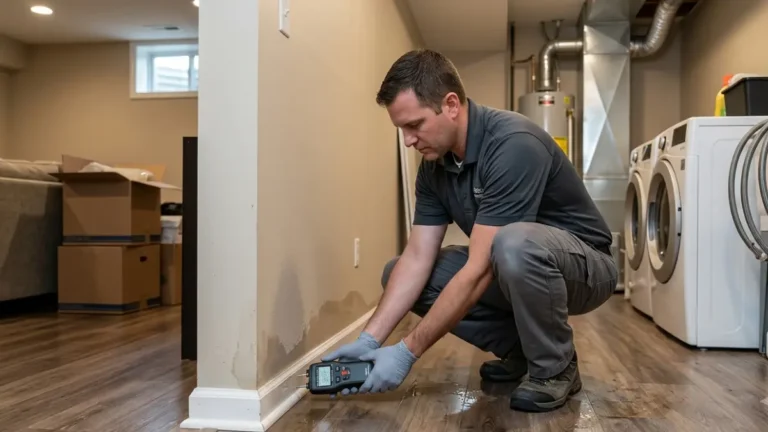
The Smart Way to Read Dry Standard Water Damage Numbers

Dry standard water damage readings above 30% are qualitative only, per the USDA. That covers most genuinely wet material a homeowner would check.
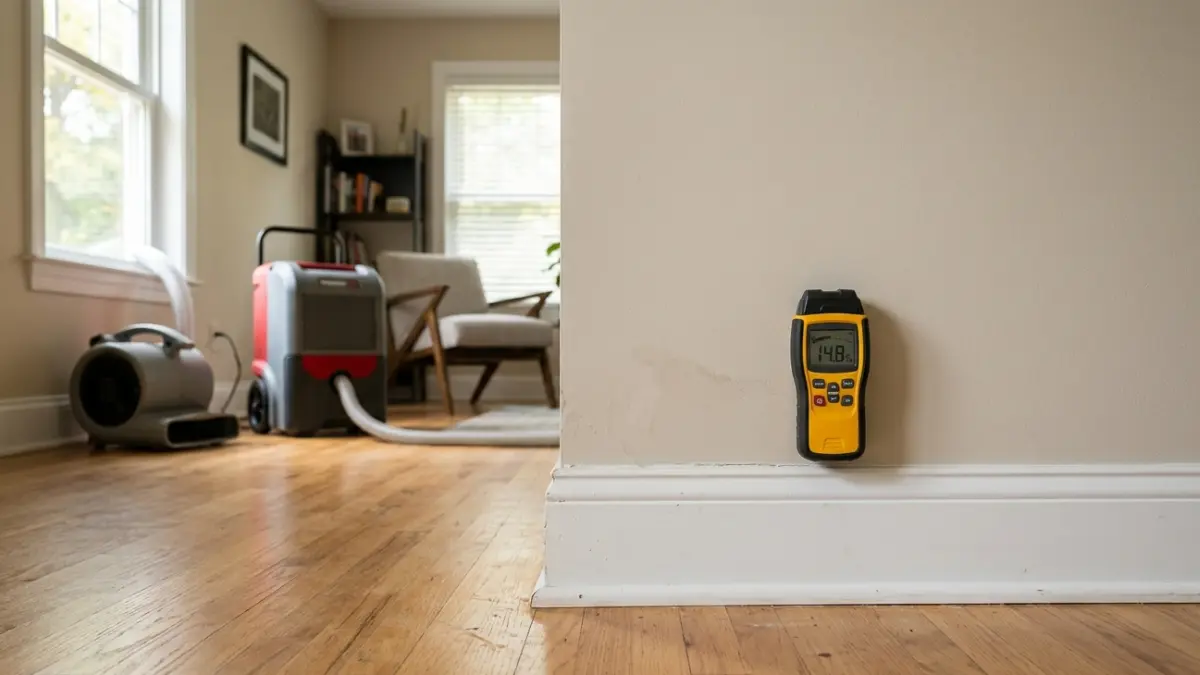
Table of Contents
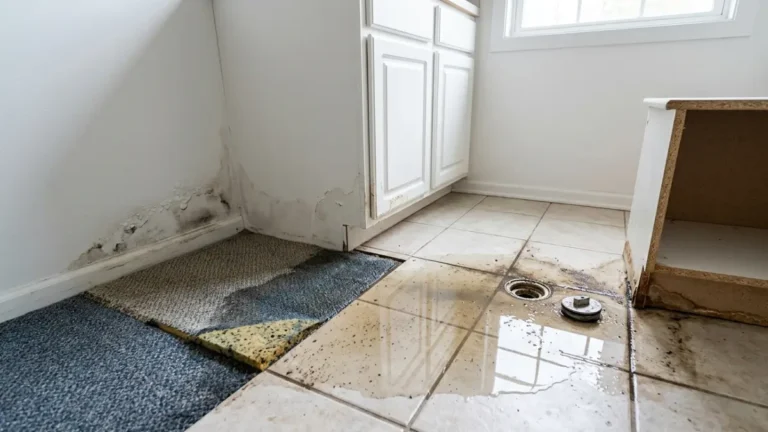
Your house looks dry. That isn’t the same as being dry
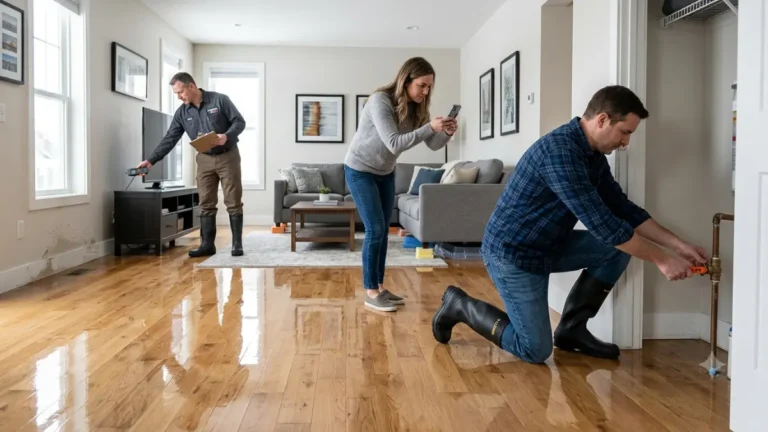
The fans are gone, the wall looks normal, and nobody explained how anyone decided you were finished.
Where you are in the process
If the drying equipment is still running, start at the next section. If the crew packed up this week and you’re deciding whether to sign, skip to the drying log. If it’s been weeks and a closed-up room smells wrong, go to the last section.
If the water arrived in the last day or two, you’re early — what to do in the first hour is the page you want.
There is no percentage you can look up that means dry. That isn’t evasion — it’s the real answer, and this page explains why.
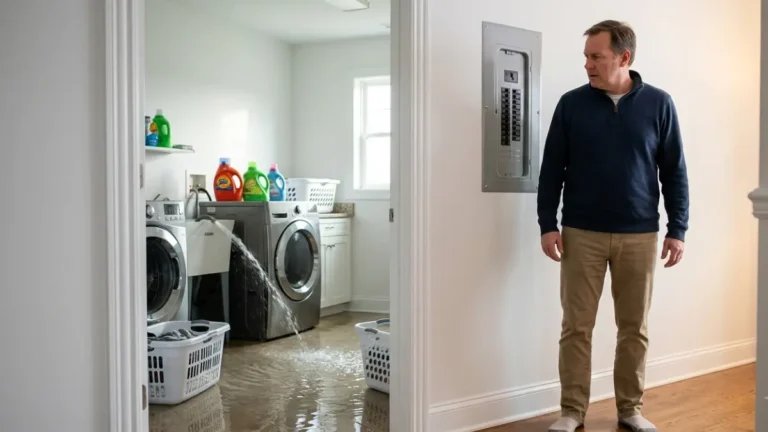
ℹ️ Safety Note: This article helps you verify drying, not perform it. Don’t enter standing water, wet basements, attics, or crawl spaces to take readings, and don’t open walls, floors, or ceilings. If the water was contaminated, or if anyone in the household has asthma, is immunocompromised, is pregnant, or is a young child, this decision belongs to a qualified professional rather than a homeowner with a meter.
What a dry standard actually is
A dry standard is what a material’s moisture level was before the water got in — the condition the building is being returned to.
The dry standard is a comparison, not a value
The ANSI/IICRC S500, the consensus standard most US restorers work to, defines it as roughly “a reasonable approximation” of a material’s moisture level before the intrusion. It hands over no number, because it can’t: the right figure belongs to your building.
The method it describes is a comparison. Read similar unaffected material elsewhere in the same structure, and that reading becomes the target. Where nothing unaffected can be found, regional data stands in.
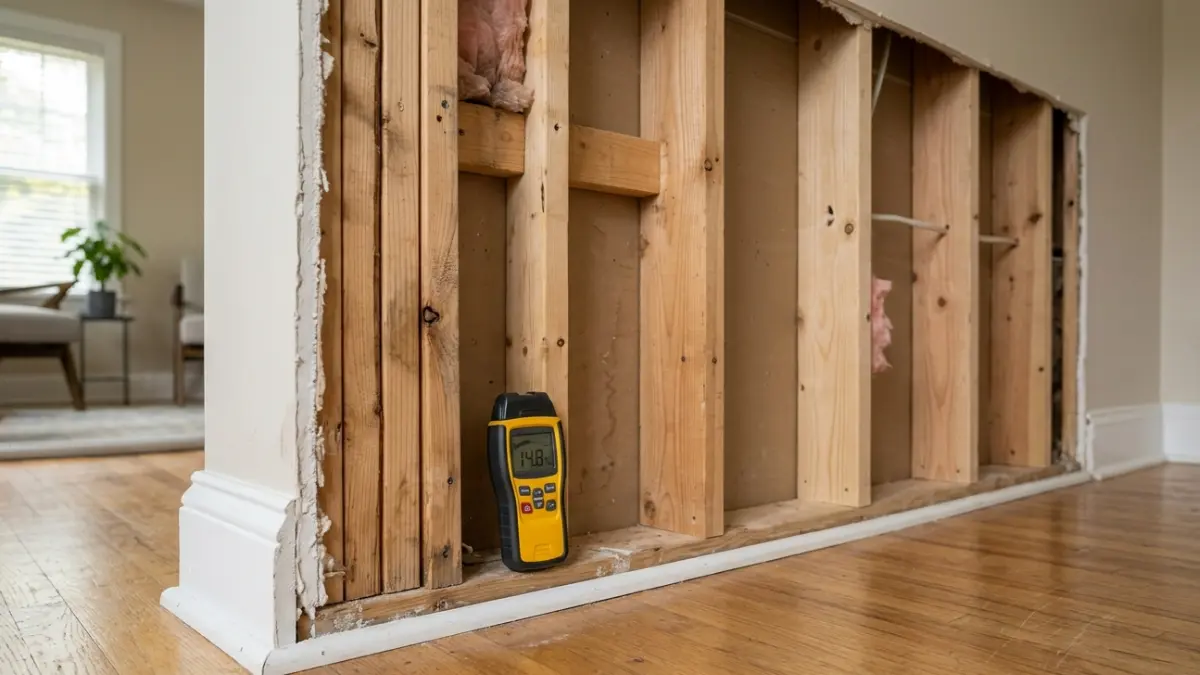
The drying goal is set by the restorer
Here is the distinction almost nobody makes, and it matters more than the definition.
The dry standard describes your house. The drying goal is the end-of-drying target a restorer chooses — informed by the dry standard, but chosen by a person. One is a condition, the other is a decision, and the decision is what you can ask about.
Setting both is the last of the eight things a restorer is supposed to do before drying starts.
It also assumes drying was the right endpoint. At Category 2 or 3, material may come out instead — which category of water you were dealing with decides that before any target is set.
Why no percentage means dry
No published moisture reading means dry, for a reason you can verify yourself in about a minute.

- CLOCK AND ALARM FUNCTION – Combines an indoor thermometer hygrometer with a clock and alarm for convenient everyday use….
- BATTERY INCLUDED, UP TO 12-MONTH BATTERY LIFE – Powered by one AAA battery, which is included for quick setup. A single …
- DUAL COMFORT INDICATOR – Quickly understand indoor conditions with two easy-to-read comfort indicators. The humidity ind…
What the USDA lists as normal
The USDA Forest Products Laboratory publishes recommended moisture content values for interior wood in its 2021 Wood Handbook, and it gives three different answers.
Most of the United States: 8%. The dry southwestern area: 6%. Damp, warm coastal areas: 11%.
Individual pieces run from 4% to 13% and are still normal. So 11% is unremarkable in coastal Louisiana and soaking in Phoenix. No national threshold can be right in both places, which is why the standard sends the restorer to your own unaffected material.
📊 Sourced: USDA Forest Products Laboratory, Wood Handbook FPL-GTR-282 (2021), Table 13-2 — one federal source, three regional figures for one material, decided by geography. Note what it is: a wood-engineering document about installing and storing lumber. It tells you what normal moisture content is, not when a flooded house has finished drying.
What the same standard gets quoted as
The numbers circulating online don’t agree with each other either. We surveyed what restoration pages publish as “dry” on 11 August 2026.
| What gets published | What it’s presented as | Where it appears | Cites a section? |
|---|---|---|---|
| Under 13%, and under 12% | The reading that means dry | Both figures on one remediation page | No |
| 15% or lower | An S500 requirement | Restoration company page | No |
| 16% | Where mold becomes possible | Restoration company page | No |
| Above 20% | Wood that needs drying | Two restoration pages | No |
| “Drywall under 1%” | Normal drywall | Two restoration pages | No |
| Within 3 percentage points | The S500 tolerance | Restoration company page | No |
| Within 2–4 percentage points | The S500 tolerance | Industry explainer page | No |
| Within 10% | The S500 tolerance | Trade magazine, fifth edition | No |
| 8% / 6% / 11% by region | Normal interior wood | USDA Wood Handbook, 2021 | Table 13-2 |
Original desk survey, 11 August 2026. Rows 1–8 report what each page claims, not what the standard says: the S500 we have not purchased, and no page above names the section it quotes.
Four different tolerances, all attributed to one standard. That spread is the clearest evidence that the number you want doesn’t exist in the form you want it.
Where water was contaminated, none of this applies, because materials come out instead of drying. The EPA’s water damage cleanup table says so in its own footnote: it covers clean water only.
What a moisture meter can and can’t tell you

- HUMIDITY SENSOR: Our handy meter tool can quickly determine what level of remediation is needed to keep your family safe…
- WATER LEAK DETECTOR: Finding the moisture content in your wood or drywall is the first step in early prevention. Continu…
- MOISTURE READER: The mold test features large 0.3″ high digits in a backlit LCD for quick and easy detecting. Our mildew…
A moisture meter is a reasonable thing to own, and it won’t settle this question alone.
Pin versus pinless, and what each one misses

- Accurate & Easy to Use – This pinless moisture meter offers quick, non-invasive readings without surface damage. Simply …
- Early Moisture Detection – Helps identify hidden dampness in floor, wood, and masonry, reducing the risk of long-term wa…
- Deep Sensing Capability – With up to 0.75 inches of penetration depth, this moisture detector provides reliable readings…
The USDA’s guidance on how electrical moisture meters actually work names three limits worth knowing before you trust a reading.
Readings above 30% are qualitative only. On genuinely wet material — exactly what worries you — the number on screen is an indication, not a measurement.
Pinless meters read surface layers most strongly and may miss the core where moisture is uneven. Pin meters with uninsulated probes report the wettest point along their length, not an average.
🔍 Why It Works: These meters infer moisture from an electrical property rather than measuring water directly, so the correlation is never perfect. Both types need a species correction, and resistance meters need roughly a 0.5% adjustment per 10°F the material sits from the meter’s calibration temperature. Corrected and used properly, a reading lands within about 1% of true.
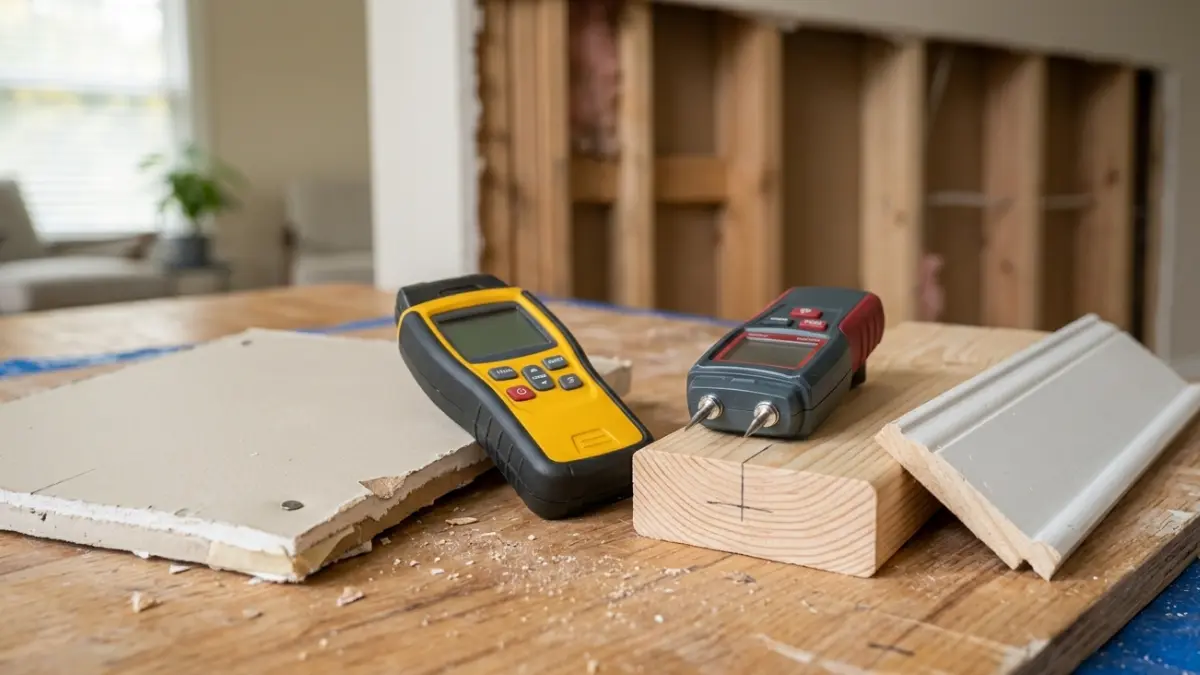
Can I check it myself?
Yes, within limits. Use a pinless meter on a finished surface that’s dry to the touch, and compare it against unaffected material of the same type elsewhere in the house. The comparison is the useful part; the isolated number isn’t.

- Precision in 7 Modes: This wood moisture detector offers seven calibration scales designed for various wood and building…
- 3-In-1: Featuring sensitive pins and a back sensor, this tester measures moisture in various materials and monitors ambi…
- User-Friendly Design: Hold function locks readings for easy viewing and recording; Large color backlit LCD display ensur…
⚠️ Watch Out: Never push pin probes into a finished wall or ceiling. Electrical wiring runs through those cavities and you can’t see where. Keep away from outlets and switches, and leave in-cavity, subfloor, and above-30% readings to a professional with an instrument built for them.
What your reading proves is narrow: this material, at this depth, right now. It says nothing about what sits behind it.
The drying log, and the three things to look for in it
The record that answers your question already exists, and it isn’t in your hands.
What a drying log contains
Documenting daily monitoring — readings, locations, equipment — is standard professional practice on a water loss and an expectation under the S500. Most crews keep one and hand it over without being asked. It should show numbered measurement points, a reading for each, and a date for every visit from the first day to the last.
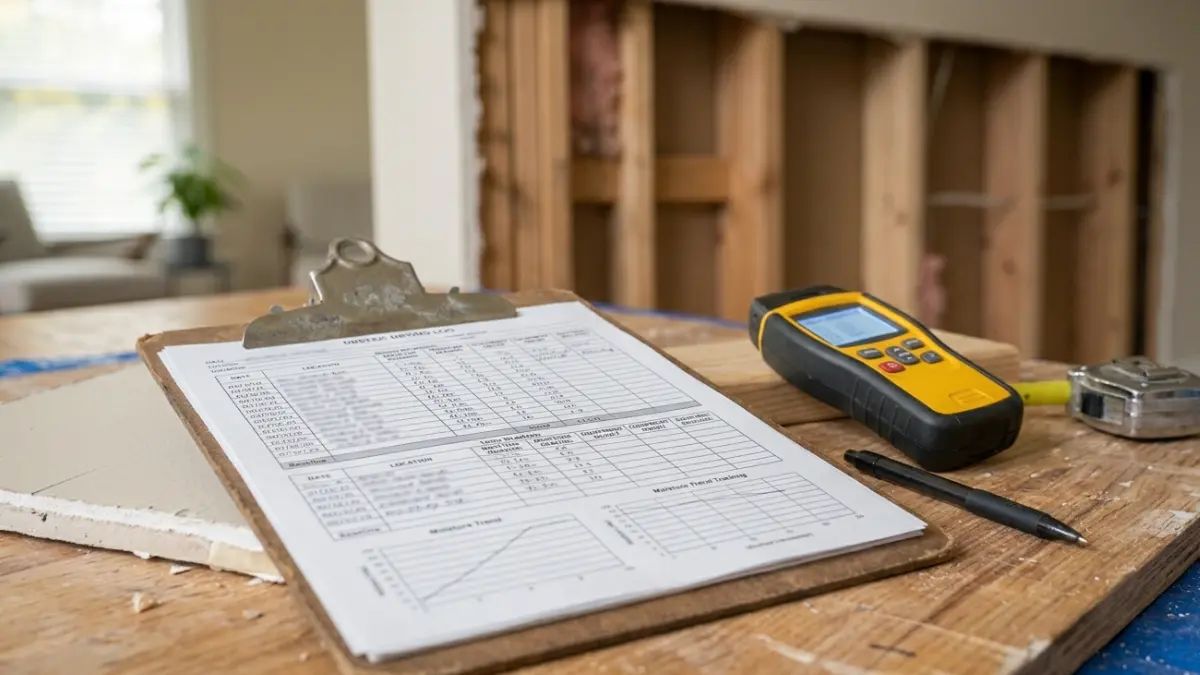
Reading the baseline column
Three checks tell you whether a dry standard was ever properly set.
- Is there a baseline from an unaffected area of the same material, recorded before equipment went in? Without it, the final readings have nothing to measure against.
- Were the same numbered points read on the same schedule, or do points appear and vanish between visits?
- Do the final readings sit beside that baseline, or beside a round number with no baseline near it?
✅ Do This: Ask for the log before you sign a completion form, in plain words: “Can I see the daily drying log, including the baseline readings from the unaffected areas?” A crew that keeps good records produces it without friction.
The parallel question — how anyone proves remediation worked — is covered in verification testing after remediation.
When it’s dry enough to close the wall
The rebuild crew wants to start, and wood framing closed up wet stays wet.
Before the drywall goes back
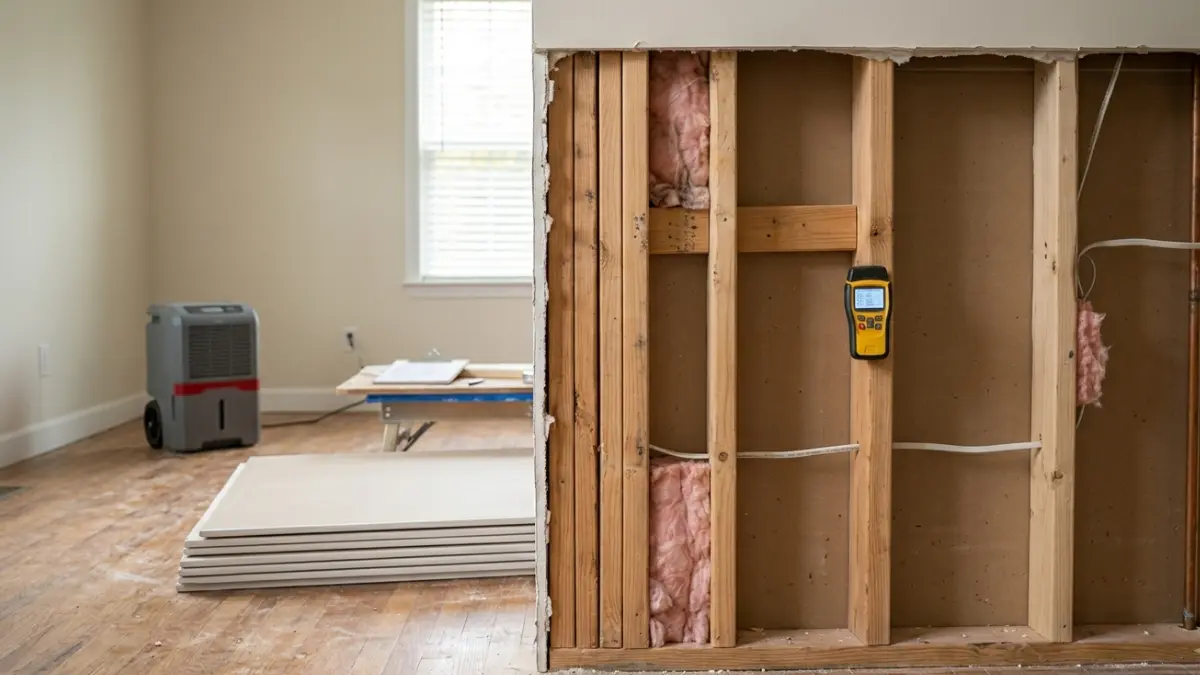
The USDA’s guidance is the best-sourced answer available. Framing should sit no more than about 5 percentage points above the moisture content it will settle at in service when wall and ceiling finish goes on, and interior trim can normally be installed as members approach an average of about 12%.
Two other figures are worth holding. Lumber stored above 20% moisture content without drying can allow decay to develop — can, not will. And “dry lumber” under the American Softwood Lumber Standard means a maximum of 19%.
None of these are water-damage numbers. They describe new construction and lumber storage, and they remain the closest sourced threshold anyone publishes.
The humidity the room has to hold
Material dries to match the air around it, so the air decides whether dry stays dry. The EPA’s indoor humidity guidance is to keep relative humidity below 60%, ideally between 30% and 50%, and it notes that a combined temperature and humidity gauge runs under $50 at hardware stores. Holding that range afterward is what a dehumidifier is actually for.
✅ Do This: Before the cavity is closed, ask whether framing readings were taken and recorded. Where material integrity is in question, the EPA directs that a structural engineer or professional with relevant expertise be consulted — ask whether the framing was assessed, not just dried.
When the numbers don’t add up
Sometimes the paperwork says finished and the house disagrees.
Three signs worth escalating
A musty smell that returns when the house is shut up for a day. A reading that stops falling for several days while equipment still runs. Material that has changed shape — a cupped board, a soft spot, an opened seam.
Any of these is worth a second opinion, and mold that keeps coming back after remediation usually traces to moisture never fully removed.
An indoor environmental professional designs a sampling strategy, submits samples to a lab, and interprets what returns. The S500 points toward one where occupants are at elevated risk or a contaminant needs identifying — and also says an IEP is often not necessary. Both halves are true.
What not to do while you wait
Don’t cut into anything to look, don’t push pins into walls, and don’t apply bleach or disinfectant. Skip the DIY test kit too — sampling without a plan produces numbers nobody can interpret.
⚠️ Watch Out: Whoever assesses the drying shouldn’t be the company that performed it. Ask any assessor about financial ties to your restorer, and get the sampling plan in writing first. If the loss was storm-driven, storm water isn’t automatically Category 3 — and choosing a company covers vetting a second firm.
Common questions about dry standards and moisture readings
1. What is a dry standard in water damage?
A dry standard water damage target is an approximation of what a material’s moisture level was before the water arrived. It is found by reading similar unaffected material elsewhere in the same building, which is why it belongs to your house specifically rather than being published as a fixed figure anywhere.
2. What moisture percentage is considered dry for drywall?
No single percentage is, and pages publishing “under 1%” for drywall don’t cite a source. The dry standard water damage approach compares affected drywall against unaffected drywall in the same structure, because normal varies by climate and by building. If mold has already appeared, removing mold from drywall becomes a separate job.
3. How do I know if my walls are dry after a leak?
Ask for the drying log and check three things: a baseline reading taken from an unaffected area of the same material, the same numbered points read on the same schedule each visit, and final readings recorded beside that baseline. Below-grade rooms hold moisture longest, so basement moisture deserves its own separate look.
4. How accurate are moisture meters?
Electrical moisture readings always carry some uncertainty. Used correctly and corrected for both species and temperature, a reading lands within about 1% of true, according to the USDA. Above 30% moisture content, readings are qualitative only — which covers most genuinely wet material during a dry standard water damage job.
5. How long should drying equipment stay in my house?
Until the readings say so, rather than until a day count says so. Equipment comes out when affected materials reach the dry standard set from unaffected material in your own building. A crew quoting a fixed number of days before taking any readings is describing a schedule, not a measurement.
6. What should be in a drying log?
Numbered measurement points tied to locations, a moisture reading for each point, the date of every monitoring visit, and equipment placement. The first entry should be a baseline taken before drying equipment went in. Original daily entries tell you more than a single summary sheet produced at the end of the job.
7. Is 15% moisture too high in wood framing?
It is not a pass-or-fail line. Fifteen percent sits below the 19% maximum that defines “dry lumber” under the American Softwood Lumber Standard, and above the roughly 12% at which interior trim normally goes on. Whether it is acceptable here depends on what unaffected framing in your own building reads.
8. Can I check the moisture myself?
Yes, within limits. Use a pinless meter on a finished, dry-to-touch surface and compare it against unaffected material of the same type elsewhere in the house. Never push pin probes into walls or ceilings where wiring runs, never take readings in standing water, and leave in-cavity readings to a professional.
What to do before you sign anything
The number that means dry comes from your building, not from a chart.
The drying log records whether anyone established it, and the baseline reading from an unaffected area is the line to look for. If it isn’t there, the final readings aren’t measuring anything.
Ask for the log, find the baseline, and compare it against the final readings. If the two don’t sit beside each other, that’s the question to raise — and the full sequence a restorer follows before drying starts shows where it should have been set.