The Hidden Logic Behind What Sewage Backup Cleanup Removes

Sewage backup cleanup has no drying shortcut. The EPA table that lets drywall stay says in its own footnote that it applies to clean water only.
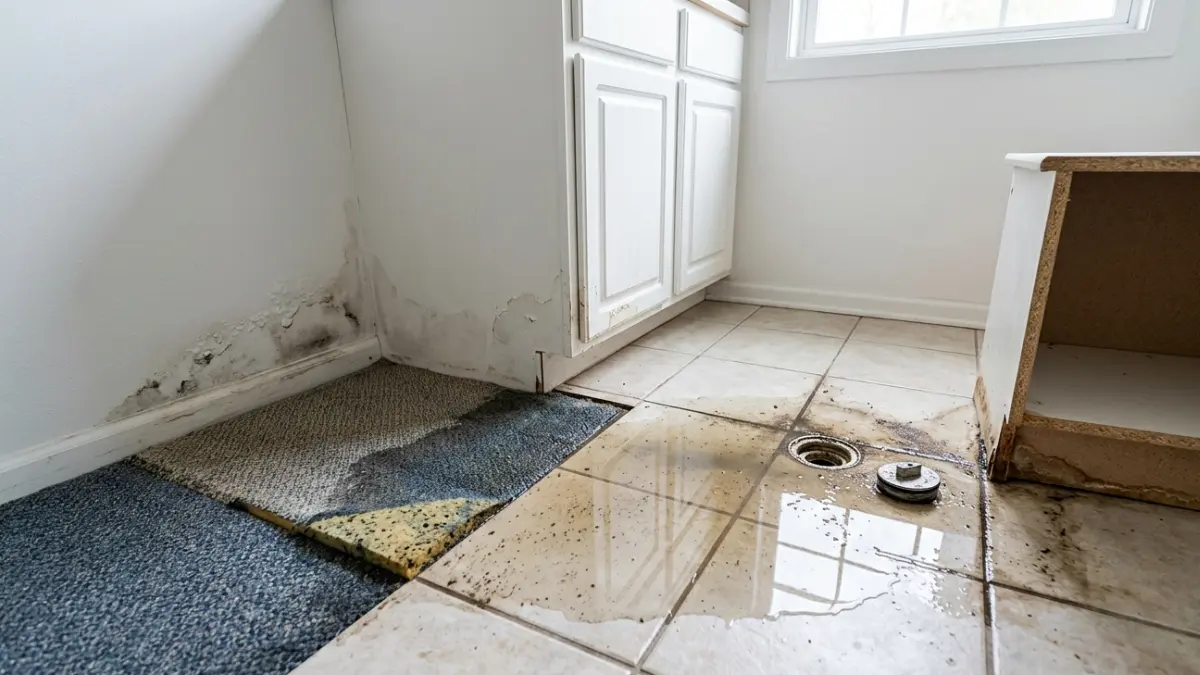
Table of Contents
Why the removal list is longer than the mess
The list of things leaving your house after a sewage backup cleanup is almost always longer than the puddle on the floor suggests. Most people expect the water to go and the room to be scrubbed. What arrives instead is a scope sheet naming drywall, insulation, carpet padding and furniture.
The decision behind that list turns on what a material is, not on how dirty it looks.
If a restorer has already handed you a scope
You are holding a tear-out list and wondering whether it is standard or padded. Start at the fourth and fifth sections — what federal guidance names, and where scopes run past it.
If nothing has been touched yet
Read what puts a backup in the most contaminated water category, then the documentation section, before a single bag leaves. If water is still arriving, the first hour after water damage comes first.
This page explains decisions rather than methods, names the source behind every rule below, and sells nothing. The full order of work sits in what happens before drying starts.
ℹ️ Safety Note: A sewage backup is a health hazard, not a cleaning job. Keep people and pets out of the area, and leave assessment, material removal and drying to an IICRC-certified restoration contractor, with a licensed plumber for the cause. This article explains why those decisions get made; it is not instruction for doing the work.
What makes a backup Category 3 water
Category 3 water is the most contaminated of the three tiers in the ANSI/IICRC S500 standard, and a 2026 position statement from that standard’s consensus body sets out what falls inside it.
Beyond the trap is the dividing line
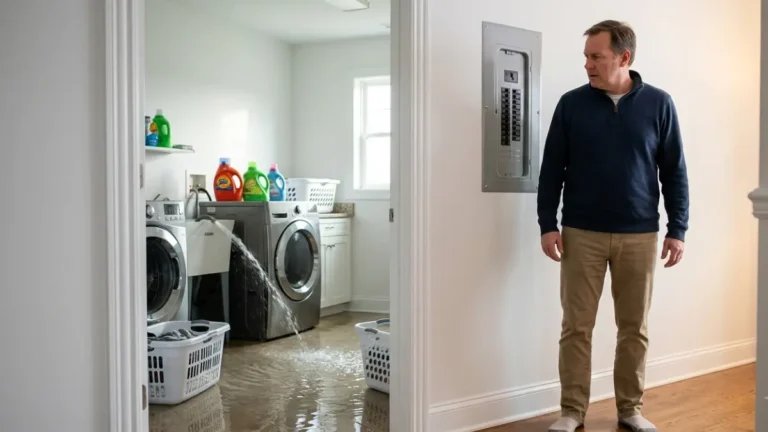
Every fixture has a trap — the curved pipe holding a water seal between your room and the waste line. The standard’s Category 3 examples include sewage, and waste line backflows originating from beyond any trap. Where the water came from decides this, not how much of it there is.
Color and clarity decide nothing
The same definition applies “regardless of visible content or color.” Clear water rising in a floor drain is treated the same as the obvious kind, which is why a restorer will not downgrade a backup because it looks weak.
The call itself is a preliminary determination, made on site. Ask what it rested on and whether it came before or after the scope was written — how water categories are decided sets out all three tiers.
Why porosity decides what gets removed
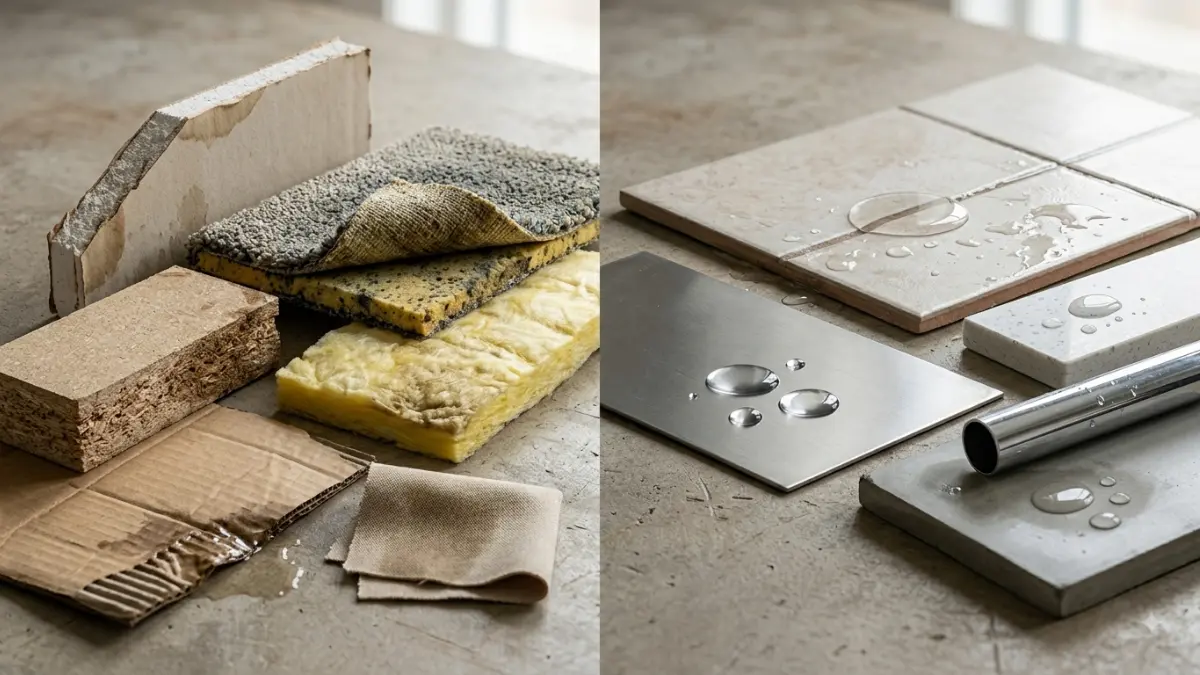
Porous materials draw liquid into their thickness instead of holding it on the surface. That single property is the variable behind almost every line on a removal list.
What porous covers in a house
Carpet and its padding, drywall, fiberglass and cellulose insulation, particleboard, upholstery, mattresses, cardboard and paper all absorb. Concrete, ceramic tile, metal, sealed countertops, sinks and plumbing fixtures do not. CDC directs that second group to be cleaned with hot water and detergent rather than replaced.
Why cleaning a surface isn’t the same thing
EPA explains the mechanism in its mold guidance: contamination infiltrates porous substances, filling the spaces and crevices inside them, so complete removal becomes difficult or impossible. A disinfectant acts on a surface it can reach. It cannot reach the interior of a material it never penetrates.
🔍 Why It Works: A hard surface holds contamination where a cleaner can get to it. An absorbent one carries it inward through the material’s own structure, so wiping the face leaves the inside untouched. Porosity, not visible dirt, decides which materials leave.
What no federal source publishes is a threshold — a number saying how absorbent is too absorbent. The guidance names materials instead of measuring them, which is one reason two contractors can write two different scopes for one room.
What the federal guidance actually names for removal
Two federal sources name materials, and they do not use the same strength of instruction. CDC’s post-disaster cleaning guidance is flat about drywall and insulation contaminated with sewage: remove and discard. EPA’s sewer overflow guidance says rugs, curtains, flooring, wallboard panels and upholstered furniture that contact sewage usually must be replaced.
The two CDC rules are not the same rule
Alongside that, CDC gives a second, conditional rule: throw away anything you cannot clean or dry quickly, listing mattresses, carpet, padding, rugs, upholstery, books and paper. The first rule turns on contamination; the second turns on whether an item can be salvaged in time.
What EPA’s wording leaves open
“Usually” is doing real work in EPA’s sentence. It leaves room for an item outside the contaminated path, and for a high-value piece a specialist restores off site. It is not the blanket rule the search results turn it into.
| Material | What the source says | Source | Date | Key detail — how firmly it’s stated |
|---|---|---|---|---|
| Drywall and insulation | Remove and discard where contaminated with sewage or floodwater | CDC, cleaning safely after a disaster | Reviewed Feb 2024 | Unconditional |
| Rugs, curtains, flooring, wallboard panels, upholstered furniture | Usually must be replaced after contact with sewage | EPA, sanitary sewer overflow guidance | Updated Apr 2026 | Qualified — “usually” |
| Mattresses, carpet, padding, books, paper, foam items | Throw away anything you cannot clean or dry quickly | CDC, same page | Reviewed Feb 2024 | Conditional on salvage, not on contact |
| Concrete, countertops, appliances, sinks, fixtures, metal and wood furniture | Clean with hot water and detergent | CDC, same page | Reviewed Feb 2024 | Cleanable, not removable |
| Wallboard | May be dried in place if there is no swelling and the seams are intact | EPA Table 1 | Updated Sep 2025 | Clean water only — explicitly not sewage |
| “All porous materials must be discarded” | The absolute version repeated across the web | NDSU Extension, citing IICRC S500 2nd edition | 1999 edition | Absolute, and traceable to a 1999 text |
Sources named and dated, every page retrieved 9–10 August 2026. Nothing here was tested — the table records what each source states and how firmly.
⚠️ Watch Out: That EPA wallboard row is the one homeowners find and hope for, because it is the only guidance anywhere that lets drywall stay. Read the line above the fine print: those guidelines are for clean water damage. Where sewage is suspected, EPA says protective equipment and containment are required by OSHA.
One absence matters as much as any of it. The IICRC position statement — the document the industry cites on sewage — contains no material-removal clause, only the instruction that remediation precedes restorative drying at Category 2 or 3. The removal list comes from federal guidance and from practice, not from a standard anyone can read.
Carpet gets its own version of this argument in whether carpet can be cleaned or has to go, and drywall in what happens to wet drywall.
Where removal scopes go further than the sources do

- Precision in 7 Modes: This wood moisture detector offers seven calibration scales designed for various wood and building…
- 3-In-1: Featuring sensitive pins and a back sensor, this tester measures moisture in various materials and monitors ambi…
- User-Friendly Design: Hold function locks readings for easy viewing and recording; Large color backlit LCD display ensur…
Removal can be over-scoped as well as under-scoped, and two places are worth checking.
The cut height nobody can cite
Ask how high the wall material is coming out and you will get a number delivered with complete confidence.
📊 Sourced: Nine restoration and drywall pages checked on 10 August 2026 give the removal height as 12 inches, 12 to 18, 12 to 24, or 12 to 48 above the water line, with one page stating two different ranges in its own copy. Each calls its figure the industry standard. None cites one.
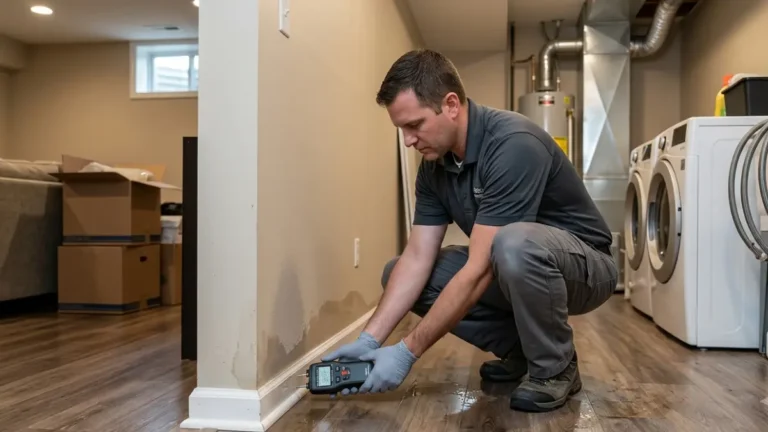
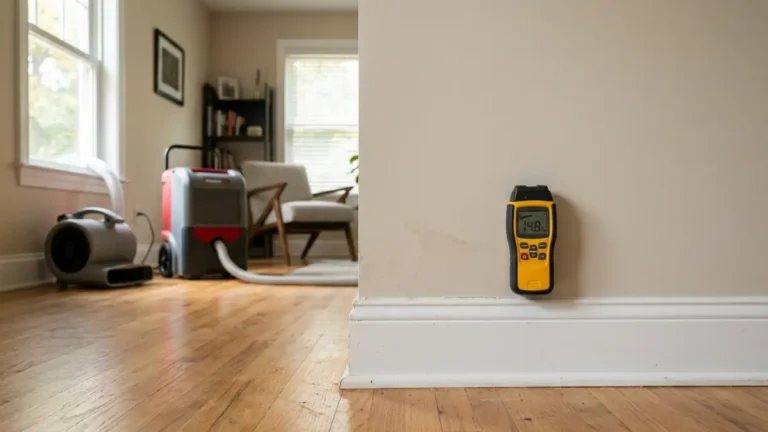
Two of those nine give the rule that holds up: the height follows moisture readings, not the line the water left. That is the method a competent restorer already uses, comparing readings in an unaffected area against the affected one. A round number is a shortcut standing in for a measurement.
What doesn’t automatically have to go
Hard, non-porous surfaces are cleanable, and belongings outside the contaminated path were never in scope. Not every overflow is a waste line backflow either — the standard’s example is water arriving from beyond the trap, which is a different event from a supply line letting go. Your restorer makes that call, but you can ask which one was recorded, the same way not every intrusion is Category 3 applies to storm water.
Why cleaning comes before drying, and fans wait
A clean-water job dries first. A sewage job cleans first, and the reversal is deliberate.
Remediation before restorative drying
The S500 consensus body’s 2026 statement uses two different registers. At Category 2 or 3, remediation should occur before restorative drying — and restorers shall use contamination controls and appropriate worker protection. The second verb is the stronger one, and the difference is not accidental.
Why the air handler stays off
EPA’s water damage table says not to use fans before the water has been determined clean or sanitary. Air pushed across contaminated material moves that material into the air, and into rooms that were fine an hour ago. The same reasoning sends a furnace or air conditioner to a professional check before any restart.
✅ Do This: Ask whether an indoor environmental professional is being brought in. The standard names conditions that call for one — high-risk occupants, a public health issue, likely health effects, an unidentified contaminant, suspected airborne contamination, or real doubt about whether the water is contaminated. It also says an assessment often is not necessary, so ask rather than demand.
Drying that starts too early is the failure mode behind much mold found after flooding. The eight checks a restorer runs first sit in what happens before drying starts.
What to document before anything leaves the house

- 5200°F Fireproof & Water-resistant Safe: The upgraded important document organizer is made of thickened silicone-coated …
- Soft Box: Large-capacity(15″x11″x4.1″),Compared with other bags,our fireproof file organizer adopts a multi-layer design…
- Combination Lock Protection: Compared with other bags,our 5200°F fireproof document organizer can lock files and items i…

Once material is bagged and hauled away, the evidence goes with it. This part is yours, and the window is narrow.
Questions that test a scope
Ask for the reason behind each material, and whether it is contamination, saturation or access — access is legitimate, and not the same as contamination. Ask what the category determination rested on, and what is being cleaned rather than removed, because that list should exist too.
Why this is treated as occupational exposure
CDC’s guidance for people who handle sewage as a job — written for sanitation workers rather than homeowners — sets out dedicated protective equipment, a hygiene protocol, training, and vaccination status reviewed with health authorities. EPA notes that sewage carries bacteria, viruses, protozoa and intestinal parasites, with illness ranging from mild stomach upset upward. That is the level of control this material gets where handling it is a job.
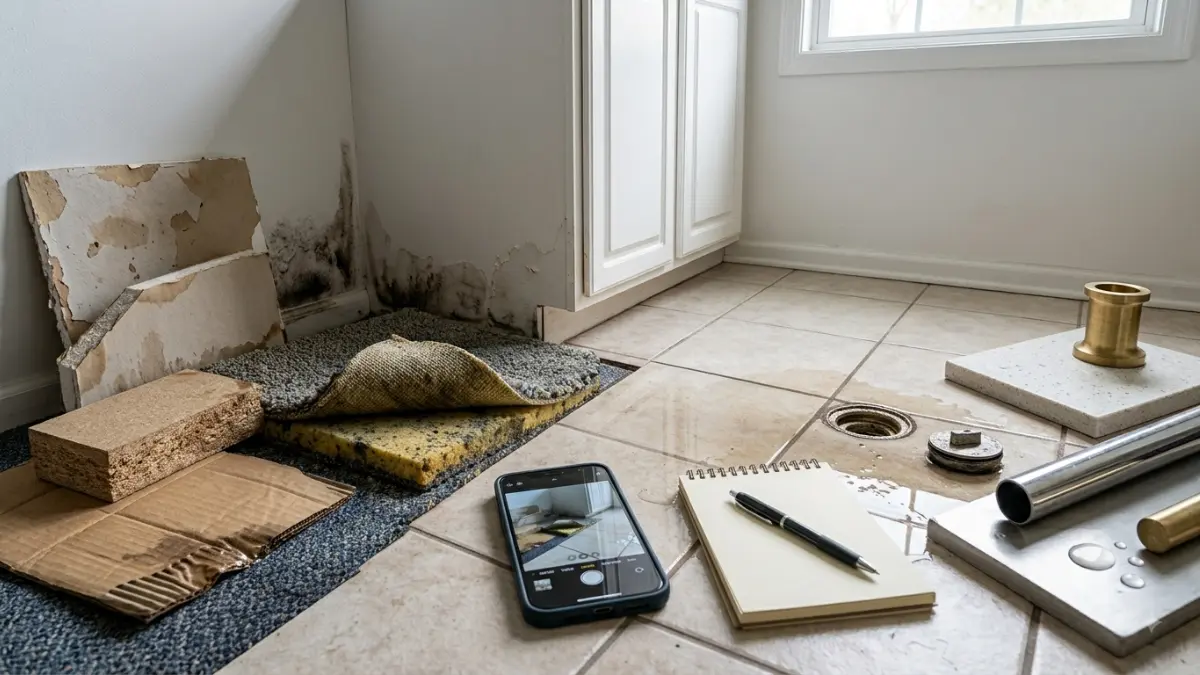
✅ Do This: Photograph each room wide, then each affected material close, before anything moves. Write a plain list of what is leaving and where it came from. This one is our recommendation rather than a rule from any agency.
- Contractor Garbage Bags: 55 Gal | 40 Bags | Black | Heavy Duty
- Heavy Duty: Thick 2 mil contractor trash bags, designed to hold heavy loads and construction debris
- Large Contractor Bags: 55 Gallon Trash Bags (36″ x 56″), for large construction projects
Coverage is a separate system decided by different people; how coverage questions are handled covers that conversation. Keep children and pets clear until the work is finished, which is CDC’s instruction too.
Sewage backup cleanup questions people ask
1. Is a sewage backup always Category 3 water?
The standard’s Category 3 examples include sewage and waste line backflows originating from beyond any trap, and the definition applies whatever the water looks like. So a backup from the waste side sits in that tier by definition. The determination is still made on site by your restorer, who records what the call rested on.
2. What has to be thrown away after a sewage backup?
CDC directs that drywall and insulation contaminated with sewage be removed and discarded, and that anything you cannot clean or dry quickly be thrown away, naming mattresses, carpet, padding, rugs, upholstery, books and paper. EPA adds that rugs, curtains, flooring, wallboard panels and upholstered furniture usually must be replaced. Hard surfaces are cleaned instead.
3. Can carpet be saved after a sewage backup?
Carpet and padding sit in different places in the guidance, so ask about them separately after a sewage backup. CDC groups carpet with items to discard when they cannot be cleaned or dried quickly, and padding is the more absorbent of the two. EPA’s wording leaves room for a high-value piece restored off site, but that is the exception.
4. Does drywall always have to be removed after sewage?
Where sewage has contaminated it, CDC’s instruction carries no condition: remove and discard. The EPA table that allows wallboard to be dried in place applies only to clean water damage, and says so directly. How far the removal extends is a judgment your restorer makes from moisture readings rather than from the visible water line.
5. How high do they cut the drywall?
No free primary source states a height. Nine industry pages checked in August 2026 give figures from 12 to 48 inches above the water line, each calling its own number the industry standard. The defensible height is the one moisture readings support, so ask what the readings showed rather than which number was used.
6. Can I clean up a small sewage backup myself?
Treat this as professional work. EPA states that where the water is contaminated with sewage, protective equipment and containment are required by OSHA, and directs anyone without expertise in contaminated water to consult an experienced professional. Call an IICRC-certified restoration contractor and a licensed plumber, and keep people and pets out of the area meanwhile.
7. Why can’t the area just be disinfected after a sewage backup?
Disinfectant acts only on surfaces it can reach, which is the limit sewage backup cleanup runs into. EPA explains that contamination infiltrates porous substances and fills the spaces inside them, so complete removal from absorbent material becomes difficult or impossible. Hard surfaces are cleaned and treated, while absorbent ones are removed because their interior cannot be reached.
8. Should I keep damaged items for the insurance claim?
Photograph and list everything before it leaves, which is our recommendation rather than an agency rule. A wide shot of each room and close shots of each affected material take minutes and cannot be recreated afterwards. Whether a backup is covered is a separate question decided by your policy and your insurer, so raise it with them early.
What to do with this before the crew arrives
Three things are yours in the next hour. Photograph and list what is in the affected space before anything moves. Ask what the category determination rested on, and ask for the reason behind each material on the list.
The rest belongs to people with training and equipment you should not be buying today. If you are still choosing who does the work, choosing a remediation company covers what to verify, and the full restoration sequence shows where removal sits in the order of work.