The overlooked clauses in a termite bond that cost you later

Your termite bond may be retreat-only, retreat-and-repair, or unavailable —
regulators name three outcomes, and the paperwork decides which one you have.

Table of Contents
A termite bond is a service contract with a pest control company, not an insurance policy, and the version in front of you was written by the firm that wants to sell it.
Where you are right now decides what to read first. If an unsigned proposal is on the table, start with the three agreement types below, then work through the ten questions.
If you are deciding whether to pay another annual renewal, go to the renewal and booster section. If you are buying a house and inheriting someone else’s coverage, the sections on excluded damage and on switching companies are the ones that can cost you money.
North Carolina’s structural pest control regulator describes three possible outcomes here, not the two that most pages cover. One of them is that no guarantee gets offered at all.
Everything else follows from a single problem: nobody can date termite damage. The treatment itself is priced separately, and what termite treatment actually costs and why covers that side of the decision.
ℹ️ Safety Note: Termite agreements are binding contracts with real financial stakes, and both the contract terms and the state rules governing them vary. This article describes how these documents are structured and what regulators require them to contain — it is not legal, contract, or financial advice. For your own agreement, ask a licensed pest management professional, your state structural pest control agency, or an attorney.
What a termite bond actually promises
Before comparing prices, find out which of three agreements you are being offered. The service agreement you sign determines everything that happens later.
| Agreement type | What the company owes you | Key detail |
|---|---|---|
| Re-treatment only | Further treatment if termites are found in the structure during the agreement period | No obligation to repair, replace, or correct damage. The most common practice in the industry |
| Re-treatment and damage repair | Treatment, plus repair of damage occurring after the initial treatment, up to a stated amount | Not offered by every firm, and the structure typically has to meet criteria to qualify |
| No guarantee or warranty | Nothing beyond the initial treatment | The absence of any such agreement should be clearly indicated in your paperwork |
Sourced from the North Carolina Department of Agriculture and Consumer Services, Structural Pest Control Division.

Re-treatment only — the industry default
Termites return inside the term, the company treats again at no extra charge, and the repair bill stays with you. Most agreements run one year following the initial treatment, after which you decide whether to continue.
Re-treatment and damage repair — and who qualifies
This adds an obligation to repair damage that occurs after the initial treatment, up to a limit written into your document. Your house has to qualify first, which is a separate question from whether you can afford the upgrade.
No guarantee at all — the outcome nobody publishes
A company can decline to offer any continuing agreement. That happens for physical reasons covered further down, and it is worth knowing before you assume coverage is yours to choose. The regulator’s own wording is in North Carolina’s guide to termite service agreements, and none of these agreements is an assurance that termites will not come back — only a promise of specific corrective action. Skipping coverage entirely is a fourth path, and why the treatment isn’t the thing you’re buying is worth reading before you take it.
Ten questions, and where each answer should already be written
- AUTOMATIC LOCK – Self locking mechanism allows blade to lock automatically and retract at the push of a button.
- NYLON COATED BLADE – Provides maximum blade protection.
- IMPACT RESISTENT CASE – ABS plastic with rubber over mold protects the case from accidental drops.
Most of what salespeople answer out loud is already required to be written down. Ask the question, then find the contract clause that answers it — a verbal answer that contradicts the paperwork is worthless.
- Which of the three agreement types is this? — guarantee or service agreement clause
- What is the repair limit, in dollars? — damage repair provision
- How do you establish that damage is new? — claims or evidence provision
- What is excluded from coverage? — exclusions
- What can I do that voids this? — homeowner obligations
- What is the term, and what does each renewal buy? — term and renewal
- What happens if a renewal payment is late? — cancellation
- Is any part of the standard treatment being skipped? — treatment specification or waiver form
- Will a booster treatment be required later, and who pays? — renewal or booster provision
- If we disagree, what happens next? — dispute resolution
What your state already requires to be in the document
North Carolina requires the contract to be in writing and to carry the license number and phase, a foundation diagram marked active or inactive, the location of visibly damaged timbers, whether re-inspections happen and at what interval, the conditions for re-treatment, and the total price.
Oklahoma requires a pre-treatment disclosure covering the warranty period, renewal options and costs, obligations to re-treat or repair, areas excluded from treatment, and the conditions caused by owner action or inaction that void the warranty — a list you can read at Oklahoma State Extension’s guidance on choosing a termite company.
Those two lists are examples. Your state sets its own, and the annual visit is a different document from a real estate report — see the difference between a WDO inspection and an annual renewal inspection.
✅ Do This: Ask the salesperson to point to the clause answering each question, and get any promise that isn’t in the document added in writing before you sign. Your state structural pest control agency can tell you what your state requires the contract to contain.
How a repair claim is actually judged

- ALL-DAY RUNTIMES: Flashlight includes two FL1 rated modes that last up to 10 hours
- ON-THE-GO FLOOD LIGHT: Flashlight features an additional array light for larger area coverage with three modes
- HANDS-FREE WORKLIGHT:The magnetic end cap and side-barrel LEDs allow for a convenient, hands-free mounted work light
Repair coverage is not triggered by finding damage. It is triggered by proving the damage is new, which in practice means showing live termites at the site.
Why “new damage” is the hard part
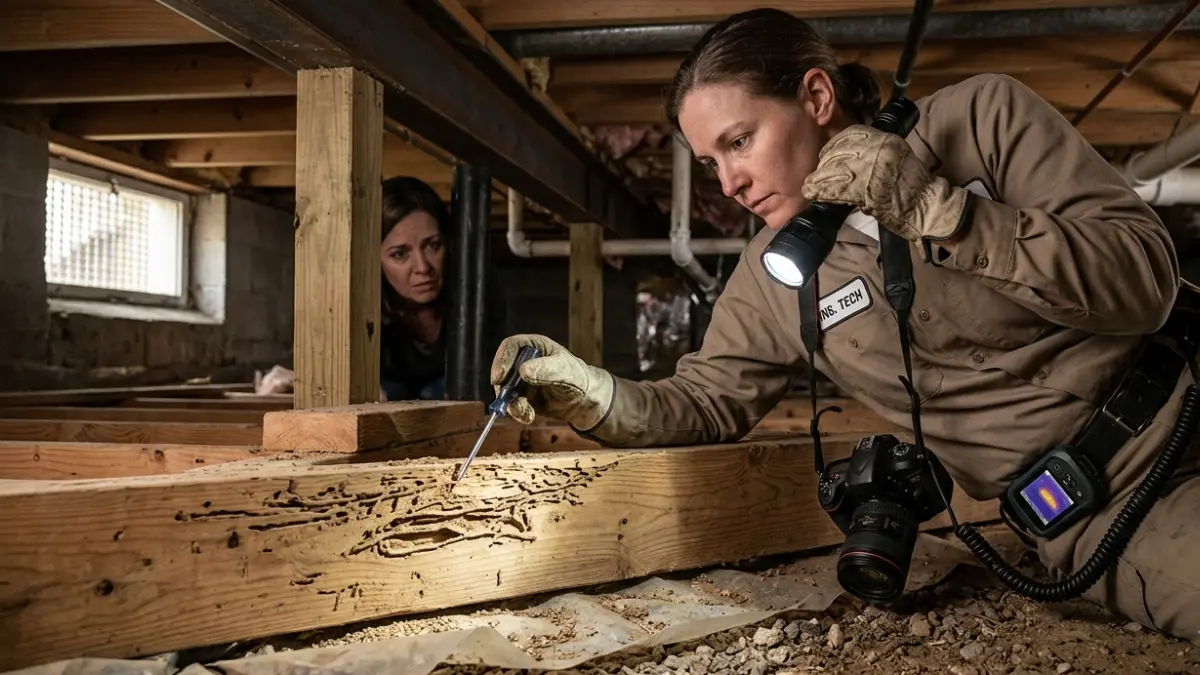
“New” means damage documented as occurring since the treatment date. Termites infest wood, feed, and move on, leaving evidence but no timestamp.
🔍 Why It Works: Nothing in damaged wood records when the feeding happened. Extension guidance from both Georgia and North Carolina states there is no scientifically sound way to determine the age of termite damage — so the claim has to rest on current activity instead.
What you have to be able to show
A claim usually requires live termites at the damaged area, and photographs or video of that activity help. The company may verify the activity itself.
📊 Sourced: A University of Georgia extension entomologist describes the practical standard plainly: because damage cannot be dated, claims against a repair contract generally require live termites at the site of the damage. Read it in a University of Georgia entomologist’s explanation of termite contracts.
The existing-damage exclusion, and why it isn’t a loophole
Buy a previously-owned house with no prior agreement, and damage found later with no termites present is normally treated as pre-existing and excluded. North Carolina State Extension describes this as a legitimate evidentiary problem rather than an excuse, and one to have explained before signing.
Before assuming what you found is termite work at all, telling termite damage from rot matters, and so does documenting live activity the moment you find it. Inspections only cover visible, accessible areas — not wall voids, not under floor coverings.
What voids it, and what was never covered

- ✔️ UNPARALLELED ACCURACY: Say goodbye to uncertainty. Achieve pinpoint accuracy and know the precise moisture level of y…
- ✔️NON-DAMAGING: The non-damaging pinless sensor helps you preserve your craftsmanship. Obtain accurate moisture readings…
- ✔️ DUAL DEPTH MEASUREMENT: Measures both ¼’’ depth and ¾” depth
Two different failures get confused here. One is coverage you lost; the other is coverage that never existed, and the exclusions clause is where you find out which.

Things you can do that void it
- Disturbing treated soil through excavation, landscaping, or renovation
- Letting moisture conditions develop against the foundation
- Planting too close to exterior walls
- Failing to correct problems the inspector reported to you
Things it never covered in the first place
- Spray foam insulation in a crawl space or attic — many companies will not warranty a home they cannot inspect properly, per UF/IFAS
- Aerial infestations living above ground inside the structure, which soil treatment cannot reach
- Formosan and Asian subterranean termites, excludable from warranties in states that allow it, including Florida
- Other wood-destroying organisms — carpenter ants, carpenter bees, powderpost beetles, wood-decay fungi — unless named
⚠️ Watch Out: Call your pest management professional before foundation work, regrading, or crawl-space insulation, not after. The conditions that void coverage are listed at UF/IFAS on termite prevention and control, and a voided agreement is usually discovered at claim time.
Which species your agreement names matters, which is why subterranean and drywood termites are treated differently, and where Formosan exclusions apply is worth checking regionally.
The renewal, the term, and the booster clause
The annual renewal does not buy an annual re-treatment, which surprises most people paying it.
What the annual fee buys — and doesn’t
📊 Sourced: NC State Extension notes that annual treatments without evidence of activity are illegal under most termiticide labels. The fee buys an inspection and continued eligibility, not a yearly re-spray. The same source notes that EPA registration requires manufacturers to demonstrate at least five years of efficacy — which is a product standard, not a promise about your house.
Missing a payment
Renewal generally takes effect only when the company receives the fee, and most firms may cancel if it isn’t paid by the due date. Terms are commonly annually renewable over a set number of years, though bait agreements often run open-ended.
The booster treatment clause
Some agreements require a booster treatment after a period to keep the guarantee alive, and that cost is usually not covered by your current agreement. The alternative sometimes offered is a significantly higher renewal.
⚠️ Watch Out: Ask whether a booster is required, when, at whose cost, and what happens to your renewal if you decline. The clause is explained in NC State Extension’s guidance on annual termite contracts, and it is the most common reason a cheap agreement stops being cheap.
Renewal economics differ by system — see how bait and liquid agreements differ, the systems these agreements are written around, and what the initial treatment price is built from.
When a bond earns its keep — and when switching costs you

- Expanding file folder in Black with flap and cord closure for organizing and securing 8.5 x 11-inch letter-size document…
- Holds up to 260 sheets; 13 pockets for easy subdividing; each pocket expands to 7/8-inch
- Archival quality, acid free, and PVC free
The case for continuous coverage
Coverage held with one company since the house was built is the strongest position available, because any damage discovered must have occurred during that coverage.
What changing companies resets
Move to a new provider and the existing-damage exclusion applies again from day one. Anything already inside your walls becomes undatable and therefore unclaimable, however long you paid the previous firm. If repair coverage is the reason you are paying, that timing consequence is worth more than a lower quote.
If a claim is refused
✅ Do This: Start with the company’s owner or manager, since some refusals are miscommunication. If that fails, contact your state department of agriculture or structural pest control division — the agency inspects structural pest control work and investigates complaints. Keep every inspection record and pass them to the buyer when you sell.
Termite bond questions homeowners ask
1. Is a termite bond the same as insurance?
No. A termite bond is a service contract with a pest control company, and the company’s obligations are limited to what the document says. Regulators describe these agreements as providing for specific corrective action, not as an assurance that termites will not return. Everything depends on the wording you sign.
2. Does homeowners insurance cover termite damage?
Insurers’ own consumer guidance generally treats insect damage as a maintenance issue excluded from standard policies. Coverage language varies by policy and by state, so read your own policy and ask your insurer directly rather than assuming either way. A termite bond is a separate product entirely, sold by a pest control company.
3. Can a pest control company refuse to give me a bond?
Yes. A company may decline to offer any continuing agreement, and that absence should be stated clearly in your paperwork. Refusals commonly follow conditions that prevent proper inspection or treatment, such as spray foam insulation or inaccessible areas. Ask what would need to change for coverage to become available.
4. What voids a termite warranty?
Disturbing treated soil, allowing moisture conditions against the foundation, planting too close to walls, and failing to correct problems the inspector reported can all void coverage. Your agreement must list the owner actions and inactions that void it in states like Oklahoma. Ask your pest management professional before any foundation or landscaping work.
5. Is a termite bond transferable when I sell?
Ask, and get the answer written into the agreement — transfer terms are set by each contract rather than by a general rule. Ask specifically whether a fee applies and what the buyer must do to keep coverage active. Pass all inspection records to the buyer, which extension guidance recommends regardless of transferability.
6. Do they re-treat my house every year?
No. An annual agreement covers inspection and eligibility, not a yearly re-treatment. Annual treatments without evidence of termite activity are illegal under most termiticide labels. If activity is found during the year, the company acts under the terms of your agreement, usually treating the affected area at no additional charge.
7. What happens if I miss a renewal payment?
Renewal generally takes effect only when the company receives the fee, and most firms may cancel the agreement if payment misses its due date. Reinstating lapsed coverage is a new negotiation, not a resumption. Set a reminder ahead of the due date and confirm receipt rather than assuming payment landed.
8. How much is annual termite bond renewal?
Published figures vary widely by state, house size, construction type, and agreement type, and the ranges circulating online come from self-reported data rather than verified sources. Ask the company for the renewal figure in writing, along with how much it can increase and under what conditions, before you sign the first year.
9. What is a booster treatment?
A partial re-treatment some agreements require after a period of years to keep the guarantee in force. The cost is usually not covered by your current agreement, and the alternative offered is sometimes a significantly higher annual renewal. Ask whether your agreement contains a booster requirement before signing, not at year five.
10. What if the company denies my repair claim?
Start with the company’s owner or manager, since some refusals come from miscommunication rather than the contract. If that does not resolve it, contact your state department of agriculture or structural pest control division, which investigates complaints about structural pest control work. Keep every record you have been given.

Before you sign
Take the ten questions to the appointment and make the salesperson point to the clause that answers each one. Anything promised out loud and missing from the document is not part of the agreement.
The single fact worth carrying into that conversation: repair coverage pays on live termites, not on damage, because damage cannot be dated. That one mechanism explains the existing-damage exclusion, the value of unbroken coverage with a single company, and why photographing live activity the moment you find it matters more than photographing the wood.
Every source consulted for this article says the same thing about timing — termites work slowly, and you have time to read it properly.