How to Find the Right HVAC Filter Size for Your Home

HVAC filter size sits on the frame as three numbers. Read them, or measure the slot and round up, then check thickness and fit before you buy.
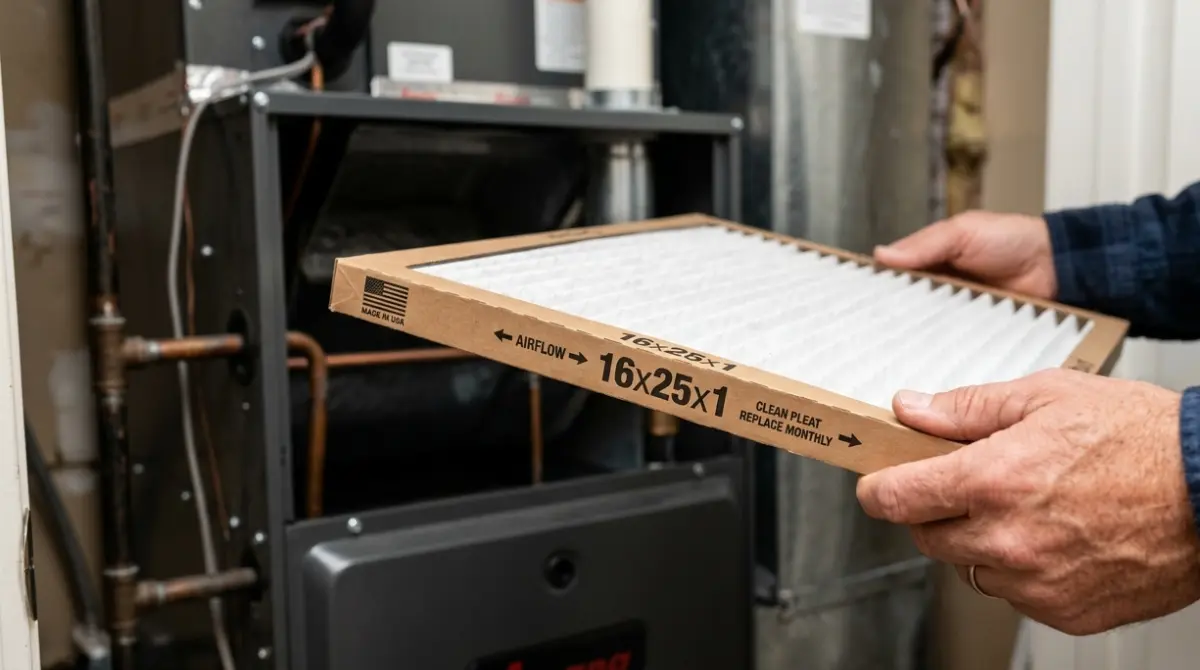
Table of Contents
Your HVAC filter size is probably printed on the frame
Your HVAC filter size is printed on the frame of the filter already in your system, so start there. If the label is gone or the filter is missing, one of two backups will work.
Which of these three routes fits you?
- Old filter in hand, label readable: read the three numbers printed on the frame and order that size.
- Label faded or missing: measure the filter slot and round up each number.
- No filter, or can’t find the slot: locate the filter first, then measure.
What you’ll need
A tape measure and your phone’s camera. Photograph the label or slot as you go so you never repeat this.
How to read the size printed on your filter
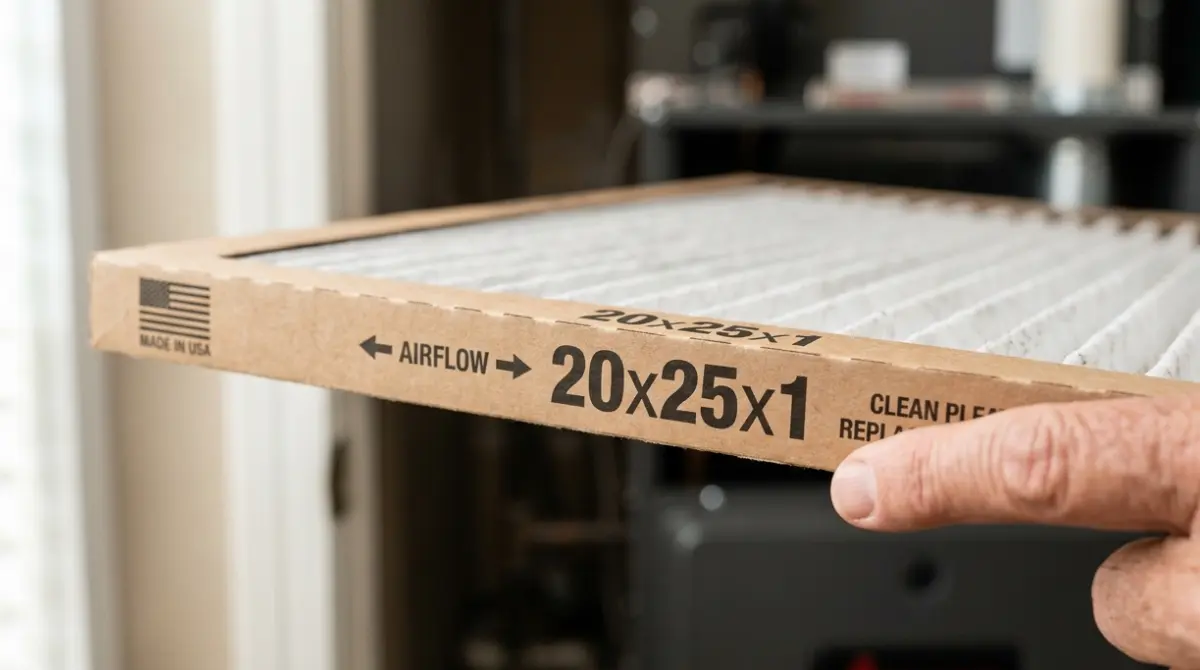
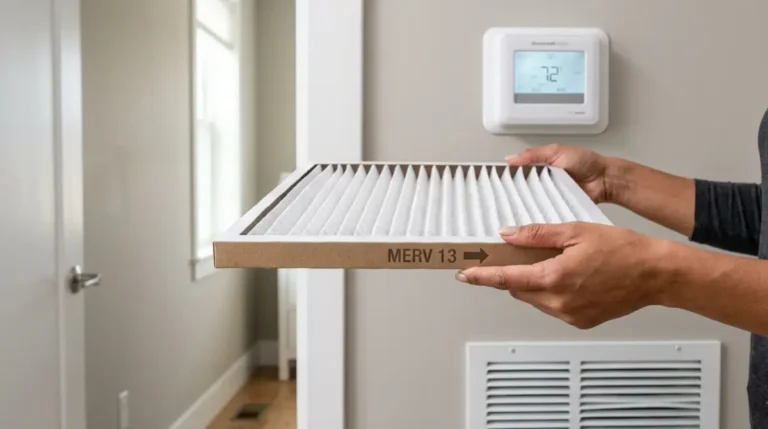
Pull the old filter and read the three numbers printed on its frame: length, width and thickness, in inches. Order that same size.
Where to look on the frame
The size sits along an edge of the cardboard frame, like 16x25x1.
Length × width × thickness, in inches
A 16x25x1 filter is 16 inches by 25 inches and 1 inch thick.
Nominal size vs. actual size
The printed number is the nominal size, a rounded label. The actual size a tape measure reads is usually slightly smaller.
📊 Tested / Spec: Same printed size, different actual size (manufacturer listings). Order by the printed number.
| Printed size | Actual size (inches) | Source |
|---|---|---|
| 20x20x1 | 19.75 × 19.75 × 0.75 | Aerostar |
| 20x20x1 | 19.5 × 19.5 × 0.75 | Atomic Filters |
| 16x25x1 | 15.5 × 24.5 × 0.75 | Atomic Filters |
No label? Measure the filter slot instead
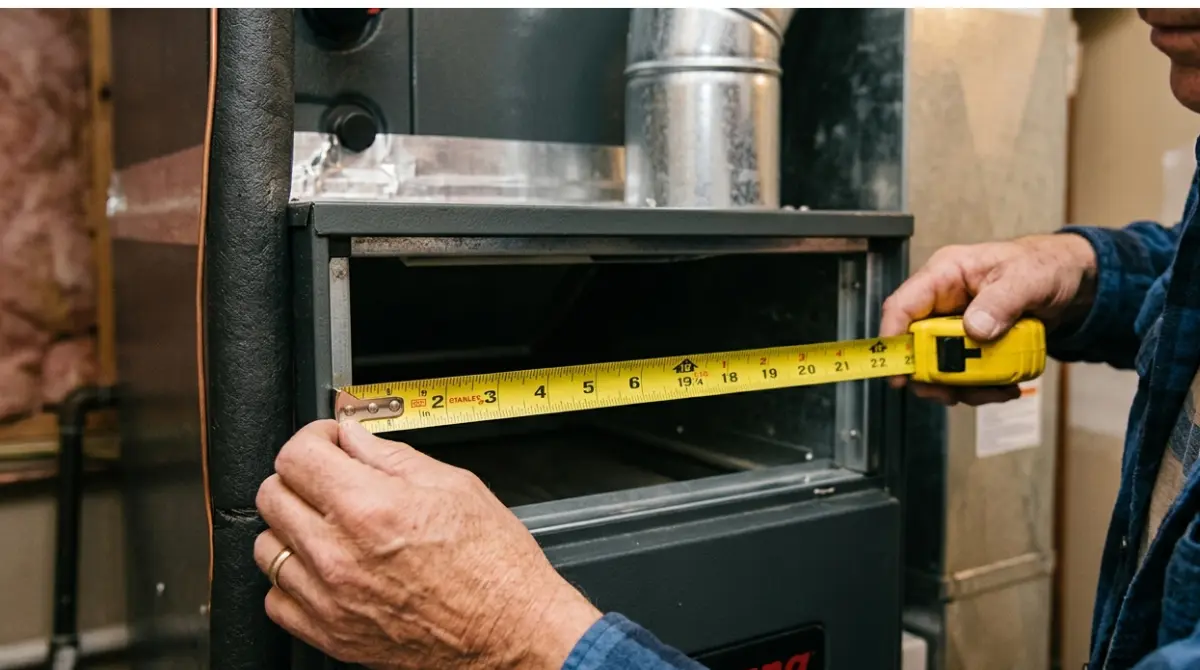
A tape measure gives you the same answer.
Measure length, width and depth
Open the filter door following your owner’s manual, remove any old filter, and measure the slot’s length, width and depth in inches.
Round up each number
Round each measurement up to the nearest inch, which gives the size to order. For example, a slot of 15¾ by 24¾ by ¾ inches rounds up to a 16x25x1 filter.
What if your numbers land between sizes?
If the result matches no size you can find, check your owner’s manual or a label inside the filter compartment, or ask an HVAC technician. Don’t force a near fit.
✅ Do This: Photograph the slot with the tape measure in frame, so you can check your numbers against any product listing.
Can’t find your filter? Check these four spots
Filter location depends on your system type; see how split and packaged systems differ.
Furnace or air handler slot
On a split system, check the furnace or air handler, often a 1-inch or 4-inch slot behind a slim cover in a basement, crawlspace, attic or closet, per Trane’s filter guide.
Return vent grille in a wall or ceiling
Look behind a large return vent in a ceiling or interior wall.
Packaged units, room units, and homes with more than one
- Packaged system: the main filter is most likely behind an indoor return vent.
- Room air conditioner: the filter sits in the grill facing the room.
- More than one system: expect at least one filter per unit.
If access in an attic or crawlspace is awkward, ask an HVAC technician.
Check thickness and fit before you buy
Matching the thickness matters as much as length and width.
1-inch vs. thicker filters
Filters commonly come in thicknesses of 1 to 5 inches, per the EPA’s guide to home air cleaners. A thicker filter needs a slot built for it, so check your owner’s manual.
How a snug fit looks
The EPA says it should fit snugly so air doesn’t leak around it, with no bending or crushing.
Why close enough isn’t
Trane says a filter that is too small or too large lets debris into the unit.
⚠️ Watch Out: Never bend or crush a filter to fit. A filter that must be forced is the wrong size or thickness.
Once you have the size, choose a MERV rating
MERV is a 1-to-16 rating of how well a filter traps particles, separate from size.
What MERV means in one minute
Higher numbers capture more particles; the EPA’s MERV explainer lists average capture rates.
| MERV | 0.3–1.0 µm particles | 3.0–10.0 µm particles |
|---|---|---|
| 8 | not listed | ≥70% |
| 11 | ≥20% | ≥85% |
| 13 | ≥50% | ≥90% |
Source: EPA, average capture efficiency.
How high your system can go
If you upgrade, the EPA says choose at least MERV 13, or as high as your fan and filter slot allow. Trane says most homes do well at MERV 8 to 13; follow your owner’s manual if it names a limit.
💡 Pro Tip: Filters don’t fix mold, which comes from moisture; see what filters and purifiers can and can’t do about mold.
Signs you bought the wrong size, and what to do
Here is how to spot a wrong-size filter.
Signs the size is wrong
You have to bend or crush the filter to fit, or you can see gaps along the edges.
What to do next
Swap in the correct size as soon as you can, as Trane advises. If you also see mold in the slot or ducts, read about mold in your air ducts.
Write it down so you never redo this
Save the size in your phone and follow the manufacturer’s replacement schedule, typically every 60 to 90 days per the EPA.
📊 Tested / Spec: The Department of Energy says swapping a clogged air conditioner filter for a clean one can cut energy use 5% to 15%.
HVAC filter size FAQs
1. How do I find my HVAC filter size without the old filter?
Measure the slot’s length, width and depth, then round each up to the nearest inch for your HVAC filter size.
2. What do the three numbers on an HVAC filter mean?
Length, width and thickness in inches, so a 16x25x1 HVAC filter is 16 by 25 inches and 1 inch thick.
3. Is my HVAC filter size the nominal or actual size?
The printed HVAC filter size is the nominal size, a rounded label. The actual size usually measures slightly smaller.
4. Where is my HVAC filter located?
Check the furnace or air handler slot, then any large return vent. Some homes have more than one HVAC filter.
5. Do I need more than one HVAC filter?
Possibly. Homes with more than one system usually have at least one HVAC filter per unit, and some have two locations.
6. Can I use a filter that’s slightly too small or too large?
No. A wrong HVAC filter size lets debris into the unit. Choose a snug fit that needs no bending or crushing.
7. Can I switch from a 1-inch to a thicker HVAC filter?
Only if your slot or cabinet is built for it. Filters run 1 to 5 inches thick, so match your HVAC filter size.
8. What MERV rating should my HVAC filter be?
The EPA says choose at least MERV 13, or as high as your fan and HVAC filter slot allow, if you upgrade.
9. How often should I change my HVAC filter?
Follow the manufacturer’s schedule for your HVAC filter; the EPA says that is typically every 60 to 90 days.
10. What if my HVAC filter size falls between two standard sizes?
Check your owner’s manual or a label inside the filter compartment, or ask an HVAC technician. Don’t force a near-fit HVAC filter into the slot.
Next step: write down your size
You now have three ways to find your HVAC filter size: read the frame, measure the slot, or locate the filter first. Save the size in your phone, photograph the label, and set a reminder for your filter’s replacement date. If anything doesn’t fit, your owner’s manual or an HVAC technician is the next call.