How to Choose an HVAC Contractor With Real Credential Checks

Choosing an HVAC contractor? The FTC calls asking you to get the permits a scam sign. Six free lookups show who else to skip.

Table of Contents
How to choose an HVAC contractor: the 6 lookups at a glance
Six free lookups separate an accountable contractor from a risky one.
The six lookups in order
Run these on every HVAC contractor before comparing quotes:
- License: the business may do HVAC work locally.
- Insurance: a current policy covers accidents.
- EPA 608: the technician may legally handle refrigerant.
- NATE: the technician passed voluntary skills exams.
- Complaints: how the company treats unhappy customers.
- Permits: the company works with your building department.
Which section to jump to
- System just died: run lookups 1 to 3 today, then read the quote section.
- Door-knock offer: go straight to the red flags.
- Still choosing equipment: start with choosing the right HVAC system for your home.
ℹ️ Safety Note: Gas, 240-volt wiring and refrigerant carry carbon monoxide, shock and fire risks. This guide covers checking a contractor, not doing the work: hire a licensed HVAC contractor, get required permits and follow local code.
Lookups 1 and 2: check the license and the insurance
The FTC’s first advice is to hire only licensed, insured contractors.
Lookup 1: find your licensing office and search the license

Licensing is set by states, and sometimes by cities or counties, so ENERGY STAR advises learning your state’s license requirements first. Search the company on your state or county licensing site; in California, that’s the Contractors State License Board. Confirm the license is active, covers heating and cooling, and shows no disciplinary actions.
Lookup 2: get the certificate of insurance and confirm it
Ask for a certificate of insurance and what it covers. Then call the agent named on it; a certificate only shows coverage on the day it was printed.
✅ Do This: No match? Ask for the exact licensed business name and number, then search again.
Lookups 3 and 4: verify EPA 608 and NATE certification
A license covers the business; these checks cover the technicians.
Lookup 3: EPA 608 is required for anyone installing or servicing your system
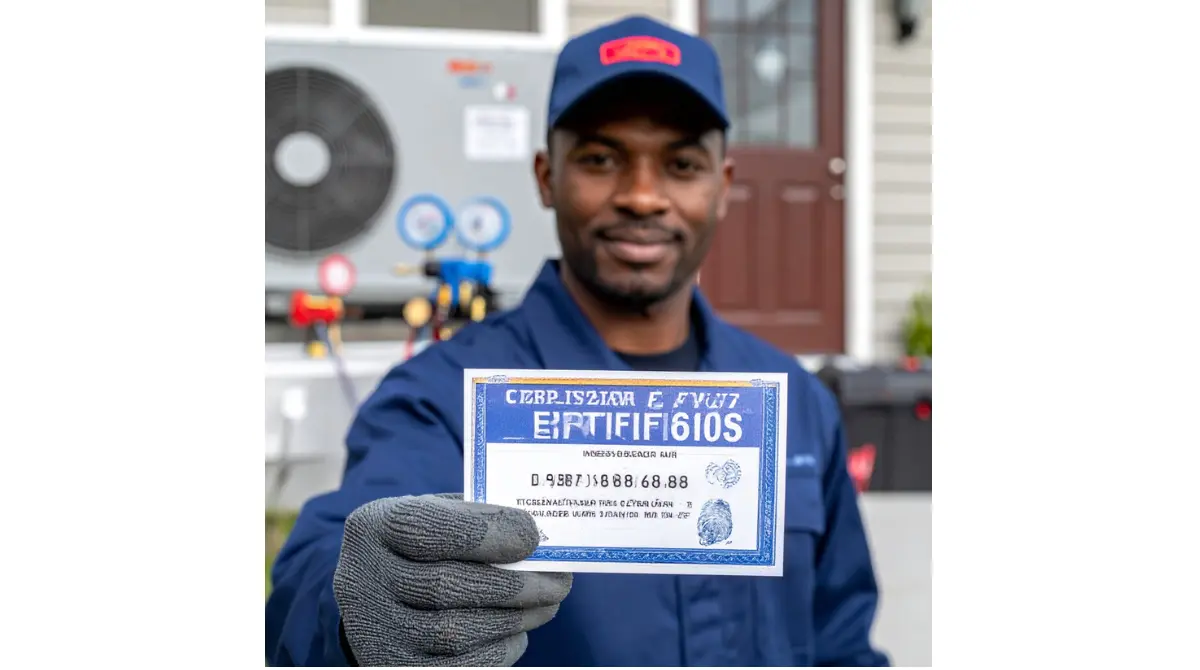
The EPA requires Section 608 certification for anyone installing or servicing refrigerant-containing equipment, except supervised apprentices. There’s no national lookup, so:
- Note the certifying organization on the technician’s 608 card.
- Confirm it’s on EPA’s list of approved Section 608 certifying organizations.
- Search that organization’s published technician list.
📊 Tested / Spec: Under 40 CFR 82.161, certifiers must list technicians certified since January 1, 2017, but technicians can opt out, and credentials never expire. A missing name means “ask,” not “fraud.”
Lookup 4: NATE is a voluntary skills credential worth checking
NATE certification isn’t legally required, but it shows a technician passed industry skills exams. Enter their ID on NATE’s ID verification page.
⚠️ Watch Out: Refrigerant sales are restricted to certified technicians, so an uncertified friend can’t legally charge a system you bought online.
Lookups 5 and 6: complaints, reviews and permit history
These two lookups show how a contractor acts when a job goes wrong.
Lookup 5: complaints first, reviews second
The FTC suggests asking your consumer protection office and local Home Builders Association about complaints, then searching the company name with “scam,” “complaint” and “review.” Read reviews critically.
Lookup 6: ask your building department about permits
Ask your local building department whether it can show permits this contractor has pulled, and which HVAC work needs one.
The 6-Lookup Proof Matrix
| Lookup | Where | Proves | Can’t prove |
|---|---|---|---|
| License | State or county site | Authorized locally | Workmanship |
| Insurance | Certificate, then insurer | Policy is current | Coverage fits your job |
| EPA 608 | Certifier’s list | Passed federal exam | Opted-out or pre-2017 techs |
| NATE | NATE ID check | Passed skills exams | Any legal requirement |
| Complaints | Consumer office, search | Dispute patterns | No problems exist |
| Permits | Building department | Pulls permits | Inspections passed |
Sources: FTC, EPA, 40 CFR 82.161, NATE.
What a trustworthy HVAC visit and quote look like
A good contractor earns the job in your home.
The home evaluation: sizing, ducts and airflow
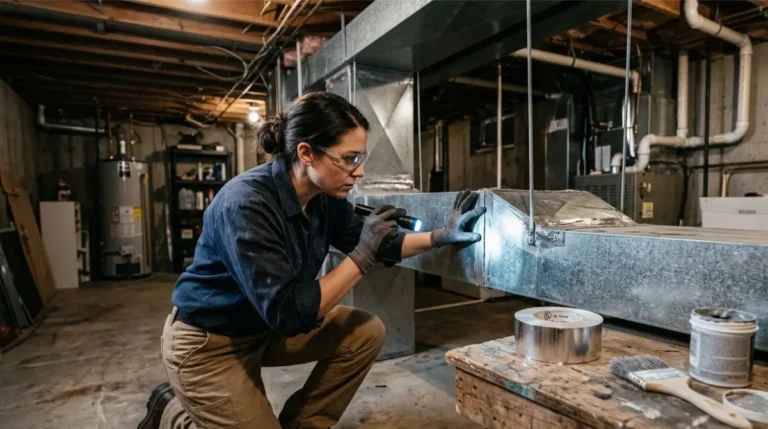
ENERGY STAR says the contractor should inspect your home, size the system from its size, insulation and windows, check ductwork for leaks, and measure airflow. See how to request a Manual J load calculation in writing, and what sealing duct leaks by gap size involves.
What a written, itemized quote should list
A complete HVAC quote lists:
- Model numbers and capacity
- Efficiency ratings
- Work description and materials
- Price, start and completion dates
- Warranty terms
Why the lowest bid isn’t automatically the best
ENERGY STAR’s contractor hiring tips note a cheaper, less efficient system can cost more to run. The FTC advises multiple estimates and asking why bids differ widely.
✅ Do This: Ask each licensed HVAC contractor to show the load calculation behind their quoted size.
HVAC contractor red flags that mean walk away
Most bad contractors reveal themselves before you sign.
The FTC’s scam signs
The FTC’s home improvement scam warning signs include:
- Door-knocking because they’re “in the area”
- Leftover materials from another job
- Pressure for an immediate decision
- Full payment up front, or cash only
- Asking you to get the permits
- Pushing a lender they know
HVAC-specific red flags
- No home evaluation or sizing explanation
- No written, itemized quote
- No 608 card for the refrigerant technician
- Claiming a working R-410A system must be replaced now; the EPA says existing systems can keep running and be repaired
⚠️ Watch Out: One flag isn’t proof of fraud. A flag plus a failed lookup is reason to walk away.
Before you sign: contract, deposit and your right to cancel
Read the contract before making any payment.
What the contract must include
The FTC says a home improvement contract should list the contractor’s name, address, phone and license number; start and completion dates; verbal promises; and, if signed at home, your right to cancel. Leave no blanks.
Deposits: state limits and an example
Never pay everything up front; some states cap down payments. California’s cap is $1,000 or 10%, whichever is less.
The 3-day cancellation rule and its exceptions
Sometimes you can cancel. The FTC’s Cooling-Off Rule covers many in-home sales until midnight of the third business day. It excludes emergencies and repair visits you requested, but extras sold beyond that repair are covered.
✅ Do This: Get in writing whether the rule applies before signing. For state rules, ask your attorney general’s consumer office. This isn’t legal advice.
Questions about how to choose an HVAC contractor
1. How do I choose an HVAC contractor?
To choose an HVAC contractor, run six lookups (license, insurance, EPA 608, NATE, complaints, permits), then compare written, itemized quotes.
2. How do I check an HVAC contractor’s license?
Check an HVAC contractor’s license on your state or county licensing site, confirming it’s active and covers heating and cooling.
3. Does an HVAC contractor need insurance?
The FTC advises hiring only licensed, insured contractors, so ask any HVAC contractor for a certificate of insurance first.
4. How do I look up EPA 608 certification?
To look up EPA 608 certification, find the certifying organization on the technician’s card, then search its published list.
5. Does EPA 608 certification expire?
No. EPA Section 608 certification credentials never expire, so a technician’s older card can still be valid.
6. Is NATE certification required?
No. NATE certification is voluntary; EPA 608 is the federally required credential for technicians handling refrigerant.
7. Should an HVAC contractor do a load calculation?
Yes. ENERGY STAR says an HVAC contractor should size your system from your home’s size, insulation and windows.
8. How much deposit should an HVAC contractor ask for?
HVAC deposit limits vary by state; California caps home improvement down payments at $1,000 or 10%, whichever is less. Check your state’s rules first.
9. Who should get the permit for HVAC work?
The HVAC contractor should; the FTC lists asking homeowners to get permits as a scam warning sign. Confirm with your building department.
10. Can I cancel an HVAC contract after signing?
Sometimes. The FTC Cooling-Off Rule covers many in-home HVAC contract sales until midnight of the third business day. Ask the seller for the cancellation forms.
Your next step before the first estimate
Run lookups 1 to 3 on every contractor before booking visits; they’re free. Then note your unit’s model and age from its data plate, since ENERGY STAR suggests knowing your system’s model before you call.