Getting Rid of Bed Bugs at Home Without the Risk

Getting rid of bed bugs starts with confirming them, not spraying. Heat kills them at 122°F — here’s the safe, step-by-step plan to keep them gone.
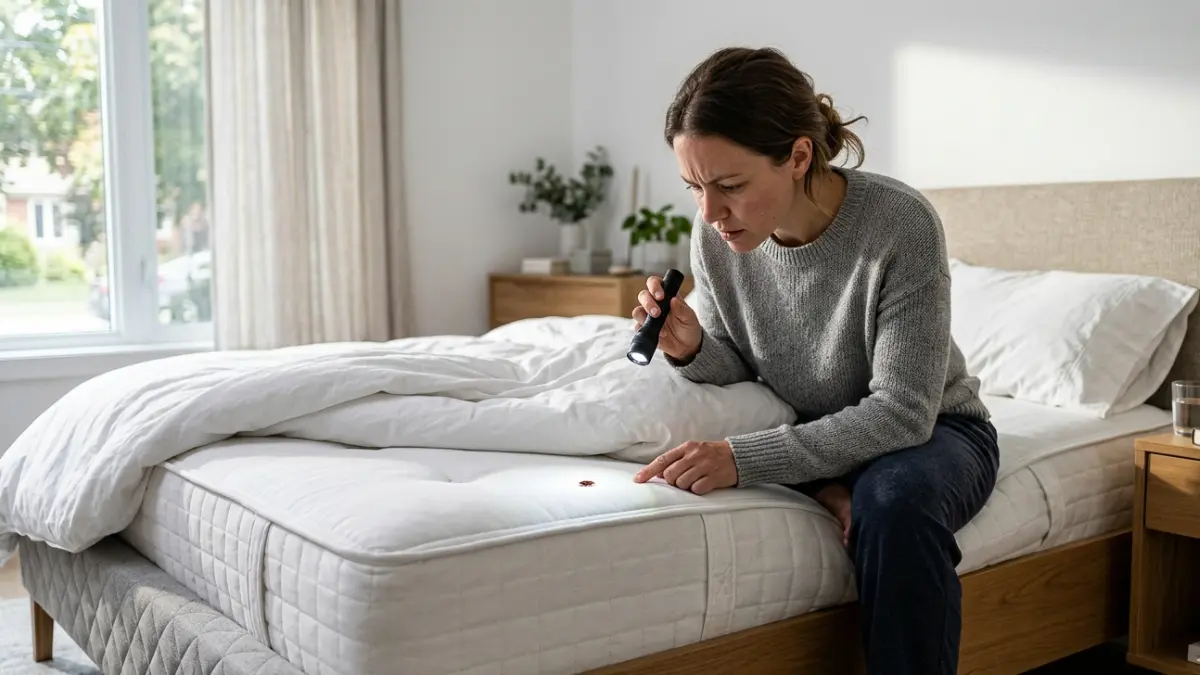
Table of Contents
Found bed bugs? Start here with a calm 5-step plan
If you’ve just spotted a small reddish-brown bug near your mattress or woken up with a row of itchy bites, take a breath. Bed bugs are stressful, but they are beatable with a clear plan and some patience. This guide walks you through a safe, five-step process to confirm an infestation and get rid of it without wasting money or putting your household at risk.
The single most important thing to know up front: there is no one spray, bomb, or gadget that ends this overnight. Getting rid of bed bugs takes a sequence of steps done in order, and usually a follow-up a couple of weeks later. Most early infestations, though, can be handled at home if you act methodically.
📣 Disclosure: This article contains affiliate links. If you buy through them, we may earn a small commission at no extra cost to you. Our picks are based on research and sourced evidence, not commissions.
If you just found a bug or bites tonight (start here)
Go straight to Step 1 and confirm it is actually bed bugs before you buy or spray anything. Misidentifying the pest is the most common early mistake, and it sends people down the wrong path for weeks.
If you’re a renter, read this first
Before you treat anything, see the renter section below on who is responsible and why you should notify your landlord in writing right away. In many buildings the law puts treatment on the landlord, and acting alone can work against you.
If you’re on a budget and want to do it yourself
The non-chemical methods in Step 3 are the cheapest and safest place to start, and they do most of the heavy lifting. You can treat a contained, early infestation for the cost of a few supplies.
If you’ve already treated and they came back
Skip to Step 5 and the troubleshooting notes. Bed bugs almost always “come back” because eggs survived the first round and hatched, not because you did nothing wrong.
The 5-step plan at a glance
Here is the whole plan in order, and the rest of this guide is simply each step in detail:
- Confirm it is bed bugs (inspect and identify).
- Contain the infestation so it stops spreading.
- Kill what you can without chemicals (heat, steam, laundering, vacuuming, encasements).
- Treat with EPA-registered products used safely, or hire a licensed pro.
- Monitor, retreat on schedule, and prevent a comeback.
Work the steps in order, and don’t jump to chemicals first. The reason that order matters becomes clear as soon as you understand how these insects live.
ℹ️ Safety Note: Getting rid of bed bugs often involves pesticides, and pesticide misuse is a genuine hazard. Never use outdoor or garden pesticides indoors, never use foggers or “bug bombs” (they are both ineffective against bed bugs and a poisoning and fire risk), and never improvise heat with space heaters, ovens, or microwaves. The pesticide steps below are general guidance only; always follow the product label exactly, and if the infestation is large, has spread between rooms, or is in a multi-unit building, hire a licensed pest control professional.
How to identify bed bugs: signs, photos, and what they look like
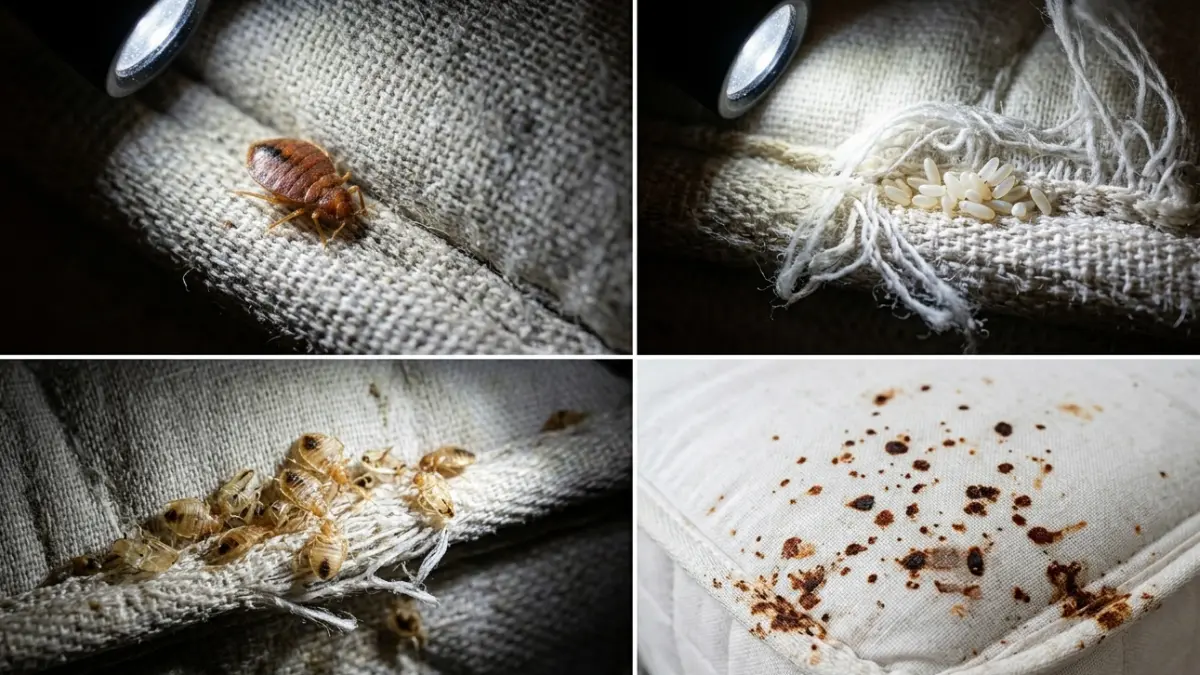
Before you spend a dollar on treatment, confirm you actually have bed bugs. The four signs that together confirm an infestation are live bugs or pearly eggs, rust-and-marker fecal stains, translucent shed skins, and small blood streaks on your sheets. Finding two or more near where you sleep is strong evidence; finding a live bug or a viable egg is proof.

- Box spring cover is independently lab-tested
- Stretchable 100% polyester knit fabric makes installation a breeze – includes Installation Kit
- Queen size (60” x 80”) fits box spring depths of 9″- 11″
What do bed bugs look like? (size, color, shape)
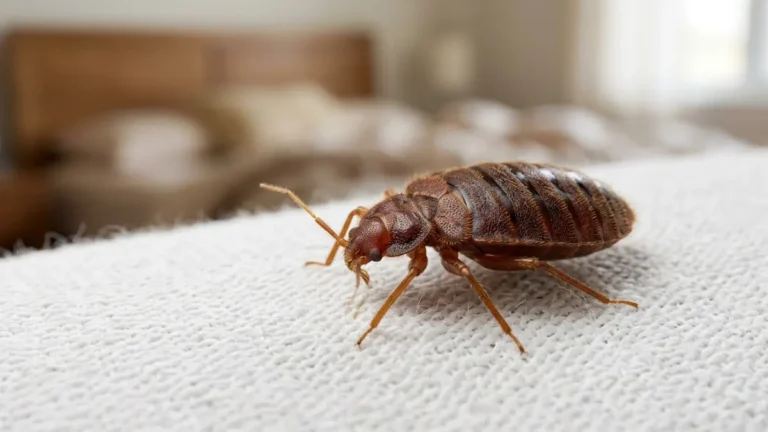
An adult bed bug is flat, oval, wingless, and reddish-brown, about a quarter inch long — roughly the size and shape of an apple seed before it feeds. After a blood meal it swells and darkens to a deeper red. Young bed bugs, called nymphs, look like smaller, paler versions of the adults and can be hard to see.
The 4 signs that confirm bed bugs
Each sign on its own tells you something; together they confirm an active problem:
- Live bugs or eggs: the only definitive proof. Eggs are tiny (about 1 mm), pearly white, and laid in clusters in cracks and seams.
- Fecal spots: dark spots that look like a felt-tip marker bled into the fabric, per the EPA’s description.
- Shed skins: pale, translucent shells shaped like the bug, left behind as nymphs molt.
- Blood streaks: small rust-colored smears on sheets from crushed bugs after feeding.
One caution from pest inspectors: shed skins, blood spots, or fecal marks alone show only that bed bugs were present at some point. Only a live bug or a viable egg confirms an active infestation today.
What bed bug droppings and stains look like
Fecal stains are digested blood, so they soak into porous surfaces and bleed at the edges like ink. They usually cluster along mattress seams, the headboard, and the top edge of your fitted sheet.
🔍 Why It Works: Bed bug droppings are mostly digested blood, which is why they smear when wiped with a damp cloth and “bleed” into fabric instead of sitting on top like a solid crumb. That smear test is one of the quickest ways to tell a fecal spot from a fleck of dirt.
Bed bug eggs and shed skins
Eggs are pale, about a millimeter long, and glued into tight spaces like seams and frame joints. Because a bed bug molts five times on its way to adulthood, a heavier infestation leaves many shed skins near hiding spots. Finding clusters of skins and eggs together means bugs are actively breeding nearby.
Where bed bugs hide (and where to look first)
Bed bugs stay close to where you sleep, so start within about five or six feet of the bed. Check the mattress seams, box spring, bed frame, and headboard first, then work outward to nearby cracks, baseboards, and upholstered furniture.
In a heavier infestation they push into less obvious spots — behind the headboard, inside the seams of nearby chairs and sofas, along carpet edges, behind baseboards and loose wallpaper, inside electrical outlets, and behind picture frames. The pattern is always the same: near a sleeping host, but tucked into a tight, dark crack. A light, early infestation is usually confined to the bed; finding bugs spread across the room signals a larger problem and often a job for a professional.
✅ Do This: Start your search at the top edge of the fitted sheet and the seam where the mattress meets the box spring. On a light, smooth, tightly woven sheet, early fecal spots show up there first.
How to inspect your bed and room, step by step
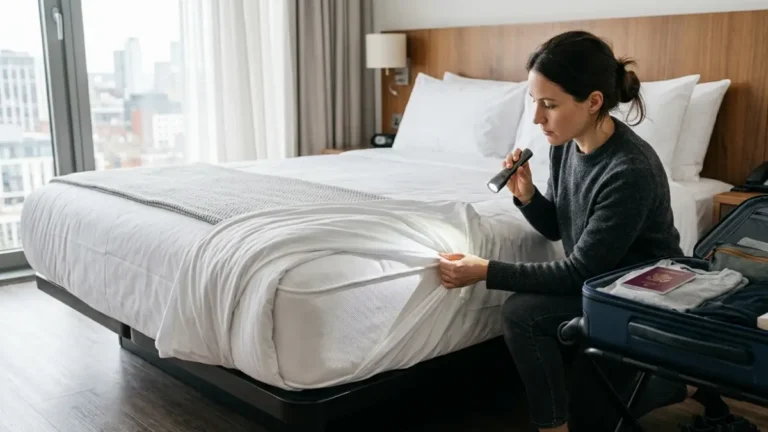
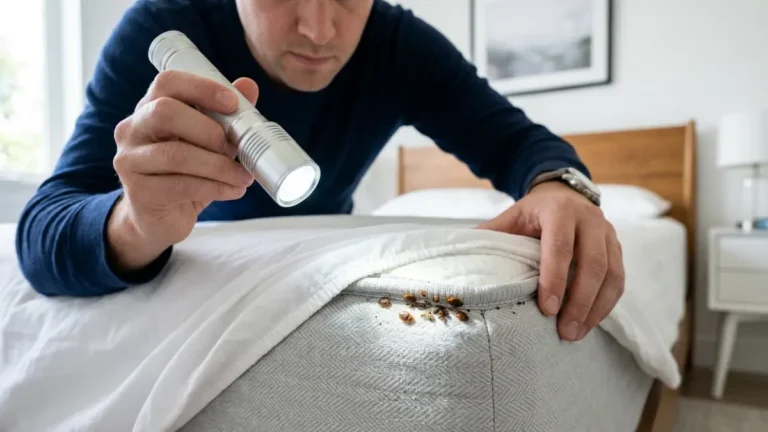
A careful inspection takes about fifteen minutes and a flashlight:
- Strip the bed in place, slowly, so you don’t fling eggs around the room.
- With a flashlight, inspect every seam, fold, tuft, and label on the mattress and box spring.
- Check the frame, headboard, and the wall directly behind it.
- Look along baseboards and inside the joints of nearby furniture.
- Seal any evidence you collect in a plastic bag so you can show a professional if needed.
💡 Pro Tip: A bright clip-on flashlight and an old card to drag along seams make a home inspection far more reliable. Pest professionals note that small nymphs hide deep in folds where a casual glance misses them.
What bed bug bites look like (and why bites alone aren’t proof)
Bites are how most people first suspect bed bugs, but they’re the least reliable single clue. Bed bug bites usually look like small, red, itchy welts, often in a line or a small cluster — sometimes called a “breakfast, lunch, and dinner” pattern from one bug feeding in a row. They tend to land on skin left exposed while you sleep: the face, neck, arms, hands, and shoulders.
The catch is that reactions vary enormously from person to person. According to the CDC, most people don’t notice the marks until one to several days after the bite, and the American Academy of Dermatology notes welts can take up to 14 days to itch — while some people never visibly react at all. The longer the biting goes on, the faster and stronger the reaction tends to get.
Because of that variability, bites can’t confirm bed bugs on their own, and they’re easy to mistake for mosquito or flea bites. Treat new bites as a reason to inspect for physical proof — live bugs, eggs, fecal stains, and shed skins — not as a diagnosis. If welts are severe, blistering, or look infected, see a healthcare provider.
Bed bugs vs. fleas, carpet beetles, and other look-alikes
It’s easy to confuse bed bugs with other small household pests. The droppings are often the clearest tell:
| Pest | What it looks like | Where you find it | Key tell |
|---|---|---|---|
| Bed bug | Flat, oval, reddish-brown, apple-seed size | Mattress seams, headboard, frame | Marker-like fecal stains that bleed into fabric |
| Cockroach | Larger, longer body, fast-moving | Kitchens, bathrooms, pantries | Droppings look like coffee grounds or black pepper |
| Flea | Tiny, dark, jumps when disturbed | On pets, carpet, around ankles | Bites usually on lower legs; visible jumping |
| Carpet beetle | Small, round, mottled; fuzzy larvae | Carpets, closets, stored fabrics | Larvae damage fabric and don’t bite people |
Source: pest-control identification guidance — bed bug feces soak into surfaces, while cockroach droppings are solid pellets.
If you want photos to compare against what you’re seeing, the EPA’s guide to finding bed bugs shows real fecal staining and common hiding spots.
Bed bug biology: why they bite and why they’re hard to kill
Understanding how bed bugs live tells you exactly why one spray fails and why the plan needs a follow-up. These insects survive months without a meal and lay eggs faster than most people expect. That is the whole reason a single treatment rarely finishes the job.
The bed bug life cycle (eggs, nymphs, adults)
A bed bug starts as a tiny egg, hatches into a nymph, and molts five times — taking a blood meal before each molt — before reaching adulthood. In warm conditions the trip from egg to adult takes as little as about three weeks.
📊 Spec: Over 90% of bed bug eggs hatch by about day 9 at room temperature, and egg-to-adult development can take roughly 21 days in warm conditions. (Source: university extension and pest-biology research.)
How fast bed bugs reproduce
A single fed female lays roughly one to seven eggs a day and up to about 500 in her lifetime. That is how a handful of bugs becomes a serious infestation in a couple of months.
Why bed bugs survive when you “wait them out”
Leaving the room empty does not starve them out. At normal room temperature, bed bugs can survive several months without feeding, and under ideal conditions some adults have lasted over a year. The room itself has to be treated and monitored — time alone won’t do it.
Why many sprays no longer work (pesticide resistance)
Bed bugs have developed genetic resistance to many common insecticides over decades, especially the pyrethroids in a lot of store-bought sprays. That resistance is one reason random spraying often fails, and why following an integrated plan beats reaching for one product.
🔍 Why It Works: Resistance spreads because the few bugs that survive a chemical pass their tolerance to the next generation. The more you spray the same product, the more you select for survivors — which is exactly why pest experts warn against daily or excessive applications.
Do bed bug bites spread disease?
Here is the reassuring part: bed bugs are not known to transmit any human disease. Bites are itchy and can disrupt sleep, and scratching can lead to a secondary skin infection, but the bugs themselves are a nuisance rather than the health threat many people fear.
Where bed bugs come from (it’s not about being dirty)
Bed bugs spread by hitching rides — in luggage, on used furniture, and through walls between apartments — not because a home is unclean. A spotless home and a cluttered one are equally able to get them; clutter only gives them more places to hide. If you want a deeper, non-alarmist source on their biology, the University of Minnesota Extension’s bed bug page is a good one.
Step 2: contain the infestation and stop it spreading
Once you’ve confirmed bed bugs, your next job is to keep them from hitching a ride into clean rooms before you start killing them. The fastest way to stop the spread is to stop moving infested items around and to seal what you remove. Bag bedding and clothing, keep it sealed, and resist the urge to relocate the mattress or haul things to another room.
Don’t do this: the moves that spread bed bugs
⚠️ Watch Out: The instinct to grab everything and move it to a “safe” room is exactly how a one-room problem becomes a whole-home one. Don’t drag the mattress through the house, don’t pile infested bedding on the couch, and don’t carry boxes from the bedroom into living areas — bugs and eggs fall off along the way.
How to contain bedding and clothing safely
Strip the bed carefully and put the bedding straight into sealed plastic bags until you can launder it on high heat. Remove clothing while standing on a hard, non-carpeted floor so any stray bugs have to travel, then bag those items too.
Declutter without scattering the problem
Clutter gives bed bugs more places to hide and makes every other step harder. Clear the floor and surfaces around the bed, but bag items as you go rather than carrying loose piles to another room.
✅ Do This: Set up a “clean zone” — a sealed bin or bag for treated, bug-free items — and never put anything back into it until the whole room is done.
Handling and disposing of infested items
If something is too infested to save, seal it before it leaves the room and mark discarded furniture clearly so no one else takes it home. After vacuuming, seal the bag tightly and put it directly in an outdoor trash bin.
🛒 Our Pick: For containment, look for heavy-duty sealable plastic bags or zippered storage bags large enough for bedding and clothing — the quality of the seal is what matters most. (We may earn a commission from product links, at no extra cost to you.)
Renters: notify your landlord in writing now
If you rent, tell your landlord or building manager in writing as soon as you suspect bed bugs, and keep a dated copy. In multi-unit buildings the bugs move through shared walls, so a single unit treating alone often isn’t enough — the renter section below covers who pays and what to ask for.
Step 3: how to kill bed bugs without chemicals
Heat and physical removal are your safest, highest-impact tools, and they’re where every plan should start. The key number to remember: bed bugs and their eggs die at high heat, but the eggs are tougher than the adults. Heat treatment works only if it’s hot enough, for long enough, to reach the eggs too.

- Kills bed bugs and their eggs on contact
- Kills bed bugs on surfaces for up to 4 weeks
- Foam expands into hard to reach indoor places, and is easy to see where you sprayed
📊 Spec: At 122°F (50°C), adult bed bugs and nymphs die within seconds, but eggs can survive brief exposure — so sustained temperatures of about 130°F or higher for at least 90 minutes are needed to kill all life stages. (Source: pest-control and university extension data.)

- 【High-Efficiency Deep Cleaning】Our UV mattress vacuum cleaner features a powerful 500W motor, providing 16kPa of strong …
- 【Advanced UV-C Technology】Our versatile bed vacuum cleaner features a 253.7nm UV-C light and 40,000Hz ultrasonic waves, …
- 【Multi-Layer Filtration】The handheld vacuum cleaner is designed with a layered filtration system and dual dust cup struc…

- [ ULTRA LONG RANGE – 3280 FT & ADJUSTABLE FOCUS ] The Esgreen ED2405B rechargeable flashlights high lumens is made of im…
- [ SINGLE 2 MODES HIGH/LOW – BRIGHTNESS ADJUSTABLE ] The Esgreen LED flashlight rechargeable USB C is single modes, only …
- [ MULTIFUNCTIONAL 2-IN-1 USB C CHARGING & DISCHARGING ] The super bright LED flashlight long range is built-in 2 USB int…
What temperature kills bed bugs?
The short answer is hotter and longer than most people assume. Adults die fast at 122°F, but because eggs hold on longer, reliable kills need that sustained 130°F-plus exposure. Cold can work too, but it has to be severe and prolonged.
High-heat laundering and drying (step by step)
Your washer and dryer are the most effective bed bug tools you already own. Laundering infested clothes and bedding in hot water and drying above 122°F kills bed bugs at every life stage — but the EPA notes that washing alone may not do the job, so the heat of the dryer is the part that matters most. A full high-heat dryer cycle of at least 30 minutes is the reliable killer.
- Carry items to the laundry sealed in their bags, and don’t set the bags down in a clean room.
- Empty each bag directly into the machine, then immediately seal and discard the bag outside.
- Wash hot if the fabric allows, then dry on the highest heat the fabric can take for at least 30 minutes.
- For items that can’t be hot-washed but can survive a dryer, skip the wash and run them through a hot dryer cycle anyway — dry heat alone kills all life stages.
- Store cleaned items in fresh sealed bags until the whole room is treated, so they don’t get re-infested on the way back.
Sort as you go into four piles: washable on hot, dryer-only on high, dry-clean or delicate, and items that can’t be heated at all (covered below). Keeping those piles separate and bagged is what stops you from spreading bugs between loads.
Steam treatment for mattresses and furniture
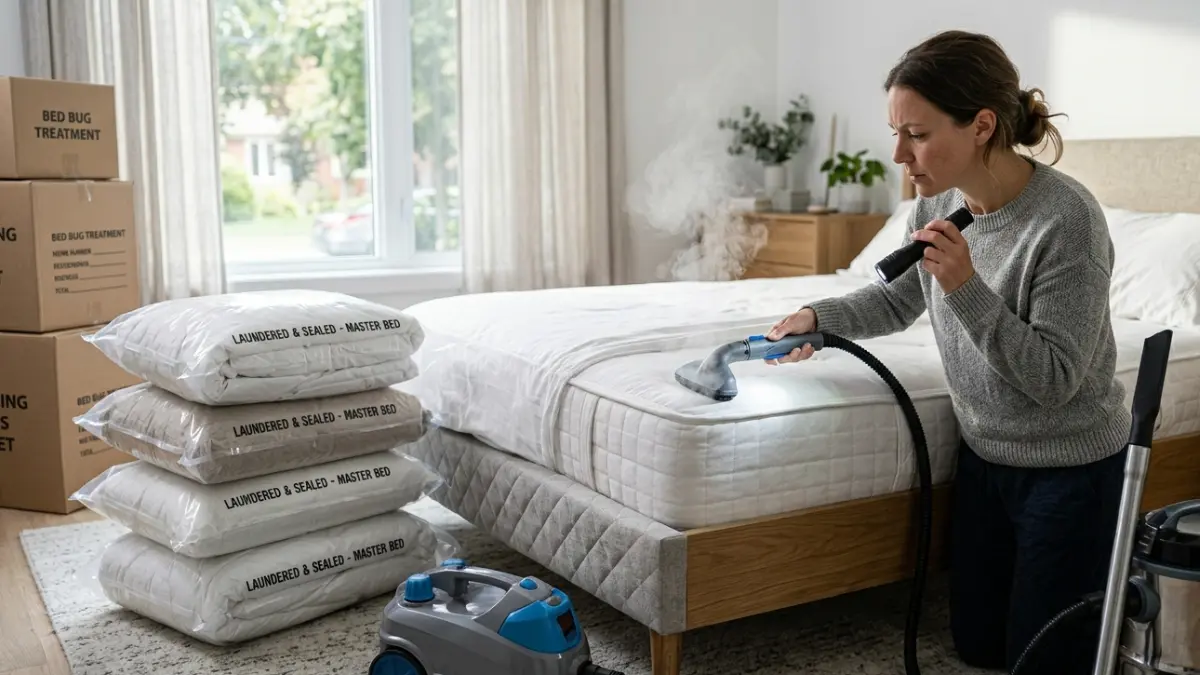
Steam kills bugs and eggs on contact and reaches into seams and tufts that laundering can’t. University extension guidance recommends a commercial steamer rather than a clothing steamer or carpet machine, because it needs enough sustained heat right at the surface — the steam should reach roughly 130°F or more at the surface to kill all life stages.
Technique matters as much as the tool. Move the nozzle slowly, about one inch per second, so the heat actually penetrates the seam instead of just passing over it, and work methodically along mattress seams, the box spring, the bed frame, baseboards, and upholstered furniture. Use a low-vapor “dry steam” setting where you can so you’re not soaking the mattress, and keep steam well away from electrical outlets and electronics.
Vacuuming the right way
Vacuuming physically removes live bugs, eggs, and skins, especially along seams and edges. Use a crevice tool, move slowly, and immediately seal the vacuum contents in a bag and discard it outdoors. A thin sock stretched over the nozzle lets you trap bugs without leaving them sitting in the vacuum afterward.
Mattress and box-spring encasements
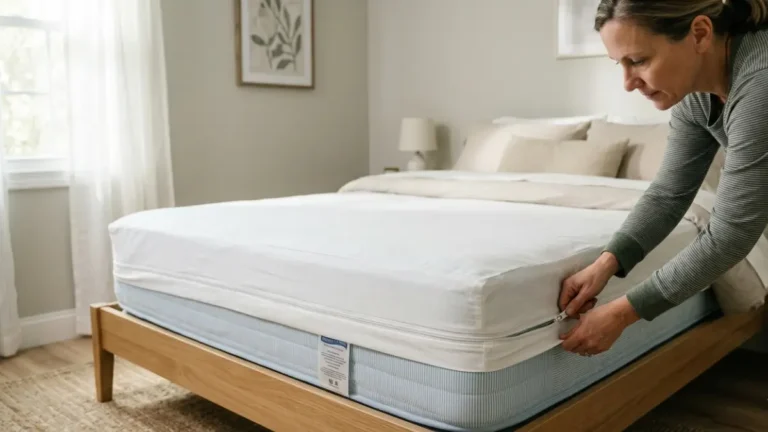
A zippered encasement seals the mattress and box spring so bugs inside can’t get out or feed, and new ones can’t get in. Use covers specifically labeled for bed bug control, not general dust-mite covers, and leave them on for at least a year.
🛒 Our Pick: Look for a fully zippered, bed-bug-rated mattress and box-spring encasement that seals completely at the zipper. The bed-bug rating and a secure zipper closure are what separate a real barrier from a basic cover. (We may earn a commission from product links, at no extra cost to you.)
Isolating the bed (the “island” method)
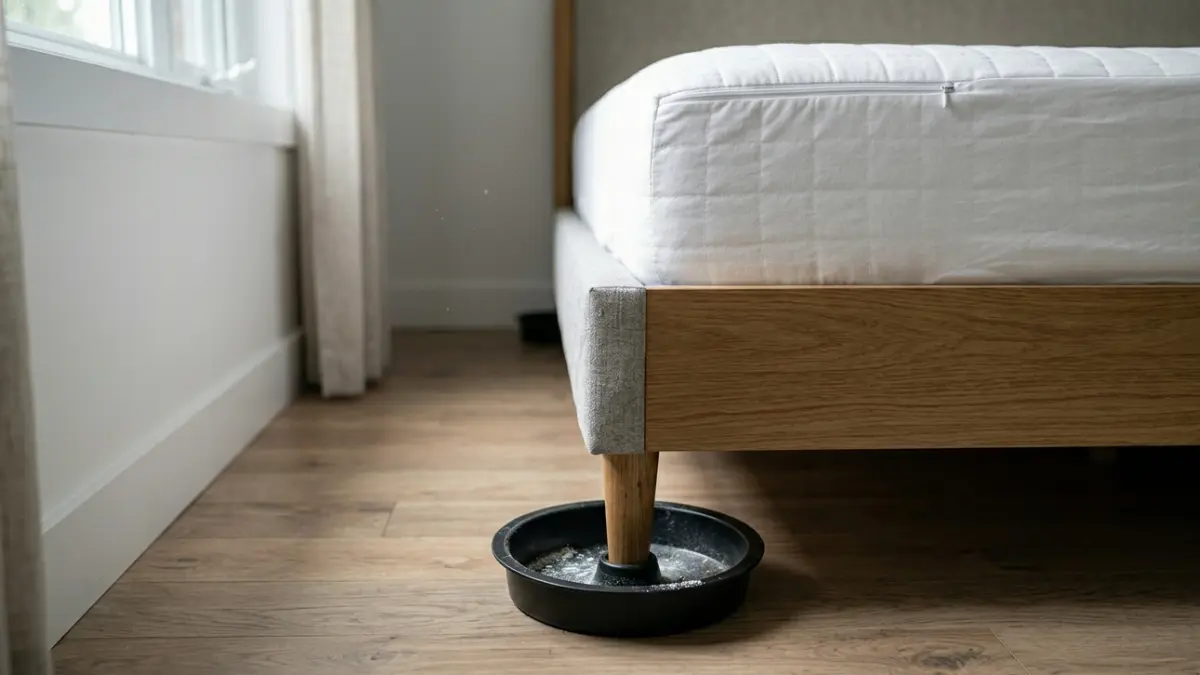
Once the bed itself is treated and encased, you can turn it into the safest spot in the room — an “island” bugs can’t reach. Pull the bed a few inches away from the wall and any other furniture, and make sure no bedding, skirts, or pillows touch the floor. Then put a trap under each leg so the only route to you runs through a checkpoint.
✅ Do This: Per EPA guidance, place a bed bug interceptor under each leg of the bed, remove everything stored underneath, and keep the bed clear of the wall and floor. Inspect the interceptors daily at first — they double as proof of whether bugs are still active.
This does two jobs at once: it stops bugs from climbing back into a clean, treated bed, and it forces any survivors in the room to cross an interceptor, giving you an early read on whether the infestation is actually shrinking.
What to do with items you can’t wash or heat
Books, papers, electronics, shoes, and delicate items can’t go through a hot wash or dryer, but they can still harbor bugs. For these, sealing is your tool — but remember that bed bugs survive months without feeding, so a quick few days in a bag won’t finish them.
Seal non-washable items in sturdy, tightly closed bags or bins and keep them sealed for an extended stretch — generally several months at room temperature to be safe — or have them professionally treated. For electronics, unplug them and inspect the warm interior nooks where bugs like to shelter; older devices in particular can hide them. On a high-value or sentimental item, ask a pest professional rather than guessing.
Does freezing kill bed bugs?
Cold can kill bed bugs, but only at about 0°F sustained for several days, and most home freezers and winter porches don’t reliably hit that. Putting bags outside in winter is unreliable and shouldn’t be your main method.
⚠️ Watch Out: Never try to “cook” bugs with space heaters, an oven, or a microwave. These are serious fire and burn hazards, they heat items unevenly, and they leave survivors. Leave whole-room heat to professionals with the right equipment.
What about professional heat treatment?
Professional heat treatment raises a whole room to roughly 135–145°F and kills every life stage, including eggs, in a single visit. It’s faster than chemical rounds but costs more up front and offers no lasting protection, so it’s often paired with monitoring. For the non-chemical groundwork before or alongside any professional treatment, the EPA’s do-it-yourself bed bug control steps are a solid reference.
Step 4: using bed bug pesticides safely (or calling a pro)
If non-chemical steps can’t reach every hiding spot, the next layer is a carefully chosen pesticide used strictly by its label — or a licensed professional. No product works on its own; pesticides are one part of the plan, not a shortcut around it. Choosing the wrong product, or using too much, makes things worse and can be dangerous.
The golden rule: the label is the law
A pesticide label is a legal document, and using a product any way other than the label directs is both illegal and unsafe. The most common cause of bed bug-related pesticide illness is simply using too much.
⚠️ Watch Out: Never use outdoor or agricultural pesticides indoors, even diluted. The CDC and ATSDR have documented people sickened — and homes contaminated — by indoor misuse of products meant for outdoor use, including a case where a family had to be relocated.
EPA-registered products that actually work
Stick to products that are EPA-registered and specifically labeled for bed bugs. Registered options range from desiccant dusts and cold-pressed neem oil to conventional insecticides, and the label tells you exactly where and how much you can apply. With resistance widespread, the conventional sprays are also where the label and a professional’s judgment matter most.
The chemical classes registered for bed bugs
It helps to know what’s actually on the shelf and why professionals rotate products. The EPA reports that more than 300 registered products fall into seven chemical classes: pyrethrins, pyrethroids, desiccants, biochemicals, pyrroles, neonicotinoids, and insect growth regulators. Each kills in a different way, which matters because of resistance.
Pyrethrins and pyrethroids are the most common, but many bed bug populations now resist them — and on a resistant population, these may just flush bugs out or push them to a new hiding spot. Desiccants (the registered kind) dry bugs out and don’t trigger resistance, neonicotinoids use a different mode of action that can still work on resistant bugs, pyrroles like chlorfenapyr disrupt the bug’s cells, and insect growth regulators interfere with development.
Because resistance is so common, the EPA notes that combination products and switching between modes of action improve control. That rotation — and matching the product to a resistant local population — is exactly the judgment a licensed professional brings, and a big reason store-bought pyrethroid sprays so often disappoint. None of these replace the heat, encasement, and monitoring steps; they’re the chemical layer on top of them.
Desiccant dusts (and the food-grade warning)
Desiccant dusts like diatomaceous earth and silica gel kill bugs by drying out their shells, but you must use an EPA-registered version labeled for bed bugs.
⚠️ Watch Out: Do not use pool-grade or food-grade diatomaceous earth. The EPA warns that this type poses an inhalation risk; the registered pesticide version uses a different particle size and is limited to cracks and crevices to reduce that risk.
Used alone, dust is slow and often not enough — in one university study, dust by itself satisfactorily reduced bugs in only one of six apartments.
Cold-pressed neem oil
Cold-pressed neem oil is the only biochemical pesticide registered against bed bugs, and trials at label rates show it can affect adults, nymphs, and eggs. As with any product, it works as part of the plan, not as a standalone cure.
Why “more spray” makes it worse
Doubling up on spray doesn’t double results — it raises your exposure and helps resistant bugs survive and spread. Pest experts specifically warn against daily or excessive applications for exactly this reason.
How to prep your home before treatment
Whether you’re treating the room yourself or a pro is coming, preparation is what makes the treatment actually work — unprepared rooms are a top reason treatments fail, because bugs stay tucked into clutter the product never reaches. If you’ve hired a company, follow their specific prep list first; the steps below are the common core.
- Launder and bag: wash and high-heat dry all bedding, clothing, curtains, and soft items, then seal them in bags until after treatment.
- Declutter: clear floors, closets, and under-bed areas, and dispose of anything you can’t or won’t treat (sealed and clearly marked).
- Vacuum thoroughly: work mattress seams, the frame, baseboards, and edges, then seal and bin the contents outside.
- Pull furniture out: move beds and furniture one to two feet from the walls so baseboards and backs can be reached.
- Don’t move items between rooms: work from clean rooms toward infested ones, and never carry loose items into clean areas.
- Skip the store sprays: don’t use over-the-counter foggers or sprays in the days before professional treatment — they scatter bugs and can interfere with the pro’s products.
⚠️ Watch Out: Don’t leave prep to the last minute. Laundry, bagging, and sorting take longer than people expect, and a half-prepped room can mean the treatment misses bugs and has to be repeated.
When to stop DIY and hire a professional
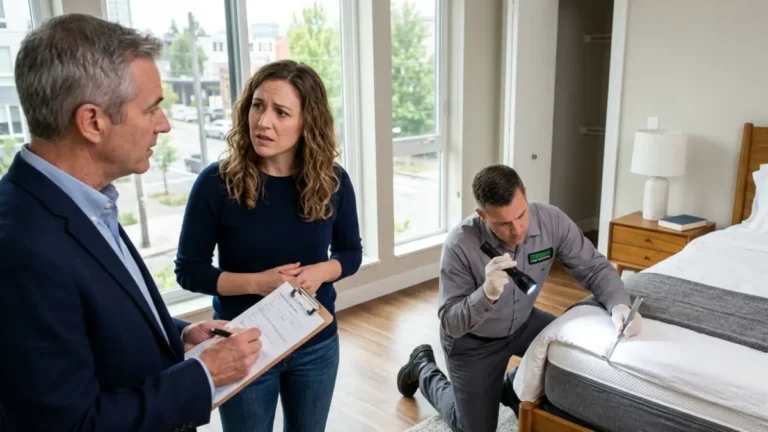
Call a licensed professional if the infestation has spread beyond one room, keeps returning after treatment, is in a multi-unit building, or involves anyone medically vulnerable. Heat or professional-grade treatment in experienced hands is often the difference between months of frustration and a clean result.
How to choose a reputable pest control company
Use a company that is registered and employs licensed applicators with real bed bug experience.
✅ Do This: Before you hire, ask a company for its license or registration, its bed bug experience specifically, the treatment method and number of visits included, what preparation you’ll need to do, and whether there’s a warranty if bugs survive. To sanity-check any product a company or store suggests, the EPA’s list of pesticides registered for bed bugs is the place to look.
What doesn’t work on bed bugs (and what’s dangerous)
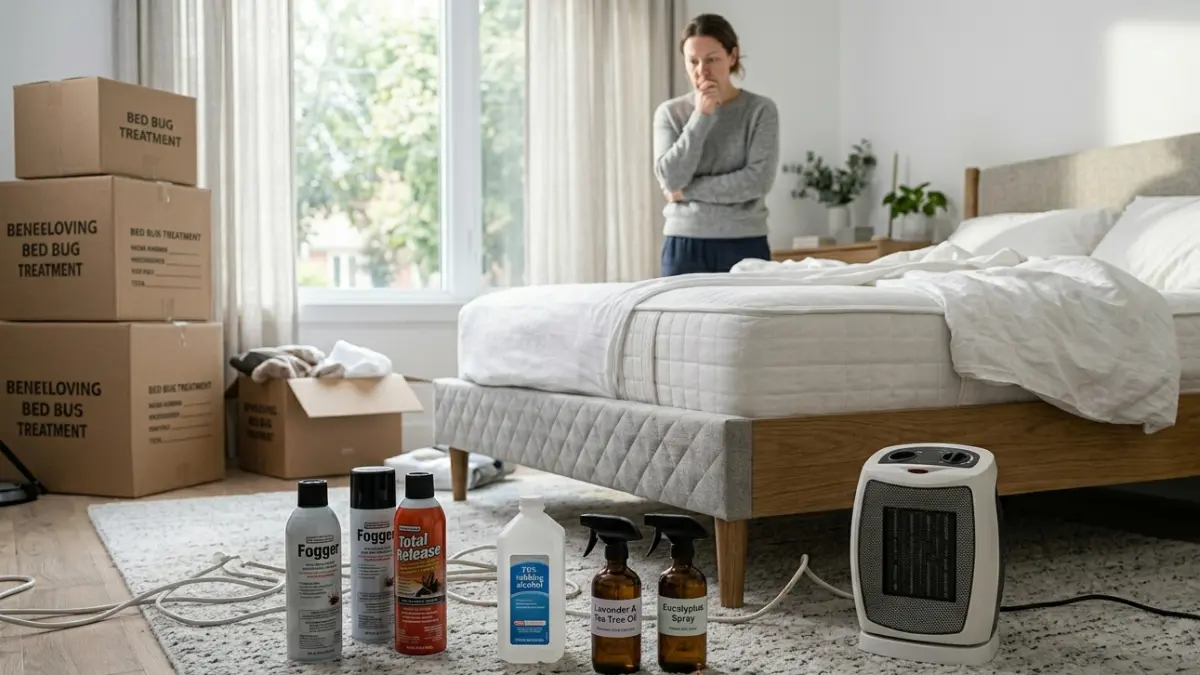
Some of the most popular “solutions” either waste your money or put your household at risk, and avoiding them is as important as doing the right steps. The biggest one to skip is foggers and “bug bombs.” They don’t kill bed bugs where they hide, and they carry real poisoning and fire risk.
📊 Spec: Field-tested bed bugs showed little to no effect from the pyrethroids released by total-release foggers, and the CDC linked 466 cases of acute pesticide illness or injury to foggers across eight states over a six-year period. (Source: CDC and a Journal of Economic Entomology study.)
Foggers and “bug bombs” (ineffective and dangerous)
Bed bugs hide deep in seams, cracks, and behind baseboards where fogger mist doesn’t reach, so foggers mostly scatter them. On top of that, foggers are flammable near pilot lights and ignition sources and have caused injuries when misused. Skip them entirely.
Using outdoor or agricultural pesticides indoors
This is the most dangerous mistake people make. Outdoor products used indoors can poison the people in the home and force expensive cleanups, and it’s against the law. Across one CDC review, 111 bed bug-related insecticide illnesses, including one death, were documented in seven states.
⚠️ Watch Out: If you’re tempted to reach for a stronger, non-household chemical, that is the moment to stop and call a licensed professional instead. The contamination from indoor misuse can cost far more than the treatment would have.
Food-grade diatomaceous earth
As covered in Step 4, pool- and food-grade diatomaceous earth is the wrong product — it poses an inhalation risk, and only the EPA-registered version belongs indoors, in cracks and crevices. The marketing may call it “natural,” but the particle size is what makes it a hazard.
DIY heat: space heaters, ovens, and microwaves
Trying to heat a room with space heaters, or “baking” items in an oven or microwave, is a fire and burn hazard and heats unevenly, leaving survivors. Whole-room heat is a job for professionals with calibrated equipment.
Essential oils, rubbing alcohol, and “natural” sprays
An essential-oil blend or alcohol spray may kill a bug it directly soaks, but it doesn’t solve an infestation and it evaporates without lasting effect. No single spray-on product eliminates bed bugs on its own, so relying on these mainly delays real treatment while the bugs keep breeding.
Throwing out the mattress or moving out
Tossing the mattress or temporarily moving out rarely works, because bugs hide throughout the room and survive months without you. Moving out can even carry them to a new place in your belongings. The verdict table below sums up what to skip and why:
| “Solution” | Why it fails / the risk | Do this instead |
|---|---|---|
| Foggers / bug bombs | Don’t reach hiding spots; poisoning and fire risk | Heat, encasements, EPA-registered products by label |
| Outdoor pesticides indoors | Illegal; documented poisonings and contamination | Only EPA-registered, bed-bug-labeled products |
| Food-grade diatomaceous earth | Inhalation risk; wrong particle size | EPA-registered desiccant, in cracks and crevices |
| DIY oven/heater “cooking” | Fire and burn hazard; uneven heat | Professional heat treatment |
| Essential oils / alcohol | No lasting effect on an infestation | A full step-by-step plan, not a single spray |
| Tossing the mattress / moving out | Bugs survive room-wide for months | Treat the whole room and monitor |
Source: fogger and pesticide-misuse hazards per the CDC and NPIC; survival-without-feeding per pest-biology data.
For plain-language guidance on using pesticides safely against bed bugs, the National Pesticide Information Center’s bed bug page is a reliable, non-commercial source.
Step 5: monitor, retreat, and keep bed bugs from coming back
After treatment, two things finish the job: confirming the bugs are actually gone, and making sure new ones don’t move in. This is the step people skip, and it’s why infestations seem to “return.” A little monitoring now saves you from starting over later.
How to know if the bed bugs are gone
The clearest sign of success is no new bites, no fresh fecal spots, and empty monitors over several weeks after your last live sighting. Because survivors can lie low, give it time rather than declaring victory after a few quiet days.
✅ Do This: Mark your calendar and re-inspect the bed and your monitors weekly for at least a few weeks after the last sign of activity before you consider it resolved.
Why and when you’ll need to retreat
Chemical treatments usually need a follow-up because eggs survive the first pass and hatch days later. Since most eggs hatch within about 6–10 days, a second treatment timed to that window catches the newly hatched nymphs before they can breed. Skipping the follow-up is the single most common reason a treatment “fails.”
Monitoring with bed bug interceptors
Interceptors are small cups placed under each bed and furniture leg that trap bugs trying to climb up. They give you an early-warning system and proof of whether activity continues, and both store-bought and DIY versions work.
🛒 Our Pick: Look for under-leg interceptors (also called monitors) with a textured outer wall bugs can climb and a slick inner well they can’t escape. Placed under every bed and couch leg, they double as your “is it really gone?” check. (We may earn a commission from product links, at no extra cost to you.)
Preventing bed bugs when you travel
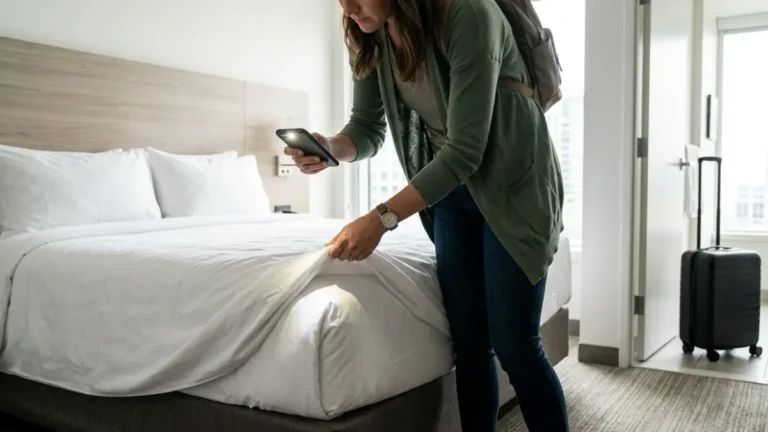
Travel is the most common way bed bugs come home. Keep luggage off the floor and bed, check the mattress seams and headboard of your room, and after the trip, unpack away from the bedroom and run washable items through a hot wash and dry.
Inspecting secondhand furniture before it comes inside
Used furniture — especially beds, upholstered pieces, and mattresses — is a classic source. Inspect every seam, joint, and underside for fecal stains, shed skins, and live bugs before anything crosses your threshold.
Everyday habits that keep bed bugs out
A few light habits go a long way: keep clutter down so bugs have fewer hiding spots, leave encasements on your mattress and box spring, and stay alert after hotels, hospitals, and secondhand buys.
💡 Pro Tip: Keeping mattress and box-spring encasements on permanently makes future inspections far easier — any new fecal spots show up on a smooth white surface instead of disappearing into seams. This reflects standard integrated-pest-management guidance.
How much does professional bed bug treatment cost?
Cost is often the deciding factor between DIY and hiring out, so here are honest 2026 ranges — and the part most guides leave out, which is that the headline number is rarely the whole bill. Treat these as estimates; your actual cost depends on home size, severity, method, and region.
📊 Spec: In 2026, chemical bed bug treatment runs roughly $150–$400 per room and professional heat about $400–$900 per room, with whole-home treatment commonly $1,500–$5,000 and fumigation starting around $2,000. (Source: current contractor cost data.)
Bed bug treatment cost at a glance (2026)
| Treatment | Typical cost (2026) | Visits | Best for |
|---|---|---|---|
| Chemical (insecticide) | ~$150–$400 per room | Usually 2–4 | Budget; lighter, contained infestations |
| Professional heat | ~$400–$900 per room | Often 1 | Faster results; killing eggs in one pass |
| Whole-home treatment | ~$1,500–$5,000 total | Varies | Spread-out or multi-room infestations |
| Fumigation | ~$2,000+ | 1 (tented) | Severe, building-wide cases |
| Initial inspection | ~$75–$200 | 1 | Confirming and scoping the problem |
Source: 2026 contractor cost guides; ranges are estimates that vary by region and provider.
Chemical vs. heat vs. fumigation pricing
Chemical is cheapest per visit but usually needs several visits. Heat costs more up front but often clears all life stages in one session, and fumigation is the most expensive, reserved for severe cases.
Why one visit is rarely the whole bill
Here’s the line most quotes bury: chemical treatment of, say, $270–$775 per room typically takes two to four visits, so three visits can easily total far more than the first number suggests. Always price the full job, not one visit.
A realistic full-cycle example: a moderate two-room chemical job at about $350 per room across three visits, plus a roughly $150 inspection, lands near $2,250 — not the ~$700 a single-visit headline implies. Pricing the whole cycle up front is how you avoid the under-quote trap.
DIY cost vs. professional cost
DIY supplies — encasements, interceptors, a registered dust, high-heat laundering — can run well under a couple hundred dollars for an early, contained infestation. A professional whole-home job is the bigger spend, but it’s often what severe or spread-out cases actually need. The honest trade-off is time and certainty versus money.
What makes your quote go up
Severity, square footage, number of rooms, clutter, multi-unit buildings, and emergency scheduling all push the price up. Apartment buildings in dense cities can run notably higher because of how easily bugs spread between units.
Questions to ask before you pay
✅ Do This: Ask each company exactly what the quote includes — inspection, number of treatments, follow-up, prep, and warranty — because two “$2,000” quotes can cover completely different scopes of work.
Bed bugs in a rental: who pays, you or your landlord?
If you rent, the big question is who pays — and in most multi-unit situations, the answer leans toward your landlord. This is general information, not legal advice, and the specifics vary by state, so check your local rules. Acting early and in writing protects you either way.
Is the landlord responsible for bed bugs?
In multi-unit buildings, most states’ default places primary responsibility on the landlord, because bed bugs travel through shared walls, plumbing, and conduits that a single tenant can’t control. Even when a tenant introduced the bugs, the landlord generally still has to handle building-wide treatment.
When a tenant can be held responsible
A tenant may be on the hook if the infestation clearly traces to something they brought in, if they delayed reporting it, or if they refused to cooperate with treatment. That’s a strong reason to report promptly and keep records.
How responsibility varies by state
State law differs — some states place the cost squarely on the landlord while others handle it differently — so your jurisdiction’s rules matter. Check your state and city housing rules, or a local tenant resource, for the specifics that apply to you.
How to notify your landlord (and why writing matters)
Notify your landlord or manager in writing as soon as you suspect bed bugs, and keep a dated copy. Written notice starts the clock on their obligation and protects you if there’s a dispute later.
✅ Do This: Send written notice (email is fine), describe what you found, ask for a licensed inspection, and save everything — your notice, your photos, and any responses.
Does renters insurance cover bed bugs?
Usually not. Renters’ insurance typically won’t pay for bed bug eradication or related damage, so don’t count on it to cover the bill.
What to do if your landlord won’t act
If your landlord doesn’t respond, options can include contacting your city’s code enforcement or housing department, and some renters consult a tenant attorney or local housing resource. Steps like rent withholding carry risk and aren’t allowed everywhere, so get local guidance before acting.
Frequently asked questions about bed bugs
1. Can you get rid of bed bugs yourself?
Yes, you can often get rid of bed bugs yourself if the infestation is early and contained to one room. Start with the non-chemical steps — high-heat laundering, steam, vacuuming, and encasements — then add an EPA-registered product by its label if needed. If it has spread between rooms or keeps returning, hire a licensed professional.
2. What kills bed bugs on contact?
Heat and steam kill bed bugs on contact. Adults and nymphs die within seconds at about 122°F, though eggs need sustained higher heat. No spray-on product reliably ends an infestation by itself, which is why heat, encasements, and monitoring matter more than any single bottle. Professional heat clears all life stages in one pass.
3. Do bed bugs spread disease?
No. Bed bugs are not known to transmit any human disease. Their bites are itchy and can disrupt sleep, and scratching can lead to a secondary skin infection, but the bugs themselves are a nuisance rather than a disease threat. That’s one reason it’s safe to treat methodically rather than panic.
4. Can bed bugs live in your hair or on your body?
No. Unlike lice, bed bugs don’t live on your body or in your hair — they feed and then retreat to nearby cracks and seams. They may hitch a ride on your clothing, which is why bagging and hot-drying clothes helps, but they don’t travel directly on people the way head lice do.
5. How long can bed bugs survive without feeding?
A long time, which is why “waiting them out” fails. At normal room temperature, bed bugs can survive several months without feeding, and under ideal conditions some adults have lasted over a year. Leaving a room empty doesn’t starve them out; you have to treat the room and monitor it.
6. Does diatomaceous earth kill bed bugs?
It can, slowly, but only the right kind and only as part of a plan. Use an EPA-registered desiccant labeled for bed bugs — never pool- or food-grade, which poses an inhalation risk. In one university study, dust alone satisfactorily reduced bugs in just one of six apartments, so pair it with heat and encasements.
7. How long does it take to get rid of bed bugs?
Usually a few weeks, not a few days. Because eggs hatch within about 6–10 days, most plans need a follow-up treatment timed to that window to catch newly hatched nymphs. Expect to monitor for several weeks after the last sign of activity before calling it resolved. Rushing the timeline is how infestations return.
8. What do bed bug bites look like?
Bed bug bites often appear as small, itchy, red welts, sometimes in a line or cluster on exposed skin. On their own, bites don’t confirm bed bugs — reactions vary, and other things cause similar marks. Look for physical proof too: live bugs, pearly eggs, marker-like fecal stains, and shed skins near where you sleep.
9. Where do bed bugs come from?
Bed bugs spread by hitchhiking, not by poor hygiene. They ride home in luggage, on used furniture, and through walls between apartments. A clean home and a cluttered one are equally able to get them; clutter just gives them more hiding spots. That’s why prevention focuses on travel habits and inspecting secondhand items.
10. Do bug bombs work on bed bugs?
No. Foggers and bug bombs don’t reach where bed bugs hide, so they mostly scatter them, and field tests show little effect on the bugs. They also carry poisoning and fire risk and have been linked to hundreds of pesticide-illness cases. Skip them and use heat, encasements, and EPA-registered products instead.
11. Can bed bugs go away on their own?
No. Because they survive months without feeding and breed quickly, bed bugs don’t disappear on their own — an untreated infestation grows. A single fed female can lay up to about 500 eggs in her lifetime. Waiting only makes treatment harder and more expensive, so act as soon as you confirm them.
12. How do I check a hotel room for bed bugs?
Keep your luggage off the floor and bed, then inspect the mattress seams, the headboard, and the area behind it with a flashlight, looking for marker-like fecal spots, shed skins, or live bugs. After the trip, unpack away from your bedroom and run washable items through a hot wash and dry as a precaution.
13. Your next step to a bed-bug-free home
If you’ve read this far, you’re already past the hardest part — the panic — and into a plan. Bed bugs are beatable, and most early infestations come down to working the five steps in order and giving the follow-up time to do its job. You don’t have to get everything perfect; you have to be steady and thorough.
Your most important move right now is the simplest one: tonight, confirm it’s actually bed bugs and bag your bedding for a hot wash. From there, contain the room, treat it without chemicals first, add an EPA-registered product by its label only if needed, and monitor.
✅ Do This: Download our free bed bug inspection and prep checklist to walk your room step by step and track your treatment and follow-up dates in one place.
The one thing worth hiring out: if the infestation has spread beyond one room, keeps coming back, or is in a multi-unit building, bring in a licensed pest control professional — and ask for their license, their bed bug experience, the number of visits included, and a warranty. That single decision often saves months.