Finding the Best Crawl Space Dehumidifier for Your Sealed Space

Crawl space dehumidifier specs hide a cold-weather catch: one pick starts at 50°F, another runs to 33.8°F. See which fits a space that dips into the 40s.
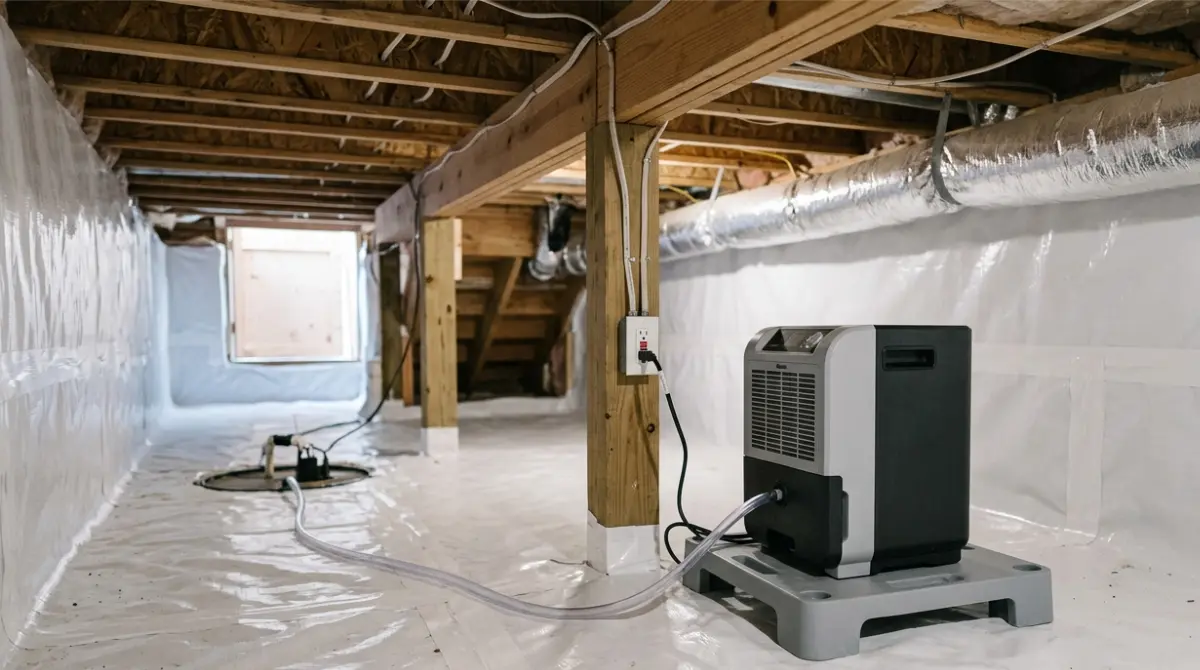
Table of Contents
Which crawl space dehumidifier do you actually need?
A crawl space dehumidifier works best in a sealed space with a clear humidity target.
What humidity your crawl space should hold
The EPA advises keeping indoor humidity below 60%, ideally 30% to 50%, and suggests a dehumidifier when a below-grade space runs damp; see EPA’s guidance on humidity and mold. For sealed crawl spaces, Bruce Davis of building-science firm Advanced Energy has advised a 45% to 50% setting in the Journal of Light Construction.
Find your situation
- Open vents: start with the vented-or-sealed section.
- Sealed or encapsulated: go to sizing and picks.
- Damp basement instead: see our recall-checked basement dehumidifier picks.
- Old portable unit under the house: run the recall check first.
ℹ️ Safety Note: Crawl spaces can hold wiring, mold, pests and gas appliances. This guide is general information; sealing or conditioning a crawl space changes how your house handles air and moisture. Hire a licensed crawl space or building-performance contractor, follow local code, and have widespread mold assessed by a professional.
Why a “70-pint” crawl space unit may remove only 35 pints
Crawl space units advertise capacity under different test conditions, so box numbers often aren’t comparable.
Three test conditions behind one number
| Model | Saturation rating | 80°F / 60% RH (AHAM) | Key Detail |
|---|---|---|---|
| AprilAire E070 | Not published | 70 pints/day | 53 pints/day at 73°F / 60% RH |
| AlorAir Sentinel HD55 | 113 pints/day | 53 pints/day | Headline uses saturation |
| Moiswell Defender S60 | 70 pints/day | About 35 pints/day | Sold as a “70-pint” unit |
Figures from AprilAire’s E070 specification sheet, AlorAir’s HD55 product page and the Moiswell S60 retail listing, checked October 17, 2026.
🔍 Why It Works: Warmer, wetter air holds more water, so a unit pulls more pints from it. A saturation rating uses air far wetter than the 45% to 50% you’re trying to hold.
How to compare units fairly
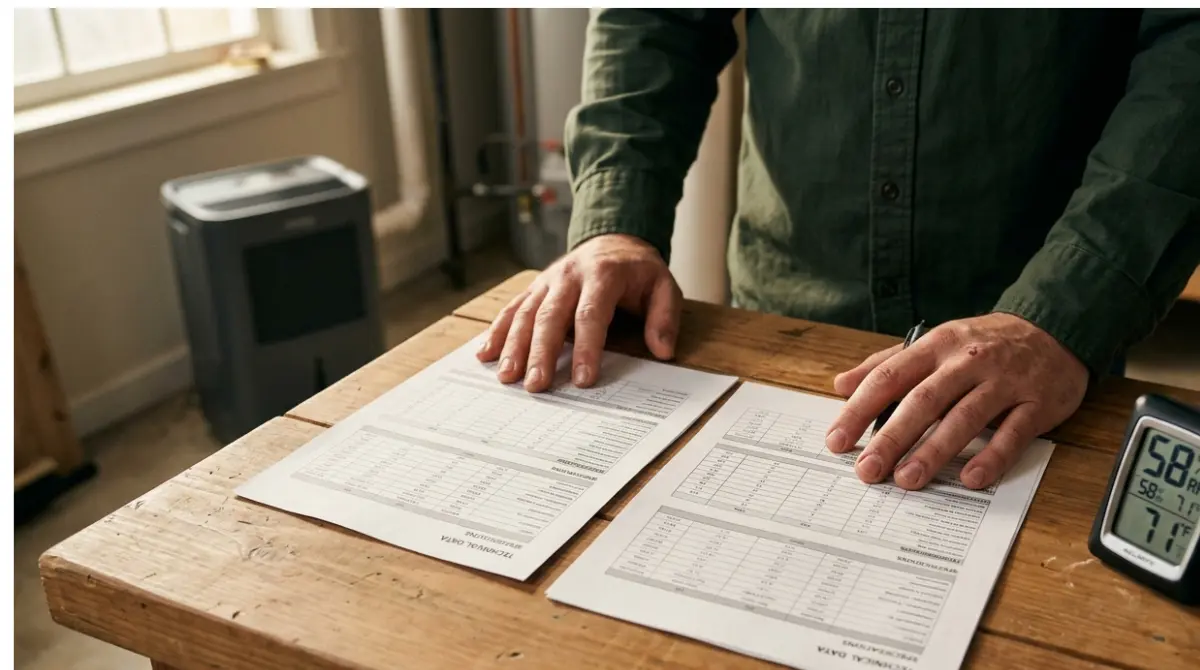
Line up every candidate at the same 80°F / 60% rating, often labeled AHAM. If a listing shows only a saturation figure, ask the seller for the AHAM number.
What size crawl space dehumidifier you need
Size depends on moisture load, cold limits and your hatch.
Size by moisture load and the maker’s chart
The 2021 International Residential Code lists dehumidification “sized in accordance with manufacturer’s specifications” as one way to dry an unvented crawl space. AlorAir, for example, rates the HD55 for up to 1,200 square feet. Davis notes it only keeps up when incoming moisture stays below what it removes.
Cold crawl spaces need a low operating limit
AprilAire lists E070 dehumidification from 50°F, Moiswell lists 41°F for the S60, and AlorAir lists the HD55 down to 33.8°F with auto-defrost. If yours dips into the 40s, that line decides which unit keeps working.
Will it fit through the hatch?
The E070 is 25 inches long and 56 pounds; the HD55 is 19.2 inches and 41.7 pounds. Measure the hatch before ordering, because damp framing stays at wood-rot and termite risk until the space dries.
Best crawl space dehumidifiers, spec-checked
These three picks cover warm, cold and small sealed crawl spaces.
How we picked
We compared manufacturer spec sheets at matching test conditions, plus operating temperature, weight, warranty and recall history. We did not hands-on test these units.
| Pick | Best For | Removal at 80°F / 60% RH | Lowest operating temp | Key Detail |
|---|---|---|---|---|
| AprilAire E070 | Warm, humid crawl spaces | 70 pints/day | 50°F | 56 lb, 5-year warranty |
| AlorAir Sentinel HD55 | Cold crawl spaces, tight hatches | 53 pints/day | 33.8°F | 41.7 lb, cETL listed, 6-year limited warranty |
| Moiswell Defender S60 | Small sealed spaces | About 35 pints/day | 41°F | Seller lists ENERGY STAR Most Efficient |
Specs from manufacturer sheets and retailer listings, checked October 17, 2026. Our search found no CPSC recall naming these three brands’ dehumidifiers as of that date.
AprilAire E070: best for warm, humid crawl spaces
🛒 Our Pick: The highest rated removal of the three at 80°F / 60% RH, with a ¾-inch drain connection and an optional AprilAire pump rated for a 22-foot lift. Check the AprilAire E070 on Amazon.
AlorAir Sentinel HD55: best for cold crawl spaces
🛒 Our Pick: The lowest operating limit here, 33.8°F with auto-defrost, and the lightest unit. It drains by gravity only, so plan a pump if no lower drain exists. Check the AlorAir Sentinel HD55 on Amazon.
Moiswell Defender S60: best for small sealed spaces
🛒 Our Pick: About 35 pints/day at 80°F / 60% RH, and its seller lists it as ENERGY STAR Most Efficient. ENERGY STAR says certified units are 13% more efficient; confirm the model in ENERGY STAR’s certified dehumidifier list.
Vented or sealed: when a dehumidifier is the wrong fix
A dehumidifier belongs in a sealed crawl space, not one that trades air with the outdoors.
Vented crawl spaces
Through open vents, a unit keeps drawing in humid outdoor air and may never reach its setpoint.
Sealed crawl spaces and the code
DOE’s Building America guide to unvented crawl spaces calls for a polyethylene vapor retarder over the floor and walls, with radon venting beneath it where needed, plus a code drying method such as an exhaust fan or conditioned air. If your furnace or ducts sit down there, see how your HVAC system shapes indoor air.
When to call a contractor
✅ Do This: Hire a licensed crawl space or BPI-certified building-performance contractor. Ask which code drying method they’ll use, how seams are sealed, whether any gas appliance draws combustion air from the space, and whether radon venting is needed.
Drain, power and placement for a unit you rarely see
Crawl space units run unattended, so setup matters.
Gravity drain or condensate pump
A gravity hose needs a drain point lower than the unit’s outlet; otherwise you need a condensate pump. ENERGY STAR notes that whole-home units drain by hose, routed by an HVAC professional to a floor drain or pump.
Placement and setpoint
Install the unit per its manual, set it to 45% to 50%, and verify with a hygrometer. Have an electrician confirm the outlet is GFCI-protected and can carry the load; the E070 draws 5.8 amps.
Ducts in the crawl space
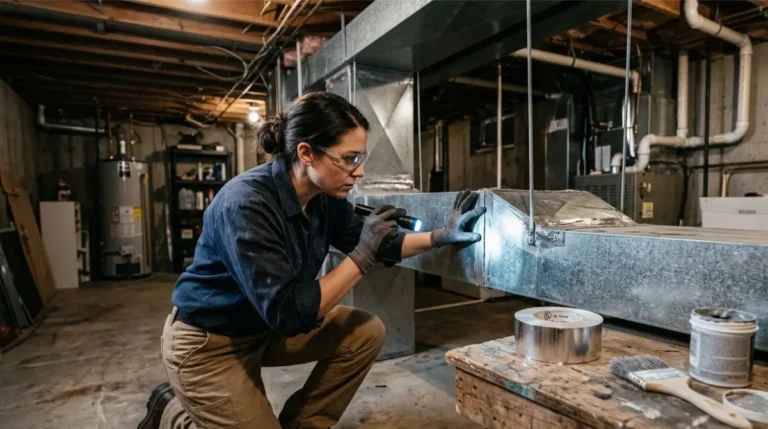
Ducts in the space can sweat or leak conditioned air; start with which duct leaks you can seal yourself.
Check old units for recalls, and signs it can’t keep up
Recall-check any older portable unit before it runs unattended.
Run the model-number recall check
CPSC warns four deaths may be tied to recalled Gree dehumidifiers sold under brands including Kenmore, GE and SoleusAir; a separate Midea recall covers units sold from 2003 through 2013. Find the nameplate model number and check CPSC’s recalled Gree dehumidifier warning. Unplug any match and follow the remedy CPSC lists.
Signs it can’t keep up
A dehumidifier dries air; it can’t fix standing water or a leak. Pooled water, wet soil or visible mold means it’s time to compare crawl space mold removal costs and next steps.
⚠️ Watch Out: A dehumidifier over standing water hides the source while wood stays wet; have a crawl space or waterproofing contractor find where water enters.
Crawl space dehumidifier FAQ
1. What is the best crawl space dehumidifier for a cold crawl space?
Of our three picks, the AlorAir Sentinel HD55 lists the lowest limit, 33.8°F with auto-defrost, versus 50°F for AprilAire’s E070 crawl space dehumidifier.
2. What humidity should a crawl space dehumidifier hold?
Set a crawl space dehumidifier to 45% to 50%; the EPA advises indoor humidity below 60%, ideally 30% to 50%.
3. Why does a 70-pint crawl space dehumidifier remove less?
Some crawl space dehumidifier ratings use saturation conditions; Moiswell’s “70-pint” S60 rates about 35 pints/day at 80°F and 60% humidity.
4. Do vented crawl spaces need a dehumidifier?
A crawl space dehumidifier in a vented space keeps drawing in humid outdoor air and may never reach its setpoint. Have a licensed contractor assess sealing first.
5. What size crawl space dehumidifier do I need?
The 2021 IRC says to size a crawl space dehumidifier to manufacturer’s specifications, so compare coverage charts at the same 80°F/60% rating.
6. Does a crawl space dehumidifier need a pump?
A crawl space dehumidifier needs a condensate pump when no drain sits lower than its outlet; otherwise a gravity hose works.
7. Is an ENERGY STAR crawl space dehumidifier worth it?
ENERGY STAR says certified units are 13% more efficient; confirm any crawl space dehumidifier’s model in its certified list before buying.
8. How do I check a dehumidifier for recalls?
Find the model number on your crawl space dehumidifier’s nameplate and check CPSC’s recall records. Unplug any match and follow the remedy CPSC lists.
9. Can a crawl space dehumidifier fix standing water?
No. A crawl space dehumidifier dries air but can’t fix standing water or a leak. Call a crawl space or waterproofing contractor to find the source.
10. Will a crawl space dehumidifier fit through my hatch?
Measure first: the AprilAire E070 crawl space dehumidifier is 25 inches long and 56 pounds; the AlorAir HD55 is 19.2 inches.
Your next step for a drier crawl space
Measure your crawl space humidity with a hygrometer and confirm the space is sealed. Then compare units at the same 80°F / 60% rating and check the coldest temperature each will face. Before you buy or reuse a unit, run its model number through a CPSC recall check.