Smart Gutter Maintenance That Helps Keep Your Basement Dry

Gutter maintenance matters because one inch of rain on a 1,000 sq ft roof sheds about 623 gallons—here’s where that water should go.

Table of Contents
Why fall gutter prep decides whether your basement stays dry
The leaves filling your gutters this month decide where next spring’s rain ends up. A blocked gutter doesn’t stop water; it dumps it straight down beside your foundation, which is exactly where a basement is most exposed.
Start with the line that matches your situation:
- Gutters full, basement dry: work through the cleaning and downspout sections below before the last leaves drop.
- Basement already damp after rain: pin down the source first with our guide to why water is coming into your basement, then come back here.
- You rent: the EPA advises renters to report moisture problems to the building owner or manager right away, so put gutter overflow in writing.
ℹ️ Safety Note: Gutter cleaning means ladder work at roof height, which carries a real fall risk. This guide covers general maintenance only. For two-story homes or steep roofs, hire a gutter professional, and have visible mold or foundation cracks assessed by a qualified mold or waterproofing professional.
How clogged gutters end up as water in your basement
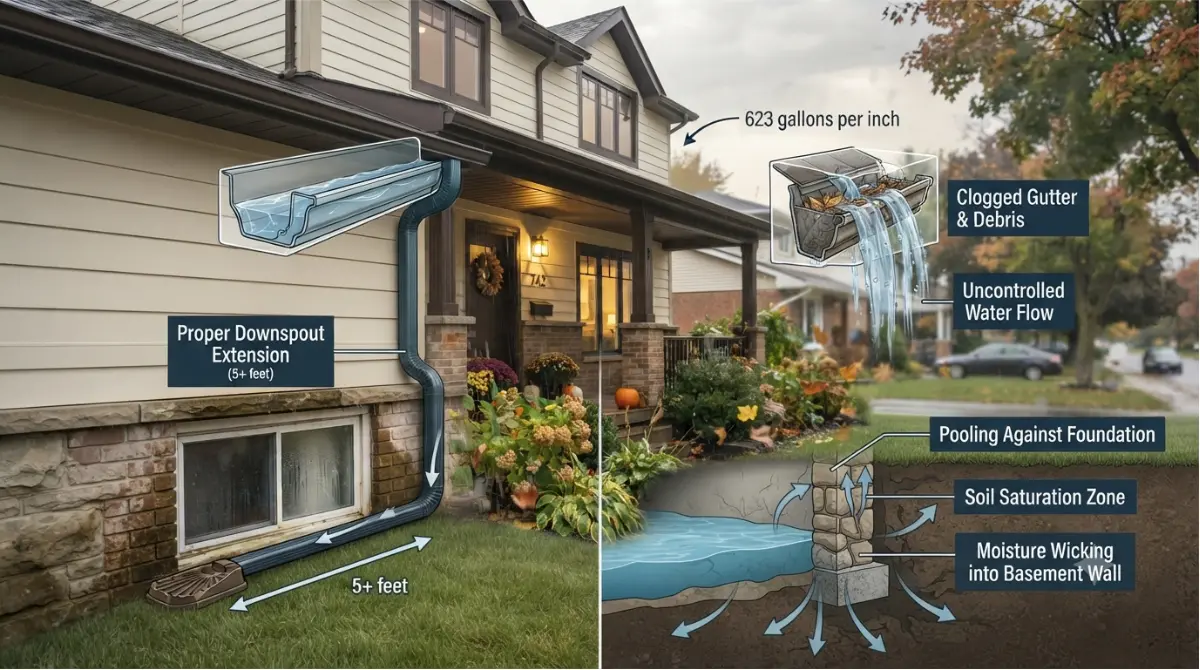
Your roof collects a surprising amount of water, and the gutter decides where all of it lands. When debris blocks the trough, water spills over the edge and soaks the soil against your basement wall.
The runoff math for your roof
One inch of rain falling on 1,000 square feet of roof produces about 623 gallons of water. Multiply your own roof footprint by the same factor; you can [measure your roof footprint]
📊 Tested / Spec: Calculated, not measured: 1,000 sq ft × 1/12 ft of rain = 83.3 cubic feet × 7.48 gallons per cubic foot ≈ 623 gallons per inch of rain.
Where overflowing water goes
🔍 Why It Works: The Department of Energy explains that roof runoff that isn’t drained away can quickly saturate the soil around a house and wick through the foundation into the interior, where it can cause mold and rot. Clean gutters and well-placed downspouts are what keep that soil from ever getting saturated.
Fall gutter cleaning, step by step, starting from the ground

Most of this job is planning at ground level; the ladder part should be short and careful.
Ladder safety before you climb
The CPSC’s outdoor repair safety checklist covers the essentials. Have someone spot you, set the extension ladder on stable ground, never stand on the top rung, and keep the ladder away from power lines. The CPSC also notes that adults 65 and older are 80% more likely than other adults to visit an emergency room for ladder injuries.
Clear, flush, then hose-test each downspout
- Scoop debris into a bucket rather than onto the ground below the wall.
- Flush each gutter run with a garden hose toward its downspout.
- Run the hose at the far end of each run, then watch the downspout outlet. Water should come out steadily, not back up or overflow at the eaves.
- Note where the water lands and measure how far it is from the foundation.
When to hire it out
✅ Do This: Hire a gutter professional for two-story homes, steep roofs, or gutters pulling away from the fascia. Ask whether they’ll flush and check each downspout, not just empty the troughs.
How far downspouts should drain from your foundation
Downspouts should discharge at least 5 feet from the foundation, or feed an underground catchment system at least 10 feet away, according to the Department of Energy’s gutter and downspout guidance.
| Discharge type | Minimum distance | Key detail |
|---|---|---|
| Surface pipe to daylight | 5 ft from foundation | Pitch the pipe away at least 5/8 inch per foot, onto ground that slopes away |
| Underground catchment (dry well) | 10 ft from foundation | Use non-perforated pipe |
| Rain barrel | Overflow meets the same distances | An overflow branch must reach at least 5 ft |
Source: DOE Building America Solution Center, verified September 21, 2026.
Surface extensions and splash blocks
A splash block set right against the wall doesn’t reach 5 feet on its own. DOE places the splash block at the end of the pipe, where it controls erosion.
Buried drain pipe
Before digging a trench, contact your local utility-locating service.
The mistake: tying into the foundation drain
⚠️ Watch Out: Never connect a gutter drain to the perforated foundation drain around your basement. DOE warns this soaks the foundation, which is the exact opposite of what you want.
Fixing the overflow spots gutters alone can’t solve
Clean gutters fail if the ground sends water back toward the house.
Check your grade in 10 feet
DOE’s foundation grading guidance calls for soil sloping away at least half an inch per foot for the first 10 feet. If yours runs flat or tilts inward, our guide to regrading around your foundation walks through your options.
Sagging gutters and bad slope
DOE specifies a gutter slope of at least 1/16 inch per foot toward the downspouts. Standing water in a clean gutter usually means a sag. It also recommends downspouts every 20 to 50 feet along the gutter.
Walk the foundation line
Look for soil washed out below the eaves and for downspouts detached from the gutter. Both mean water is landing at the wall.
When to do fall gutter prep for your trees and climate
Time the job to your trees rather than the calendar. Clean after the heaviest leaf drop, and recheck after major storms.
Heavy tree cover
More overhanging trees mean more frequent checks. Leaf guards cut down on debris, but they’re not a reason to stop looking.
Cold climates
DOE advises cleaning gutters as winter approaches, or adding screen guards, so gutters don’t hold water that freezes. In heavy-snow areas, snow-packed gutters can freeze into a forming ice dam.
Heavy-rain regions
DOE recommends larger gutter and downspout capacity where heavy rain is common. It also recommends kick-out flashing where a roof edge meets a wall, which stops overflow from running down the siding.
When a damp basement means it’s time to call a pro
If water already got in, speed matters more than finding the cause.
If water already got in
EPA’s homeowner guide to mold and moisture says drying wet areas within 24–48 hours prevents mold growth in most cases. If mold covers more than about 10 square feet, the EPA points to professional-level guidance; see our guide to safely handling basement mold.
Signs it’s not a gutter problem
Dampness that persists after you’ve fixed the gutters, downspouts, and grade points to a deeper issue. So do cracks that keep widening.
✅ Do This: Call a licensed waterproofing contractor, or a structural engineer for widening cracks. Ask them to show you where water is entering. For mold, ask the remediation company whether it follows the EPA’s professional remediation guidelines.
Gutter and basement water FAQ
1. Can clogged gutters cause water in the basement?
Yes. Clogged gutters overflow at the eaves and saturate soil against the foundation, where water can wick through into your basement.
2. How often should gutters be cleaned to prevent basement water?
Clean gutters after the heaviest fall leaf drop, before winter, and recheck after major storms; homes under heavy tree cover need more frequent checks.
3. How far should downspouts extend from the foundation?
DOE guidance says downspouts should discharge at least 5 feet from the foundation, or feed an underground catchment at least 10 feet away.
4. Can downspouts connect to the foundation drain?
No. DOE warns that tying gutter drains into the perforated foundation drain soaks your foundation instead of protecting it from basement water.
5. How much should the ground slope away from the house?
DOE recommends soil sloping away from your foundation at least half an inch per foot for the first 10 feet.
6. How much slope do gutters need?
DOE guidance calls for gutters sloping at least 1/16 inch per foot toward the downspouts so water drains instead of pooling.
7. Is it safe to clean gutters from a ladder?
It can be, with a spotter and stable ground, never standing on the top rung, per CPSC guidance. For two-story or steep roofs, hire a gutter professional.
8. Do gutter guards prevent basement water?
Gutter guards keep leaves out of gutters, but they can’t fix short downspouts or grading that sends water back toward your basement.
9. Why is my basement wet if my gutters are clean?
Short downspout discharge, soil sloping toward the house, or foundation cracks can still let water into your basement after the gutters are cleaned. If dampness persists, call a licensed waterproofing contractor.
10. How fast must a wet basement dry to prevent mold?
The EPA says drying wet areas within 24–48 hours prevents mold growth in most cases. If mold covers more than 10 square feet, consult a professional.
Your fall gutter plan for this weekend
Pick one dry day after the leaves drop. Clear and flush the gutters, hose-test every downspout, measure where each one discharges, and check your grade. If water still finds its way in, see what basement waterproofing costs, line by line before you request quotes.