Reading Basement Waterproofing Cost the Right Way, Quote by Quote

asement waterproofing cost can start with the yard: model code requires at least a 6-inch fall in the first 10 feet. Check it before comparing quotes.
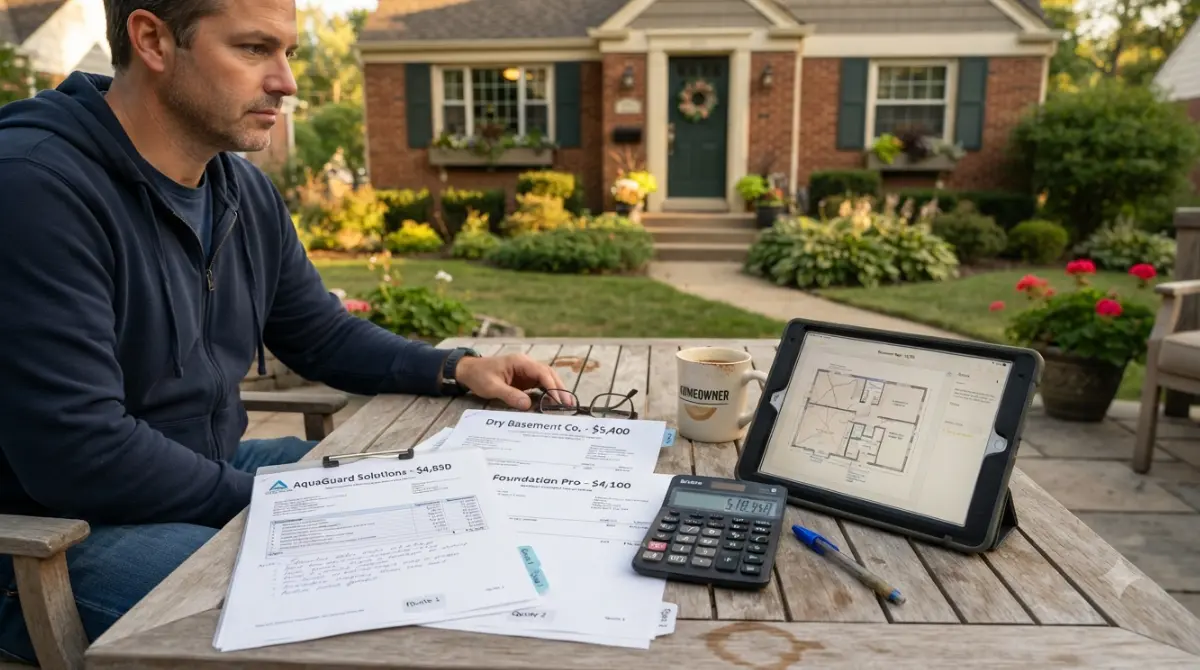
Table of Contents
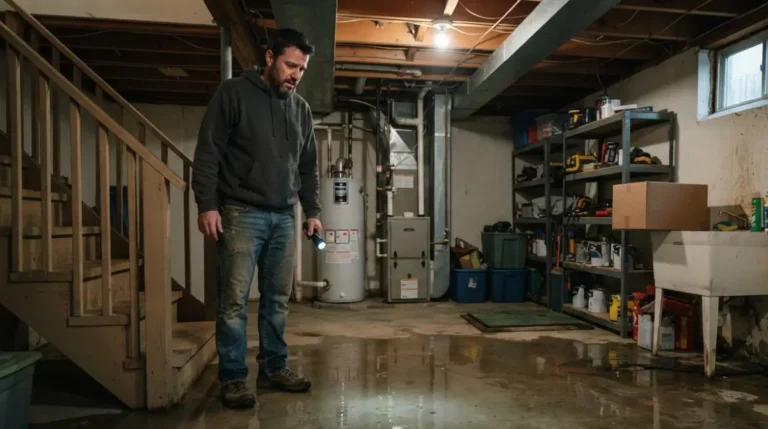
One basement in [City, State] got three written waterproofing quotes. They ranged from [Quote low total] to [Quote high total], and the final invoice came to [Invoice total]. The gap between those numbers wasn’t random, and the line items explain almost all of it.
If you’re comparing basement waterproofing cost right now, the totals on your quotes probably don’t tell you much. This walkthrough shows you what does.
Where these quotes and the invoice came from
A homeowner in [City, State] shared three written quotes and the final invoice for their [poured concrete / concrete block] basement, about [basement size] square feet, from [month and year]. Contractor names and personal details are redacted [unless: named with written permission]. Gladewick did not install, inspect, or test this work. Everything below comes from the documents and the homeowner’s account.
Jump to your situation
- Holding quotes that don’t match? Start with the side-by-side quotes, then learn to read your own.
- Just found water and don’t know why? Start with the section on leaks versus condensation.
- Working with a tight budget? Go to cost by method. Some fixes cost far less than a full system.
- Finishing, buying, or selling the house? Read the contract and warranty checks and the paperwork to keep.
- Worried about mold or radon? Go to the sump cover and drying section.
ℹ️ Safety Note: Basement water problems can involve foundation cracks, excavation next to your home, sump pump electrical work in wet areas, mold exposure, and radon. This article is for general understanding, not repair instructions. Hire a licensed waterproofing or foundation contractor, a structural engineer for any sign of wall movement, or a certified radon professional as needed, and follow your local code and permit requirements.
Is it a leak, seepage, or just condensation?
Knowing where the water comes from can save you from buying a system you don’t need.
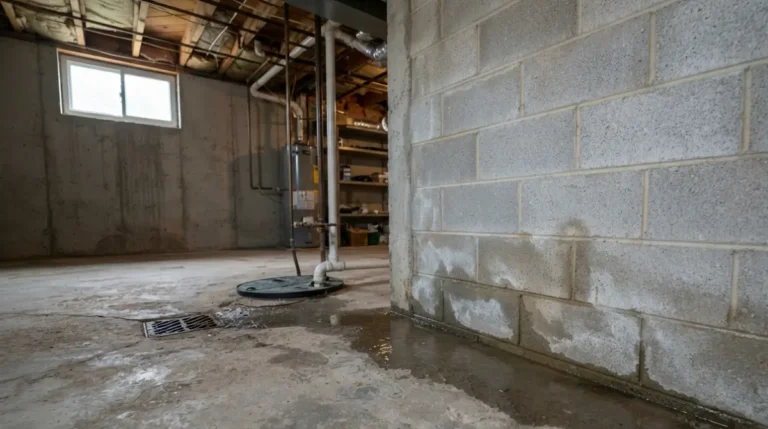
Condensation forms when humid air meets a cool basement wall, so moisture tends to appear across surfaces and gets worse in humid weather. Seepage or a leak shows up in specific spots, such as a crack, the joint where wall meets floor, or a corner, usually after heavy rain or snowmelt. Where and when the water appears are your first two clues.
🔍 Why It Works: Warm air holds more water vapor than cool air. When humid air touches concrete that’s colder than the air’s dew point, the vapor turns back into liquid on the surface. That’s why condensation can soak a wall with no leak at all.
Condensation vs. water coming through
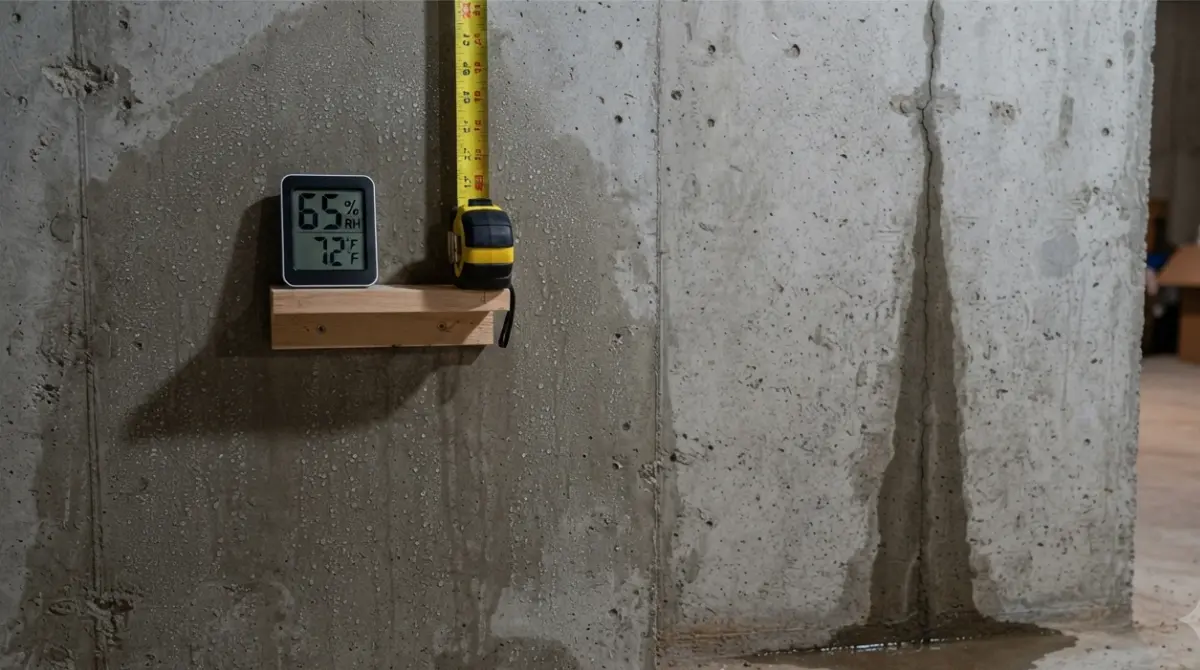
If moisture tracks with humidity rather than rain, air moisture is the likely culprit. The EPA advises keeping indoor humidity below 60 percent, ideally between 30 and 50 percent. You can check it with an inexpensive humidity meter.
Outside fixes to check before any quote
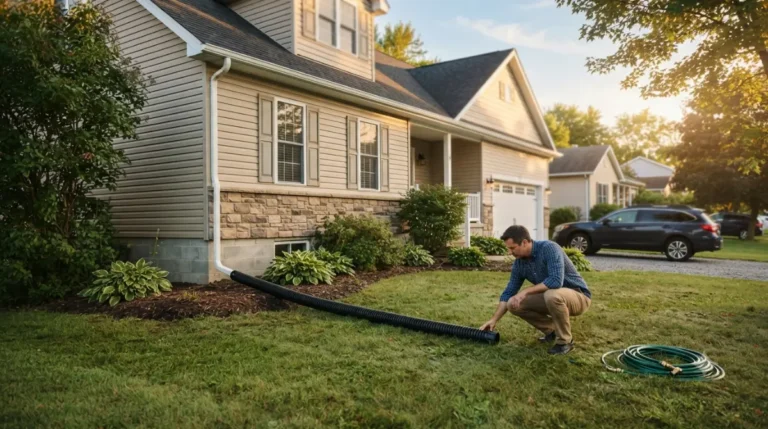
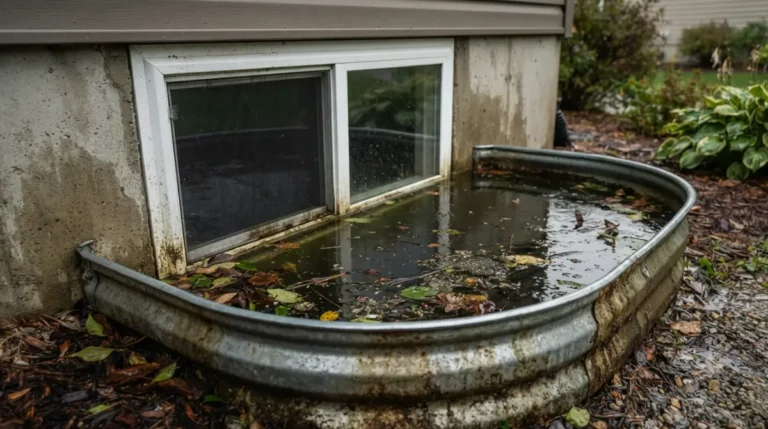
A lot of basement water starts in the yard. The International Residential Code (IRC) requires the ground to slope away from foundation walls, falling at least 6 inches within the first 10 feet. Hard surfaces like patios within that zone should slope at least 2 percent away from the house.
Also look at where your downspouts empty. Our guide to fixing gutters and downspouts that dump water at the foundation covers the checks. If you have standing water right now, handle that first with our steps for drying out a flooded basement.
Here’s what each contractor wrote down as the cause of this basement’s water.
Signs you need a structural engineer, not a waterproofer
Some basement problems are structural rather than just wet. Walls that appear to bow or lean, or cracks that keep getting wider, can point to foundation movement.
That doesn’t automatically mean your foundation is failing. It means a waterproofing system alone may not be the right first purchase.
✅ Do This: If you see signs of wall movement, hire a licensed structural engineer before signing a waterproofing contract. Ask for a written assessment that says whether the movement is active and what repair, if any, comes first.
Same basement, three quotes: where the money went
Waterproofing quotes vary mainly because each company prices a different scope, not the same job at different markups. For this basement, the biggest gaps came from [top scope difference, e.g., drain length] and [second scope difference, e.g., backup pump]. Compare line items before you compare quote totals.
| Line item | Quote A | Quote B | Quote C | Key Detail |
|---|---|---|---|---|
| Total price | [A total] | [B total] | [C total] | [spread between low and high] |
| Method proposed | [A method] | [B method] | [C method] | [interior / exterior / mixed] |
| Perimeter drain (linear feet) | [A ft or “not specified”] | [B ft] | [C ft] | [measurable or vague?] |
| Sump pump model | [A model] | [B model] | [C model] | [named model or generic?] |
| Battery backup pump | [included / extra / none] | [ ] | [ ] | [cost if extra] |
| Wall membrane or vapor barrier | [ ] | [ ] | [ ] | [ ] |
| Crack repair | [ ] | [ ] | [ ] | [ ] |
| Permit | [ ] | [ ] | [ ] | [who pulls it] |
| Warranty | [ ] | [ ] | [ ] | [transferable?] |
| Deposit and payment terms | [ ] | [ ] | [ ] | [% up front] |
Source: the three written quotes, transcribed as written. “Not specified” means the quote doesn’t mention the item.
The three totals and what each one covered
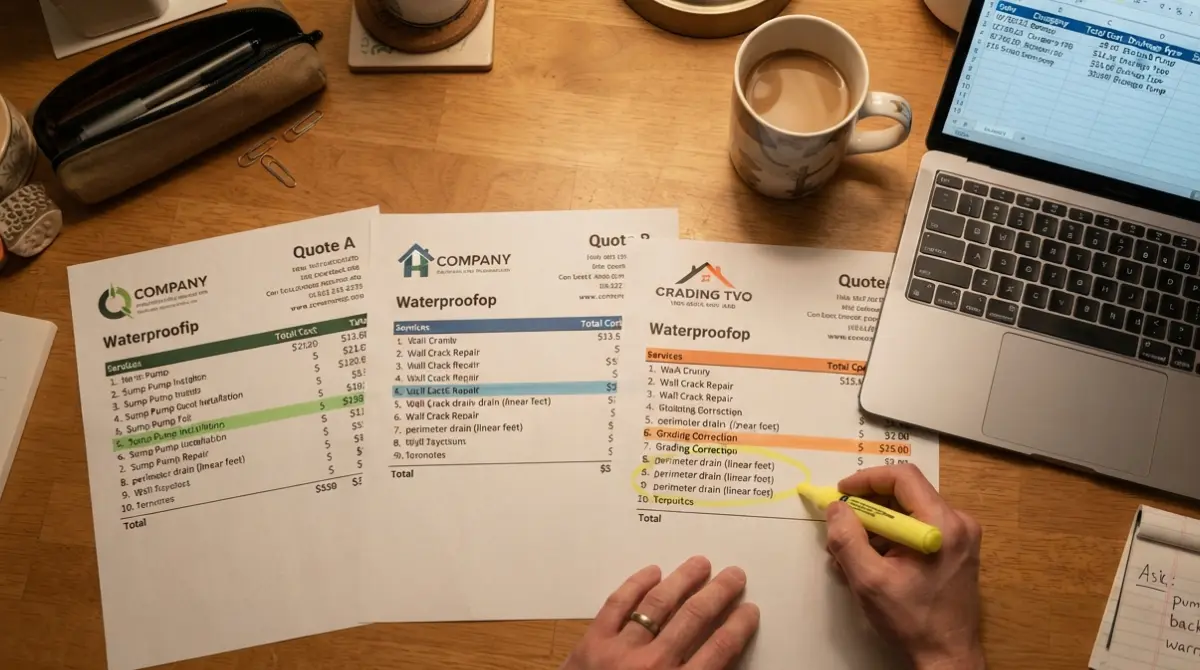
Quote A, at [A total], proposed [A scope summary in plain language]. Quote B, at [B total], proposed [B scope summary]. Quote C, at [C total], proposed [C scope summary].
[One or two sentences on what the totals looked like side by side before reading the line items. State only what the documents show.]
Line items only one quote included
The most useful rows are the ones where only one company wrote something down. [List each item that appeared on only one quote, e.g., “Only Quote B specified a discharge line extension.”] A lower total that leaves these out isn’t necessarily cheaper once you add them back.
How each handled the sump pump and backup
Contractors themselves advise asking how many feet of perimeter drain are being installed, which pump model, and whether battery backup is included or extra. For this basement: [A pump and backup detail], [B pump and backup detail], [C pump and backup detail]. If backup matters to you, our guide to sump pump battery backup options explains the types.
Warranty terms in writing, compared
“Lifetime warranty” appeared on [number] of the three quotes. The written terms differed on [e.g., parts vs. labor, transferability, maintenance conditions]: [A terms], [B terms], [C terms].
What the final invoice showed vs. the quote
A quote is a promise, and the invoice shows what was actually paid. The homeowner chose Quote [letter] because [homeowner’s stated reason, attributed to them].
| Item | Chosen quote | Final invoice | Difference | Key Detail |
|---|---|---|---|---|
| Total | [quote total] | [invoice total] | [difference] | [reason] |
| [Line item] | [ ] | [ ] | [ ] | [ ] |
| [Line item] | [ ] | [ ] | [ ] | [ ] |
| Change orders | — | [amount] | [amount] | [reason given] |
Source: the chosen written quote and the final invoice.
Change orders and why they happened
[If change orders exist: list each one, its amount, and the reason written on the change order. If none: “The invoice matched the quote with no change orders. That’s worth noting, because a written, itemized scope is what makes that possible.”]
Quoted vs. paid, line by line
[Walk through any line that changed, in plain language: what was quoted, what was billed, and the reason on the paperwork. Don’t speculate about reasons the documents don’t give.]
How long the job took from contract to done
The contract was signed on [date], work started on [date], and the invoice was issued on [date].
Basement waterproofing cost by method
Your quotes make more sense once you see where they sit against national numbers and against each method.
Nationally, Angi’s 2026 cost data puts most basement waterproofing jobs between $2,461 and $8,201, with an average of $5,240 and roughly $3 to $10 per square foot. The three quotes here came in at [low]–[high] for about [size] square feet, [below / within / above] that range. These national figures are industry estimates, and local labor, foundation type, and soil change them.
To turn per-square-foot ranges into your own budget, measure first with our Square Footage Calculator.
| Approach | What it does | Cost signal | Best For |
|---|---|---|---|
| Grading and downspout fixes | Moves surface water away from the foundation | Lowest | Water that shows up only after rain near one wall |
| Crack repair | Seals a specific non-structural crack | Low (Angi: from about $600) | A single leaking crack |
| Interior drainage and sump | Collects water at the wall-floor joint and pumps it out | Mid | Seepage at the base of walls or through the floor |
| Exterior excavation and membrane | Seals the outside of the foundation wall | Highest | Water entering through walls, where digging is practical |
Cost signals per Angi’s 2026 data, which notes interior work costs less than exterior because it skips excavation and complete systems can reach $15,000. Treat these as estimates, not quotes.
Interior drainage vs. exterior excavation
Neither method is better everywhere. Interior systems manage water that reaches the basement. Exterior work tries to keep it off the wall in the first place, but it requires digging along the foundation.
The right choice depends on where water enters and what your foundation is made of. If a contractor mentions cracks, our guide to which foundation cracks are structural helps you ask better follow-up questions.
Where sealers and waterproof paint fit
Surface coatings are aimed at dampness, not water under pressure. The coating manufacturer Drylok warns that applying waterproofer over efflorescence (white mineral deposits) without proper surface prep can make the coating fail. Those deposits mean moisture is moving through the masonry, so find the source first.
Can you do any of this yourself?
Clearing gutters, extending downspouts, and tracking humidity are reasonable homeowner tasks. Drain tile installation, excavation, crack injection, and sump pump wiring are not DIY territory.
⚠️ Watch Out: Digging next to a foundation or cutting into a basement slab can damage the structure, hit buried lines, or create electrical hazards around water. These jobs belong to a licensed contractor working under your local permit rules.
✅ Do This: Before accepting any method, ask the contractor to show you exactly where water is entering and to write that diagnosis on the quote.
How to read a basement waterproofing quote
This checklist lets you run the same comparison on your own quotes. Every basement waterproofing quote should spell out:
- The stated cause of the water.
- The method and exactly where it will be installed.
- The length of drain in linear feet, not just “full perimeter.”
- The sump pump model and basin.
- Whether a battery backup pump is included or extra.
- Where the discharge line will send the water.
- Who pulls the permit, and what cleanup is included.
- Warranty terms and the payment schedule.
Of those eight, Quote A spelled out [N], Quote B [N], and Quote C [N]. Getting more than one itemized estimate is what exposed those gaps here, because a single quote would have hidden them.
💡 Pro Tip: Waterproofing contractors themselves point out that most quote disputes come from scope mismatch, not price. One side assumed an item was included and the other didn’t. An itemized quote gives both of you the same line to point at.
Questions to ask each contractor
- How many linear feet of drain are you installing, and can I verify that with a tape measure?
- Which pump model, what’s its capacity, and is the backup included?
- Where does the discharge line end?
- What does the warranty exclude, and does it transfer if I sell?
- What happens, and what does it cost, if you find something unexpected once work starts?
Waterproofing contractor red flags and contract checks
A clean quote still needs a safe contract.
Pressure tactics and payment traps
The FTC lists warning signs of home improvement scams:
- Pressure for an immediate decision.
- Demands for payment up front or cash only.
- Asking you to get the building permits.
- Pushing you toward a lender they know.
The FTC also advises against paying the full amount up front and notes that some states limit how much a contractor can ask as a down payment.
For this basement, deposit terms were [A terms], [B terms], and [C terms].
⚠️ Watch Out: “Sign today for this price” is a pressure tactic, not a discount. Waterproofing is rarely so urgent that you can’t take a few days to compare written quotes.
Licenses, insurance, and permits
The FTC recommends considering only licensed, insured contractors. Confirm the license with your state or county government and ask for proof of insurance.
Permit requirements for basement waterproofing vary by city and county. Ask your local building department before work starts.
What a warranty must say in writing
A warranty is only as useful as its written terms. Check whether it covers parts, labor, or both, and whether it transfers to a buyer. Also check what maintenance you’re required to do to keep it valid.
✅ Do This: Verify the contractor’s license with your state or county licensing authority before signing. If a dispute comes up later that you can’t resolve with the contractor, contact your state attorney general or local consumer protection office.
Mold, radon, and sump covers: ask before you sign
Waterproofing touches two health issues worth raising before work begins.
Why fast drying matters for mold
The EPA’s guide to mold and moisture in your home says that if wet or damp areas are dried within 24 to 48 hours, mold won’t grow in most cases. Stopping the water source matters as much as cleaning up. If mold has already spread, our breakdown of what mold remediation actually costs helps you budget.
Is the sump cover sealed?
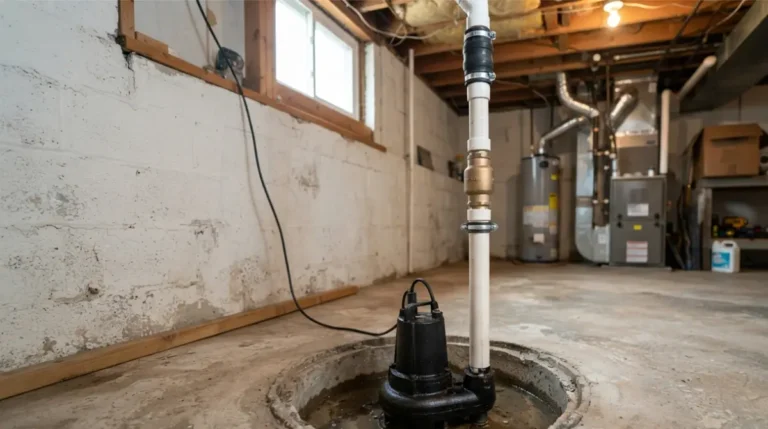
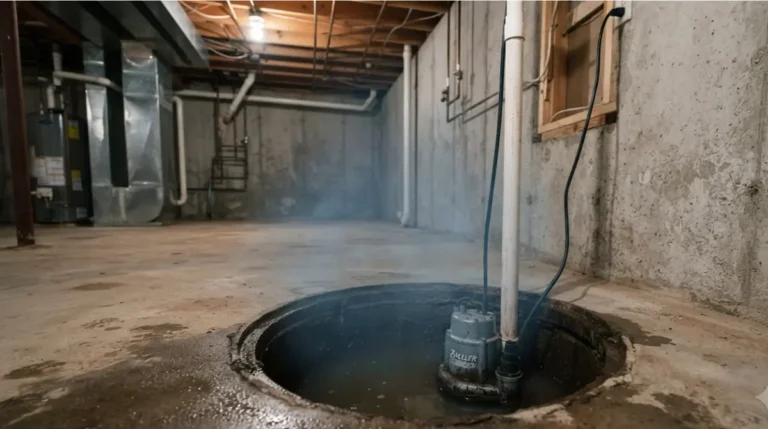
An open sump pit can let radon and other soil gases into the basement. The Department of Energy’s Building America Solution Center notes that recent editions of the IRC require installed sumps to have a gas-tight, removable cover.
For this basement, a sealed sump lid was specified on [Quote A: yes/no/not specified], [Quote B], and [Quote C].
A sealed lid doesn’t prove your radon level is fine, and an open pit doesn’t prove it’s high. Testing is the only way to know. The EPA’s Consumer’s Guide to Radon Reduction explains how reduction systems work.
✅ Do This: Test for radon, and if results concern you, hire a certified radon measurement or mitigation professional. Ask whether the new sump lid will be gasketed and sealed, and whether it can connect to a mitigation system later.
Keeping a waterproofed basement dry
Once the system is in, a few habits protect what you paid for.
Sump pump checks
Follow the maintenance schedule in your pump’s manufacturer manual. Also meet any maintenance conditions in your warranty. This homeowner’s warranty requires [maintenance terms as written, or “no stated maintenance terms”].
Humidity and alarms
Keep basement humidity within the EPA’s recommended range, and use a dehumidifier if it runs high. Our guide to choosing a basement dehumidifier compares sizes. A water leak alarm near the sump gives early warning if the pump stops.
Paperwork to keep for resale
Keep the signed contract, the itemized invoice, any change orders, and the warranty with its transfer instructions together. Buyers and inspectors will ask what was done and whether the warranty moves with the house.
Basement waterproofing cost questions
1. How much does basement waterproofing cost?
Angi’s 2026 data puts most basement waterproofing jobs between $2,461 and $8,201; this basement’s three quotes ranged from [low] to [high].
2. How many basement waterproofing quotes should I get?
Get enough itemized quotes to compare scope line by line; this basement’s three quotes revealed differences a single quote would hide.
3. Do I need a permit for basement waterproofing?
Permit rules for basement waterproofing vary by city and county, and the FTC warns about contractors who ask you to pull permits. Check with your local building department before work starts.
4. How much deposit should a waterproofing contractor ask for?
The FTC advises against paying a waterproofing contractor the full amount up front, and some states limit down payments. Check your state or local consumer agency for the rules.
5. Is interior or exterior basement waterproofing better?
Neither interior nor exterior basement waterproofing is better everywhere; the right method depends on where water enters your foundation. Ask a licensed contractor to document the entry point.
6. Can gutters and grading fix a wet basement?
Sometimes. Code requires the ground to fall at least 6 inches within 10 feet of the foundation, so check grading and downspouts before paying for a system.
7. Does basement waterproofing prevent mold?
Waterproofing helps by stopping water, and the EPA says drying wet materials within 24–48 hours usually prevents mold growth. Hire a remediation professional for extensive mold.
8. Should a sump pit be sealed for radon?
Yes. Recent residential codes require a gas-tight, removable sump cover because open pits can let radon into basements. Test your home for radon to know your actual level.
Your next step before signing a waterproofing quote
If you’re holding quotes that don’t match, you’re in a better position than you think. The differences on paper are exactly what you need to ask about.
Explore our water damage restoration guide, our breakdown of French drain costs inside and outside, and our steps for testing your home for radon.