Finding a Smart Laser Level for Floors, Spec by Spec

Laser level for floors vs digital: ±0.2° works out to about 0.042 inch per foot, roughly ten times a laser’s listed error. See what each can show.
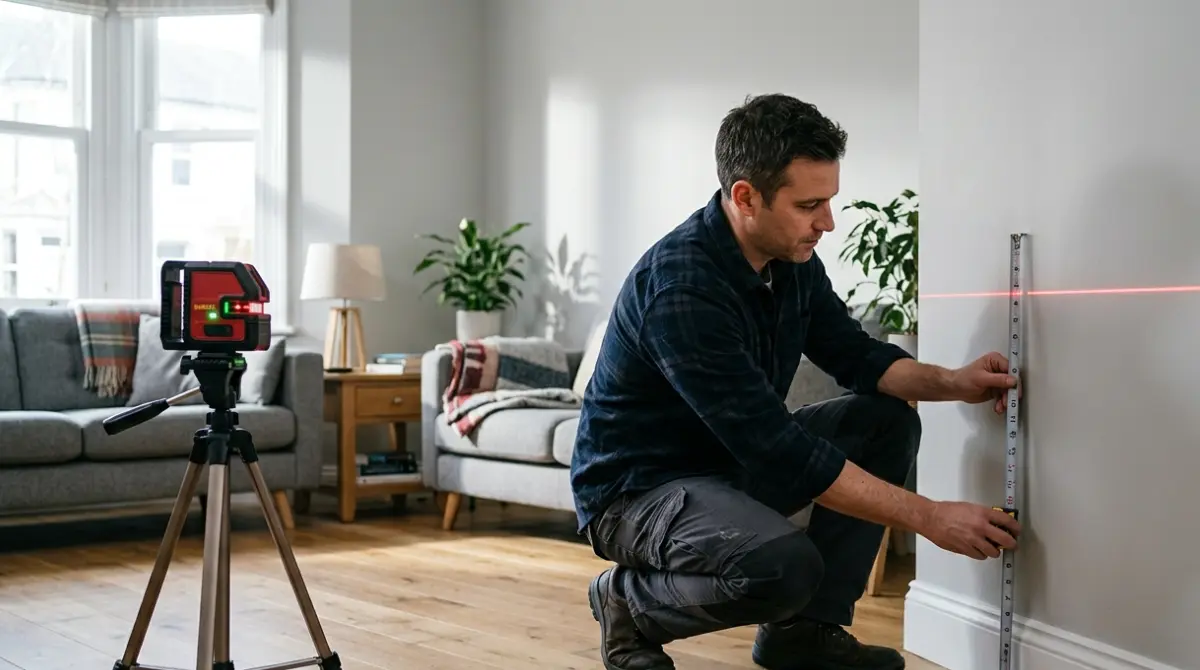
Table of Contents
Laser level for floors: what it can and can’t tell you
A laser level for floors projects a level line; a tape measure turns it into slope numbers.
Which tool answers which question
- Whole room: laser level plus tape measure.
- One doorway or spot: digital level.
- Foundation worries: see who to call first.
What a reading can’t tell you
A reading shows how far a sloping floor is out of level, not why.
ℹ️ Safety Note: Never stare into a laser beam. A floor reading isn’t an engineering evaluation; with new cracks or sticking doors, hire a licensed structural engineer and follow local code.
Laser vs digital level: what the accuracy numbers mean
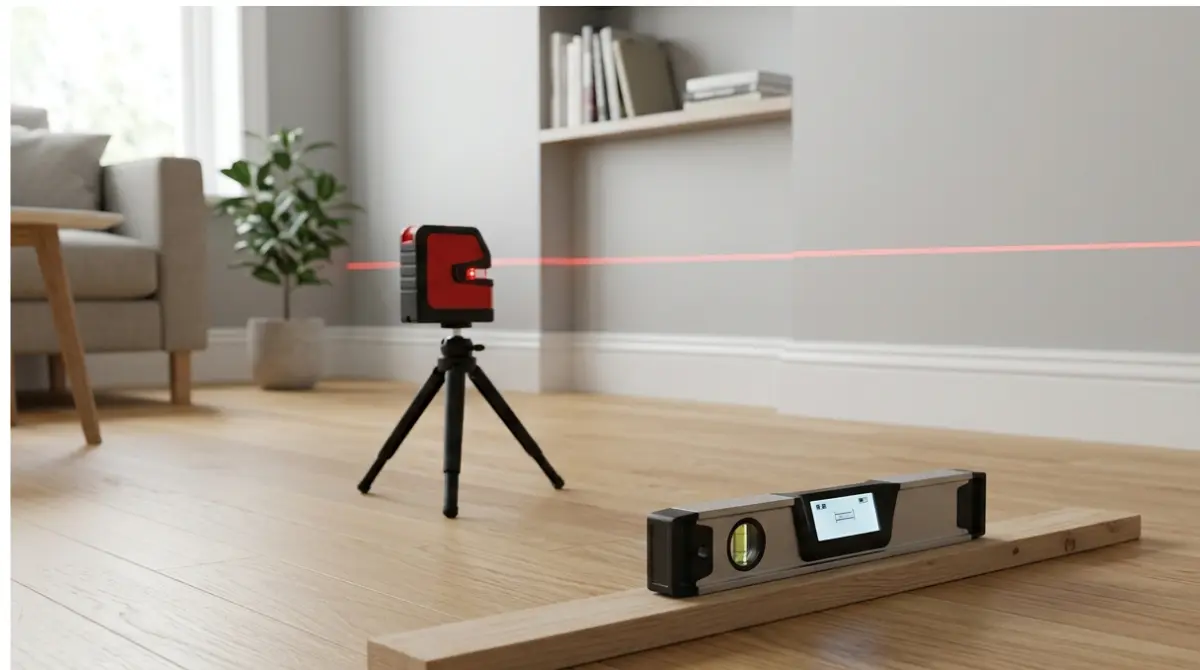
A laser gives a level line; a digital level reads one spot’s tilt.
Reading ±1/8 inch at 30 feet
DeWalt lists ±1/8 inch at 30 feet, about 0.004 inch per foot.
Why a digital level’s ±0.2° is coarse
Klein’s ±0.2° is about 0.042 inch per foot, roughly ten times the laser figure.
Laser line vs digital angle: what each measures
| Tool | Listed accuracy | Inches per foot |
|---|---|---|
| DEWALT DW088K, DW089LG | ±1/8 in at 30 ft | about 0.004 |
| Klein 935DAA | ±0.1° (0–1°) | about 0.021 |
| Klein 935DAGL | ±0.2° | about 0.042 |
📊 Tested / Spec: Sourced, not tested by us. Per-foot figures are our calculation (tan angle × 12; laser scaled from 30 feet).
How to check floor slope with a laser level
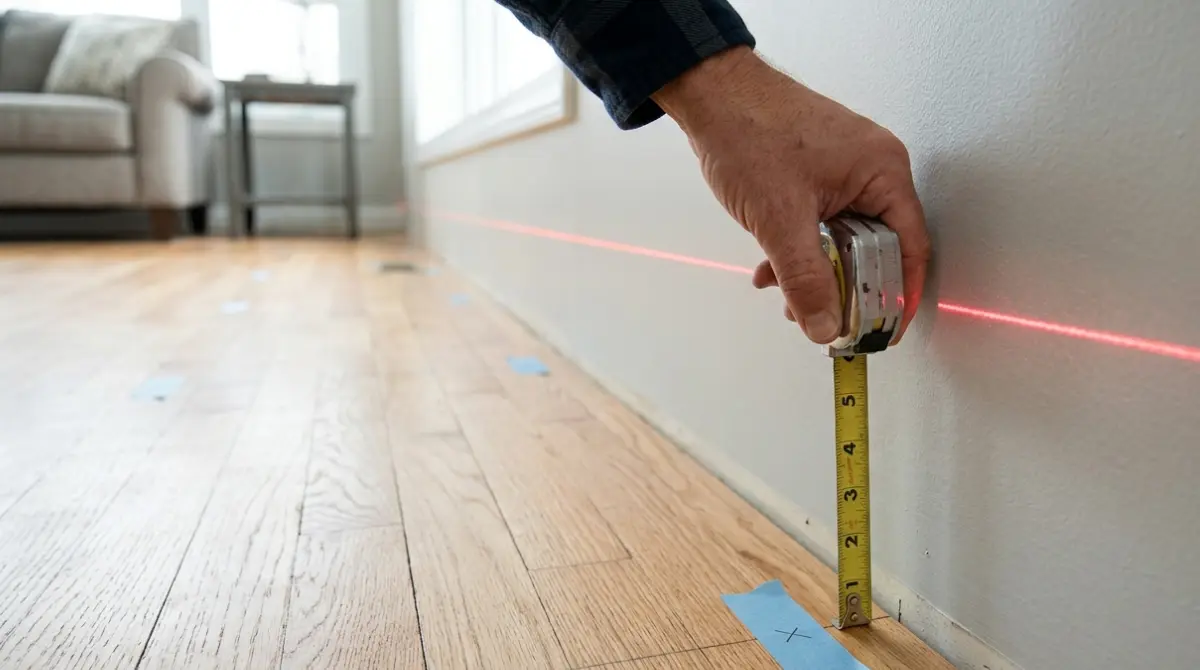
Set a self-leveling laser down, measure from its line to the floor at marked points, and compare.
Set up and mark your line
- Settle the laser on a stable surface.
- Tape a grid across the floor.
Measure laser-to-floor on a grid
- Hold the tape upright; read floor to laser line.
- Note and date each reading.
Read the highs and lows
- A larger reading means a lower floor.
- Keep the laser in place throughout.
🔍 Why It Works: A self-leveling laser levels its own beam. Bosch lists up to ±4° for its GLL3-330CG, far wider than the 0.12° tilt of a floor sloping 1/2 inch in 20 feet.
Then read whether sloping floors mean foundation trouble.
Laser and digital levels that fit floor-slope checks
Four tools fit, chosen from published specs.
Two laser picks for room-scale mapping
DeWalt’s DW089LG page and DW088K page list the same accuracy.
Two digital levels for spot checks
Klein’s 935DAGL page lists ±0.2°.
How we chose, and what we didn’t test
Bosch lists no accuracy figure for the GLL3-330CG, so we left it out.
Laser level eye safety and recall checks before you buy
The FDA’s laser products FAQ says most laser products, including levels, need a warning label.
Class 2 lasers: don’t stare into the beam
DeWalt’s DW088K page lists Class 2: never stare into the beam.
Glasses that brighten the line aren’t eye protection
Johnson Level says tinted glasses don’t protect your eyes from the beam.
Check recall status before you buy
As of October 12, 2026, a CPSC recall search found none covering these four tools. Search CPSC’s recalls page by brand and model before buying.
How much floor slope is normal, and when to call an engineer
No single number settles it, but reference points help.
Reference points, not a diagnosis
NAHB’s performance guidelines say a wood floor shouldn’t slope more than 1/2 inch in 20 feet (0.025 inch per foot), a builder’s minimum criterion, not a foundation test.
Why contractors and warranties use different numbers
One warranty form we read starts coverage at 1 part in 240 (about 0.05 inch per foot), another at 1 inch; see warranty tolerances.
When to stop measuring
✅ Do This: With new cracks, growing gaps, or doors sticking all year, book an independent licensed structural engineer. Ask what is causing the slope and whether it’s still moving.
Odd readings? Check your tool, then sag and rot
Rule out a bad setup before blaming the foundation.
Check your tool before blaming your floor
Repeat the survey from a second laser position; if numbers change, suspect the setup.
Slope vs sag: what your grid shows
A one-way tilt suggests settlement; a mid-room dip suggests weak joists.
Soft wood or a musty smell changes the plan
Soft wood, a musty smell, or mud tubes call for a pest pro; see termite vs water damage and rot.
⚠️ Watch Out: Don’t shim, jack, or patch a sloping floor before a pro sees it; that can hide the movement.
Laser level for floors: questions answered quickly
1. Best laser level for floors?
On paper, the DEWALT DW089LG’s three 360° lines suit whole rooms best; we compared specs only.
2. Can a laser level check floors?
Yes. A self-leveling laser level projects a level line; tape readings to the floor show slope.
3. Is a digital level accurate enough?
Klein’s 935DAGL lists ±0.2°, about 0.042 inch per foot, so use a digital level for spots.
4. How much floor slope is too much?
NAHB’s builder guideline is 1/2 inch in 20 feet. With cracks or sticking doors, call a licensed structural engineer.
5. What does ±1/8 inch at 30 feet mean?
A laser level may be off by about 1/8 inch at 30 feet, roughly 0.004 inch per foot.
6. Does a laser level show the cause?
No. A laser level reading shows how much a floor is off level, not why. Ask a licensed structural engineer.
7. How do I measure floor slope?
Tape a grid and read from the laser level line to the floor; larger numbers mean lower spots.
8. Is a laser level safe for eyes?
Never stare into a laser level beam, and tinted glasses aren’t eye protection. Read the manual first.
9. How do I check laser level recalls?
Search CPSC’s recall list by brand and model; we found none for these four laser levels as of October 12, 2026.
Your next step for checking floor slope
Tape a grid, record each reading on a dated sketch, and request our Floor-Level Map and Door Log worksheet at hello@gladewick.com. If cracks appear, book an independent structural engineer first.