The Overlooked Reason Basement Waterproofing Cost Varies

Basement waterproofing cost estimates run from $5,000 to $13,640 nationally. The gap
isn’t error — it’s four publishers pricing four different jobs.
Table of Contents
Four national cost guides price the same job and report four different answers: $5,000, $5,240, $6,000–$18,000, and $13,640. None of them is lying. They measure different things, and none of them tells you which.
This page puts the four figures side by side with what each publisher says its number covers.
Jump to your situation:
- Water on your floor right now? Handle water in the basement after heavy rain first.
- Holding a quote? Start with the four figures, then why they diverge.
- Budgeting before you call anyone? Go to which figure fits your basement.
- Told you need a full system? Read what a national average can’t tell you.
ℹ️ Safety Note: Basement water work can involve foundation cracks, excavation beside your home, sump pump wiring in wet areas, and mould exposure. This article is about published cost figures, not repair instructions. Hire a licensed waterproofing or foundation contractor, and a structural engineer for any sign of wall movement, and follow your local code and permit rules.
What four cost guides actually report

Here is every figure, with the basis each publisher states and the date we read it.
| Publisher | Reported basement waterproofing cost | Stated basis | Key Detail |
|---|---|---|---|
| Angi | $5,240 average; $2,461–$8,201 typical | $3–$10 per sq ft; crack sealing from ~$600; full system to ~$15,000 | Lowest published floor |
| Fixr | $5,000 average; $3,000–$10,000 typical | $3–$10 per sq ft; labour ~$200 per hour | Near-agreement with Angi |
| HomeGuide | $6,000–$18,000 | Sump pump $600–$2,500+ | Publishes no single average |
| This Old House | $13,640 average; $12,447–$14,833 | Stated for a 1,000 sq ft basement | Only source naming a size |
Source: each publisher’s 2026 cost page, read 19 September 2026. Gladewick did not price, install, or inspect any waterproofing work.
📊 Spec: The highest published average is 2.7 times the lowest. Both describe “basement waterproofing.” Source: This Old House ($13,640) and Fixr ($5,000), read 19 September 2026.
Why the four numbers disagree this much
They price different scopes, rest on different data, assume different basement sizes, and were published on different dates.
Scope does most of the work. Angi’s own range runs from about $600 for sealing one crack to roughly $15,000 for a complete system — a 25-fold spread inside a single publisher’s figure. An “average” that spans both is an average of unlike jobs.
The physical reason is that water reaches a basement more than one way. University of Minnesota Extension identifies three separate sources of basement moisture — liquid water, interior humidity, and humid outside air condensing on cool surfaces. Three causes, three repair categories, one headline number.
🔍 Why It Works: Averages compress. Blend a $600 crack seal and a $15,000 excavation into one figure and you get a number that describes neither basement, but looks authoritative on a search results page.
What each number is actually measuring
Two publishers price by square footage, one prices components, and one prices a specific house. Those are not comparable units.
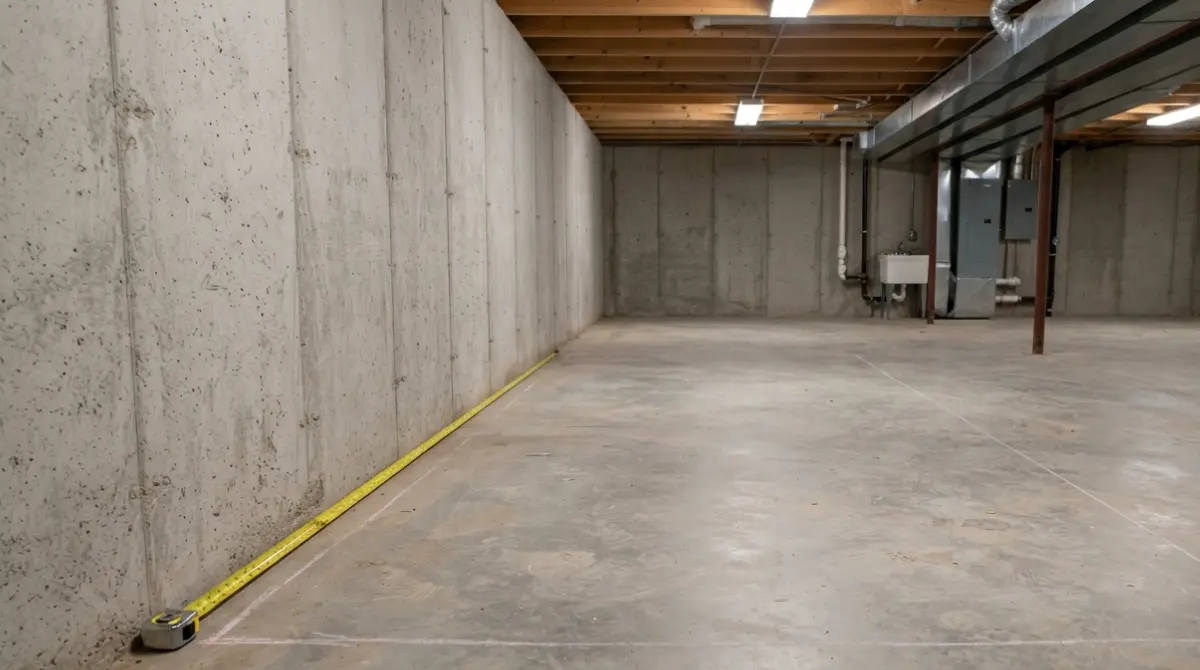
Angi and Fixr both put waterproofing at $3 to $10 per square foot. This Old House states $13,640 for a 1,000 square foot basement. Divide the second by its own stated size and you get roughly $13.64 per square foot — above the top of the range the other two.
📊 Spec: $13,640 ÷ 1,000 sq ft = $13.64 per sq ft, versus the $3–$10 per sq ft cited by Angi and Fixr. Source: publisher figures as listed above; arithmetic ours.
Perimeter drainage is quoted per linear foot of wall, while coatings are quoted per square foot of surface. Before any per-square-foot rate means anything, measure with our Square Footage Calculator, and read how interior and exterior systems differ so you know which unit applies.
Which figure is closest to your basement
Pick the figure whose scope matches your diagnosis, not the one nearest your budget.
If water appears in one spot after rain, you are likely in Angi’s sub-$1,000 crack-repair territory, not its $15,000 system territory. If water rises at the wall-floor joint across the perimeter, the interior-system figures apply. If nobody has told you where the water enters, no published figure applies yet — start by working out why water is coming into your basement.
The Department of Energy’s guidance on foundation moisture control puts grading and downspouts first, and advises consulting a qualified builder or contractor for moisture problems in an existing home.
✅ Do This: Before comparing your quote to any national average, write down one sentence naming where water enters and when. If you can’t, that’s the next purchase — a diagnosis, not a system.
What a national average can’t tell you
A published range is a sanity check on a quote, not a substitute for one.
No national figure knows your foundation type, soil, water table, or local labour rate. It cannot tell you whether the quote in your hand includes a battery backup pump, who pulls the permit, or how many linear feet of drain you’re buying. Those differences, not the headline total, are where quotes actually separate.
That’s the comparison worth running: our walkthrough of three quotes on one basement, read line by line shows what the totals hide.
⚠️ Watch Out: A national average is an anchor. Read $5,240 first and a $9,000 quote feels like a markup — when it may simply include a scope the average never covered.
When cost stops being the question
Some findings outrank price comparison entirely.
The EPA’s guide to mould and moisture in the home says wet materials dried within 24 to 48 hours usually won’t grow mould, and puts the do-it-yourself cleanup limit at roughly 10 square feet — about a three-foot square. Above that, it’s professional work.
Walls that bow or lean, or cracks that keep widening, are an engineer’s call rather than a waterproofer’s.
✅ Do This: For mould past about 10 square feet, hire a certified remediation professional. For any sign of wall movement, get a licensed structural engineer’s written assessment before you sign a waterproofing contract.
Basement waterproofing cost questions
1. How much does basement waterproofing cost?
Four national publishers report averages from $5,000 to $13,640, with full ranges spanning roughly $2,461 to $18,000.
2. Why do cost websites give different basement waterproofing costs?
They price different scopes, use different data, assume different basement sizes, and publish on different dates. The gap is structural, not error.
3. Which basement waterproofing cost estimate should I trust?
The one whose scope matches your diagnosis. Without knowing where water enters, no published basement waterproofing cost figure applies to your house.
4. Is $3 to $10 per square foot accurate?
Angi and Fixr both publish that range. This Old House’s stated figure works out to about $13.64 per square foot.
5. Why is one published average so much higher?
This Old House states its $13,640 figure for a 1,000 square foot basement. The other three name no reference size.
6. Does a national average tell me if my quote is fair?
No. It’s a sanity check. Fairness depends on line items — drain footage, pump model, permit, warranty — not the total.
7. How often do published cost figures change?
Publishers revise them without notice. Every figure here carries our access date of 19 September 2026 for that reason.
8. What’s the cheapest basement waterproofing fix?
Angi puts sealing a single crack from about $600. Grading and downspout corrections cost less again and come first.
9. Does the average include a sump pump?
Not reliably. HomeGuide prices sump pump installation separately at $600 to $2,500 or more.
10. When should I stop comparing prices?
When mould exceeds roughly 10 square feet or a wall shows movement. Hire a certified remediation professional or a licensed structural engineer first.
Your next step
Before you weigh any quote against a national figure, get one sentence in writing from a contractor naming where water enters your basement and why. That sentence decides which of these four numbers is even relevant to you.